Coming Unstuck

Sometimes, I just don’t have any ideas.  I feel uninspired, unfocussed and generally “meh” about things.  Fortunately, this doesn’t happen frequently, but every now and then I feel like there’s nothing there.  I can talk with others, inspirational people, and still have nothing to contribute or feel that is worth sharing.

Clinical psychologist Dr Terry Singh suggests that to get unstuck we need to understand that getting unstuck is not the same as feeling better about something, or successfully changing, rather that is it the first step towards change. He suggests starting with focussing on the experience of being stuck, this could be something physiological, a tensing or chest tightening, that could lead on to feelings of anxiety. Knowing what you know about yourself, your feelings and experiences and so on is what helps you get unstuck. We need to delve deeply into those experiences; usually we only scratch the surface when we consider our experience of the moment. Think about what you are thinking, one or many thoughts, physical feelings, level of comfort/discomfort, emotions – present or absent and intensity.  Dr Singh says it’s important not to take shortcuts when we consider our experience.  Taking a closer look at the blind spots in our experience is the key to unlocking change. 

We need to look at our physical state and how that impacts our internal state and impacting our thoughts and emotions.  It could be something simple like drinking too much coffee first thing in the morning is not likely to help you if you have high anxiety levels. 

Getting unstuck is more nuanced.  Singh says “Paying attention to your experience is a skill just like riding a bike.  The more we practice paying attention to our experience in our daily lives, the better we get at it.  The better we get at it, the less likely we are to get stuck when faced with a problem”.

When I have moments of creative block I usually remove myself from the scene.  Take time out to do something else and forget about whatever it was I was stuck with and go back to it another time.  Some suggest that you should ignore your most creative time of day and do whatever it is you’re stuck on at your least creative time of day.  This might be because you could be more insightful at non-optimal times of the day.  The focused energy can sometimes crowd out the eureka moments.

For some, according to a study by researchers in Germany, turning lights down low helps with a sense of freedom and reduces inhibition, which in turn can increase creative and help us come up with new solutions.

One that I have done myself, so can testify to it actually working, is to share the idea with someone that you don’t always agree with.  They will be your harshest critic and argue and debate it with you.  Having to defend your ideas helps expose its weaknesses and offers different viewpoints. 

The best suggestion of all, not that I’m advocating we should all do it, is to get slightly tipsy.  Alcohol decreases focus, which would not be good if you had to do something highly analytical, but it’s great for brainstorming.  How many times have we heard that the “best ideas happen in the pub”.

Next time I get stuck for an idea, I crack open a beer!  Cheers.

Don’t get stuck in a rut

Predictability is all well and good, and there’s certainly a place for having a routine that helps you navigate the day, especially when you have lots going on. But it can feel like being stuck in a rut or on a merry-go-round at times, when things happen and there’s no energy or enthusiasm in it.

Every now and then its good to mix things up a bit.  Now, I’m certainly someone that likes a bit of regimented routine, I like to plan things well in advance, and I am conscious that there’s a lot in the diary to keep me occupied.  Having a lot in the diary isn’t the same though.  A lot of those things are the same only slightly different.  There are #bellringing meetings.  They could be with different groups of people about slightly different topics, but essentially they are meetings about #bellringing.  Then there’s actually ringing, currently the online version, however C and I have been continuing to ring two bells at the Cathedral on a Sunday morning to keep things ticking over. Again, that’s all a bit predictable and “safe”.

Even doing small things differently can help us keep that enthusiasm going.  Something as simple as trying a different menu option on the takeaway menu can add a bit of intrigue.

Every now and then something larger scale needs to happen to really shake things up a bit.  Maybe rearrange the furniture in the lounge.  Redecorate.  Take cooking lessons.  Learn a new skill. 

https://www.under30ceo.com/25-ways-to-live-differently/ offers some ideas on how to make small changes that may have a big impact on living differently:

  1. Think Big – don’t let self-imposed limits hold you back.
  2. Work hard for yourself, no one else.
  3. Be inspired. Find out what makes you tick and do more of that.
  4. Do something regularly that scares you. Maybe send that report you’re worried out what reception it will receive.  Put yourself out there.  Do that talk.  Challenge your fears.
  5. Travel.  Locally, nationally, internationally.  Investigate other people and places.
  6. Find ways to be more productive.  Working from home can free up commute time that you could do something else in.
  7. Find out when you’re most productive. If you’re more switched on first thing in the morning, or last thing at night, do your best work then.
  8. Be responsible for your own life.  Your health, wealth, your environment and well-being.
  9. Live your dream, not someone else’s.
  10. Unlearn things.  Having more or bigger stuff doesn’t mean its better.
  11. Spend within your limits.  If the cash isn’t in your account, you shouldn’t get it.  You’ll end up paying twice as much in the long run.
  12. Be outdoors as much as you can, taking in the natural world.  If you can take your laptop or phone outside for meetings then do that.  
  13. Don’t sit around all day.  Move.  Your body will thank you.
  14. Declutter.  Do you need all that stuff?  What purpose does it serve?  Would someone else benefit from it?
  15. Don’t waste precious natural resources.  Recycle, reduce energy, reuse.
  16. Turn off notifications.  Stop letting social media dictate when you should access it.
  17. Turn the TV off and read a book instead.  You’re more likely to learn something.

We need to stop comparing ourselves to others and trying to keep up with the Jones’s.  They’re not living our life and we need to live our dreams.

Being in the Zone

I’ve just watched a 2 minute excerpt from a TED talk given by learning expert Eduardo Briceno on what he considers to be the key to high performance. https://www.ted.com/talks/eduardo_briceno_how_to_get_better_at_the_things_you_care_about?utm_source=linkedin.com&utm_medium=social&utm_campaign=social&utm_content=2021-3-18-cutdown

We all go through life trying to do the best we can, and equating that to #bellringing, we all turn up at practice night, or Sunday service ringing, or for a wedding or special practice, or quarter or peal attempt or, at the moment virtual practice, with full intention to do the best we can.  To ring the method accurately.  To strike our bell in the right place.  But at a practice night we’re there to try to learn new things as well and extend our repertoire (if we want to).

Briceno offers that sometimes, despite our best intentions we might not always get any better at the things we want to achieve, despite working hard at them.  What he learned from his research is that we should deliberately alternate between two different zones.

Learning Zone: here the goal is to improve.  So we undertake activities that help that improvement.  This could be attending a training day, reading around the subject, watching YouTube videos, asking others for advice, standing behind someone while they ring, asking for feedback and so on. Here, we spend time concentrating on what we haven’t mastered yet, and expect to make mistakes along the way knowing that we will learn from them.

Performance Zone: is where the goal is to do something as best as we can, to execute it.  Where we concentrate on what we already have mastered and try to minimise the mistakes.  This might be ringing for a special event or a peal attempt, or a striking competition.

Briceno suggests that we should be deliberately alternating between the two zones to purposefully build our skills in the learning zone in order to apply them in the performance zone.  Being clear about when we want to be in each of these zones, with what goal, focus and execution in mind helps us better perform and improve. The performance zone maximises our immediate performance, whilst our learning zone maximises our growth and future performance. The more time we spend in the learning zone the more we will improve in the performance zone.

To be able to spend more time in the learning zone we need to believe that we can improve, we must want to improve that particular skill, we must have an idea about what we can do to improve. Just performing the same method over and over again doesn’t necessarily help us improve. Without the process of practice, making mistakes, getting feedback and revision we will tend to stagnate in our current “safe” zone; methods that are familiar and easy, that we won’t feel like we’d be ridiculed for if we go wrong.  My favourite is “if in doubt, ring the Treble”, that way I’ll stand a better change of not going wrong, or mucking it up for everyone else. The trouble with that is, I don’t progress myself.

In our #bellringing context this could be the difference between learning the theory of a new method and practicing it on a practice night on using an ringing simulator, in order to perform it to the best of our ability of a Sunday morning, or during a striking competition, or a quarter peal or peal. I also know that I’m really bad at this too.  Often I might turn up to a practice having not put enough effort into the learning part, and then hash my way through it, or do enough to just get by without making too much of a pigs ear, but I haven’t learned it properly and will immediately forget it because I’ve not gone back over the bits I find difficult, or asked for help.

My latest thing is to try to learn to ring handbells.  I don’t particularly want to ring handbells quarters or peals, but I want to be able to hold my own if I were asked if I could ring something simple.  It’s been nearly 40 years since I learnt to ring a tower bell so going back to the beginning to ring handbells, to unlearn some of the things I’ve learned on tower bells and learn them in a different way, has been, so far, really quite difficult.  However, I must persevere if I am to reach a decent performance zone.  I must make that effort and spend that time in the learning zone, read, watch, listen, practice, make mistakes, get feedback, try again and eventually I will improve.

The Instant Gratification Monkey

I was reading an online article from Tim Urban, who studied why procrastinators procrastinate.  He possets that they can’t help it.  In their brain the procrastinator has the Rational Decision Maker who steadily guides the mind in to doing what needs to be done, and then there’s the Instant Gratification Monkey who sideswipes things and sends the mind off wandering for some instant satisfaction for information or other, that takes us away from our steady path.

The Instant Gratification Monkey takes us off to play in what Urban calls the Dark Playground, that space where all the fun, new, shiny things hang out that distract us from what we should be doing. In the back of our minds though is this constant feeling of anxiety or regret for that looming deadline or that thing that we’ve been working towards for ages.  When that deadline approaches though, it’s time for a visit from the Panic Monster who scares us away from the Dark Playground back in to a sense of productivity to get things done.

Urban offers three steps to turn procrastination into motivation:

  1. recognise that you are procrastinating.  Being aware of something is usually the first step in resolving it. 
  2. Understand the reason for the procrastination.  Is it the task itself, or is it you? Is it that you aren’t enjoying it, not qualified for it, or feeling overwhelmed by it?
  3. Set objectives, tactics and rewards.  Depending on the reason for the procrastination in the first place it might be as simple as having a to do list if you’re feeling overwhelmed, or someone that holds you to account, or if you promise yourself a treat if you get that thing done.

There are times that I procrastinate.  It’s not usually because I don’t want to do something, more that I don’t want to do that particular thing right now.  I will send that email out but after I’ve watched this episode of that tv programme I like.  I will write that report just as soon as I’ve finished making lunch.  I will learn how to ring handbells properly, just as soon as I’ve written that report and sent that email.  Sometimes it can become a vicious cycle.

Other days, I can blast through even the most boring, or painful task without so much as a second thought.  It’s about the frame of mind that I’m in.  Sometimes, I find being in a particular place, or with particular people helps galvanise me into action.  Sometimes I just wake up and tell myself that today I’m going to power on through all that stuff and clear my to do list.

Today has definitely been one of the latter type of days.  I’ve finished the first draft of a strategy document.  I’ve documented a framework that I invented that supports that strategy.  I’ve been for a power walk.  I’ve read the next section on learning to ring handbells and had a few goes at it.  My Rational Decision Maker was in charge today.

I wonder if that means tomorrow I’ll be all out of juice and my Instant Gratification Monkey will be running the show.

Inspiring Award Winners

I watched the Association of Ringing Teachers (ART) Awards ceremony this evening. Considering we haven’t been able to do much ringing in the real world over the last 12 months there were so many inspiring stories of what people have managed to achieve.

From young ringers who haven’t been #bellringing very long themselves, achieving great things, contributing to their local towers and beyond, teaching and inspiring. Others made contributions in print and on line, recruiting new and retaining existing ringers, encouraging, leading, educating and developing.

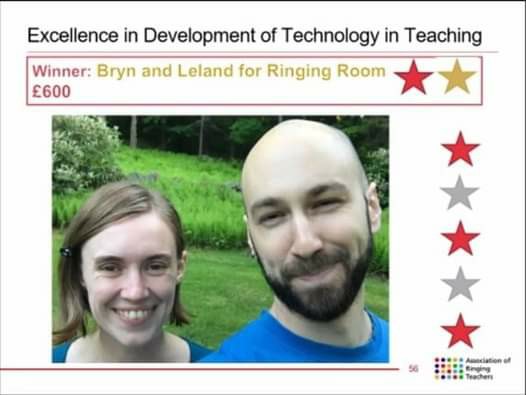
The big winners of the evening, which were thoroughly deserved, were the joint runners up in the award for Excellence in Development of technology Graham John and the team behind Handbell Stadium and e-bells. Handbell ringing has taken off massively and having a real handling experience has been a massive benefit. The undoubted winners of the night were Bryn and Leland, the creators of RingingRoom. Over 10,000 registered users across the world have had the benefit of being able to ring with each other on the virtual platform which has been a real life saver for ringing.

It was quite emotional to hear all the testimonials for each nomination. If all the nominees were together the power of the tower would be palpable.

Ringing is in very good hands. Congratulations to all the nominees and winners.

A different frame of mind

I think I’ve probably mentioned this before, but how we choose to respond to outside stimuli, pressures and events is entirely within our own undertaking.  We can choose to get wound up by things, or we can choose to let it go.

My first day back at work this week was horrid.  By the end of the day I was absolutely sure that the conversation when I got home was going to be around how much longer I would have to put up with this.  C was his usual stoic self and confirmed my worst fear that I would have to stick it out for a few more years yet.  Damn.  I felt exhausted after just 1 day back in the office.  I felt dejected.  I felt well and truly fed up.  This has a physical impact as well.  I was unmotivated to do anything else and I stuffed my face with crisps and chocolate. I felt physically sick at the prospect of having to go back the next day and deal with it all, all over again.

Fast forward a few days and I’m in a much better frame of mind.  The plans I put in place on Monday have had a positive result and things are looking ok for the coming week.  I’ve also made the conscious observation, out loud to others, about what I am currently employed to do versus what I get dragged back in to, through necessity, but that I shouldn’t really, and the impact that is having both on trying to deliver what it is I’m supposed to be doing, but also providing the right kind of support to those in the department.  A fuller conversation as to how that plays out is happening later this week.

My point being, my mind-set had changed.  I had chosen to not allow the frustrations at the beginning of the week to overshadow the rest of the week.  I packed that day away and moved on.  I’m not pretending it was an easy transition.  I still woke up on the Tuesday really not wanting to go to work.

According to the Mayo Clinic (https://www.mayoclinic.org/healthy-lifestyle/stress-management/in-depth/positive-thinking/art-20043950), whether you are a pessimist or an optimist can have an effect on your longer term mental health, but also has physical manifestations too.  Being more positive doesn’t mean that you gloss over the difficult things but that by approaching them in a more positive way can be more productive.  Making the best out of a bad situation.  Thinking positively can improve life span, reduce depression and distress, provide greater resistance to colds and better psychological and physical wellbeing, cardiovascular health and general better coping skills.

By focusing on positive thinking we can identify areas of life that may need changing, stopping to check on our thinking and finding ways to put a positive spin on it.  By being open to allowing yourself to have a laugh during difficult times can help you feel less stressed.  Following a healthy lifestyle is often cited, and probably the one I do least of.  Surrounding yourself with positivity will rub off on you and practicing positive self-talk will help you realise that you have a lot to be thankful for.

I’m heading to the end of this week with a much more positive outlook that I had at the beginning.

Making the most of time

No surprises but there are 24 hours in a day. How we spend them is our choice. Whether we spend them wisely is debatable. Some people profess to be really good at time management whilst others feel that there isn’t enough time to get everything done. Is time slipping away from us or are we wasting it?

The latest dossier in Psychologies Magazine goes into some detail about where commitment lies, understanding procrastination, understanding how we currently spend our time and prioritising what’s important. It offers some advice on timekeeping tips for the proverbial laters. Then comes the inevitable 10 question test to determine what stops you making the most of your time.

My results indicated the dominant trait of overthinking, putting hours into mulling over events, conversations, decisions and tasks. This leads to being overwhelmed and worry that others seem to be more productive. Others may be unaware the extent of the overthinking because the outward impression is one of calm. It suggests that I should schedule worry time and limit it to 15 minutes.

A close second was overcommitment, a difficulty in saying no to opportunity and helping others. But if that time does not align with core values it will undermine wellbeing. The challenge here is to find space in my life to connect with the people I love and nurture new connections. Resist the urge to fill all the time up.

Both easier said than done. Today for example. First day back at work after 2 weeks off. By midday I was already feeling that I’d had enough. I didn’t want to be there. By the end if the day I was starting to seriously consider my get out strategy. I had a meeting in the evening I had a zoom call which was fine, not anything stressful, just a bit of preplanned for something which may, or may not, be happening next week.

I’ll try and give tomorrow a fresh start and not worry about the things that I can’t do anything about. And it’ll be C’s birthday so I intend to spend the evening with him and not worrying about what else still needs to be done.

Virtual Henry Johnson Dinner with the St Martin’s Guild

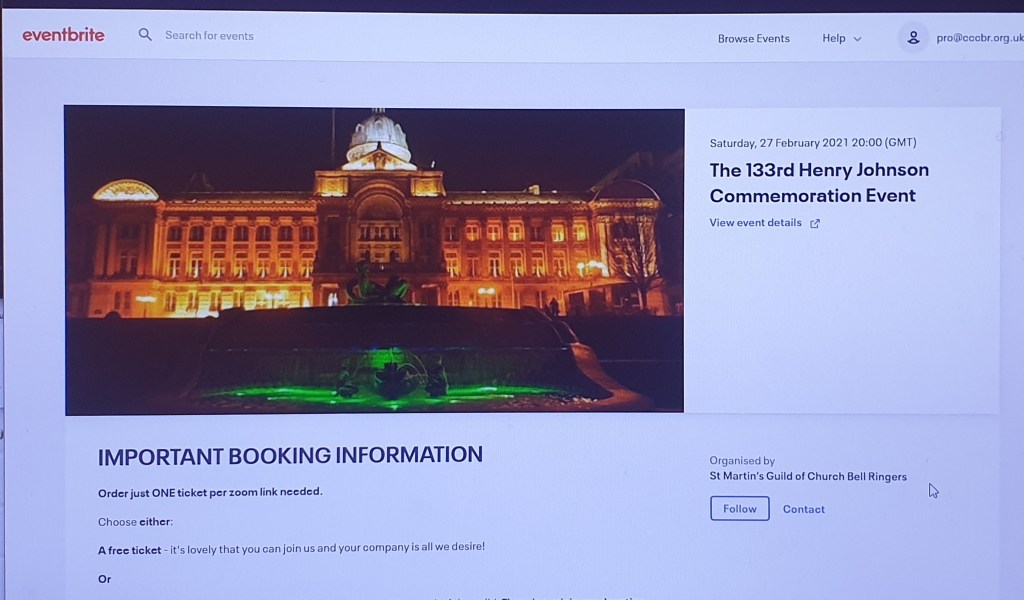
As I’d given a talk to the St Martin’s Guild in September last year, I was kindly invited to attend the virtual 133rd Henry Johnson Dinner.

The invitation included a suggested menu that we may have been eating had the dinner has taken place for real. This was optional to follow but added an element of authenticity to proceedings. Personally, I went with whatever C dished up.

The evening started with a musical performance by one of the ringers and his fiancée. This was followed by a talk on the history of Henry Johnson and the establishment of the Dinner, followed by a toast.

After that was a video of ringing in Ringing Room of call changes on 16 bells, call changes on 6 bells and handbells by The Brumdingers, the young ringers group. This included photos of the young people playing jenga using Caramel wafer chocolate bars. There was another speech and then a photo montage of previous dinners.

What a fantastic event with 69 participants logged in but many were couples or family groups, so possibly 90+ attendees. Its the first virtual dinner that I’ve been to. All the appropriate proceedings were observed. Congratulations to the Guild and thank you for the invitation.

50 Ways to Enjoy Turning Fifty

My sister bought me this book for my birthday last week.  I thought I’d better take more than a cursory look at it.  It claims to have 50 ways to make this the best year EVER.  The book is set out in chapters based on making the most of turning 50, planning the best year EVER, implementing the plan, treating yourself well, having fun, looking back, looking within, expressing gratitude, putting things in order, eliminating what you don’t need, giving and looking forward. 

Each chapter has key questions to help you analyse yourself and figure how to make the most of turning 50, thought experiences to delve a little deeper and activities to do. It does say that you can dip in and out of the book, fast forward to the bits that most interest you and so on but being a pedant, I started at the beginning.  

Way #1 Accept your age. 

Thought experiment 1 asks you to make a list of people you admire who are over fifty and who are living terrific lives and make a note of what you admire about how this person is living their life.  OK, so first thing is to think of people over 50 who I admire.

I’m not going to list them all here because some of them might read this and either be embarrassed or disagree.  I’ve written each of them in the book.  Suffice to say that it includes C, my parents and siblings, a few former work colleagues, and some ringers I know. In some cases, I admire what they have achieved over adversity.  In others I admire what they’re currently doing with their lives, and if I’m honest, I’m probably a bit jealous of.  Some I admire because I wish I were more like them.

The key questions were what are some benefits of turning 50? and What are you looking forward to this year?

I guess benefits might include being that little bit wiser sometimes.  Having more opportunities to reflect on what I want out of life and trying to achieve a better work/life balance. Nearer to retirement age (although still some considerable way to go).  Looking forward to getting to see R again.  This year has been an exception and we haven’t been able to spend time together, so as soon as we can we’ll do that.  Can plan for the trip that we should have had for my 50th birthday.

Thought experiment 2: what concerns do you have about turning fifty?  What challenges are you experiencing or expecting? Which of those can’t you change? What constructive actions can you take regarding that item?

I’m not really bothered about turning 50.  It’s just a number.  I guess ill health, or my level of unfitness is probably going to be an issue at some point.  I’m feeling less tolerant of other people, which I need to reign in a bit sometimes and there are other things that I’d rather be doing with my time but have to work instead. I can’t change that for a few more years yet unless something amazing comes up, like winning the lottery.

Freedom in sight

So today our Prime Minister has set out a road map to ending the UK lockdown completely by 21st June. To be honest I’m not sure how I feel about that.

Outdoor gatherings of up to 6 people could take place from 29 March. That means people will start mixing long before many have had both vaccine jabs. Therefore increasing the risk of spreading again.

Non essential shops like hairdressers etc and outdoor hospitality could be open again by 12 April. That’s good news for R and her flatmate who’ll be able to return to work. It also means that beer gardens will be open again so the idiots whose “first thing I’m gonna do is go down the pub” mentality will again be people gathering who haven’t had both jabs, increasing the risk.

From 17 May 2 households might be able to mix indoors. That means we’ll be able to go and see R for the first time since about November. It also means a possible return to ringing more than just 2 bells.

Then all restrictions could be lifted by 21 June. That is provided the 4 tests on vaccine take up, vaccine efficacy, infection rates and new variants get passed. There will still be great numbers of people that won’t have had the 2 vaccine jabs yet.

Whilst I want there to be people at work and people being able to see family members, its the idiots who go too far by flouting the rules and are purely selfish about it all that puts it all at risk again.

Please let’s not see a return to stupidity.