What do you need for hope to flourish?

There is hope but if you’re struggling to feel energised about the year ahead, what blocking your natural optimism and how can you make hope spring eternal?

According to Psychologies Magazine ten question quiz, my need to boost my optimism comes from the need for inspiration.

Its not surprising that you find it hard to feel hopeful about the year ahead if all it  seems to hold is more of the same. Knowing in your heart of hearts that you’ve been coasting, or that your routine is well overdue a shake up, doesn’t always mean you’ll be any clearer about what changes to make.

You might put it down to a lack of motivation, but the reasons we stay in stuck mode are usually far more complex. For some, its about unravelling others’ expectations for ourselves from our own passions, or getting a perspective on a drive to do the ‘right thing’ and always be responsible.  And sometimes the most productive thing to do is to do nothing. Give yourself permission to be in information- gathering mode, with no immediate pressure to come up with the answers; its amazing what we notice when we quiet a busy, planning mind and really pay attention to what’s going on around us.

There’s much to be learned by simply noticing what piques your interest, or what triggers moments of feeling energised. You might find yourself saying yes to things you normally say no to, or feeling drawn to new experiences  – even small shifts can help you feel more inspired about the future.

As I’ve spent 2021 on a journey of self discovery, I’m still experiencing new feelings, motivations and desires. I have a better idea of the person I want to be and I have more confidence in making that happen. I’m doing more of what makes me happy and feel good.

I feel optimistic about the year ahead and my plans to move forward will come to fruition of I stick to my guns. I’m still information gathering as I experience new opportunities and look forward to where that may take me.

Happy new year, happy new me.

There is hope

Image by ShonEjai from Pixabay

All is not lost.  So says Bernadette Russell in Psychologies Magazine.  She even goes so far as to offer three ways of finding hope:

  1. Set a goal – if you’re feeling overwhelmed and hopeless over a seemingly insurmountable problem, find a purpose can help by providing another focus.  Think of something you’ve always wanted to do – doesn’t have to be big or cost any/much money.  Could be something as simple as finishing that half-read book, running 5K, growing some herbs or a spot of DIY.  Choose something that excites or interest you, something that you can look forward to doing.
  2. Go story hunting – what’s interesting about where you live? Start with a building, a street or a name that intrigues you. Follow that lead and look into its history.  Maybe you’re wondering who Tom Smith Close was names after, or why the local park was never built upon, or what that old place on the corner was originally built for.  The way things look around us now has so often been shaped by local people stepping in and making things happen.  It shows us positive change in living colour.
  3. Find something to look forward to – if you have a difficult day, give yourself one thing to anticipate tomorrow, and thing about it before you go to sleep.  It needs be much, a cup of tea, a catch-up with friends or a nice soak in the tub.  Sometimes having even a small treat planned can deliver us through difficult days and give us hope~: “tomorrow will be better, I have this to look forward to”.

At this stage in the game, I am feeling rather hopeful and optimistic about the year ahead.  I know we’ll still have things to contend with, things that from time to time will bring us down a bit, plans that don’t quite go as we’d hoped.  However, I’m looking at it from an opportunity perspective.  Everything that comes my way is an opportunity for me to grow, develop, evolve. 

I chose not to let most things get me down.  I get frustrated, annoyed, upset, sure, but it’s often short-lived, or I’ll talk myself round to thinking on a scale of 0-10 how important is it in my life.  Anything less than a 7 and I’ll stop worrying about it soon enough.

I’m looking forward to putting some plans I have into action.  I’m looking forward to being more confident and assertive with what I want in my life.  I’m more optimistic about how I am going to respond to things and others.

I have a goal for 2022 and it revolves around improving relationships.  That’s with anyone, family, friends, colleagues etc.  In fact, I’ve already started putting some of it into action.  Where I live has a rich history, being one of the first Roman settlements in England.  Most people associate it with radio, but so much happened before that, it annoys me when people overlook that. Looking forward to small daily things is useful, for example, as I’m writing this, I’m looking forward to trying a new restaurant for brunch tomorrow. 

The simple things in life can be so rewarding if we choose to look around us and find the positive. Hope is not lost.

Have you tried shedding?

No, I don’t mean building or living in a shed. I mean shedding the baggage of your past, or things that no longer serve you, so you can become the best version of yourself.

I’ve started a bit of that during 2021 and will do some more over the coming year. Its been quite liberating to let go of past feelings, thoughts, behaviours, expectations, old habits and loyalties. I’ve started to foster a different outlook on life that focuses on what’s important to me. I’ve started to feel more confident in my abilities, in myself, and am exploring more of what makes me happy.

In February’s Platinum magazine (anyone else concerned February’s magazines are already out and we haven’t finished December yet?), Julie Leonard offered five ways to make shedding as successful, and painless, as possible:

  1. Follow the seasons – there is a natural transition in the seasons, usually spring and autumn. These might be the ideal time to naturally embrace a fresh start.
  2. Clarify – take time to visualise and gain clarity on the life you want to lead. Knowing what’s important and the direction you want your life to go will help you identify the things that no longer work for you.
  3. Say goodbye – its said that you are the five people you surround yourself with. Who is in your life? Do they support you and cheer you on? Are they positive and encouraging? Can you be your true self around them? If not, it might be time to say goodbye.
  4. Refrigerator- shedding is not a selfish act but a healthy process. Reframe any negativity and self doubt, let go of guilt and give yourself permission to choose who and what you have in your life.
  5. Make a list – write down all the areas of your life you need to examine: relationships, duties, loyalties, habits, fun, learning, home, work. Then under each heading list all things related to it, then ask yourself do I love it? Is it useful? Does it bring me joy? Does it bring me meaning and purpose? Does it fit with my vision of the life I want? If the answer is no, time to shed it.

There will be some more shedding of habits, limiting beliefs and self doubt to come along with reframing relationships. I have already drawn a mindmap of different people in my life and what I want to achieve in those relationships. Mostly its around lowering my expectations/desire from others, whilst upping my own game. I intend to give extra consideration, care and attention, with more effort to communicate.

So watch out folks, I’m coming for you 😁

Cake brings an end to festive gatherings

How lovely it was to have C’s other two daughters over today. With them was son-in-law and four month old granddaughter.

It required a two day intensive tidy up in the kitchen and lounge. C is a hoarder and has so much stuff, a lot of it not even ours, all over the place. Pretty much every horizontal surface has piles of stuff on it.

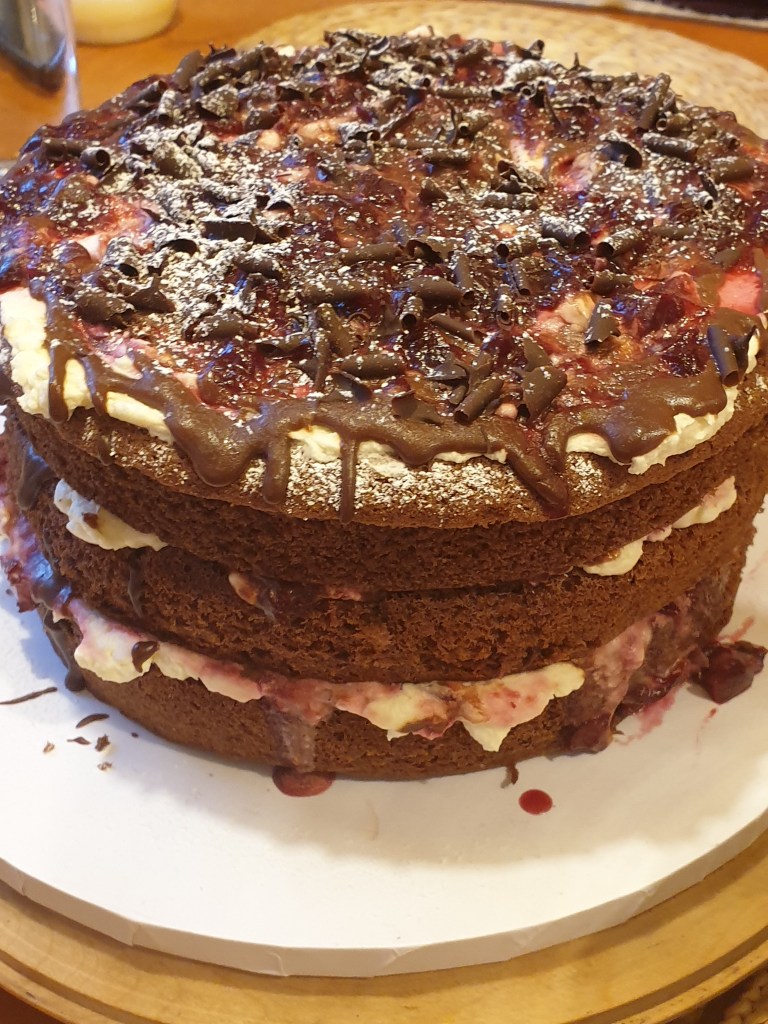
The girls, and M, were coming over for a few hours and a light lunch. We’d decided to make a Pinch of Nom bacon, potato and leek soup. C also baked some bread and rolls. We did those the day before. During the morning of their arrival C was finishing up the clearing whilst I baked a black forest gateau from a green BakedIn box.

Baby E was of course the centre of attention, enjoying ripping wrapping paper open, but then trying to eat it. Most things she was given went straight to her mouth. Over lunch she sucked on a slice of cucumber but also seemed to enjoy sucking on a piece of grandad’s homemade white bread roll.

All this attention, new sights, smells and interesting things to look at soon took their toll and she eventually used her daddy’s belly as a cushion for a nice long nap.

Although the black forest gateau didn’t look the prettiest, my jam was to runny and I’d used too much of the cream between the bottom layers there was hardly enough to cover the top, it did taste rather nice. The half hour or so of destoning and chopping the cherries was worth it. C and M had seconds so it couldn’t have been too bad. There was a little bit left over for me and C later on.

C stopped by his brother’s on the way back from putting flowers on his parents graves in Suffolk a couple of days before Christmas. We’ve seen most of my family at dad’s birthday gathering. Spent two lovely days with R on Christmas/Boxing Day, then some time with the other girls and M. That’s all our planned Christmas gatherings complete.

We’re lucky to have been able to see and spend time with everyone especially as others we know have had their plans changed and not been able to see family.

If everyone acts sensibly and limits their exposure to other people over the New Year, hopefully we’ll not see the return of harsher restrictions, or another lockdown.

We’ll be spending New Year at home, just the two of us, watching telly and falling asleep.

The Education Column

You can’t teach an old dog new tricks. Or can you? I hope so. I subscribe to the philosophy that you can always learn something new no matter what your knowledge or experience.

I’ve never really been into reading #bellringing theory books. I get too easily distracted and find I skip bits that I think I already know. I also have the attention span of a gnat so find it hard to read theory books for too long. I usually skip through to the chapter I’m most interested in then skim read it for some golden nugget.

I expect that because of this, I skip right past the bits I should actually take notice of, and if I’d bothered to read the whole thing from beginning to end, I might have actually understood it a lot better.

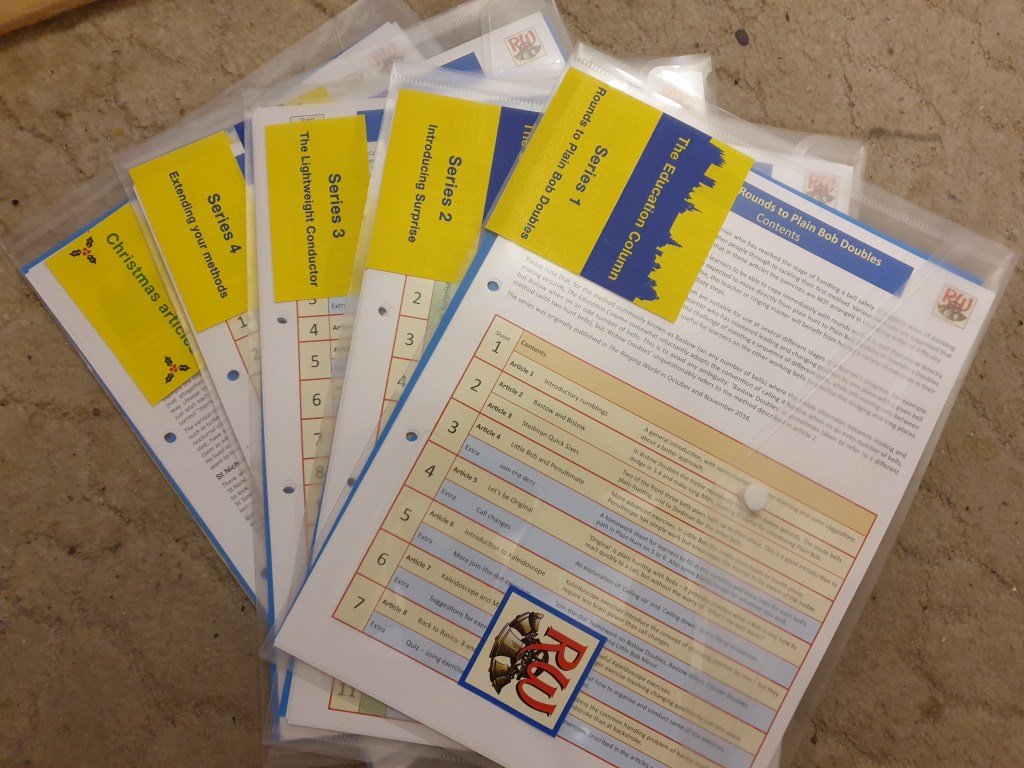
For Christmas C bought me (at my request) the entire five series of The Ringing World’s Education Columns, written over a number of articles, over several years, by the eternally patient and thoroughly nice bloke, David Smith.

Series 1 covers Rounds to Plain Bob Doubles. Series 2 introduces us to Surprise methods. Series 3 is entitled the Lightweight Conductor. Series 4 is about extending methods and Series 5 is a collection of Christmas articles. Each series is very well presented on high gloss paper and the collection of articles in each series is in a plastic wallet. There are quizzes and worksheets to accompany them too. You can buy them individually depending on what stage you’re at, or as the entire set.

I’m looking forward to reading through them and thoroughly intending to go through each one, start to finish, no matter if I’ve already surpassed that level. There’s always something to learn and a different way of seeing it. It will also help explaining it to learners as well.

Did anyone else get them for Christmas? Or what #bellringing gifts did you get this year?

6 Tips to building improved relationships

Image by Gerd Altmann from Pixabay

Carol Bruess wrote that most of us are aware that having close, supportive relationships benefits our overall wellbeing and happiness, and human connection affects our mental health but also is key to how long we’ll live and how physically healthy we’ll be. Robert Waldinger, the Director of the Harvard “longest study of happiness”, stated people who were more socially connected to family, friend and community, were happier, healthier and lived longer than those less connected.

They weren’t just talking about extremely close relationships like your spouse/partner, they were talking about professional, social, volunteering and even the person behind you in the queue for the grocery checkout.  Bruess came up with six small changes we could make to yield big results in improving relationships:

“1. Change the words we’re thinking about other people – Words matter. Not only the words we use when we speak to others, but the words we say to ourselves about others.

Our internal narrative — especially the story we tell ourselves about other people, their decisions, behaviours, quirks and irritating habits — has a profound effect on how we interact with them. When we tell ourselves “they’re so controlling” or “they never listen to me” or “they’re so self-centred” before or during a conversation with a partner, colleague or sibling sets us up to be more likely to find evidence of their controlling/non-listening/self-centred behaviour because we’ve primed ourselves to spot it.

By creating micro-moments of positivity, we’re starting a wave of good feelings that spreads through our life and through the lives of those we encounter.

There are three simple steps we can take here. The first is to recognize when one of these judgmental thoughts enters our head that reinforces a negative narrative. Next, stop ourselves from telling this story. Finally, replace it with a more positive word or phrase. Pick a word or phrase that reminds us to show some compassion (“They’re trying their best”), acknowledge the journey we’re on (“We’re all works in progress”) or capture what we want to do more of in our relationships (“Listen — really listen”). 

Bruess suggested we’d be surprised how quickly changing our words can also change the quality of our relationships

2. Create tiny moments of positivity during your day – Want to experience more connection in our day-to-day life and a healthier and more connected sense of being in the world?

Turns out, we can do this wherever we are and wherever we go. Just take five seconds to learn the name of that nice person in the apron at the coffee shop who helped you decide which one to have. Or, look the pharmacist in the eye and thank them for showing up during this challenging time, or stop by a co-worker’s office and ask how their aging parents are holding up.

Whenever we share a tiny, positive moment with another human — even if it’s just a warm smile or our eyes meeting as we acknowledge each other for existing on this planet — we unleash a cascade of positive reactions in us and them.

3. When you and your partner argue, hold hands with them (really!) – When couples are in conflict, it’s important for them to remember they’re on the same team despite their differences. One of the easiest ways to do so is to agree to hold hands while you argue. This simple gesture helps couples feel more connected and, as a result, they’ve been found to be less destructive as they fight. If this doesn’t work for you, come up with your own way to reinforce your bond.

Maybe you and your partner decide to interrupt each disagreement — at least once — with a 10-second kiss. Or, you could both agree, while fighting, to hold up three fingers at the beginning, middle and end of a tense discussion, a nonverbal symbol that means “I love you.”

4. Ask an open-ended question of someone in your life every day – Actively listening while letting someone else speak is also communication, and it’s one of the most undervalued methods of building relationships with others. This means listening simply to better understand the other person and giving them space to share their story, express their fears, articulate their hopes or just tell us what irritated or delighted them today.

One of the easiest resolutions we can make to improve any of our close relationships is to listen more, speak less and ask open-ended questions. Ask someone near you: “What’s been the best part of your week so far?”; ask a neighbour when out walking: “What’s keeping you going these days?”; or ask someone over dinner: “What are you most afraid of happening in the next year?”

Then, be fully present with them as you listen to them answer, without interrupting them with your own response or turning away. When we do this, we show the people in our lives that we really care about them.

5. Schedule time to spend with your best friends – Strong, quality relationships require maintenance and ongoing investment. Friendships have been shown to be key to our happiness and longevity, especially as we age, but even the best of them will wither if we don’t nurture them. 

One easy way to do this is to carve out time in your weekly or monthly schedule to connect with your friends. If you can, meeting them in person is best, but even a regular Zoom or phone call is enough to provide you with benefits. And whenever you’re invited to do something with someone who is not one of your key connections, ask yourself this before you say yes: “Is this best for me and the relationships I value?”

These small, regular investments of attention made regularly in our relationships are essential to growing and sustaining them.

6. Deliver an overdue apology – Many of us — because we’re only human and imperfect — have ended a relationship in a clumsy or careless way. Or, maybe we’ve been on the receiving end. Regardless of which role you played, we walk around with grudges or resentment towards a colleague, boss, cousin, roommate, neighbour, ex-partner, etc.

Why not start the year by picking one of the people in your life with whom you had a falling out and write them a note or send them a voice memo? Keep your apology short and simple, and accept responsibility for what you did or didn’t do well. When we embrace our humility, we’re not only more likely to forgive and be forgiven but we can get a significant boost in our happiness as well.

However, if you choose to do this, don’t expect to get a response. If the other person takes in your words and says they forgive you, that’s great. But keep in mind that forgiveness is partly an internal process when you can lighten your load by letting go of unnecessary emotions weighing you down.”

For me, number one is a biggy.  I know that I have certain views of certain people that stick with me in every interaction I have with them.  Usually this is born out of an experience I have with that person, and then I hold that opinion of them. I have spent some time this year considering this and how I might change my own mindset toward that person in an attempt to develop a better relationship with them. I have plans on how to go about this and will look for an early opportunity to get started on it in the new year.

I’m ok with positivity generally.  I’m fairly neutral about most things, I don’t get overly depressed about much but then I don’t get overly excited about stuff either. 

C and I never argue.  We have periods of time when we don’t speak to each other, but that’s usually fairly short-lived. 

I always try to ask open questions.  I remember when R was at school and C used to ask her whether she’d done her homework or not, to which she’s reluctantly say “yes”. I’d follow that up with something more specific about the task she had to do, or how she’d got on with a particular thing.  That would eventually elicit whether she’d actually done it or not.

Scheduling time for friends and family is something we have to do anyway.  We have so much going on, as do most of the people we meet, so we have to book in in advance for anything like a family visit or lunch with a friend. I do feel that I could do more of this on a slightly more ad-hoc basis, there is room to be made, particularly on my non-working day, and some weekends.   Again, plans under development for the new year.

I feel that I have apologised to those that I know I need to apologise to.  If others feel I haven’t apologised for something, it’s because I’m not aware I need to, so you’ll have to tell me what it is I’ve done to upset you.  I think the one thing I do need to apologise about is the words I use to myself about other people that shapes the way I interact with them. 
The power of love

Image by Manish Dhawan from Pixabay

Love is a choice that we get to create.  Love has the power to heal, to bring more connection, bring people together where ideas can emerge, to make us healthier, happier and richer (in the wider sense).  Sometimes it can be hard, other times it can be really easy.

Podcast fave Tonya Leigh described love as the most amazing emotion but we can withhold love from ourselves and other people.  Love is always something we create from within, so why do we separate ourselves from this emotion?

If we feel that love isn’t being given, we can create stories that lead to resentment and anger, and end up pushing the other person further away.  Because of the way our minds are wired we can think that love is something that we have to chase, wanting the world to change in order for us to feel more love.  But when we acknowledge we are the common denominator, it is down to us to stop blaming others for how we feel. 

We love our children no matter what, but someone else could do something not nearly as bad as what our child does but we then withhold love from them.  The only person that hurts is us.  When we’re in a state of love we are happier, more creative, exciting and more loving, and as a result we attract more love in our life.

We can feel that we want our partner to do something different, say or do certain things, in order for us to feel loved.  We get to do that for ourselves, we can buy the things we want, we can be who we want to be, and we should practice letting our partners be who they are. 

If we have someone in our life who is difficult to love (doesn’t have to be a partner), they can be our greatest teachers.  This doesn’t mean we should let people walk all over us, there’s room for tough love too. Boundaries are important for us and the other person and we may have to love them from afar.  But don’t use that as an excuse not to feel love for that person.  We shouldn’t let ourselves think thoughts that hurt ourselves about that person. 

Withholding or feeling love is a choice we get to make, and depending on what’s happening on our life, we can be better at it than at other times.  Choosing love feels good when we don’t use outside circumstances to shut us away from love. 

If we don’t have love for ourselves and others we don’t have a love for life and we end up trying to manipulate the world and other people to make our outside world feel different in order for us to feel love. 

Every day we should look for opportunities to love.  Ask ourselves in difficult situations, “what would love do”? If we don’t love ourselves, we can’t love anyone else or our life.  Think about where we are withholding love in our life and ask how does it serve you?  We might try to convince ourselves that its protecting us and no one can hurt us, but its only hurting us when we withhold love. How does our future-self feel love when we’ve created the things we want in our lives?  It’ll be challenging as we are more familiar with resentment, anger and fear, but love can become our familiar emotion if we choose to practice it.

The right place to look for love is within ourselves, love is created by the thoughts in our head.  Notice what thoughts separate us from love and begin to reach for more love. The more we practice, the more we realise that withholding it from ourselves only ever hurt us.  Giving love to ourselves helps us show up differently. We start to attract different relationships, the people around us start to change as we’re no longer resisting them. 

If there’s someone we feel there’s no way we could love them, TL suggested loving ourselves first, be kind and gracious to ourselves, and over time they may be easier to love.

Love is a choice we get to make for ourselves, and is created by the thoughts in our head.  It’s always available, it has no limits.  Stop chasing love and be love. 

13 Ways to build strong relationships

Image by truthseeker08 from Pixabay

I was reading an article by YEC (Young Entrepreneurs Council) about 13 key traits to have strong professional relationships, and as I was reading, thought this wasn’t just about professional relationships, this is about all relationships.

YEC wrote about the need for strong relationships as key to business and career success, but the challenge of building relationships in the social media era means that our digital relationships can be superficial. We should aim to establish and cultivate deep and meaningful relationships with the people in our lives.  YEC members came up with the following essential traits for strong and meaningful relationships, and I think we can apply these to all our relationships in all areas of our lives, so replace each mention of clients and business with friends, family and colleagues, you’ll see what I mean:

“1. Empathy – Understanding where the other person in the relationship is coming from and what they’re feeling is important to any strong relationship. You can’t fix everyone’s problems or try to change them, so instead, it’s important to just listen and be there for them.

2. Vulnerability – The most essential trait of a strong and meaningful relationship is vulnerability. Relationships based on vulnerability are positive, judgment-free and improvement-oriented. Trust, communication, love and other important relationship characteristics come from vulnerability.

3. Respect – If you do not respect your friends or your clients, you most likely won’t give those people your “all” when it counts. You only get what you give, and in order to receive respect, you need to demonstrate it to others as well. This is true in establishing a rapport with clients, as much as it is in maintaining an intimate relationship.

4. Real Face Time – Online communication tools like FaceTime and Skype enable us to see and talk to anyone instantly on the other side of the world. However, the relationships that are the strongest are ones where we see each other in person. Because it takes more work to meet in the offline world, it signals to the person that they are important.

5. A Giving-First Mentality – One trait of strong business relationships is providing something of value before asking for something. Far too often these days, folks just want others to give and give without offering anything in return. This will not build a meaningful relationship. Plus, when you’re the first to offer up something of value, you’re much more likely to have your request for help fulfilled.

6. Unique Perspective – The strongest and most meaningful relationships offer a unique perspective. Thanks to our long history together, these individuals provide context for my actions and motivations. They can help us realize how we’ve changed, how we haven’t changed and what’s really important in life.

7. Intent – We’ve all met that person who is eager to misunderstand you no matter how much you explain yourself. And then there’s the other person who will understand you without you having to say a word; this is because they know your intent is good. Strong and meaningful relationships start with good intent.

8. Hard Work – Strong relationships don’t maintain themselves. They require a commitment by both people to make an effort and to set aside time to engage with each other. This is as true of business relationships as it is of personal relationships. Lasting business relationships are built through active engagement and a commitment to going the extra mile.

9. Honesty – Your first instinct or impression is usually right, and the cornerstone to a meaningful relationship is always honesty. Never be afraid to tell your team or co-workers your honest opinion. Too often, businesses slip into a culture of gossip and phony smiles. Clear communication built on a foundation of honesty is essential.

10. Challenge – In business especially, you need to have relationships with people that are challenging—not where they push back on everything you say, but in the way that they challenge you to think differently and try new things. This can inspire healthy competition, and it’ll keep you on your toes and always striving to be better.

11. Value – When developing relationships in business, you must lead with value. “How can I add value to you and your business?” When you ask this question and commit to it before asking for anything for yourself, you are demonstrating, through action, that you are more concerned in building a strong relationship than getting someone out of it for yourself. Leading with this mentality can take you far.

12. Conscientiousness – It’s important to be conscientious and know what page the relationship is on. We tend to have a bank account of credits between each other, and we deposit and withdraw those credits. How present are you with your partner’s feelings? Be aware of tension between you, and have honest and open communications about that.

13. Friendship – All relationships require vulnerability, attention and care, but a genuinely meaningful one is built on a solid foundation of friendship. Beginning your relationship with a client, a peer or even people in your personal life with these building blocks up front will set you up for a trusting and long-term connection.”

See what I mean?

How to have an elegant morning

Image by Free Photos from Pixabay

How do you start most of your days? What do think when you wake up?  What’s the first thing you do in the morning? How do you feel? Our mornings set us up for the rest of the day, so in order to have a good day, we need a good morning.

When we’re stressed, or worried, or reacting to our lives, we often don’t sleep well.  In turn this means that when we wake, we’re not fully rested and fresh, ready for the day ahead.  We can often wake up thinking our life is what’s happening to us, with the first thoughts of the day are things like “this is going to be a toughie”, “I’m so overwhelmed”, “I’m never going to get anything done”. Straightaway, we feel overwhelmed, frustrated and hopeless.  This is the energy we start our day with.  The cycle continues throughout the day.

When we learn to manage our minds, we sleep better.  When we sleep better we wake up a little bit more refreshed, and it can all begin to change the trajectory of your day or your life. 

By making our mornings simple, elegant and intentional, we can really start to tweak them so that we feel better, more empowered and excited about our day. 

One simple thing may be to have a fantastic cup of coffee.  Many people find journaling in the morning about the person we intend to be for the day, anything that’s holding us back, giving ourselves a pep talk at the beginning of the day, can really set the intention and direction of how the day will pan out. Decide ahead of time what we want to create and how we’re going to make that happen, how we’re going to feel, think and do in order to create that. If we don’t know what we want, our brains have no direction or focus, so it will attempt to recreate what we did yesterday.

Whether we journal our thoughts for the day ahead, or simply take to the time to consider them, we can change to direction based on what it is we want to create, what are our goals, what is it that we’re wanting to experience, what do we want to do, who do we want to be. 

Another thing to do in the morning is to recognise things to celebrate and appreciate.  The more we appreciate and celebrate our lives, the more is celebrates us back.  Be mindful of our first thoughts of the day. Ask ourselves what amazing things are going to happen today.  Start with one thought that is a little bit better than the “here we go again” mindset.  Think of a new day as a fresh start where we get to practice something different, looking for things to be grateful for. Our energy flows where our attention goes, and what we focus on expands.  This is a great opportunity to change the direction of our focus and attention. 

Most people are waiting for their world to change first in order for them to feel better, but when we start to feel better, the world outside will start to change.  Then in our state of celebration and gratitude, we are creating those good feelings first thing in the morning. How we start the day is generally how our day is going to go, so we need to get our energy going in the right direction.

Then when we create space for inspiration, reading, watching or listening to something that is going to inspire us in some way, we can infuse our goals and dreams.  It may be playing some music that helps us get in the zone of being more energetic, focussed, fun or whatever.  It can be very fluid based on what our soul wants to be inspired by, a podcast, a book or article. 

Think about how we start our day.  We’re often rushed and before we’re clear on our commitments of the day, we’re already plugged in to the chaos of the world.  Our mornings are a chance to take back our power, to be creative, and decide ahead of time what we’re going to do today. 

My workday morning routine usually revolves around drinking a coffee, then spending five to ten minutes playing a matching game on my tablet.  It gives me time to focus on something else, to sharpen my brain and my responses.  I can usually tell whether I’m in a focussed state of mind for the day ahead based on my game score of the morning.

I don’t do journaling, I did try, but never really got into it, but I do think about my day ahead.  I think about the meetings I have, or the messages I need to respond to.  I think about the work I need to accomplish that day and try to imagine carving parts of my day out to support getting those activities done.  I imagine to myself that I’ll get xyz done by lunch time, then abc done by the end of the day.  Then I’ll think about the things I need to do each evening; more meetings, emails and pieces of work.  I am quite good at putting things in priority and can therefore put something on the side if I’m not in the right place to deal with it that day. 

That does mean however, that when I get thrown a curve ball, I’m not always receptive to having to deal with it in the moment.  If I’ve already got it in my mind that I’ll deal with that tomorrow, I really can’t get enthused about dealing with it today.  Sometimes C will ask me to look at a document later in the evening, when I’ve already switched my brain off for the day.  I can’t always respond in a positive manner. 

I did give myself a pep talk the other day.  After a couple of days in the doldrums, I woke up the next day thinking that I could either wallow in self-pity, or put it out of my mind and get on with things.  I chose the latter and my day was much more productive; I engaged with those around me much more positively and by the end of the day, the thing that had been annoying me the previous couple of days, was almost forgotten.

The power of our attitude toward the day, really can change our experience of the day ahead.

Early birthday baking

My father’s birthday is 22nd December so we use that as an excuse for the family gathering. Mum, Dad, the four of us and our attachments go out for a pub dinner, making a point of using the standard menu rather than the Christmas menu.

This year there were to be 13 of us. That turned out to be an unlucky number. One took ill with Covid and was isolating at University, then three more couldn’t come having just moved house and still trying to unpack, and fix things they’d didn’t know about until they moved in. Just too much to try and do. Totally understandable. So we were down to 9, but still had a great meal out, then back to HQ for cake.

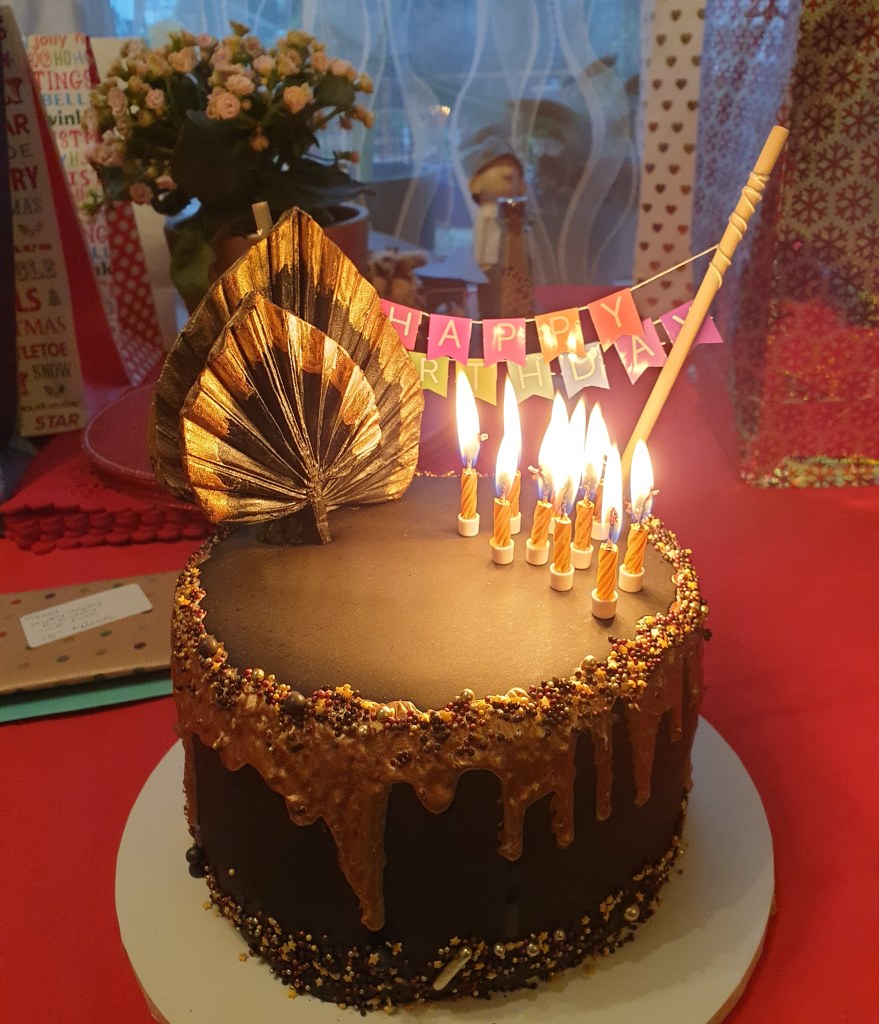
I’d made the cake on Friday. Fruits of the Forest flavoured sponge and crumbcoat, with black icing and gold and black decorations. I had used a white chocolate drip that I painted in gold edible paint. The drip didn’t set hard so I couldn’t paint it smoothly, so it looks a bit lumpy.

It wasn’t a particularly complicated cake to make but it did remind me why I love baking cake. It was only the 2nd cake I’d made all year, the first one being my brothers wedding cake. I love the smell of the sponge cooking permeated the house. The pleasure of seeing an idea I came up with in October coming into existence.

I need to find more reasons to bake. I need to create more cakey goodness. I need to use up the things I bought; I’m a sucker for sprinkles. I need to make more use of all the gadgets and moulds and tools I have amassed over the years.

In the meantime, happy birthday to my Pops. Enjoy your cakage. 😋