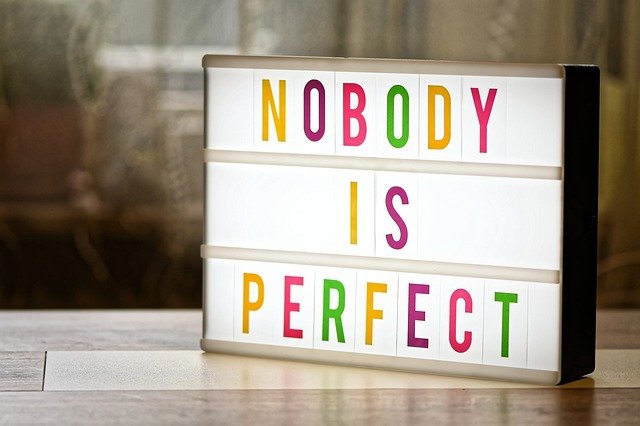
It’s ok not to be perfect

Try telling that to a perfectionist!  We all have lists of flaws we measure ourselves against that can take over other traits.  We ask ourselves do I talk too much, am I too sensitive, am I doing enough, happy enough, am I meeting my own high expectations of myself?  This month’s Woman & Home magazine offered some suggestions on how we can be kinder to ourselves and accept our success regardless of our imperfections.

Live in the present – be honest with yourself and understand who you are rather than who you think you are supposed to be.  Make a decision that you are enough and focus on what you have now rather than fixate on a future fantasy ideal.  Find the balance between ambition and appreciation by celebrating the little wins.

Let down your walls – we all have a flawed personality that might try to tame but our needs, feelings and opinions are just as valid as anyone else’s. If we keep trying to people please and holding back in case other people don’t like it, we’ll end up very lonely.  Experiment showing vulnerability by picking one or two trusted friends to confide in, and tell them how you are really feeling.  Make your own needs a priority and stop ignoring yourself to please others.

Challenge your inner critic – when you hear your inner critic, make a note of those thoughts and learn to unpick and question them.  Reframe thoughts as they happen.  Cultivate positivity to enable you to turn your inner critic into your inner cheerleader and flip negative thoughts into positive ones.  Focus on those things that have gone well.  When you hear negative chatter tell it to stop and dispute the evidence and give it a good grilling.

Adjust your expectations – instead of needing to feel popular we should be truly faithful to ourselves.  Instead of falling into a comparison trap about what you should have, use your own compass to navigate life and regain control of thought patterns.  Set your own standards, choose different benchmarks for success and identify small achievable goals.  Learn to fail. Shift how you think of failure and see it as an opportunity to learn.  Revise your expectations.  Real life doesn’t always go to plan and we have to overcome obstacles.  This is where we’ll find strength and a sense of accomplishment.

Flaws can be flags – our perceived flaws can be a prompt to highlight feelings that need to be addressed.  Our feelings can leave us feel unworthy of the good things in life.  Remind yourself that feelings aren’t facts.  Reframe your guild or whatever flaw is holding you back.  Address the guilt, consider what the belief is and what you have actually done/not done.  Hold yourself accountable but with compassion and perspective.  Change the way you think about it or talk about it until you can let it go.

Time to reign in the perfectionist and reframe my flaws.

Time for tea

Image by Myriams-Fotos from Pixabay

An article in November’s Good Housekeeping discussed the benefits of a daily herbal cuppa.  Drinking herbs that have been steeped in hot water can help boost our wellbeing, help revive, relax and boost our memory.

It works by drawing out the compounds from plants that are caffeine free, gaining their beneficial properties such as water-soluble vitamins and antioxidants.  It’s super easy to make.  One heaped teaspoon per mug of hot water, infuse for ten minutes, discard the herbs and enjoy.  It can be a few moments of mindfulness as you draw in the smell and taste.

Different herbs have different benefits and combining some can help prevent feelings of stress, bloating, depression, can make us feel more awake, flushed, focussed, less headachy or overheated (for those of us women of a certain age).

To reduce stress – Chamomile, lavender and pink rosebuds.  Use half the lavender to the other ingredients, 25g each of chamomile and pink rosebuds to 15g lavender.

 To feel less bloated – fennel, peppermint and catmint.  Drink after dinner, equal parts of each herb.

To reduce feeling low – Pink rosebuds, lemon verbena and lemon balm.  Blend 25g of each for an uplifting feeling, clear the cobwebs and give yourself a hug.

To feel more awake – Chamomile, lime flowers and valerian.  Mix in equal parts for a soothing, easy drink.

To feel less flushed – Red clover, rose and sage – 30g each of rose and sae to 40g red cover to help with those menopausal moments.

To be more focussed – Rosemary, ginkgo and peppermint – 25g each for a perkier brain.

To reduce headaches – Rosemary, peppermint, ginger and lime flower.  Blend in equal parts to take the edge off the ache.

To reduce overheating – Peppermint, lemon balm and lemon peel.  Mix 50g peppermint, 40g lemon balm and 10g lemon peel to cool down.

Other suggested herbs were Nettle filled with vitamins, minerals and protein for nourishing and cleansing and Elderflower to help fight colds and ease sinus problems.

The article’s experts suggested that loose tea is better than tea bags as some of the volatile oils in herbs can evaporate during the tea bagging process and they lose some of their flavour.  If you’re making your own blend then try 1.2 teaspoons of herbs per person, according to taste preferences.  Leaving is to infuse for five to ten minutes, but harder herbs and barks will need longer.  No more than three cups per day is the recommended maximum.  Fresh herbs are best as they are slightly milder flavoured but you’ll need twice the amount.  Cold brew is just as good so if you prefer iced tea it won’t diminish the effects. You can of course by all the separate herbs and concoct your own blends but there is an increasing market in ready mades now.

I am not a massive tea drinker, certainly not standard black tea anyway.  I do enjoy a mint tea in the afternoon and find it quite refreshing, but I’m not convinced about purchasing different blends until I’ve been able to try it without shelling out for expensive products.  If someone has some I’ll try it.

What’s your favourite tea?

Things that are just not worth your time

Image by Gerd Altmann from Pixabay

We waste so much time on things that don’t bring joy and value to our lives.  That don’t align with who we want to be and what we want to create.  Have you ever conducted a time inventory and really analysed how you spend your time?  How we spend our time is a reflection on the quality of our life.

Using time wisely is one of the best acts of self-love we can give ourselves.  Having strict rules around where and when and on what we spend our time can give us the space to create our lives.  Looking at the discrepancies between the reality and the desire of our lives side by side can be enlightening.  The key is to choose how we use the hours we have by avoiding things that waste our time we regain more time to create, love, enjoy and live.

My mate Tonya Leigh suggested we should list the things we should stop doing that are wasting our time, here are some of hers, and mine suggestions:

  1. Using our best persuasion tactics in an attempt to change our mind or talk ourselves out of, or in to something;
  2. Explaining to others the details of why.  We shouldn’t need to explain why we don’t want to do something or need to change or cancel plans.  We don’t need to explain our lives away.
  3. Obsessing with perfectionism.  Done is better than perfect.  Do your best then move on.
  4. Questioning our own ability to do, say or be something.  Acknowledge our inner critic, but don’t indulge it.
  5. Waiting in long queues to buy the latest thing, or tickets for an event or be the first to have something.  So what if you’re not the first to have it?  It’ll nearly always still be there once the queue has died down.
  6. Spending hours and hours on social media so that we don’t miss out on anything.  Dip in and out and use the rest of the time to do something of value.  If it’s important we know something, someone will tell us.
  7. Following through on the obligatory “yes, let’s get together”, when you can’t fit it in or simply don’t want to.
  8. Keeping up with the latest trend, beauty, fashion, gadget etc.  Do you, not everyone else.
  9. Fuelling committing to the impossible job of making sure others like us.  It’s our job to like ourselves and accept others either like us or they don’t. What others think of us is none of our business.  What we think of ourselves is most definitely our business. Personally, I’d rather spend time with people I don’t need to try to convince.
  10. Fanning, caressing and swaddling our stories from the past.  Let it go, it’s done.  Enjoy today and look to a bright future.
  11. Making lists of all the things we don’t have.  Wake up to all the things we do have and appreciate them.
  12. Poking our noses into other people’s drama, even when we’re trying to be helpful.  I personally don’t have time for other people’s crazy.
  13. Spending hours in the gym. We shouldn’t waste time obsessing over the perfect body, but love the one we have.  Going for a walk or doing anything that moves our bodies is good enough.
  14. Insisting on cleaning before getting on with what we should be doing.  I have no interest in being a cleaner and we have too much stuff in our house to bother too much about it.  Cleaning before getting on with things is just a distraction task and often not really productive.
  15. Committing to get better at things we should and could be better at but don’t really want to. We don’t need to be the best at everything and I would personally rather spend the time doing things that I’m naturally good at (if only I knew what that was).  Accept our own strengths then use other people’s strengths to fill in the gaps.
  16. Preparing gourmet dinners that should be on the front of Good Food magazine.  Don’t make it complicated.  Eat well and simply.
  17. Placating the negative nay-sayers.  If they cannot believe and support our personal dreams, they don’t deserve to be around us when those dreams come true.  This doesn’t include those who hold a different opinion as discussion and challenge are always beneficial.  Just those who tell us it’s not possible, or it’ll never work.
  18. Holding pity parties for one with a dose of self-loathing. Nothing good comes from hating ourselves.  We have the choice whether to hate or love ourselves.
  19. Refreshing the email inbox again, and again, and again.  Checking emails hundreds of times a day is not productive; it’s a distraction from focussing on what’s truly important.
  20. Indulging in trash.  Whether its trashy tv or social media, we know what’s trash by the way it makes us feel. 
  21. Beating ourselves up over wasting time.  Sometimes it’s inevitable.  How we chose to spend our time is such an individual thing.  We should make a commitment not to waste time but not beat ourselves up when it does happen. We can’t be perfect all the time, remember?

The idea is to master the art of how we spend our time and energy, to tweak it to align with our desires.

What would be on your list of things to stop wasting time doing?

When did you last tend to the details?

Ernest Hemmingway said something along the lines of “everyone’s life ends the same way, it’s the detail of how they lived and died that distinguishes one person from another”.  We can be so busy with life, work, college, business, going to the gym, hobbies, trying to change ourselves and the world around us that we can forget what we truly crave, the beauty of what is found in the detail of life.

You guessed it, I’ve been listening to Tonya Leigh (I swear that I’ll change channels soon) again, who suggested that the details can be small, simple things like putting on some lippy, enjoying a good book, or cup of tea, the beauty of fresh flowers, coffee and cake with friends, art, a glass of good wine, enthusiastic conversation about something you’re passionate about, or even quiet time alone.  Beauty is found in the details of how you live, making time for those special moments.

TL offered that whilst its fine to have an eye on the bigger picture, driving ambition and success over time and quality can make us almost afraid to stop and appreciate the simpler things in life, like a beautiful sunset.  We’re often racing around to get the next thing done instead of taking notice of what’s right in front of our eyes.

When we decide to tend to the details of everyday it requires discipline, but can lead to a beautiful life.  We need to break the habit of saying we’ll get round to it one day, or we’re too busy, or it doesn’t really matter. This is something I’m guilty of.  The “I’ll get round to it eventually” and thinking that there’s so much to do and get done that I’m too busy to take time to achieve any of it.  I need to tackle one small detail at a time and before you know it, the rest will follow.  Prime example is that I decided to make my side of the bedroom less industrial.  My bedside table is full of jewellery boxes, glasses cases, old watches I no longer wear and a jumble of stuff.  I got as far as buying myself a statuette (fake bronze but never mind) with the idea of clearing the table of all that stuff and just having a beautiful statuette there, elegant and romantic. 

So far, the statuette has arrived and is still in its box.  I could have made a start on clearing space last weekend but didn’t get round to it, instead I sat reading, or catching up on things having just returned from holiday.  You could argue that sitting reading and catching up on things was tending to some details but it didn’t feel like I’d achieved anything towards my goal.  I need to break that habit of “I’ll get round to it one day” and just do it. 

Taking attention to the details, slowing down and appreciating things, can inspire us and those around us.  People will appreciate the time you offer to truly be with them.

What is the one small detail you’ll tend to this week?

And now to stop chasing happiness

Image by mohamed Hassan from Pixabay

Recently I have been posting about how we are encouraged to try to find our happiness by defining what we desire and taking action to achieve it.  Today, I’m going to suggest that we stop trying to chase happiness.  We spend so much time, energy and money in trying to achieve a state of happiness but are we truly any happier?

Some nuggets of wisdom from my podcast fave (sorry if you’re getting sick of her but I find her interesting and challenging)  Tonya Leigh who suggested that we should stop chasing happiness and accept that we have different moods, sometimes things are a bit doom and gloom, and we’re not always on our A game.  These emotions should not be avoided or resisted but acknowledged and allowed.  She questioned what if we used our emotions to discover the wisdom those days hold, what if we didn’t make a negative emotion mean something has gone terribly wrong in our lives?

The chances are when we delve deeper into our emotions they can be the key to unlocking a successful life, feeling and understanding our emotions can be fundamental to our creativity and desires.

Continually trying to chase happiness can be exhausting and whilst we are intent on that, we can be abandoning taking care of ourselves.  Consider whether we are running towards something or away from something when we chase happiness.  Sitting with our emotions can be a journey of discovery of beliefs that have been holding us back, patterns that keep showing up and how we can feel an emotion without having to react to it.

TL suggested that there  will always be occasions when we are not on top of the world but that’s ok, its normal and part of everyday emotion.  However, we still get up and get on with our day.   She suggested that it was important to show up and be who you are in the moment.  Trying to be happy all the time can actually make us more miserable as we’re always striving for something slightly out of reach.  Turn the focus off of you and onto all that is around you, even when you are feeling less than 100%.

She suggested that is was normal to have negative emotions.  It’s only the meaning we chose to attach to it and that when you stop resisting or reacting to an emotion it simply becomes a feeling in your body.  She concluded that moods come and go, so navigate according to your desire, not your mood.

You could be happier if you stopped chasing happiness.

What do you need to take control of your future?

Image by Gino Crescoli from Pixabay

This was the latest question posed in Psychologies Magazine with the usual ten questions to choose responses from.  One question put was “When you have to make a big decision, you tend to…”  the answer options were:

  • Ask other people’s advice
  • Put it off if you can
  • Worry about it
  • Do what’s expected of you

I chose “Do what’s expected of you” as the response that most resonated with me.  I often don’t necessarily do or respond the way I’d like to but go with what I think others want, or expect of me.  I go along with what everyone else wants, even if it really isn’t what I want to do, out of a sense of duty, out of a sense of not wanting to rock the boat, or it’s just less drama to do what the other person wants rather than what I want.  There is plenty, in all walks of life, that I would have rather done or not done, or said, that I’ve just kept quiet about.  Sometimes to the point where it has emotionally hurt me to go against what I would rather do.

The results from my answers to the ten questions suggested:

Try to think about how you feel.

There’s no doubt a stoic approach to life – ‘putting up and shutting up’ – can help you stick at things.  There are lots of upsides to having a high tolerance for discomfort, boredom or feeling ‘not quite right’, but the pay-off is often weeks and months spent ‘just getting on with it’, which can drift into years.  When your feelings come way down your list of priorities, it’s hard to justify making changes that might impact on others.  And, in a busy life, it’s easy to operate in ‘doing mode’, getting on with everyday commitments whilst switching off from how you feel.

Journaling may help you pin down your emotions and gain insight into your feelings.  At the end of each day, rate a list of categories of your choice out of 10 (achievement; happiness; peace of mind’ wellbeing’ purpose; sense of connection..) If your scores are consistently lower than five, you have proof that the way you are living is not working for you. There is much to be learned from being curious about your feelings, instated of burying anything that is difficult.

Through the work I’m doing to get to know myself better, I am starting to find that I have a wider range of emotional responses.  In the past, I would just shrug something off and try to ignore it.  I had been accused of being uncaring in the past, when actually I did care, I just didn’t dramatise it.

What I have found so far is that I am responding more openly about things that upset me, usually by crying (often shut away somewhere or in the dark).  I am becoming more decisive about things I don’t want to do, and vocalising it.  Sometimes I still have to do it but at least I can now say that I’m doing it under duress.  What I still haven’t really got to grips with is vocalising my emotions and feeling confident enough to tell other people exactly how I feel, or how they have made me feel. 

I think some of that comes from the fear of being ridiculed about feeling that way.  Some it from not wanting to come across as needy, pathetic, “over emotional” or even as hormonal being a woman of a certain age. 

Some of those around me are not great at sharing emotions either, so most of the time these things go unsaid.  I don’t think they necessarily go unnoticed, they are just not commented on or discussed, in the hope that it’ll blow over in a day or so. If I get grumpy about something someone has or hasn’t done, I usually just go into quiet mode, don’t say much.  Nothing is said back and it’s a case of leaving be until I get over it.  But that doesn’t resolve the issue.  It’s still sitting there in the dark waiting to surface again another time.

I know what I’m feeling, so I don’t think I need to keep a journal about it and score it. For me it’s about being able to communicate that with someone in a confident and supportive way. I am definitely in the ‘putting up and shutting up’ role, getting on with ‘doing mode’ rather than acknowledging how I feel, verbalising it and acting on it.

Something to work on.

Reimagining your vision board

Image by Sh1ra from Pixabay

I’ve not really been one for vision boards.  At least not the physical sort that you cut out images from magazines or pin photos to of places you want to visit, the home you want to create, the relationships you want to have, career goals, health and happiness, what you want to learn etc.  Mine is more of a vague idea or general direction in my head with a To Do List of how I’m going to get there.

According to https://blog.mindvalley.com/vision-board/ creating a vision board is a great way to be clear about your goals and dreams and to motivate yourself to bring them about.  Some people even have vision board parties where everyone brings along their pictures and glue sticks and get creative over a bottle of wine.  It is described as a way of putting the law of attraction into practice by creating a powerful visualisation tool that helps you narrow down your desires through making choices.  The law of attraction magnetises and is supposed to attract you to the opportunities you need to turn your dreams into reality.

A vision board can be inspirational and aspirational but it doesn’t offer the knowledge of who to achieve it.  To do that you need to take inspired action. Research things on your board to determine how to make them happen.  The problem with vision boards is they are inanimate objects that have no power.  The power comes from your desire to know which direction to go in.  The main factor in creating your vision is to commit to falling in love with your life right now.

Back to my current podcast fave Tonya Leigh who suggested that what you focus on grows.  When you look for what you love and when you fall in love with what’s happening right now, things get better.

A picture on a vision board can be a catalyst to set things in motion, but it needn’t be a vision board, it could be a picture, or a piece of art, or something around your home or office space that inspires you.

TL suggested that vision boards only worked when you show up and live out that vision.  People talk about their dreams or take classes without ever doing the real work.  They read financial pages but don’t crunch the numbers.  They have a shelf of cook books with beautiful recipes that never get made.  They read fashion blogs but never buy that new outfit.  They attend conferences and retreats but never put what they learned into practice.  Some people create beautiful vision boards but don’t show up for their vision and wonder why nothing has changed.  They expected the vision board to do all the work for them instead of working on their vision.

TL suggested an alternative if you’re frustrated that your vision board isn’t working for you.  Rather than spending hours creating a master collage, use that time to live out your vision.  Put yourself out there and actually do it.

The call to action today is to stop pretending to live out your dreams and make a commitment to show up and live it.

When your jeans don’t fit

Image by Couleur from Pixabay

Having just got back from a week’s holiday where we ate and drank very well, I was mildly anxious about trying to get back into my work clothes on Monday morning. I wasn’t going to deny myself the pleasures of eating out and enjoying different foods and wines.  We had everything from English, French, Greek, Mexican, Italian and Indian cuisines.  More often than not three courses too.  I also enjoyed cocktails before dinner and wine with dinner. I was on holiday.  I wasn’t going to spend it calorie counting. I’d put on about 6lb, which was about what I’d expected, knowing full well that when we got back home, I’d be back to calorie counting and being more careful what I eat.

I must admit, I was rather glad when the trousers I’d picked out to wear to work didn’t cut off the circulation. A little snugger than usual, but I could breathe.

I know that on my return to routine, I’ll get back to that sweet spot when I experience the flow of life, where I’m eating the right things in the right amounts. There was no need to spiral into doom, gloom and despair.  It’s about learning to be comfortable in your own skin, even when there’s a little bit extra around the middle.  If the trousers didn’t fit, I’d simply change the outfit.

In order to find that sweet spot, podcast favourite Tonya Leigh suggested that we need to be honest and respectful of ourselves.  What happens in our own mind is the worst thing that can happen if we let it.  It would be impossible to get back to that sweet spot if we thing of not getting into our jeans as a failure. We need to recognise that our bodies fluctuate and see it as a sign that we need to get back in touch with our body and tweak one thing at a time, rather than try to tackle it full on.

Getting to the sweet spot requires self-awareness and curiosity.  If we’ve fallen off the wagon, TL suggested asking yourself the following questions:

  1. What’s been going on?
  2. What have you neglected?
  3. What do you need to let go of?
  4. What do you need to add?
  5. What are you going to do next?

Often its about more than just food but with a new awareness and a few simple tweaks we can get back on it quickly. TL suggested that everything you desire lives within your sweet spot.  It doesn’t have to be a struggle to find it.  You can’t live in it 100% of the time; life has its ups and downs.  It can be fun to explore and be curious about yourself.  It can take a lifetime of practice to get there.  Everyone’s sweet spot is different but when you get there you can be energised full of passion and excitement and can be unstoppable (if you want to).

TL concluded that living in the sweet spot required elegance, an internal sophistication of confidence and mindset.

I am confident that by the end of the week, I’ll have lost most, if not all of that holiday gain as I’ll be back in the zone of opting for healthier foods, I’ll certainly be drinking less and not having three course meals every evening. I’ll be back in my sweet spot by the weekend.

What does your sweet spot look like?

Know your knowledge

I love learning new stuff. About me, about the world around me, about things that support my career and hobbies, about what makes people tick. I’m the sort that would read a chunky document for that one snippet of something. I will Google how to do things. I will ask others how they did that.

I am currently trying to lose some weight, not that its working but that’s more to do with my commitment than anything else, so I invested in Noom. The app that uses psychology to support weight loss. It takes you through a raft of new skills learning and understanding your own responses to food. I have finished all the modules and now its taking me through development of a self experiment in order to determine factors that will support and sustain my weight loss. This morning’s “lesson” was all about knowledge.

There are different types of knowledge that we all experience from time to time:

  1. A priori – things we just know that don’t require life experience to be considered true, like 2+2=4. No one argues about it. Its just true.
  2. A posteriori – experiential knowledge gained through some basic level of understanding, like we know the earth orbits the sun.
  3. Explicit – that knowledge gained through learning, reading around a subject.
  4. Tacit – the stuff that you just know, like all the lyrics to ABBA or Queen songs that seemed to be hardwired at birth.
  5. Propositional – the knowledge of facts that can be declared as statement, like the sun is larger than the earth.
  6. Non- propositional – procedural knowledge that can be explained and used, like knowing how to walk.

We probably experience all of those methods virtually every day.

I remember a talk at a #bellringing event demonstrating the different ways people learn. The speaker had brought in his kayak and used people of different ages to demonstrate the different ways.

He used C as the older learner where he just verbally explained what to do and C got on with it (auditory). Then he used someone in their 20s and showed them what to do (visual). Then he used R, who must have been about 10 or so, and he demonstrated, then sat with her and did it together (kinesthetic).

I think I am a mix of all three. I can take verbal instruction, so long as its not overly complex, I can watch something then copy it as I have done many times recreating cakes. And I learn through working together through a problem. I guess it depends on what the problem is.

What type of knowledge have you learned from and what type of learner are you?

Finding your signature scent

When I was younger I had a real problem with perfumed things. Sprays, some deodorants, bubblebath, shower gel, definitely perfumes and even just strong smelling things like oranges, freshly cut grass would set my nose off and if I came into skin contact, would more often than not bring me out in a horrendous rash.

As I’ve grown older I’ve been able to manage deodorants well enough and can now pretty much take my pick. I still tend to use the same shower gel for the last 30 odd years. I dont use anything in the bath on the extremely rare opportunities for a soak in the tub.

I have tried a few perfumes over the years. Its been hard to find something that I like the smell of but that’s not going to irritate.

I tend to stick with what I would describe as “clean” fragrances, rather than the heavy musk or floral scents.

I have only recently got back into spritzing on a bit of perfume. C had bought me some in the past and its sat on the dressing table gathering dust. I have three sorts, all variations from the same brand. Some are still in their cellophane wrapping.

According to perfume designer Narciso Rodriguez, musk is supposed to have a depth that is very personal and intimate. “It becomes at one with the woman who wears it“. I remember trying Obsession by Calvin Klein back in the day but didn’t really rate it.

I think perfume is a very personal thing and would never buy anyone perfume unless they had specifically requested it. Every Christmas we buy R a bottle of her favourite Black Opium by Yves Saint Lauren. The one year we didn’t we were truly chastised.

I think how you wear perfume is important too. I just give a little spritz around my decolletage. I don’t bother with all the pulse points. But there is a right and a wrong way according to https://www.byrdie.com/how-to-apply-perfume

  1. Do apply directly to the skin. The oil loving properties of the skin provide an excellent canvas and the warmth of the skin can enhance the scent.
  2. Don’t apply it to hair. The alcohol based formula can damage hair.
  3. Do apply to pulse points; insides of the elbows, back of the knees, chest, and the sides of the neck as these areas allow the perfume to “be enjoyed”.
  4. Don’t rub into the skin. Rubbing it in will make the top notes fade and evaporate.
  5. Do walk through a scent cloud if you want to fully immerse yourself but make sure its a non toxic perfume. And try not to inhale it, its toxic after all.
  6. Do layer complimentary scents. But avoid the big heavy scents that will overload and become unpleasant.
  7. Do apply to clothes. This can help revitalise musty smelling coats in the winter. If you can wash it, you can spritz it.

Perfume can be very expensive but an easy way and cheaper is to use a simple spritz spray like the Body Shop’s vanilla body mist. Same net effect but for ten quid a bottle rather than over a hundred quid a bottle.

What’s your signature scent?