Quietly competent

Image by Gerd Altmann from Pixabay

An article by Carol Stewart highlighted the difference between mistaking a lack of confidence for a lack of competence.  She was specifically fielding it as a message for introverted women, but it’s equally applicable to anyone who lacks confidence to show their competence.

There are those, and I’m sure we can all name at least one person, who is supremely confident. They can walk into any room and blag their way through whatever they’re confronted with, despite the fact they may not actually be competent.  However, there are those of us who have competence but our confidence holds us back and we write ourselves off, doing ourselves an injustice by denying ourselves to become all of what we are capable of.

Stewart demonstrates the subtle differences between where we are in the four stages of competence:

  1. Unconscious incompetence – unaware that there is a skills or knowledge gap
  2. Conscious incompetence – awareness of a skills of knowledge gap
  3. Conscious competence – having the skills and knowledge and knowing how to use them but requiring a lot of thought and practice to do so
  4. Unconscious competence – having the skills and knowledge and knowing how to use them without having to give it much thought

Of course we can be in different places in different aspects of our lives and at different times.  If you feel you are currently in the conscious incompetence stage how can you get the necessary training or who can help you with what you want to achieve?

Stewart asked us to consider what exactly is it that you lack confidence in? Clearly defining it helps make it easier to address.  If it’s because something takes you out of your comfort zone, work on stretching yourself out of it without it becoming too stressful.  It should feel slightly uncomfortable.  Reflect on how you felt, celebrate that you went that little bit further.

We can often lack confidence when we feel overwhelmed for which Stewart suggested breaking things down to clear steps of what needs to be done.

When we compare ourselves to colleagues we should take into account whether they are naturally extroverted, a woman in a male dominated environment, someone from a different socio-economic status or a place of privilege. In those situations Stewart recommends standing strong in who you are and valuing the different you bring.  You may have taken a different route to get to the table but you are there all the same and deserve it.  You many have had many obstacles and taken a few detours along the way, and this can make your contributions even more valuable.

Addressing self-doubt, limiting beliefs and imposter syndrome by identifying where you lack confidence or competence can be conquered.

I am embarking on a new role at work where I very much lack competence and thankfully I am aware of this, consciously incompetent.  I am also grateful that there are people around me willing to help me.  I spent an hour or so with a colleague the other day going through a wealth of information around reporting processes and learning opportunities. She got me access to a team and a shared drive where there is a wealth of information for me to rummage around to help familiarise myself with the processes that I’ll need to adopt to help make a success of the work I’ll be doing.  It was mind boggling at first, but the quiet competent in me told me “you got this”.  I have the ability to become consciously competent before evolving into the unconsciously competent.

5 Ways to raise your conversation vibration

Image by dandelion_tea from Pixabay

Do you spend time creating conversations on purpose?  What you talk about in your own mind, and with others, reflects a lot about your life.  Do you spend time talking about your past and problems, or about your dreams and vision?

It is important to create and monitor your conversations on purpose, to avoid stagnant and repetitive conversations.  You can get fixated on what’s happening at a given moment that you forget to think about growth, inspiration, positivity and joyful interactions.

According to podcast fave Tonya Leigh to upgrade the quality of your conversations you need to take risks and be involved in conversations that expand beyond those you usually have.  By committing to elevate the conversations in your own life you can become connected to wonderful people who can give you excellent advice and support.

No matter what you’re currently going through or struggling with you should measure the quality of the conversations you have.  You are the sum of those conversations you have with the people around you.  So when you talk with inspirational people you share your passions, visions, obstacles and solutions, share the struggles but from a place of wanting to be stronger knowing when you’re open you can gain incredible insight.

TL suggested five ways to raise your conversation vibration:

  1. Refuse to get sucked into non-productive conversations.  Others who complain or are negative don’t help those committed to dreams and growth.
  2. Invest in creating a circle of likeminded people.  The return on investment in joining groups can be immense when you are connected to incredible minds and hearts, with others also investing in their personal growth.
  3. Uplevel your virtual conversations.  The internet is full of people who enjoy discussing ideas and solutions. Find them but have some rules around how long you spend on the computer and check in with how you feel about the conversations you join and whether they are draining or supporting you.  Be responsible for the energy you bring to the conversation too.  Curate the conversations you want to have that fill your dreams and excite you.
  4. Find a Bestie who whispers in your ear even if they don’t know you exist.  This could be books, videos, podcasts.  People you’ve never met, or ever likely to, can help inspire and motivate you.  Think about where you are right now and what you’re dreaming about creating and who is having those conversations about it.
  5. Create the conversations you crave, don’t wait for them to happen.  You can change the subject, or leave the room if the conversation is not serving you.  You can bring topics up that you are passionate about. Talk about what went well and what you’re excited about. Surround yourself with people who will help you figure out how to make it work.  Curate conversations about where you want to be and a brighter future.

SL asks that you make a commitment to raising conversation standards and become the person who elevates the conversations that impact you own life and those of the people around you.

Do your conversation represent the person you want to be, your dreams and desires and how you want to be known?

I am rubbish at conversations.  I’m no good at small talk.  I can often go on for too long about something I should have shut up about already, or not expand enough about something that needed more air time.  I don’t really have anyone close that I can have the conversations I want to have about my personal growth without them thinking I’m going cuckoo, having a midlife crisis, or can offer any real constructive support with. 

So I’m stuck with the podcasts (hence the almost daily dose of TL), books and videos.  I’ve found a few social media sites that offer basic level support but it’s all very generic.  I tried reaching out to a couple of former colleagues, who would totally understand it and we all agreed that we’d meet up but when I sent them suggested dates, they never bothered to come back to me, so I guess they weren’t that committed to supporting me after all. 

I’m not at the stage where I want to invest ££s in attending personal development coaching sessions.  I can’t justify the expense in my own mind yet.  I’m sure those who deliver such coaching would tell me that it would be totally worth the investment, and I’m sure I’d get something out of it, but they tend to be very expensive.  Coaching sessions I’ve had in the past haven’t really helped me figure things out.  I’ve spent a lot of time supplying the answers myself instead of getting support on what to work on.  One person just kept telling me to think about what I’d say to someone else, and how she knew I already knew the answers within me.  Simply repeating that didn’t help at all when I wanted practical advice on what to do.

For now I’ll just have to keep having those conversations in my head.

Dare to dream

When you were younger did you have a big dream of who or what you wanted to be when you were older?  I didn’t.  I never really had a calling or particular interest.  I never felt I wanted to be a doctor, lawyer, nurse, pilot, or astronaut.  Those things just didn’t occur to me.  So much of what we want depends on other people, especially when you are younger, when where we live and what early experiences we are exposed to can shape our lives.

When you’re struggling in survival mode it can be difficult to think beyond where you are. Dreams are still there though.  You may try to bury them as something that will never happen and at some point you’ll be reminded of what you once dreamed of.

Podcast fave Tonya Leigh suggested that as you grow older you start to doubt your dreams are possible as you start to experience self-doubt and look for all the reasons why it can’t happen.  When you haven’t dreamed for so long, it’s easier to start small.  If your dream is to become healthier, maybe starting with some short walks, building up to more exercise or eating healthier.  It’s the committed to showing up, the more you do the more confident and empowers you become, from which momentum builds.

With big dreams comes big doubt and uncertainty.  If you want to create something that doesn’t exist right now it’s going to be uncomfortable.  TL said that dreams served two purposes:

  1. They are the roadmap to your destiny and everyone’s is unique.
  2. They grow you.  To create something you’ve never had you must become someone you’ve never been. They are there to help you evolve.

You’ll have all sorts of limiting beliefs along the way.  This is your mind’s attempt to keep you where you are because it likes the predictable familiar.  You must be willing to step into the unknown.

When you’re old and look back on your life, how do you want to feel about the risk you took?  Did you follow your dreams or your doubts? What if you were willing to allow yourself to want what you want unapologetically?  What if you stopped feeding and listening to the doubt?  Life could be full of possibilities and opportunities to grow.  Life could be exciting and lead you to the life you once imagined.

TL implores you to be committed to feeding your dreams not our doubts and not let the impossible scare you.  To see how much you can expand and create, how much joy you can experience.  Her parting words were to be clear, determined, passionate and committed.

I wouldn’t say I dream about a life I might want, but I probably fantasise about it, often with rose tinted glasses, but I know realistically that however hard I might want something, that’s not going to make it happen.  I have to put in the work to create it.  I’m in the process of ensuring that if I’m lucky enough to live long enough, I will retire early and live a comfortable life with no money worries, hopefully not too many health worries, and knowing that I gave everything I did my all.  I’ll never have the luxury life of a flash car, a penthouse, a jet setting lifestyle, and I’m not sure I’d want it for ever.  Might be nice to try it out once though, then get back to the real world.

I don’t have career ambitions.  I’ve evolved into my current role through ability and hard work, but I have no desire to climb corporate ladders.  I am happy where I am, and feel that I’ve probably reached my limit of where I want to be, so now its building the things necessary to be comfortable with what I have.  I guess my dream now is to have a contented life with security and freedom in my later years, without drama.

Did you ever have a big dream?  Have you fulfilled your dreams already?

Is your self-help plan doing more harm than good?

Image by Thought Catalog from Pixabay

Trying to find help in self-help books, coaching, online courses etc can lead to overconsumption and result in no benefit at all.  We can be paralysed by information overload.

The idea is that self-help needs to create something.  If all we do is consume content but don’t change anything, we’ll be no better off for it.  In fact, probably worse of having spent money on some of it.

My current podcast fave, Tonya Leigh suggested that when you apply your learning to your life, self-help can be amazing but just reading about it will only lead to disappointment if you don’t create anything from it. Consuming information is easy, but the real work is hard and can be so rewarding.  Taking what you’ve learned and applying it to your life.

We can grow and evolve beyond who we are today if we want to, but its not about trying to fix what you might consider broken.  We get to decide who we want to be and create it.  However, we don’t know what we don’t know and may need help in identifying it.

Personal development books, mentors and courses can open our minds to what is possible.  It’s doing the work, not reading about it, that gets results.

Our success is our job to create and no amount of investment will make it happen.  It can be uncomfortable and push you into hard decisions to evolve from the person you are today.  You’ll have to say “no more” to some things, risk failure and rejection, overcome your own doubts, let go of habits that no longer serve you, and do the work to create it, not just consume.

If you are someone consuming a lot of self-help content but feel you aren’t getting anywhere with it, TL suggested three rules to turn personal development into personal freedom:

  1. Commit to following through every programme you invest in.  That doesn’t just mean listening to the modules.  It means scheduling it, showing up for the sessions and taking action based on what you’re learning.
  2. Only allow a small selective group into your head at any given time.  Carefully consider who you’re personal development crew are based on your next evolution of yourself. This helps create momentum rather than only touching the surface.
  3. Diversity your consumption.  What is it you want to focus on?  Health, style, finances, etc.  Then select the people and programmes that support that.

Reading a book, watching a video, listening to a podcast is not doing the work.   The work is being willing to accept the discomfort that is going to come, showing up, scheduling the activity and the time to do it, being honest with yourself and committing to addressing the real issues.

Take what you have learned from the personal devolvement world and apply it to your life.  Do the uncomfortable, messy, hard work.

As you know, I’m on a journey (hate that phrase) of self-discovery and improvement and I have read a few books, followed a few people on social media and listened to the odd podcast.  I am quite selective about the content I consume and as soon as I recognise that it doesn’t serve my purpose, I stop, unfollow, delete or whatever.  Even with those I do follow, I sometimes skip posts or episodes if I don’t feel they speak to me in that moment.

Life is like a box of chocolates

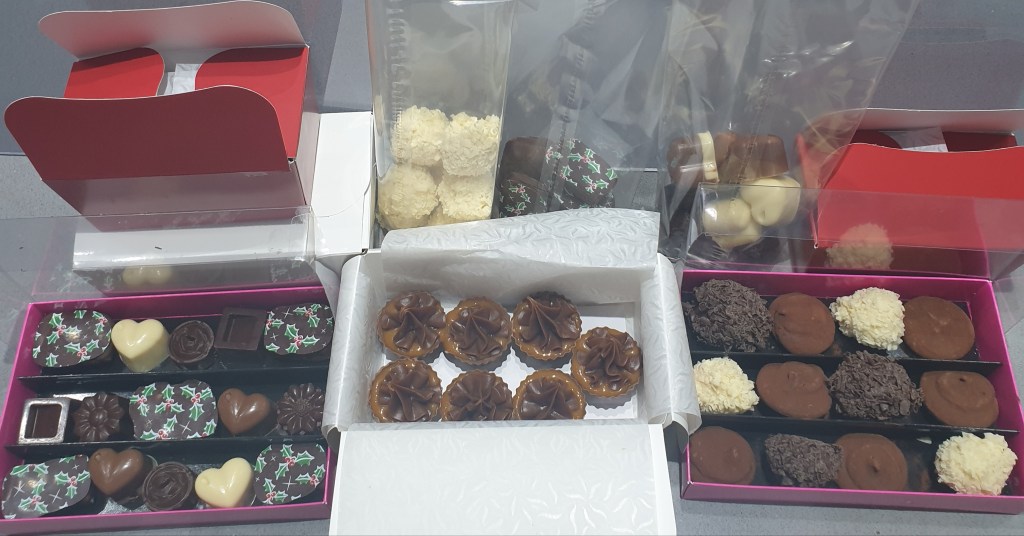
For my birthday, way back in February, my work colleagues bought me a voucher for a course with my baking buddy Sarah at The Cupcake Oven. I’ve known Sarah for a number of years since I first joined the local Sugarcraft Guild in order to be able to attend a workshop with my baking hero Paul Bradford. I’ve been on several of her courses and always have a fantastic day and learn new techniques. Sometimes I don’t really learn much but enjoy some therapeutic time making cake and the company.

I decided to do the Chocolate Box course this time. No cake involves unless you count the cupcake Sarah always prepares for her clients, and a slab of oreo cake she had left over from the previous days course. There was only myself an one other student so we had Sarah’s attention and had time for plenty of laughs and chat.

We made a wide variety of milk, dark and white chocolates. Orange ganache truffles, cassis buttons, white chocolate and raspberry truffles, caramel cups, enrobed marzipan, with any left over chocolate turned into solid moulds. All beautifully boxed and bagged.

In my head I can see me recreating these as gifts for people. Reality is, Sarah had prepared a lot of the items having wished things out to save time. If I was doing this from scratch, it would take several days. The trouble being you can’t rush chocolate.

When you melt it, you need to get it to the right temperature, then let it cool down a bit again but not too much. Once you’ve done what you’re going to do with it you need to chill it or wait for it to set a bit before putting it in the fridge. That’s assuming you have plenty of fridge space.

I may invest in some moulds and I made dabble in it at some time but for now I shall enjoy my treats over the coming days. I may share some with C if he’s lucky.

Join the CASG

Image by Bob Dmyt from Pixabay

A hilarious article by Polly Vernon in Grazia magazine really made me chuckle.  In it she launches the CASG – the Campaign Against Shit Gifts.  Love it.  Particularly as we seem to be falling into the chaotic mess that is Black Friday. Today’s blog runs the risk of upsetting some and making me look like a Mrs Grinch or totally ungrateful. That is absolutely not the intention, but it is intended to save time, money and effort for everyone.

As we approach that time of year again, we brace ourselves for the onslaught of poor taste, offensive, inappropriate, unwanted and downright thoughtless gifts, all in the name of Christmas.  Now, I’m not trying to be Mrs Grinch here, I like a gift as well as the next person, but make it relevant to me, show me that you know who I am and what I like.  Don’t give me a piece of plastic tat that has no purpose other than to collect dust and take up space in my already overcrowded house. Save yourself the time, effort and money.  Just don’t buy it.

I think the all-time worst gift I ever received was a victim of the dreaded Secret Santa.  I was given a comical handbell on which was written the phrase “Ring for Sex”.  This was at work, from a senior colleague (let’s face it there’s nothing secret about a Secret Santa).  She naturally thought it was hilarious because I ring bells.  It was completely inappropriate for the workplace, and I certainly wasn’t going to take it home to show hubby.  It found its way to a bin within the hour.  What a waste of the other person’s money, and highly embarrassing for me to have had to open this in front of other senior colleagues and pretend to be grateful.

I don’t want to add to the “stuff” in my house, I don’t want to add to landfill or recycling.  I would rather have a voucher for a meal out or an activity, or a subscription to flower deliveries or a magazine I enjoy. I don’t want book vouchers that can only be spent in bookshops when I download books from Amazon. I don’t want smellies (I’m allergic to most anyway). If you’re going to give me a voucher for £x and I’m going to give you a voucher for the same value, they’ll negate each other so what’s the point?  I don’t need gifts and I don’t want others to feel obliged to get me anything. And I am very ok with that.

That said of course, I’ve undoubtedly bought my fair share of shit gifts for others who probably felt the same about what I’d bought them.  And I know that I’ve bought a few items already for people this year that they haven’t asked for, may not actually want or need, but when I saw them I thought of them.  So I apologise in advance for anyone who thinks the gift I got them this year was shit.  Where possible I try to find things that have a use or a purpose, or that I know that person has said in the past that they wanted, and cut out the incidental stuff that’s just for the sake of padding. 

C is dreadful to buy for.  Outside of #bellringing he has no other hobbies, he dabbles with taking photos.  He’s not into sport, or gardening, or cars, or anything else really.  He has very specific requirements around camera equipment and/or #bellringing paraphernalia so he has to supply a list with links to the exact item.  If there are only two things on his list, he’s only going to get two things.  He doesn’t like stuff for the sake of stuff either. 

I don’t want to sound ungrateful but as PV said “do us all a festival favour – step away from the novelty gift”.

Written with love and gratitude.

Is charm the missing x factor to success?

Image by NickyPe from Pixabay

Do you feel confident and at ease every time you walk into a room? I know I don’t. Yet we have something to offer in each room we walk into.  Powerfully connecting with others no matter who is in the room, confidently and no longer feel ‘less than’ to achieve our goals.

Being charming can be viewed as some magic formula that gets others to do our bidding.  It can also conjure images of elegance, exclusivity, but is sometimes covering up acting charming with feeling charming.  Having a radiant charm, a deep confidence, a playful curiosity can have others wondering who you are.

I often feel like I don’t belong and avoid people and conversations, watching everyone else having fun, getting the invites and enjoying life.  We are taught the basics in life, maths, English, history, how to cook, how to balance our accounts, but we are not taught how to charm people.  Interacting with others is always part of everyday life, so being more charming can draw people to us and we can respond to any situation with confidence and grace, being able to influence others by managing our own presence.

Charm is not something reserved for the genetically pre-disposed, but something we can all learn.

Current podcast fave Tonya Leigh noted that successful people understand the power of charm.  Lacking social confidence can hold back our ability to influence and win people over, whatever our definition of success is.

TL suggested the number one killer of charm is our need to be liked.  She said that when we try so hard to be like, we actually become less likeable.  Its human nature to want to be liked, but others will back away if we appear to be coming across as too desperate.  My blog yesterday told of how I would like other people to like me more and my lack of confidence in making real friends, so this was an interesting twist for me to learn.  TL said that wanting to be liked can hold us back and make us act differently in social settings.  If we’re not concerned with being liked, how would we show up? What would we do? Where you we go?  If we’re trying to be liked, she suggested there were six signs that we may be guilty of:

  1. Saying yes when we mean no – doing things for and with others when we’d prefer to do things on our own.  Charming people say no a lot and people respect them for it.
  2. Saying no when we mean yes – not doing things because we’re afraid of what others will think.  Charming people do what they want to and inspire others because of it.
  3. Act like a crazy person around others – morphing into other versions of ourselves depending on who we’re with.  Charming people are calm and collected, having nothing to prove and everything to give.
  4. Lacking healthy boundaries – putting up with interference from others, allowing people to monopolise our time or people who take advantage of our generosity.  Charming people understand they need big fences and choose to love some people from a distance.
  5. We don’t ask for help – we help everyone else, but don’t ask for help for ourselves so we don’t burden other people, or risk rejection.  Charming people know that others love to help out and ask for help.
  6. We don’t take a stand – our opinion changes depending on who we’re with so we don’t upset anyone’s feelings or cause disagreement, so we become a plain, uninteresting version.  When we start to unapologetically share what we truly love everything changes.  People will always have an opinion of us, but others will start to relate and become attracted to us and like us for ourselves, not some crazy or plain version trying to fit in.  Charming people know what they value and believe and their purpose and what they stand for.

If we want to be more charming we need to break the habit of wanting to be liked. The definition of charm means to arouse admiration and delight greatly.  Delighting and admiring who we are ourselves makes good things happen, including having amazing friends.

So yesterday, I was saying how I would like to be liked more, but I do believe in being true to myself in the process.  I don’t think I’m guilty of morphing into different versions of myself to please others, what you see is what you get. I probably am guilty of saying yes when I mean no and vice versa and not asking for help, but I am getting better at that and becoming more vocal about what I want to do. There are definitely things that I take a stand on and can be quite vocal about that, particularly around inequalities. I am aware that I tend to be passive in a lot of interactions on the grounds that I feel I don’t have enough knowledge about a subject or confidence to come out of my comfort zone. 

Is #bellringing the pursuit of aimless joy?

Image by Pexels from Pixabay

I was reading an article about how a woman and her child walked round and round in circles in the deep snow like Winnie the Pooh and Piglet.  It had no purpose, barely counted as exercise and once more snow fell they’d do it all again.  Sometimes for over an hour.  #bellringing can be a bit like that.  We can go ringing, be it practice night, a quarter peal or peal attempt, a training day or service ringing.  Sometimes #bellringing can have no real purpose but we do it anyway.  When the child was asked why she was trudging in circles in the snow for ages, seemingly pointlessly, her simple answer was because it’s fun. #bellringing can be like that too!

Ask people who make sand sculptures, or balance stones, why they do that when they know their efforts will be lost to the elements, and they’ll tell you that it helps them shed stress, entertain others and in some cases “mess with people’s heads”.  #bellringing can be like that too! Once we’ve rung our bells, the sound is lost for ever (unless you’ve recorded it and uploaded it to YouTube). It was transitory; there and now gone.  But we do it for the fleeting joy of the activity itself.

We can spend a lot of time obsessing over personal goals and problems, feeling the weight of expectation and the fears that go with them.  #bellringing can trick us into take a break from all of that.  I often consider it therapy after a bad day at the office.  To be able to do something physical, that requires my full attention, and stretches my brain.  It can become a meditation, a moment to be in the present.  When we ring with others we can feel that we are part of something bigger but it’s equally as transient as our few moments or hours of #bellringing itself.

When we think of #bellringing vanishing into the larger scheme of space and time, along with any method mistakes we may make, we needn’t be afraid to try a new bell, a new method, have a go at conducting something for the first time.  In the few moments that follow, it becomes ephemeral and consigned to history.

Is your self-opinion holding you back?

Image by John Hain from Pixabay

What do you think about when you think of yourself? Is your opinion of yourself holding you back>  When you start to think about yourself in a certain way, you start to believe its true, but how you see yourself shapes your choices and your life. This was the topic of the latest podcast I listened to from Tonya Leigh. 

I always felt I wasn’t clever enough.  I did ok at school but not great.  I scored a handful of O levels but not enough to do A levels or go to University.  I was even told at work once that I couldn’t have a particular role because I didn’t have a degree, despite the fact I was actually doing that role anyway because I was the only person there.  At the age of 40 the opportunity came along to do a part time degree course in Business Management which took five years.  Straight after that I did a two year Masters in Senior Healthcare Leadership.  Seven years of study and two degrees and I still don’t think I’m smart. 

Here’s the deal though.  You get to decide what you believe about yourself.

TL suggested writing down what you believe about yourself, some of it will be good and others bits terrible.  Looking at the negative opinions about yourself ask if you would deliberately choose it.  If it was a choice we could choose more wisely.  By cultivating a strong self-opinion you aspire to see within yourself, you get to decide, on purpose, how you want to think about yourself.

Once you’ve decided what you want your opinion of yourself to be, you need to look for and create evidence for it.  Other people may not agree with your opinion of yourself, but it’s not up to them. You get to decide.

The more evidence you create the more deep rooted the beliefs become.  Mistakes will happen along the way, but don’t let that be the reason to think you’re not what you believe.  Don’t let perfectionism stop you.

Some may accuse you of being delusional.  We all are.  Every day every one of us interprets the day through our belief system.  Try to interpret the world that supports what you want to believe about yourself.

Most people look to the past to support the beliefs that no longer serve them, but in order to create the future you’ve never had, you’ll need to think thoughts you’ve never thought and create evidence from there.  As you start to practice and create that evidence you can be inspired to show up, take action and go for what you want.

Some of my major beliefs about myself are that I’m not clever (in the sense of being able to hold intelligent conversations about what’s going on in the world, art, literature, politics and the important things in life), I’m overweight, not pretty, not a good wife, mother, daughter, sibling and that people don’t like me. I would like to believe I’m the opposite of all of those but some are harder to achieve than others.  Whilst I can start to develop better relationships, I believe that I can’t be clever in the sense of holding intelligent conversations and knowing about the world. Some of those worldly things just don’t interest me so I don’t read about them or learn about them.  I am resigning myself to trying to be happy in my body. There’s nothing I can do about my face without major surgery so I’m stuck with it and so are others.  My weight I have some control over, and is it the end of the world that I’m slightly overweight?  Getting people to like me, for me is harder.  I think that I’ve been pigeon holed into being someone that others don’t like for so long, getting other people to change their perspective is harder.  I’ve often been told that I’m come across as harsh when people first meet me, but once people get to know me a bit better I’m actually kind and caring.  My boss and I describe me as an armadillo (crunchy on the outside, fully in the middle (see early Dime bar adverts)). A leopard can’t change its spots, right?  Or can it?

What believe have you been holding about yourself and how does it impact your behaviour?  What would you rather believe about yourself?  Imagine holding this new belief and how would you show up differently?

The horror of horoscopes

Image by Gordon Johnson from Pixabay

I’m not one that believes in horoscopes.  They are usually very generalised and could be interpreted a multitude of ways that fit your current situation.  To some horoscopes and astrology is something that brings hope, or they want to know more about themselves that horoscopes might reveal.  Some are curious to know what their horoscope says about them and others use it for guidance in love and relationships or what their lucky numbers for the lottery should be.

There are some who hold fast the characteristics assigned to their zodiac sign, live and swear by it. As a Pisces my basic character traits are supposed to be:

  • Empathetic – feeling others’ pain even when they do not talk about it, will comfort and protect others;
  • Compassionate – need to spread joy and happiness, compassionate drawing from experience of kindness to everyone who comes in contact;
  • Dreamy – lives in a fantasy reals where everything is perfect, with an incredible imagination that allows for creativity and details complex fantasies;
  • Romantic – cares for partners, deep sense of loyalty, inherent compassion and need to comfort others.  Sweet gestures and romantic surprises as speciality;
  • Creative – boundless imagination and impressed by creative surprises;
  • Artistic – creative and expressive;
  • Emotional – sensitive nature can be volatile, mirrors others’ moods when they are upset or sad;
  • Affectionate – keeps in touch with family, friends and acquaintances regularly, loves to stay in contact with people and maintain the connection.  Sincerely wanting to know everyone in their circle is doing well;
  • Generous – often giving of their time, emotional space and support to anyone who needs it even when they don’t receive the same;
  • Caring – affectionate towards those they know, takes up social causes, deeply invested in making things better;
  • Gullible – choose only to see the good in others, ignoring warning signals, gets hurt by betrayal and misuse of their kindness;
  • Mysterious – can be cryptic, expounding complex thoughts and ideas that leave others’ puzzled;
  • Idealist – looks for people to be the best versions of themselves, saddened when there’s no way to change things;
  • Simplistic – loves simplicity, nature, finds pleasure in simplistic life;
  • Thinker – not given to shallow thoughts or urges, profound penchant for deep thinking;
  • Intuitive – trust their instincts and are rarely wrong, can sense something isn’t right and gets to the bottom of the problem, difficult to lie to;
  • Protective – fiercely protective of those close to them;
  • Quiet – can suddenly get calm and be difficult to read, distance develops when others less intuitive need things laid out for them clearly to understand;
  • Loyal – invests in everything and would never betray loved ones.  Stands up for others;
  • Feminine – epitome of grace, connected to womanly side, stylish;
  • Resilient – don’t be fooled into thinking they are vulnerable or weak because of their caring and empathetic nature.  Incredibly resilient, forgiving and unstoppable when they decide what they want.

I would agree with the emotional, generous, mysterious, idealist, simplistic, thinker, intuitive, protective, quiet, loyal and resilient descriptions.  Less so the others and some the down right total opposite.

I certainly don’t prescribe to the notion of reading mine every day/week.  In fact I can’t remember the last time I read mine.  I did however read one this week in The Lady magazine.  For Pisces it said:

Ruler Neptune is aligning with planets in your chart house of travel and mould-breaking experiences.  Inner restlessness is likely to recede as you take steps into new territory – just what you need to revive you.  This period is even more productive if you remember to attend to the mundane matters in a timely way”.

The innate sceptic in me says “what a load of tosh”, however given recent developments, some of could be reasonably accurate.  We are planning our holiday for next spring which is a delayed 50th birthday event for me but now more of a 25th wedding anniversary trip.  I am about to embark on a new role at work which will provide new experiences and interest, and would therefore cause me to be more productive as I’d be learning new things and doing things that interest me more.  I just need to ensure I don’t lose sight of the mundane must do things that can sometimes be forgotten when there’s a new shiny to look at.

Are you characteristic of your star sign?  What does your horoscope have in store for you? And do you believe it?