Transformation doesn’t happen overnight

Image by John Hain from Pixabay

I remember a former Director of mine having a go at me for not being an instant success at leadership when I’d only been on the course for a few weeks of the year long programme.  I asked how did she expect me to be expert at it after only a few weeks and that it would take time for new learning to seep in and become second nature.

You’ll know if you read my blogs regularly that I am on a journey of self-discovery and improvement and that I am trying to navigate my way to becoming an improved version.  I’ve been on this journey for a few months now, and I have noticed a few things changing.  Most noticeably, my emotional responses to events and people and my expectations of others. But again, this is something that hasn’t happened overnight and that I still have to work at as it’s not yet second nature.

Julian Hayes offered five must-do steps for a successful personal transformation:

  1. Find your why – your why ignites your spirits, giving you motivation to chase your goal, to go in search of an improved version of you.
  2. Get guidance – it would be difficult to navigate all this on your own, so seek guidance to avoid being led astray and avoid or diminish setbacks that can be demotivating. Ask for help in becoming who you want to be or getting where you want to go.  Save yourself time and trouble by benefiting from those who went before you. Choose from resources such as mentors who have done a similar thing, a community that can give you support, books, tutorials etc that provide wisdom and knowledge.
  3. Leave your comfort zone – learning about yourself can be uncomfortable as you start to face some home truths, expand your mind set and skills.  You don’t have to make gigantic leaps though, but start with incremental steps and daily improvements.  Improving 1% each day has a big impact months and years down the line if you are able to stick with it.  Challenge yourself every day and reflect on how far you’ve come.
  4. Trust the process – overnight success doesn’t happen.  We don’t tend to hear about the years and years of hard slog behind the scenes that get us to even the first rung of the ladder.  The process shouldn’t be rushed, it can be messy and may not proceed in the direction you first thought or hoped for.  Think of the longer term success, which happens through consistency, daily habits, repetition, time and patience.
  5. Choose yourself – If you don’t believe in yourself how do you expect others to?  Be your biggest fan, value yourself.  When you’re trying to transform yourself, own it and claim whatever it is you’re going after.  Fear of failure is often a deterrent to people chasing their goes, but failure only is only failure when you give up.

I’ve found guidance in a number of areas.  You’ll know that I’m currently listening my way through Tonya Leigh’s podcast back catalogue.  I also starting reading appropriate magazines and books like Psychologies Magazine, Platinum etc.

I have discovered things about myself that I’m not so proud of and I’m working hard to improve them.  I’m more considered when I speak with others, but I’m also still shut down and not saying my piece in some scenarios.  I’ve been at this for several months now and I’m seeing glimmers of change but it’s still very much a work in progress and I’m always open to advice, comment and feedback (even if I may not like it) and even coaching. 

I have become less bothered by what people say or think and try to tell me that’s their business not mine.  Whilst not going out of my way to antagonise, should it happen, it’s a result of others’ responses and that’s up to them to be able to handle.  I don’t have to take feeling I’m the bad person all the time especially when that’s not the intention.

So, what have you noticed change in me?  What do you think I still need to work on?

8 Tips to travel through life solo

Image by pasja1000 from Pixabay

There are lots of reasons why we may not travel including not having someone to go with. I know I would love to travel more and explore other places and cultures and have been lucky enough to have visited several different countries with family and friends.

Travelling alone can be scary, whether it’s going on a foreign trip, or simply travelling through life.  It can make you very anxious particularly if you don’t speak the language, but could that thirst for experience outweigh the fears?

Whatever your definition of adventure is it’s important to embrace it, whether it’s backpacking through the wilderness, or sauntering along the Champs Elysees eating cheese and chocolate.  We tend to allow excuses to get in the way of exploring; money, time, family commitments, fear of being alone, afraid it’s not safe etc.

Here are some top tips from Tonya Leigh about how travelling alone can give us confidence with being by ourselves:

  1. Learn to listen to your gut – if your body tells you it’s not safe to go that way, don’t, or if it is, then go ahead.  Have a conversation with someone in the bar/hotel.  Turn left.  Go that way.  Do that thing.
  2. Gain confidence – you can do these things alone and believing otherwise impacts so many part of our lives like moving to a new city, or staying n toxic relationship.  You can do things along while building your confidence. By figuring out the underground routes, or taking a punt on a menu choice when you can’t read what it is, you learn to trust it your ability to flourish in your own life.
  3. Do whatever you want to do, when you want to do it – there’s no one telling you where you should be or what you should be doing.  No timetable to stick to.  The experience of total freedom.
  4. Get to exercise your decision muscles – we can be indecisive about where we want to go or what to do.  How many times do we say “I don’t know” or “I don’t mind, whatever” when asked where we want to go or what we want to do? Being indecisive is an excuse to stay where you are.  When you’re on your own you are forced to make decisions and therefore learn to trust your ability to do so.
  5. You get to play with new ways of being – we are surrounded at home by people who see us a certain way.  Any attempt to change may be met with resistance from those around us.  Going solo gives you the chance to play with different versions of yourself, of who you are, and to discover and cultivate the real you.
  6. You get to meet yourself – without the everyday distractions you can explore who you really are.  All of the thoughts you usually bury have a chance to surface so they can be released and let go.
  7. Space to reflect and dream – when you travel alone you’ll have space to see yourself, who you want to be, what you want and don’t want, what you dream of and are ready to create.  You’ll probably get new ideas that come from being able to look inwards.
  8. You are invited to come home – returning to yourself.  When you travel alone you discover what needs to be cleared out and let go of, what you need to make room for in your life and what actions you need to take to create your fulfilled life.  When you return home you have that opportunity to create it, to start afresh.

The reasons we fear being alone is because of the deep, dark that is buried in the recesses of our minds.

We don’t need to be travelling abroad, or far, or for very long, but as we travel through life and navigate the next phases, it gives us the chance to return with a deeper appreciation and confidence in ourselves.

How to create personal impact in 7 days

Image by Gerd Altmann from Pixabay

I was glancing along my “office” bookshelf earlier and came across a “Teach Yourself in a Week” book on personal impact by Christine Harvey.  It must have been several years since I last read it as I don’t recall it at all. It can help both in the workplace, but also when we consider #bellringing recruitment opportunities, when we are giving talks or presenting information about #bellringing.

The layout gives a bite sized topic for each day for seven days.  This one sets out:

Sunday – conquer non-verbal power

Monday – avoid embarrassment and discrediting yourself

Tuesday – structure your presentation to prove your point masterfully

Wednesday – make your point stick using incidents, analogies and humour

Thursday – grasp 13 ways to grab and hold attention

Friday – Build you fool-proof presentation planning matrix

Saturday – put icing on the cake of professionalism

Rome wasn’t built in a day but apparently we can learn in a week what experts learn in a lifetime. If only it were that simple. I thought I’d give it another read, one day at a time.

The first thing is to learn the three main aspects of impact: words, voice and non-verbal movement and actions. Harvey claims that the most accepted findings on what percentage impact each of these elements has is 7%, 38% and 55% respectively.  Therefore, it doesn’t matter what words you use, more the tone and what else you do that matters.  The five aspects of non-verbal impact are eye contact, stance, walking, gestures and projection of conviction with researchers finding that audiences give speakers 40% less effectiveness rating where there is no eye contact. So Rome wasn’t built in a day but if the Italian art of gesticular communication is anything to go by, this has a greater impact than a sedentary encounter.

The next thing to do is create credibility, personal, expert and reputable source credibility and draw upon your strengths to discuss any topic that comes your way. By providing credible facts or information this helps your listener take notice.

Then we can use emotional and logical proof to help get your point across. Using numbers or statistics, quotes and references give gravitas to your conversation. Using analogies, humour and incidents help create a picture, or a story.  It helps your audience make an emotional connection to your message that will stick with them.

In order to grab and hold attention it’s a good idea to have powerful opening, use questions, get the audience involved, use objects, create suspense and have a powerful close. I always try to do very little using Powerpoint or formal presentation styles, I’d much rather sit round a table with the audience and give them something to create that they can take away with them, especially if I’m teaching rather than presenting.

If you find yourself giving a more formal presentation its worth thinking about your main message, what are you trying to get across, plot the story so it flows.  Time your presentation so as not to go over any allotted time, or ramble on too long. Nothing so dull as someone droning on for longer than say, half an hour, about something you are not familiar with and can’t engage with. I usually find the Q&A session at the end more stressful.  Giving a presentation is easy enough if I’ve written it and know what the topic is, but you can’t foresee the sorts of questions you might be asked.  I will always admit if I don’t know the answer, or draw others in to help respond if possible, or even ask the questioner how they might tackle whatever problem they are enquiring about.

Having skim read this book again, I have refamiliarised myself with a number of useful pointers to employ next time I need to present or run a workshop (which will be quite soon apparently)!

“Thanks for the Feedback”

Image by Gerd Altmann from Pixabay

One of the best ways to learn is from feedback from others but it is useful to get the right feedback from the right people at the right time. 

That’s not to say only as for feedback from those you know will give you a glowing report.  We need to invite those with whom we have had less favourable experiences with. The most useful feedback is from those who work most closely with you; those who can actually observe your behaviour frequently.

A few years ago as part of my Masters I had to do a 360 degree feedback session.  I invited several of my peers to give feedback, and that included someone, senior to me, who I thought I had a difficult relationship with.  I wanted to explore that more and find out whether my perception of our relationship was the same as hers.  To my surprise, she gave me really constructive, glowing feedback and even said that she was in awe of me.  This from someone I thought had it all together and was the most capable person I could imagine. When I explained that I had invited her to participate as I felt that we didn’t have the best working relationship she was totally shocked.  She felt that we got on really well and that as someone who reported in to her on certain tasks, I was the most reliable, capable person within the team.  From that moment on, my relationship with her only go better.  It is important though, that those who participate in giving feedback are encouraged to do so honestly and openly. 

When asking for open, honest feedback we need to be open to the results.  We might not always like what we see.  It can be too easy to become defensive or discount the negative comments.  It is worth noting though about how much value you place on that person’s opinion.  You may have invited them to provide feedback, but are they the person who has most influence, or the person that you really need to get on side?  After some negative feedback I received once, I shared it with a trusted colleague who asked me how much I needed to value that person’s view.  It is after all just one person’s view and should be taken alongside everyone else’s and not be given more credence over the majority view that you get back from everyone.

The whole point of getting the feedback is to learn from it and decide what, if anything needs to be changed for the better and what you need to carry on doing.  Picking out themes will help overcome the tendency to dwell on one comment.  Get the general vibe from all responses rather than stick to one.

Then of course, you need to put this learning into action.  Developing an action plan to help address some of the areas that need more work helps you understand your impact it has on others and what it means for you to become effective. Then plans need to be communicated with others, you might need buy in for your own line manager, or authorisation to attend a course. Monitoring progress and asking for further feedback along the way is also useful so that you and others can see progression.

One of the best books I’ve read on the subject of feedback is called Thanks for the Feedback by Douglas Stone and Sheila Heen.  I read it shortly after a disastrous confrontation which, had I been less self-aware, may have resulted in me walking out.  From it I developed an action plan to feedback to the person I had the confrontation with.  I knew I had to do things differently, but so did they.  The way they had treated and tried to humiliate me in front of others was unacceptable. 

I ended up with a sheet of A4 with three columns:

  • How you made me feel
  • What I’m going to do
  • What you’re going to do

This particular person was very big on feelings; that you can’t change how someone felt about something.  I told her exactly how she made me feel, warts and all.  I admitted that there were things I could have done better and I listed some of those, they also included things like not being taken for granted anymore and not putting up with poor senior leadership.  Then I shared with her a list of things that I thought she ought to do differently.  Again, she was keen on the phrase “if you want a different outcome, you need a different input”, something she tried to apply to other people, just not herself. She was truly shocked.  I think partly because I dared to suggest that she had also been in the wrong, but also I just don’t think she realised the impact that she’d had.

I came out of that situation a much stronger person.  I lost all respect for her as my senior and did what I had to do to get by, but as soon as the opportunity arose, I moved into another area so I did not have to have anything further to do with her. 

Feedback is useful to help identify our Blind Self, the areas that we don’t know about ourselves but others do, and can support a plan to move towards our Open Self, the area that both you and others know about you.

What does outstanding look like?

Image by Gerd Altmann from Pixabay

I am doing a piece of gap analysis work and using the NHS change model gap analysis tool to help with this.  Over the space of nine different tabs in a spreadsheet, the tool covers:

  • Shared purpose
  • Leadership by all
  • Motivate and mobilise
  • System drivers
  • Measurement
  • Project and performance management
  • Improvement tools
  • Spread and adoption
  • GAP tool

The last one is basically a pictorial representation of the scores entered in to each of the other tabs on where we are now and where we want to be, in a range for zero to ten in radar diagrams.

On each of the other tabs, the same three questions are asked with a different emphasis:

  1. What does outstanding look and feel like?
  2. What works well?
  3. What would be even better if…?

Of course, this is a work based tool, but it could so easily be used for everyday life too. The whole point of a gap analysis is to reflect on where we are now versus where we want to be in the future.  Then we can consider what actions are required to get us there and in what timeframe.

Even if we were to look at this as an individual wanting to make changes in our lives, we can consider each of these, for example, our shared purpose might be to provide a safe and loving home environment.  Leadership in that context might mean who is going to be responsible for what and when, it could be some home maintenance, it could be primary carer responsibilities and so on.  Then how we motivate and mobilise could encompass opportunities to engage with other members of our families or social groups to assist, if someone has some particular skills that could be made use of. You could resort to incentives to gain that assistance, like “if you come over and help me paint the lounge, I’ll cook you dinner”. 

What system drivers could be included in a scenario such as this? Maybe a driver for painting the lounge is because you’re putting the house on the market and you want to freshen it up for prospective buyers.  The project and performance management includes things like planning when the activity is going to take place, what you need in order for it to happen (buying paint and brushes).  The improvement tools could be as simple as a before and after photo of what the lounge looked like and how shiny and refreshed it looked after the decorating party.  Spread and adoption could extend to now you’ve decorated the lounge, how about the bedrooms and kitchen? 

But what does outstanding look and feel like?  Do you have a DIY snagging list that you can tick everything off to make sure that the walls have been painted, that the window sills and skirting boards have been done, that the doors have been refreshed?  

A rather trivial example, but you get my meaning.  It could be adopted for pretty much anything you want to change.

Taking a more philosophical approach, what does outstanding look and feel like to you as a person?  Are you the best version you could be?  By answering the other two questions, we can start to examine how we might see outstanding. 

What works well now?  What do we instinctively know is good behaviours, habits, personal attributes?  What do other people tell us?  What non-verbal feedback do we get from others that might indicate approval in what we do or say? What things can we build on or take advantage of to make our ambitions real?

On the other hand, what would be even better if….?  What has, or might prevent us from making our ambitions a reality? How could we respond differently to get a more positive outcome?  How could we be more assertive of our needs without being obstinate?  How could we be more empathetic towards others? 

What does outstanding look and feel like to you?

Finding Inner Me Strength in Others (and maybe yourself)

As a leader in several different aspects of life, at work and at leisure, I need to make sure that my various teams are motivated and enthused about what they do.  Sometimes that’s quite difficulty, everyone is getting Covid19 weary and there is nothing I can do to change the circumstances we are in. 

What I find really difficult is to engage the unengagable.  Some of them really don’t want to get involved, don’t care and are not interested on what goes on in the wider world, or sometimes even within their own team.  These people can sometimes bring others down with them making it much harder to get anyone motivated or thinking about innovative ways to solve problems.  It might be because of the type of role they have, perhaps they don’t see that they have much option but to just go along with whatever is happening.  Any spark that someone might show is very low level and can be missed if I’m not in the right place at the right time to spot it. 

I want people to feel valued in whatever role they play, whether a member of my team at work, one of our bell ringers or someone within any of the other groups I look after outside of work.  Identifying someone’s Me Strength, the thing that they are really good at, can be difficult. Merely saying well done, although nice to hear, doesn’t really help someone see their strengths and learn to cultivate them. 

Allowing someone to use their Me Strength every day is a good way to get someone to recognise it for themselves.  It means that I need to help them identify what their Me Strength is to start with.  Having a greater understanding of what someone is energised by is a start.  This can then allow you to co-create innovative solutions.  It might be that there is another person in the team who can bounce off of someone’s Me Strength and improve their own.  It needn’t be done in isolation. 

Therese Huston https://ideas.ted.com/2-kinds-of-praise-at-work-me-strength-we-strength/ offers some questions that can help identify someone’s Me Strength:

  1. What do you know you enjoy doing but haven’t done yet?
  2. What sorts of activities do you finish and thing you’re looking forward to doing again?
  3. What do you see on your calendar that you’re excited about?
  4. Was there a time when you were doing something and you were so absorbed by it you didn’t notice the time go by?
  5. What did you do on the day that you had your best day?  What made it the best day?

The questions Huston offers to help identify We Strengths are also useful to explore:

  1. What have other people told you that you do incredibly well?
  2. What’s got you noticed?
  3. Where do you feel most useful?
  4. What have you done before that you’re not doing now that had a lot of impact?
  5. What seems to come more easily to you than for others?

Trying to answer these questions for myself is hard. As a leader I do get to do more of what I enjoy and have the privilege of being autonomous in what I do in all areas of my life, therefore I can manifest more of the things I enjoy or am better at doing, to some extent. There are some things that come more easily to me than others and I am able to do them, or others have noticed and therefore played to that strength. 

I am not sure I can remember a “best day”, let alone what I was doing on that day, but there have certainly been days when the time has whizzed by and I’m not sure where it went.

How would you respond to those questions?

6 people in your corner OR 5 mentors you need?

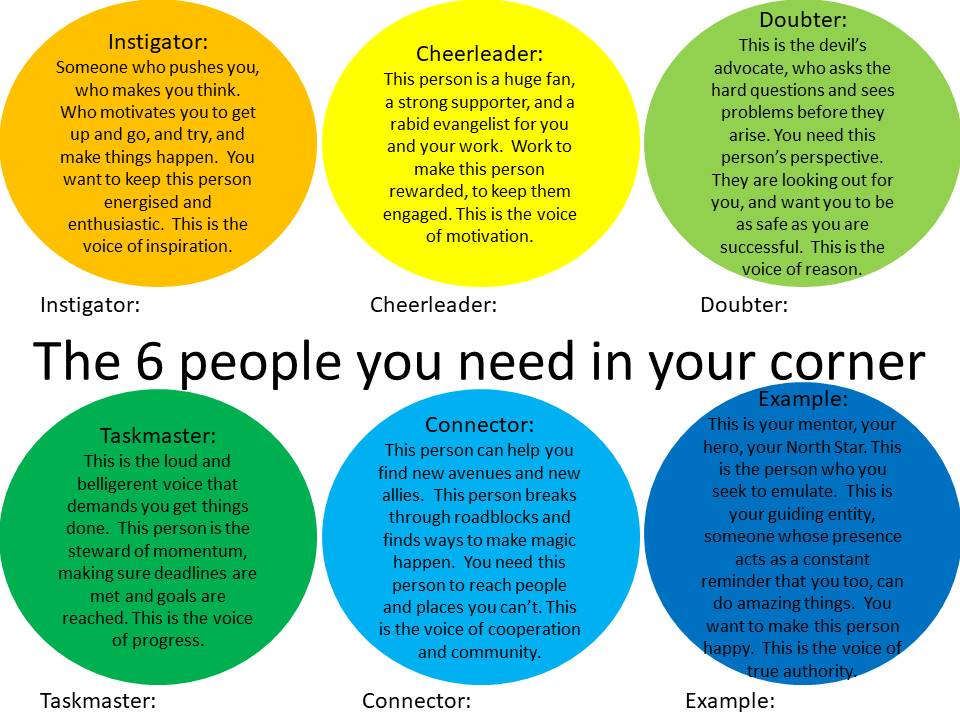
Several years back one thing I picked up, presumably from some talk or online article was the notion of having 6 people in your corner.  Basically, these represented 6 characters that would help and support your leadership journey.  They didn’t all have to be different people, although they could be, or some, or all of them could be the same person.

The 6 characters were:

The Instigator: Someone who pushes you, who makes you think.  Who motivates you to get up and go, and try, and make things happen.  You want to keep this person energised and enthusiastic.  This is the voice of inspiration.

The Cheerleader: This person is a huge fan, a strong supporter, and a rabid evangelist for you and your work.  Work to make this person rewarded, to keep them engaged. This is the voice of motivation.

The Doubter: This is the devil’s advocate, who asks the hard questions and sees problems before they arise. You need this person’s perspective.  They are looking out for you, and want you to be as safe as you are successful.  This is the voice of reason.

The Taskmaster: This is the loud and belligerent voice that demands you get things done.  This person is the steward of momentum, making sure deadlines are met and goals are reached. This is the voice of progress.

The Connector: This person can help you find new avenues and new allies.  This person breaks through roadblocks and finds ways to make magic happen.  You need this person to reach people and places you can’t. This is the voice of cooperation and community.

The Example: This is your mentor, your hero, your North Star. This is the person who you seek to emulate.  This is your guiding entity, someone whose presence acts as a constant reminder that you too, can do amazing things.  You want to make this person happy.  This is the voice of true authority.

Back in about 2009, when I first discovered this, I knew exactly who these people were.  Some of them wore multiple hats for me.  After about 2011 when I’d changed jobs, I really could not pinpoint anyone amongst my work colleagues that fitted any of those roles for me.  Happily, I am once again in the position where I can identify at least one person, even if it’s the same person, for each of those roles.

I’ve just read an article by Anthony Tjan on ideas.TED.com who suggests that we should have 5 mentors:

The Master of Craft: “If you know you want to be the best in your field — whether it’s the greatest editor, football quarterback, entrepreneur — ask, Who are the most iconic figures in that area?” says Tjan. This person can function as your personal Jedi master, someone who’s accumulated their wisdom through years of experience and who can provide insight into your industry and fine-tuning your skills. Turn to this person when you need advice about launching a new initiative or brainstorming where you should work next. “They should help you identify, realize and hone your strengths towards the closest state of perfection as possible,” he says.

The Champion of your cause: This mentor is someone who will talk you up to others, and it’s important to have one of these in your current workplace, says Tjan: “These are people who are advocates and who have your back.” But they’re more than just boosters — often, they can be connectors too, introducing you to useful people in your industry.

The Copilot: Another name for this type: Your best work bud. The copilot is the colleague who can talk you through projects, advise you in navigating the personalities at your company, and listen to you vent over coffee. This kind of mentoring relationship is best when it’s close to equally reciprocal. As Tjan puts it, “you are peers committed to supporting each other, collaborating with each other, and holding each other accountable. And when you have a copilot, both the quality of your work and your engagement level improve.”

The Anchor: his person doesn’t have to work in your industry — in fact, it could be a friend or family member. While your champion supports you to achieve specific career goals, your anchor is a confidante and a sounding board. “We’re all going to hit speed bumps and go through uncertainty in life,” says Tjan. “So we need someone who can give us a psychological lift and help us see light through the cracks during challenging times.” Because the anchor is keeping your overall best interests in mind, they can be particularly insightful when it comes to setting priorities, achieving work-life balance, and not losing sight of your values.

The Reverse Mentor: “When we say the word ‘mentor,’ we often conjure up the image of an older person or teacher,” says Tjan. “But I think the counterpoint is as important.” Pay attention to learning from the people you’re mentoring, even though they may have fewer years in the workplace than you. Speaking from his own experience, Tjan says, “Talking to my mentees gives me the opportunity to collect feedback on my leadership style, engage with the younger generation, and keep my perspectives fresh and relevant.”

They both cover a lot of the same ground but Tjan has some interesting other ideas.  I know who my Champion and Copilot are.  I think I am my own Anchor really.  I’m pretty clued up to my own values and setting personal priorities to achieve a good work-life balance.  I’m not sure who my Master of Craft is at the moment or my Reverse Mentor as I’m fairly disconnected with leading or mentoring anyone at the moment.

Do you know who you’d have in your corner or who are your 5 mentors?

The Instant Gratification Monkey

I was reading an online article from Tim Urban, who studied why procrastinators procrastinate.  He possets that they can’t help it.  In their brain the procrastinator has the Rational Decision Maker who steadily guides the mind in to doing what needs to be done, and then there’s the Instant Gratification Monkey who sideswipes things and sends the mind off wandering for some instant satisfaction for information or other, that takes us away from our steady path.

The Instant Gratification Monkey takes us off to play in what Urban calls the Dark Playground, that space where all the fun, new, shiny things hang out that distract us from what we should be doing. In the back of our minds though is this constant feeling of anxiety or regret for that looming deadline or that thing that we’ve been working towards for ages.  When that deadline approaches though, it’s time for a visit from the Panic Monster who scares us away from the Dark Playground back in to a sense of productivity to get things done.

Urban offers three steps to turn procrastination into motivation:

  1. recognise that you are procrastinating.  Being aware of something is usually the first step in resolving it. 
  2. Understand the reason for the procrastination.  Is it the task itself, or is it you? Is it that you aren’t enjoying it, not qualified for it, or feeling overwhelmed by it?
  3. Set objectives, tactics and rewards.  Depending on the reason for the procrastination in the first place it might be as simple as having a to do list if you’re feeling overwhelmed, or someone that holds you to account, or if you promise yourself a treat if you get that thing done.

There are times that I procrastinate.  It’s not usually because I don’t want to do something, more that I don’t want to do that particular thing right now.  I will send that email out but after I’ve watched this episode of that tv programme I like.  I will write that report just as soon as I’ve finished making lunch.  I will learn how to ring handbells properly, just as soon as I’ve written that report and sent that email.  Sometimes it can become a vicious cycle.

Other days, I can blast through even the most boring, or painful task without so much as a second thought.  It’s about the frame of mind that I’m in.  Sometimes, I find being in a particular place, or with particular people helps galvanise me into action.  Sometimes I just wake up and tell myself that today I’m going to power on through all that stuff and clear my to do list.

Today has definitely been one of the latter type of days.  I’ve finished the first draft of a strategy document.  I’ve documented a framework that I invented that supports that strategy.  I’ve been for a power walk.  I’ve read the next section on learning to ring handbells and had a few goes at it.  My Rational Decision Maker was in charge today.

I wonder if that means tomorrow I’ll be all out of juice and my Instant Gratification Monkey will be running the show.

That was the week (or 2) that was

The end of my 2 weeks annual leave has arrived.  Monday morning sees the return to the office.  Have I had a good holiday?  Do I feel relaxed and rejuvenated?

Yes, I’ve had a good couple of weeks off, considering.  I don’t particularly feel relaxed or rejuvenated thought.  But I suspect that’s to do with the fact that we’re in lockdown and we can’t go anywhere or do anything or see anyone.

If we have been able to do things, I might have felt more energised.  As it was, I spent most of the week not venturing far from home.

The first week I took the opportunity to undertake an online Mindfulness course.  This was quite interesting and useful, but not something that I’ve suddenly found enlightenment from.  It did give me some focus for a few days.

I had 7 virtual #bellringing sessions during the fortnight, some which I ran. I watched a funeral online. I attended 4 meetings and 1 virtual dinner.  In between, I did some reading, played some games on my tablet and celebrated my 50th birthday, lockdown stylee.

I did spend some time, quite purposefully, doing not a lot.  C still did all the housework and cooking. 

This sort of gave me an insight to what life might be like at a time when I could give up paid work completely.  However, if that was the case, things would happen very differently.  I would see a fair distribution of household labour.  I would also probably do some form of exercise, whether down the gym or online stuff at home, or more walking at least.  I would definitely do more baking and cooking.  I do miss that a little bit.

I’ve had a good couple of weeks off and enjoyed not having to get up early and go to an office and get grief all day. I’m sure that feeling will be short lived when I open the office door.

50 Ways to Enjoy Turning Fifty

My sister bought me this book for my birthday last week.  I thought I’d better take more than a cursory look at it.  It claims to have 50 ways to make this the best year EVER.  The book is set out in chapters based on making the most of turning 50, planning the best year EVER, implementing the plan, treating yourself well, having fun, looking back, looking within, expressing gratitude, putting things in order, eliminating what you don’t need, giving and looking forward. 

Each chapter has key questions to help you analyse yourself and figure how to make the most of turning 50, thought experiences to delve a little deeper and activities to do. It does say that you can dip in and out of the book, fast forward to the bits that most interest you and so on but being a pedant, I started at the beginning.  

Way #1 Accept your age. 

Thought experiment 1 asks you to make a list of people you admire who are over fifty and who are living terrific lives and make a note of what you admire about how this person is living their life.  OK, so first thing is to think of people over 50 who I admire.

I’m not going to list them all here because some of them might read this and either be embarrassed or disagree.  I’ve written each of them in the book.  Suffice to say that it includes C, my parents and siblings, a few former work colleagues, and some ringers I know. In some cases, I admire what they have achieved over adversity.  In others I admire what they’re currently doing with their lives, and if I’m honest, I’m probably a bit jealous of.  Some I admire because I wish I were more like them.

The key questions were what are some benefits of turning 50? and What are you looking forward to this year?

I guess benefits might include being that little bit wiser sometimes.  Having more opportunities to reflect on what I want out of life and trying to achieve a better work/life balance. Nearer to retirement age (although still some considerable way to go).  Looking forward to getting to see R again.  This year has been an exception and we haven’t been able to spend time together, so as soon as we can we’ll do that.  Can plan for the trip that we should have had for my 50th birthday.

Thought experiment 2: what concerns do you have about turning fifty?  What challenges are you experiencing or expecting? Which of those can’t you change? What constructive actions can you take regarding that item?

I’m not really bothered about turning 50.  It’s just a number.  I guess ill health, or my level of unfitness is probably going to be an issue at some point.  I’m feeling less tolerant of other people, which I need to reign in a bit sometimes and there are other things that I’d rather be doing with my time but have to work instead. I can’t change that for a few more years yet unless something amazing comes up, like winning the lottery.