Transferable Skills

When I talk to members of my team, particularly when they are considering alternative roles, they often tell me that “I can’t do that”. I then take them, line by line, through the job description and ask them why they think they can’t do it.

One person told me once that they weren’t very organised. She was a mother of 3 school age children, a wife, had a full time job and all the family pursuits that go with kids. I asked her to think about how she cooked dinner in the evening. She said that she’d think about what to cook before leaving for work in the morning, when she got home, she’d get everything out of the fridge, put it in the pot/pan, then check in with the kids and their homework, then finish tickling the pot/pan and dish up. I asked how she managed all that to which she replied that it had to be planned and organised. Lightbulb 💡 moment. That means she could organise. Its a transferable skill.

The Psychologies Magazine suggests when you’re thinking about a new career, that by doing a skills audit you can determine if there are any core competencies that need working on. Things to think about are communications, research planning interpersonal and HR, positive attributes, management, leadership and decision making, financial management and critical thinking.

The article also noted that you only need 70% of the skills listed on a job spec to apply for it. Then, once you’ve thought about what skills you have, and worked out what you need and why, the next step is to marry up your skills with your values.

I’m going to conduct the skills audit just to find out where my shortcomings are, and focus on “pivoting a new future“.
My new set up

Our back room has been a bit of a tip for quite some time. It used to be step daughter #1’s bedroom. We eventually moved the main PC down and created a one person workspace.

Over time both of us has needed workspace and have had to take it in turns on the main PC or one person on a laptop in the lounge. That’s OK for short meetings and quick pieces of work, but not conducive to longer periods of time when we’ve both wanted to get on with something.

With the Covid-19 situation suggesting that people should work from home if they could, there just wouldn’t be a sensible place for me to do that. I also want a place to put all my #bellringing workbooks etc. And I could be on an evening conference meeting and C could still use the main PC for whatever he wanted to get on with.

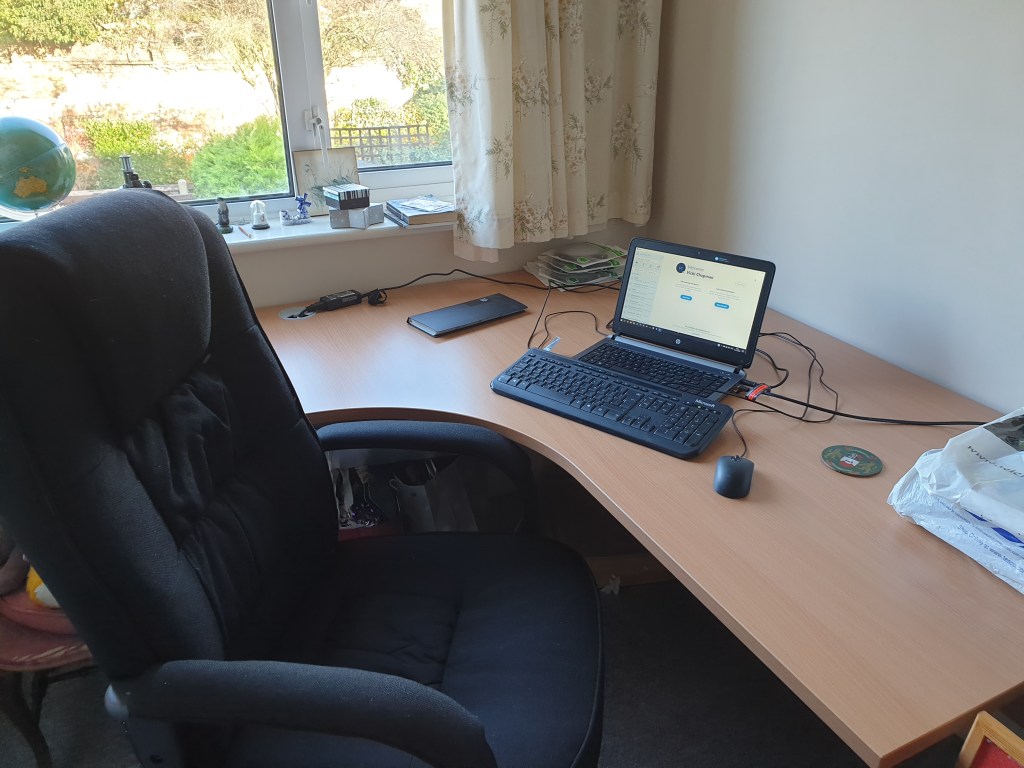
We finally agreed that I should have my own desk space so purchased desk and chair, and set about tidying up the junk.

This weekend has seen a couple of trips to the tip and a lot of sorting of boxes and files, but finally created enough space to get the desk installed. I now have my own workspace and comfy chair. I’m actually quite looking forward to doing some work from here.

I also get the window seat, so can watch the birds come and go and gaze out of the window. I mean, concentrate really hard.

We did a thing

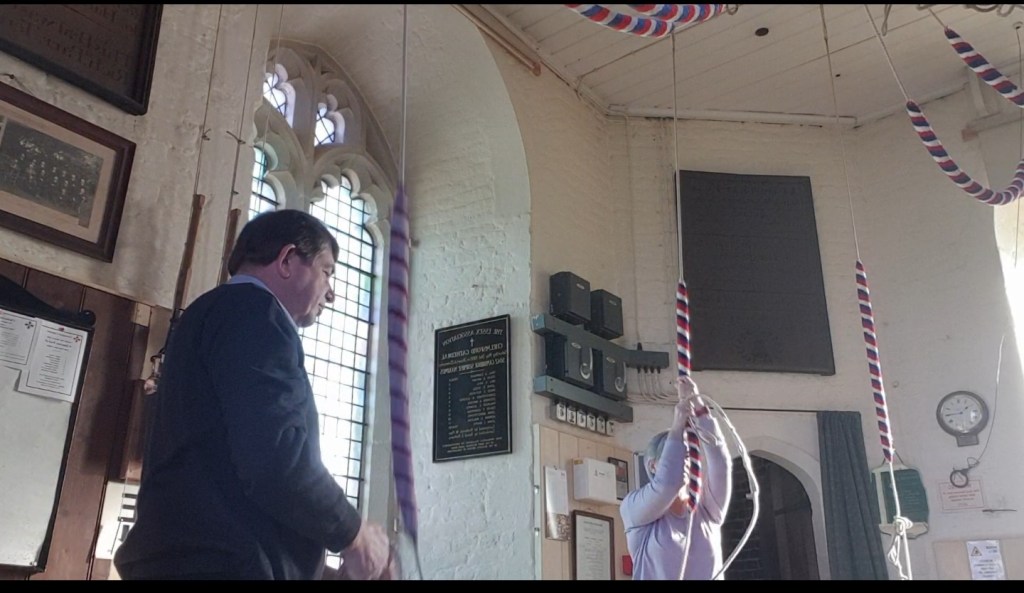
When lockdown #1 began back in March, #bellringing, like so many other things was put on hold. Fortunately, some very clever people thought up RingingRoom, an online virtual belfry that enabled groups of people, from anywhere in the world, to join together to practice.

For a while I wasn’t particularly interested in it, thinking it was a bit too techy for me to get the hang of. But as time went on, and there seemed to be no return to the usual rhythm of practice nights, meetings, quarter peals and peals, I decided to have a closer look.

From some time in May, I invited a small group of my siblings (the ones that ring), my hubby, and some friends, to a regular Thursday evening virtual #bellringing session. Each week we’d try to get the hang of ringing using a keyboard instead of a rope, and learn a different set of visual clues.

One of my siblings has always had it in her head that should could never get the hang of ringing Cambridge Surprise Minor. She had, in the dim and distant past, rung it and even scored a quarter peal of it, but it had never stuck and she rarely had the opportunity to try. I therefore made it an early mission of this group to get her to be ringing it without fuss.

We took a circuitous route, using different methods to introduce different parts of the work and build up gradually. In the meantime, she had also put out a request for anyone else to help her, during her own organised sessions, with extra practice during the daytime.

With this additional help, it wasn’t long before she’d got a plain course sorted and was trying touches. Then someone suggested going for a quarter peal attempt. There were a couple of failed attempts, either technology failures, or brain failures. She eventually changed her day time sessions to a Friday so that I could join in too on my day off.

On our Thursday evening sessions, we have moved on from Cambridge to Ipswich, Primrose and now Norwich. From someone who didn’t think she could ring Surprise Minor methods, she’s now got several under her belt.

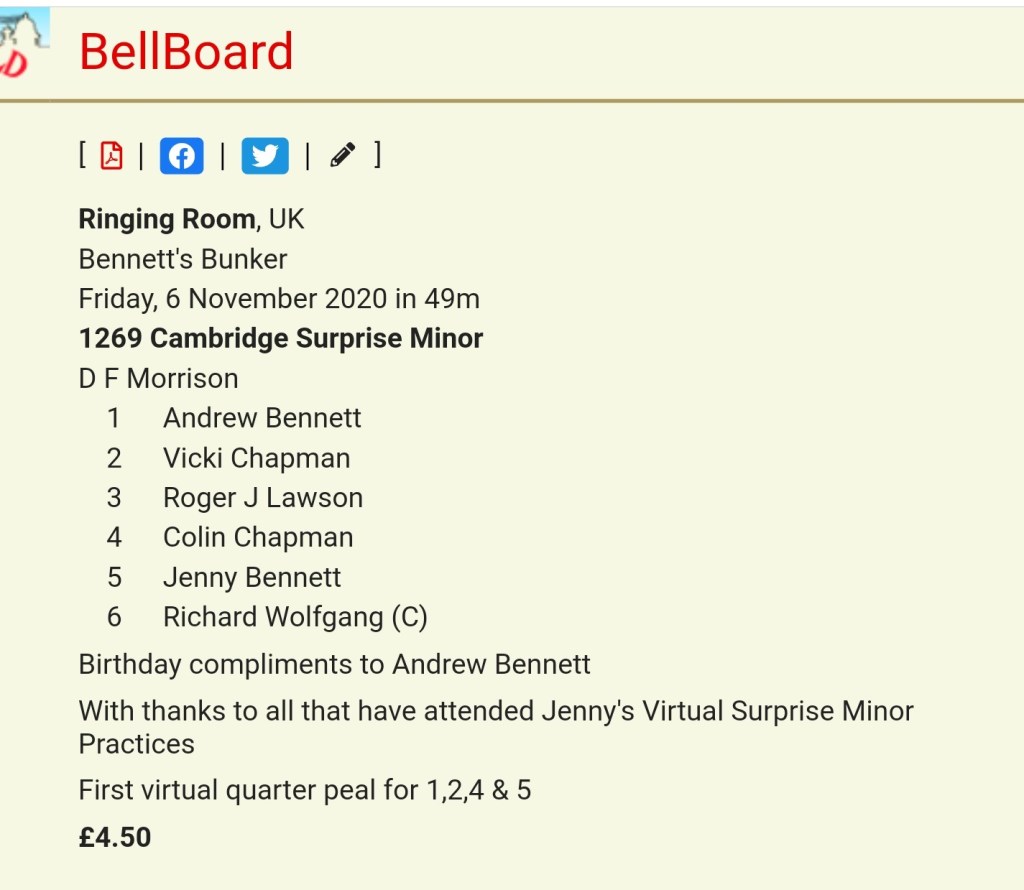
It so happened that her hubby had the week off work and it was his birthday on Friday so the suggestion was to try for a quarter peal of Cambridge again. With some trepidation 6 of us gathered, from the comfort of our respective homes and started ringing. It was going very well. Only a few clips here and there but nothing o worry about. There was quite a hiccup quite near the end, but we all stuck with it and managed to come out of it in the right order.

After 49 minutes, a very reasonable quarter peal of Cambridge Surprise Minor was scored. As you might imagine she was really chuffed. Everyone was really pleased to have scored it, especially as a birthday compliment to her hubby too.

Another #bellringing milestone ticked.

Time to Ramp Things Up

On Thursday evenings I run a RingingRoom virtual #bellringing session with a small group made up of family and friends. We’ve been doing this since about May, in leiu of actual bellringing in a tower on real bells.

Over the months we’ve been building up our repertoire of methods having started off ringing various Minor methods like Double Oxford, Buxton and Pinehurst before moving on to Surprise Minor methods, Cambridge, Primrose, Ipswich and Bourne.

For some of the group, including myself, it’s the first time that we’ve rung some of these methods so it has been a massive achievement for the group.

Some weeks are better than others. Sometimes the technology is a bit flaky and let’s the rhythm down and sometimes one or more of us isn’t quite on top form. The point is that we stick with it. Each week we have a core 8 or 9 people, so each touch requires one or more person to sit out. But that’s just what it would be like in a real tower anyway. We spend about an hour or so ringing and I use a simple matrix (pictured) to try to make sure that everyone gets a fair go, and gets to try the method from every bell.

Now we’re more proficient at ringing some Surprise Minor methods, I asked everyone how they wanted to proceed. The options were to either a) stick with Surprise Minor and work our way through some of those methods, b) to move on to ringing Major methods, starting with something basic to help us get into an 8 bell rhythm, or c) to go for a combination of both, to add some variety, but that might mean sometimes learning 2 methods at the same time for some people. I want everyone to feel that they get something out of it, enjoy it, but not to feel pressured too much that they spend all week stressing over it.

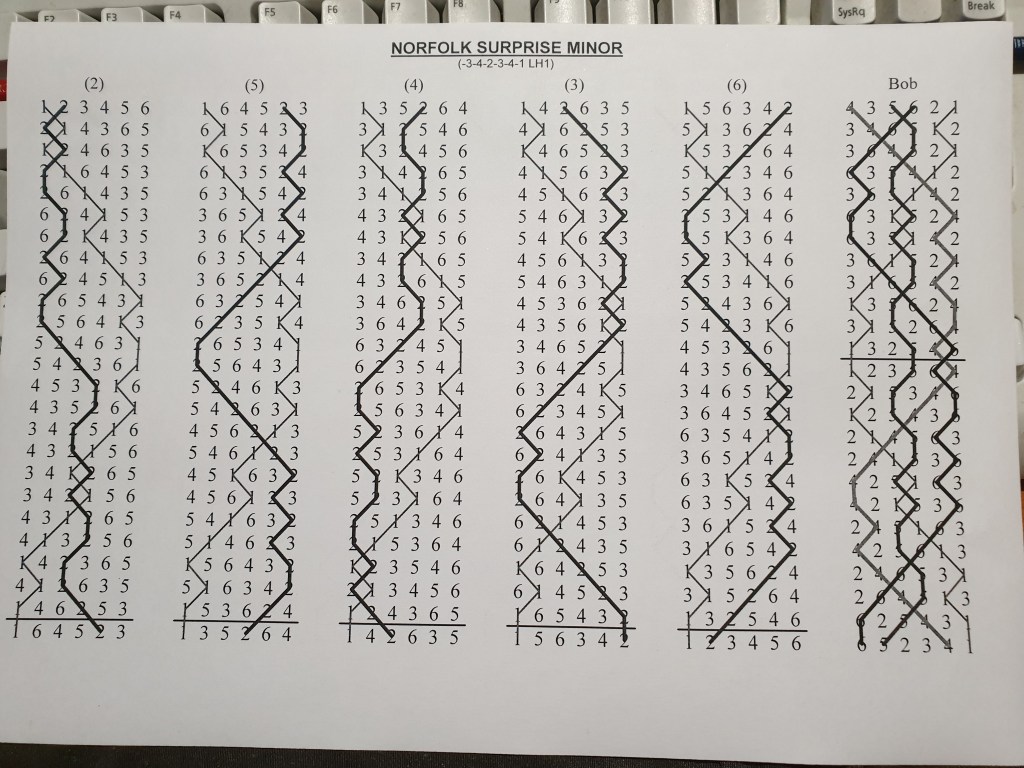
The resounding result was to try a combination of both. We then agreed that the 2 methods should be “methods of the month” so we spend every week in the month consolidating those 2 methods before moving on. So for November our methods of the month will be Norwich Surprise Minor and Little Bob Major. Hopefully we’ll be able to give everyone good go at both of those throughout the evenings.

And after an intensive ringing session, we all head down the virtual pub for a good natter to catch up with what everyone’s been up to. Just like a real ringing session but without leaving the comfort of home.

Thank goodness for the advent of RingingRoom and Zoom.

The Week Ahead

I turned the page in my diary to look at the week ahead. Its going to be a busy one.

I have the day job of course, 9.5 hour days Monday to Thursday. Then when I get home, apart from Monday evening, I have Zoom meetings or Ringing Room sessions every evening.

Tuesday a workgroup meeting, Wednesday an executive meeting, Thursday a RingingRoom #bellringing session, Friday a RingingRoom session, a joint workgroup discussion and a different workgroup meeting. Then Saturday a day off.

Its just one of those weeks when everything happens all at once. Thankfully not every week is like this.

Keeping busy is a great way to keep hopeful and motivated. Having something to occupy our time gives us something to talk about, something to learn from, something to share with others.

I know myself when I keep busy, I’m more motivated, have increased energy, more productive, more creative, more alert and more positive. When I have less to do, I get easily distracted by nothingness and lose focus, then just sit on the sofa playing games on my tablet.

Having said all that, of course it is good to have some down time, to relax and recharge. I have a week off work the following week which I’m looking forward to.

Brain drain

The brain apparently has the capacity for storage similar to that of an ipod or USB drive, but the way neurons connect many memories at a time, this capacity is exponentially increased. Why is it then, my ability to learn and retain a new #bellringing method is nanoseconds?

Learning new things is good for the brain. The younger the brain, the more space it has for new memory storage. As we get older it takes a bit longer and things become easier to forget quicker.

One way to learn is repetitive practice. It is suggested by some that spacing repetition over several weeks or months will have better longer term retention. There are tips and tricks on how to remember things more easily, if you can remember what they are in the first place. Exercice to clear your head. I don’t need exercise to clear my head, its pretty clear most of the time 🤣 Write down what needs to be remembered over and over again, just remember where you’d written it. Relate new things to what you already know, use some brain training app or game to sharpen your focus.

Lots of uber clever ringers remember methods as what the work is above and below where the treble is, or by thinking of it as a different method with bits added or chopped out.

Every time I need to learn a new method, I spend a while staring at the blue line, the pattern of the work. I sometimes even write it out a few times. Then I’ll have a go of ringing it on the simulator and do that over and over again.

Mt trouble is that I’m not very good at retaining it, so if I don’t then ring it for real very soon after learning it, I’ll forget it. I can also instantly forget it after I’ve rung it once and then have to learn it all over again for next time. And, when I learn it again, I have very little recollection of having rung it before, its like its completely new all over again.

I’m glad I get the opportunity to learn new methods and extend my repertoire, even if only temporarily. Apparently learning new things improves brain chemistry, increases learning speed, helps make connections between skill areas, makes you more interesting (😉) fights boredom and may help stave off dementia.