A plea for Pudsey

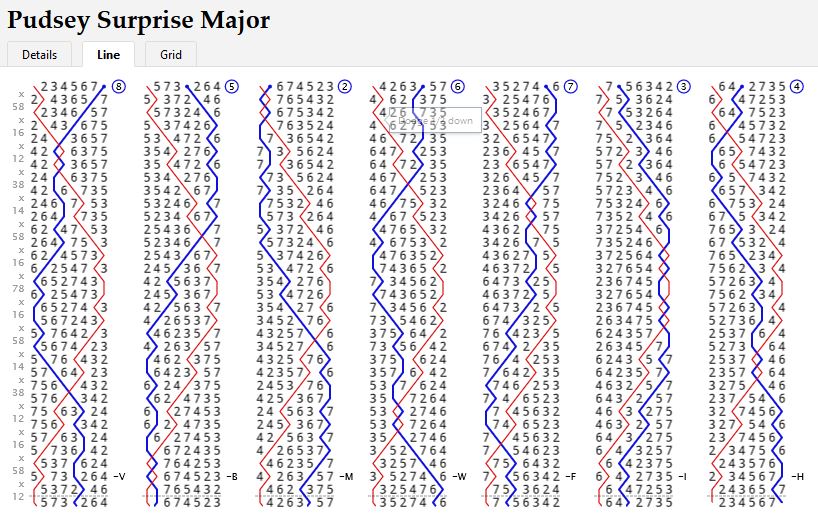
No, I don’t mean that loveable, cute, one-eyed bear synonymous with raising millions for childrens’ charities.  I mean the Surprise Major version.

For some reason this method of the Surprise Major Standard Eight gets a bad wrap.  It’s probably the least popular of the standard eight methods.  Possibly because its less musical than most of the others.  However, I quite like it.  It’s easy enough to learn.

All the places are Yorkshire places.  2nds and 5ths place bells are the same as Cambridge except the double and single/single and double dodges at the back are the other way around.  3rds place bell is similar to Cambridge but starts and ends with a dodge in 3/4 and only has one dodge at the back either side of working with the Treble.  All the work at the back otherwise is double and single or single and double with the double always coming nearest the 5/6 places.

I have rung two quarters of Pudsey Surprise Major inside and one of Pudsey Surprise Royal on the Treble, and one peal of Major inside. I’m hoping that come Sunday, it’ll be two peals.

The idea that the Standard Eight gets usurped by the Core Seven leaves Pudsey out in the cold, along with Rutland and Lincolnshire.  A bit like Pluto being demoted from a planet to a dwarf planet, not being able to exert its own orbit dominance, Pudsey may become consigned to the list of long forgotten methods that only get rung when someone is collecting the alphabet and wants an easy win.

For me, learning Pudsey was a whole lot easier than learning Superlative, which has survived the move to the Core Seven, and Cornwall and Lessness have found their way in. There are staunch supporters of the Core Seven just as there are stoic evangelists of the Standard Eight. Can’t we combine them into the Terrific Ten?

I guess it depends on where you start from.  If you came from the school of learning Kent before Cambridge or Oxford before Norwich, then Cornwall.  Unless you were like me and went straight from Plain Bob to Cambridge so didn’t have all those steppingstones along the way.

There doesn’t seem to be a linear learning route once you start into the world of Surprise methods. Cambridge is an obvious starting point as so many other methods seem to use elements of it, but then it seems to be potluck based on your local circumstances.  The Ringing World started developing various pathways and introduced the Little Purple Ringing Book that attempts to progress you through ringing simple surprise minor methods.  It made me chuckle when I read “First and foremost, don’t try to jump straight from Plain Bob and Grandsire to Cambridge”. That’s exactly what I did. 

So, I’d put a plea out for Pudsey.  Don’t give it such a hard time just because it’s been relegated to a dwarf method!

Coursing through the veins

Image by Jeon Sang-O from Pixabay

As you know, I’ve been #bellringing for 40 years now, almost exactly to the day.  I class myself as a middle of the road ringer.  There are methods that I know well, there are those I have to learn every time I ring them and methods I stress over learning because I think I can’t.  I have called a few quarter peals of Plain Bob Doubles and only a handful of touches of Plain Bob Minor or Grandsire Doubles with someone stood behind me, digging me in the leg to prompt me to shout “Bob”!  However, I certainly would not call myself a conductor at any stretch of the imagination.

So, the idea of calling and conducting is something that every now and then I think I ought to do more of, understand more about and push to be allowed to do it. 

One of our local ringers asked me the other week if there were any books on Coursing Order.  Not to my knowledge specifically about that subject although I’m sure that it’s covered in many other books on calling and conducting.  What I did manage to find were two articles from the Ringing World in about 1999 in the Learning Curve series on Conducting and Coursing Order.

The first article discusses the basic concept of understanding what coursing is, one bell following the path of another from front to back and back again.  Keeping an eye on the coursing order is what helps conductors check on whether the ringing is still correct, particularly after a call is made, or there’s a bit of a fire up. 

The way coursing orders are written is confusing it its own right.  It’s written with the Tenor last but omitted and on higher numbers the coursing order of the back bells often (but not always) doesn’t change, so that’s omitted too. Whilst ringing the idea is to work out the part of the coursing order that changes and rely on knowing the order of the fixed bells.  Coursing order applies to the whole course and therefore you can use it at any point to check the ringing is still right.

By putting a call in, it changes the coursing order, that the clever amongst us could work out in their heads as they go along. Using coursing orders can help check whether the ringing is correct, help others who go wrong and help the conductor work out where to put the calls.

If you are a very clever person you may want to call quarters or peals.  My efforts thus far have been to put the Bobs in.  I can’t put people right if they go wrong and if I called a Bob in the wrong place, I wouldn’t know how to correct it.  Still, those who do manage it look at coursing orders as part of the composition of what they are conducting.  They write it out using a grid with the calling positions across the top then as each course progresses and a call is made, they write the new coursing order under the calling position.  I’ve seen C do this a million times.  It’s like gobbledegook for the likes of me. 

If I sat down long enough with a piece of paper and the right frame of mind, I could probably work it out for a simple method like Plain Bob. For now I’ll let the clever sticks deal with it.

Growing older disgracefully

Image by Thangphan from Pixabay

I was reading an article in Platinum magazine about what various ladies thought about cosmetic procedures or “tweakments” to give your body or face a refresh.  It quoted the story of former ‘90’s supermodel Linda Evangelista, who was in a legal battle following a botched treatment that she claims has cost her her livelihood as well as leaving her with depression and self-loathing.  All in the name of beauty.

One expert claimed that the largest group getting fillers are mid-lifers; aged between 35-55 in order to iron out the odd wrinkle or a bit of skin smoothing. Many celebrities certainly feel the pressure to stay looking younger and end up with botox and hair extensions.  Society seems to be putting that pressure on women more so than men.  But who is “society”?  Surely women in those older age groups are “society”, so are they perpetuating a self-fulfilling prophecy? If they all took a stand and said no, surely there wouldn’t be this desperate need to stay looking young, because “society” would accept them for who they are.

Of course, the vast majority of us can’t afford all this time, effort and work required.  Look at Madonna. She’s over 60 and has a punishing fitness regime, goodness only knows how much work she’s had done and still uses filters on her social media.  Luckily people like Andy McDowell and Dame Helen Mirren openly embrace their older face and hair and are now being more recognised in ad campaigns. 

I used to dye my hair.  I started going grey in my mid-thirties.  I’d either keep it close to my natural colour or go with a slight burgundy tint.  I never paid out for salon colouring but got a home kit, which worked just as well.  The only problem is my hair grows really quickly and I’d have to redo it every 4-6 weeks.  I didn’t always have the time to keep colouring it, so it could go months between sessions, and I’d end up with a massive greying streak down the middle.  Eventually I decided to give up.  I’d let my hair grow down to almost the middle of my back, then one day went to the hairdressers and had it all chopped short, taking all the bottled colour with it.  From that moment I have embraced they grey.  People pay good money to have grey colouring these days!

I have no inclination to consider fillers, lifts and tucks, although I do wish my 24 year old “mum tum” could disappear, I don’t think I’d resort to surgery.

I live in apart of the UK known for its over baked fake tans, false nails, hair extensions, veneered teeth and dodgy drawn on eyebrows.  Why on earth do people feel like they can’t be natural, look natural, feel natural?  It’s a heck of a lot cheaper.  I get wound up by people who say they can’t afford things yet, they have perfectly manicured nails and brows and more spray on than a contestant on Strictly.  Why do they feel they all have to look the same? What happened to individuality?

Ageing is a natural part of life.  The more we perpetuate unacceptance of it, the more we are lining the pockets of those who take advantage of the vulnerable.  People wouldn’t feel so vulnerable if we didn’t make such a big deal over it.

I intent to grow old disgracefully. Now’t fake about me.

Mind Cards – a daily dose of mindfulness

I received a belated Christmas present at the weekend; the order had been delayed and therefore hadn’t arrived when I last met up with the giver. 

The gift was a box of Mind Cards. These cards are designed to help you become more mindful of your thoughts and feelings, giving you the tools needed to focus on the present at and spread positivity and self-care throughout your life.

By introducing positive habits into your everyday routine, the Mind Cards will help you create the happiest and healthiest life for you.

They are a set of 45 cards split into five categories: ritual; journal; kindness; gratitude and reflections, offering a different task for the day to set you on track to a more fulfilling and present way of life.

The instructions were to shuffle the deck, combining the five categories.  Each day select a card at random and take the action stated on the card.  When a journal or reflections card is chosen, take the time to acknowledge how the quote or quotations applies to your life in the present moment.  Keep the answers in a notebook or journal to allow yourself to reflect on how your responses change over time.

So, I have shuffled the deck and my first card says to take 10 undistracted minutes to answer the following question in your journal with regard to your life in this present moment: “What is your life motto”?

At the present time my life motto revolves around my desire for self-growth and self-awareness, developing a more elegant and feminine outlook and making financial plans for the next five years to work towards early retirement.  Trying to distil that into one phrase that encapsulates all of it the only phrase I can think of is “Building Better”: building a better me, building a better financial situation, building better opportunities, building a better future.  That’s not to say that I am not good enough, or I don’t have financial security or opportunities, but that I have space to grow in all those areas. 

I am working my way through self-growth and awareness, as you already know.  I have enough financial security to retire now if I wanted to, but there’s no harm in putting some more aside now whilst I can, to ensure that in five years’ time, I can retire more comfortably, considering I am still a long time off being able to collect state pensions, and even some of the work-based pensions.  It might be prudent to consolidate some of the pension pots I have and make additional voluntary contributions whilst I have some spare funds at the of each month. But I don’t want to tie my finances up so tightly that I can enjoy spending now. I want to enjoy holidays, the luxury of having my own car, the opportunities to attend events that I want to and buy the things I think will support my elegance and femininity development. 

What would your lift motto be and why?

When life gives you lemons

Sometimes life with throw you a curve ball.  A set back on reaching your potential, or your goals.  But a slight shift in mindset could be all it takes to find and keep resilience to persevere and bounce back.

In an article in Red magazine the offer four healthy habits for a physiological response to stress for your bond and mind.

Basically, resilience is the ability to pick yourself up and dust yourself off relatively quickly after a trauma, setback or everyday disappointment.  Some people seem to be more resilient than others but its not genetic and not something we are taught.  Resilience is a set of coping mechanisms that develop over time and determined, in part, by how we take care of ourselves, the people we have around us and what we do to find purpose and meaning in our every day lives.

According to the article roughly 40% of our overall happiness is derived from our own actions, and resilience is a part of that. Obviously its one thing to bounce back from broken washing machine, and quite another to try to find happiness again after the loss of a loved one.

The techniques are the same though no matter what you’re dealing with.  Here are the four healthy habits for building resilience:

  1. Rest and recharge – when we sleep our brain sorts and files our thoughts and experiences of the day away, giving you a fresh perspective to allow you to problem solve.  Sleep can bolster your immunity, and its easier to pull yourself together emotionally when you’re not feeling run down or sick. 
  2. Move your body – the recommended daily dose of exercise is 30 minutes a day in order to trigger the feelgood endorphins that quiets negative thinking.  Regular exercise can also help boost your mood and supports the treatment of depression, helping to maintain a positive outlook.
  3. Just breathe – meditation can be a simple as focussing on something for a few minutes, like your breath or a calming word or phrase.  Practicing meditation regularly may shrink the area of the brain associated with emotional processes, reducing stress and anxiety, and can even change electrical activity in the brain, making you more alert and calm.
  4. Eat enough – your body needs sustenance.  When food is scarce your body will divert what energy stores it has to the essential organs, leaving the brain hungry.  The brain needs at least 20% of your calory intake to be able to problem solve effectively.

I don’t have a problem resting and recharging, I can fall asleep anywhere, anytime.  Whether its quality sleep though is a different matter.  I find I’m waking up during the night more often these days, but that’s probably partly to do with the fact I fell asleep at 9pm on the sofa, and partly because I’m a woman of a certain age.

I try to get in a 20-30 minute walk every day if I can.  I don’t always feel better for it but make myself do it anyway if I get the opportunity. 

I’m not a fan of meditation.  I’ve tried it many times in many different forms but my mind has too much going on in it and I can never settle.  And when I do start to feel myself settle, I start thinking of all the things I should be doing instead. 

Eating enough has never been an issue.  But its about getting better at what I eat, not how much or how often.  Last year I started to introduce some fruit into my diet, being a life-long fruit hater.  I now regularly have grapefruit and blueberries with my breakfast.  I often have an apple at lunchtime, and when softer fruits are in season I’ll have strawberries, raspberries and some others too.  But I do still like cake, biscuits, bacon sandwiches and all the naughty stuff too.  So if I’ve eaten a lot and my brain needs 20% of those calories, no wonder I can sometimes be a fat head!

Are you paying attention?

According to Carol Stewart, author and podcast host of Quietly Visible, humans now have less of an attention span than goldfish. She reported that in one study they found the human attention span has diminished from 12 seconds in 2000, to 8 seconds in 2018.  I wonder how much further that has changed during two years of lockdowns and reduced opportunities.

Its no wonder then constant distractions that provide instant gratification and dopamine hits is having a negative impact on our ability and motivation towards longer term goals. So, what can we do to delay gratification in order to give ourselves a conducive environment for actively striving for our goals?

We’ve learned before that sustainable change doesn’t happen overnight.  There is a need to undo decades of ingrained thoughts, feelings and behaviours, which seems uncomfortable at best, and nigh on impossible at worst. We often want immediate results and when we don’t see them quickly enough, we give up.

We can be tempted to a quick fix in order to paint over the cracks of whatever problem we have, and whilst we see an immediate difference, it is often only temporary.  With our waning attention span, delaying gratification in pursuit of our longer-term goals, can seem boring; even when we know achieving those goals would have far greater benefit.

On her podcast CS advised that many people have seen their plans fail, especially over the last couple of years, because they can’t see the point in making long term goals.  They may have lost their jobs, or loved ones, circumstances have changed at the drop of the hat, so what’s the point when there’s still so much uncertainty ahead? However, we are goal orientated in nature and there are so many things still within our control, that can give our lives meaning and purpose.

The late psychologist, Dr Shane Lopez said “Hope is the belief that the future will be better than the present, coupled with the belief that you have the power to make it so”.

To be hopeful about the future we need to put effort into making things happen.  Think about setting intrinsically motivating goals, and what is in your control, as these are more likely to be achieved. Make your goals meaning and how they fit with your personal values.

Setting short term goals may give you a better sense of accomplishment but remember even setting long term goals doesn’t mean they are set in stone.  Things change or get in the way.  Having a strategy to support you achieving your goals is useful.  What do you need?  Break down what needs to be done in small steps so that you don’t feel overwhelmed by one big, long goal.  Get accountability from others to keep you on track.

Reward yourself for your efforts along the way, acknowledging the effort you’re putting in and the actions you are taking.  This will be more motivating and encouraging.

Also, think about those things that will drain your energy and distract you from achieving your goals. Keep a check on how you are mentally, physically and emotionally. Look at what you can do to influence change to remove those energy draining influences. If there is something that gets in the way of achieving your goal, make a detour.  Acknowledge that sometimes you might have to abandon your goal.  Its ok to accept if things in the way are totally insurmountable.

1 Question to ask when you’re in the in-between

Image by John Hain from Pixabay

The in-between is where your identity has not yet caught up with your reality you’ve created.  To keep up you need to continually back and forth where you identity shifts a little bit then you shift and create results but someone in us is the old identity so we take a few steps back into the familiar.  This can be associated to any kind of change: financially, personal growth, weight, whatever.  To achieve success at it you need to practice new thoughts and feelings about creating new ways. You need to become that person on the inside in order to become that person on the outside.

Podcast fave Tonya Leigh suggested this doesn’t happen overnight and we’re often in a hurry to make want those changes overnight.  It takes practice and sometimes years before you finally get to the point where its integrated enough and its now just who you are.

We self-sabotage by running through those doubting questions in our heads “what if it’s too good to be true?”, “what if I can’t keep this up”? “who do you think you are”? “Its too hard”, “you look silly”.  You need to be so committed to your change to be able to keep moving through those doubts if you want to continue to grow and evolve and see what you’re capable of. The pay-off is this awkward in-between stage.

The hardest part of the in-between is the discomfort of letting go of an old identity. TL suggested imagining you have two lines, one above the other, you are at the bottom line right now, but as you start to go towards to top line there’s a space in between. The closer you get to the new identity the more uncomfortable it gets and the tendency is to want to revert to what’s familiar. Muster up the courage to keep going towards that top line.  The question that TL poses to people in that in-between space is:

“What would my most expansive self do right now?”

If you want to continue to grow and evolve it will require that you stop contracting your energy.  When you’re in the in-between you’ll experience periods of both growth and contraction but when you feel yourself contracting ask yourself that question.

Go to the place of where you want to be and practice being that person, expansive version of yourself.  If you think something long enough and feel something often enough and do things to reinforce it eventually that will become your new norm; that upper line TL talked about. You get good at what you practice most.

What do you want to get good at and are you practicing it?  Are you willing to wade through the in-between of letting go of old identities and practicing the new ones to the point where it becomes normal.

Know that when you’re feeling awkward and have those two voices battling it out over whether you’re being a fraud or whether you’ve got this and to keep going, remember you get to choose which one to listen to.

Know that this in-between feeling is a normal part of the process.  Nothing has gone wrong when you’re having a sort of identity crisis, it is part of the process of change.  Be courageous enough to walk through it.

If you do just one thing…

We don’t all have the energy, capacity or resources to make transformative changes in our lives, but we can take little steps forward.  In February’s Red magazine Bella Evennett-Watts asked a number of different people to suggest small changes that could lead to long-lasting impact.  Here goes:

  1. Become a better listener – by resisting your own urges to give advice or suggestions
  2. Send “thinking of you” texts to future proof your friendships
  3. Boost your self-esteem by keeping a positivity journal
  4. Gift your partner with information to solidify your relationship
  5. Achieve Fen Shui while working from home by getting the lighting right
  6. Listen to your own advice to feel happier more often
  7. Make people listen by writing down your purpose with confidence and clarity
  8. Help yourself heal from heartbreak by looking forward
  9. Reduce your impact on the environment by investing in reusables
  10. Challenge your social awkwardness by being curious
  11. Stop blaming yourself by remembering you’re not always responsible for others’ behaviour
  12. Get better at public speaking by smiling
  13. Improve your relationship with alcohol by taking small breaks from it
  14. Choose hope over despair to build a better future
  15. Improve your relationship with the online world by slowly letting go of urgency
  16. Make a to-do list to improve your work-life balance
  17. Stop people pleasing by questioning your guilt
  18. Leave a book for a stranger in a microlibrary, waiting room or coffee shop
  19. Walk a dog, even if you don’t have one volunteer at the local dog shelter
  20. Befriend someone by using Age UK’s befriending service and sign up to visit an older person
  21. Do a two-minute clean up in your neighbourhood
  22. Become a mentor and make a difference in someone else’s life
  23. Save lives by giving blood
  24. Try translating if you speak another language
  25. Give away your old bike to the Bike Project
  26. Make someone grieving for a lost pet feel less alone by supporting the Blue Cross Pet Bereavement Support Service
  27. Get knitting for disadvantaged people
  28. Be a cheerleader and offer encouragement at the next local marathon
  29. Make a difference from your phone, check out apps that help spread goodwill
  30. Share an extra portion with a neighbour or homeless person
  31. Pass on a loved teddy bear to a children’s home
  32. Facetime a blind person to help them check out expiry dates or navigate new surroundings
  33. Search for anything to help plant trees around the world
  34. Perform a small act of kindness, ideas from the BeKind app
  35. Buy secondhand furniture to reduce wastage

What other small steps could you take?

50 endangered sayings showing a sign of the times

Apparently, dozens of sayings are at risk of dying out, according to Daniel Capurro, and a survey of 2,000 18–50-year-olds. Asked if they had used specific phrases such as “nail your colours to the mast” 71% said they had never used it.  Can’t say as I ever have either. Some of the phrases originate from the Bible or Shakespeare, or Dickens. 51% said they had never used “see a man about a dog” or “as snug as a bug in a rug”.  I have used those before.

As our language constantly evolves, phrases come in and out of fashion and it was interesting to note that 73% of those surveyed said they thought it would be a shame if those phrases did die out.  But if they are not using them, that seems the only inevitable conclusion, doesn’t it?

So, here’s the list of 50 phrases on the endangered list, with the percentage of survey participants who never use it:

  1. Pearls before swine 78%
  2. Nail your colours to the mast 71%
  3. Colder than a witch’s t– 71%
  4. Pip pip 70%
  5. Know your onions 68%
  6. A nod is as good as a wink 66%
  7. A stitch in time saves nine 64%
  8. Ready for the knackers yard 62%
  9. I’ve dropped a clanger 60%
  10. A fly in the ointment 59%
  11. Keen as mustard 58%
  12. A flash in the pan 57%
  13. Tickety boo 57%
  14. A load of codswallop 56%
  15. A curtain twitcher 56%
  16. Knickers in a twist 56%
  17. Dead as a doornail 55%
  18. A dog’s dinner 55%
  19. It’s chock a block 55%
  20. Storm in a teacup 55%
  21. Could not organise a p— up in a brewery 54%
  22. Not enough room to swing a cat 54%
  23. Flogging a dead horse 54%
  24. Toe the line 54%
  25. Popped her clogs 54%
  26. Drop them a line 53%
  27. Steal my thunder 53%
  28. A few sandwiches short of a picnic 53%
  29. A legend in one’s own lifetime 52%
  30. Be there or be square 52%
  31. Fell off the back of a lorry 52%
  32. A bodge job 52%
  33. Eat humble pie 52%
  34. Having a chinwag 52%
  35. Put a sock in it 52%
  36. Mad as a Hatter 51%
  37. Spend a penny 51%
  38. Cool as a cucumber 51%
  39. It’s gone pear shaped 51%
  40. It cost a bomb 51%
  41. Raining cats and dogs 51%
  42. See a man about a dog 51%
  43. It takes the biscuit 50%
  44. He’s a good egg 50%
  45. Snug as a bug in a rug 49%
  46. Chuffed to bits 49%
  47. Have a gander 49%
  48. Selling like hot cakes 49%
  49. Pardon my French 48%
  50. A Turn up for the books 45%

I think I’ve used all of them except the first six.  Which ones do you still use and what other phrases do you use that are dying out?

Questioning, not second guessing

Image by mohamed Hassan from Pixabay

I have been reading lots lately around the subject of values and beliefs, as well as self-confidence and personal growth.  When I start to consider what my values and beliefs are and whether I am becoming more confidence and growing as a person, I am doing it from an inquiring mind perspective, not trying to second guess.  I want to be able to evaluate my status and objectives, and what I need to do to meet them.

Abby Perkins offered five questions to ask ourselves to help evaluate where we are and where we want to be:

  1. Am I in the right job? – if you’re not passionate about what you do, you’ll be less motivated to overcome barriers and obstacles that life throws your way.  It’s important to regularly check in with yourself and your motivation bucket. If you feel yourself waning or burning out something might need to change in order to give you that clear mind and passionate drive to succeed.
  2. Am I learning from my mistakes? – failure is completely normal.  Its what we do with it that counts.  The important thing is to learn from your failures to avoid making them again. Take time to evaluate what went wrong, what needs to change, and how you could prevent it in the future.
  3. Am I consistently pushing my boundaries? – creating new, more audacious goals and attempting to reach them will help keep your passion alive and keep you striving for excellence.  Pushing through professional barriers and looking to achieve the impossible.
  4. What’s my game plan? – when you challenge yourself you can map out strategies for becoming more efficient and precise.  You may need to develop new routines and processes to allow you to do that. Create a physical map to take you from where you are to where you want to be.  Leave room for detours that could become short cuts to get you there.
  5. Do I still believe I can do this? – we all have moments of doubt, especially when we feel things aren’t going how we envisaged them.  Take a look in the mirror and ask yourself if your drive and passion match your aspirations and values.  You have to be your own cheerleader before you can be anyone else’s.

I was recently interviewed at work as part of an organisational values sharing exercise around Managing with Excellence. I was asked about how I keep motivated in tough times, how I deal with failure and how did I know I could do what I was being asked to do without any prior experience? 

For me, I am inquisitive. I like to learn new things and I’m not afraid to ask questions.  I will research things I don’t know, speak to colleagues, network with other organisations. I am driven to do my best by knowing that what I do fits into the larger organisational cogs that ultimately keep our patients safe.  Even before a patient is seen by a clinician, they have about nine interactions with different parts of our organisation, all of which have an impact on how that patient feels about the care they will receive.  It doesn’t matter what banding someone is on; we are all interwoven for one purpose; to serve our communities. If I fail, I learn from it.  I’ll ask how to do it better next time.  I took on two management roles without any previous experience based on Sir Richard Branson’s mantra of “Screw it, just do it”.  You’ll never know if you can do something or not unless you try. 

Am I in the right job?  For now, yes.  Am I learning from my mistakes?  I hope so. Am I consistently pushing my boundaries?  Absolutely, so much still to learn and experience. What’s my game plan?  Probably to retire in five years or so and know I did some good along the way.  Do I still believe I can do this?  Yes.  And when I falter, I know who to speak to.