Finding a kindred spirit

Image by Gerd Altmann from Pixabay

I was reading an article about Saira Khan, star of the 2005 series of The Apprentice and later Loose Women presenter, wellness fanatic and entrepreneur about how she felt that life was started at 50, breaking barriers and being her authentic self. Whilst there are obvious differences, like the fact she has a £2.3m house in Oxfordshire, she looks amazing and has an evolving business, the difference seems she seems content not to have to prove herself anymore.

We do both seem to have taken the opportunity of turning 50 to have a time of reflection and taking stock of where we are in life and what we want for ourselves, rather than for others. In her words “I can’t please everybody and I don’t want to please everybody”.  She clearly has an advantage over me in that she can afford to do what she wants, work how and when she wants and can afford all the niceties money can buy. However its not money, prestige or fame she’s interested in, rather not doing things she’s no longer happy doing, and looking after herself mentally and physically.

It seems that she had to work hard to get it and due to her upbringing created a persona of being loud, opinionated and assertive.  She felt that she had to be that way in order to break down religious, familial and workplace barriers.  She is clearly a confident person and doesn’t suffer fools gladly.  I can identify with some of the issues she faced and some of the ways she has responded and how others perceived her.

Obviously she was taking part in a photo shoot and interview so of course she was made to look glamorous, but it was her words that resonated most with me in expressing herself and what she wants personally.  Like me, she wants others to see that there is another side to her.  She’s not opinionated all the time.  She’s not shouty all the time.  She’s not assertive all the time.

Whilst I am fundamentally an introvert, there are groups of people who don’t see me that way.  They see me as assertive, firm, judgemental and not afraid to say what I think. Mostly, that’s so far from reality.  I don’t say half the things I think, or feel and sometimes that’s the right thing, but then I don’t say half the things I probably need to to the people who need to hear them.  I struggle with decisions in certain circumstances.  I need a level of validation and confirmation that I’m doing the right thing.  I try to do what’s right for everyone else sometimes to the detriment of what’s right for me.

Turning 50 has given me that opportunity to re-evaluate what I want for me, where I want to be in the next 5-10 years’ time, how I want to be comfortable in my own skin.  As I said before, I have considered things that I did in my younger days and let go for one reason or another, and reawakened what I had then that I want to return to now. It’s been quite liberating reinventing myself, although not everything I did 30 years ago I could get away with now. 

Are you Make In Out or Isle of Man?

Image by Peacenik from Pixabay

I remember when I first learned to call touches of Plain Bob Double and started with the basics of calling myself unaffected, but then ventured into different callings for a 120 that meant other bells would be unaffected instead.  It was described to me as Isle Of Man.  In, Out, Make.  The work of your bell when a Bob is called. 

When I was ready to string a number of 120s, and a 60 together to create a quarter peal, I recall my thought processes of calling the 60 first so I didn’t forget about it, then I called myself unaffected for two 120s, then each bell as I cycled through two each of Isle Of Man, Of Man Isle and Man Isle Of, then finish off with myself unaffected again for the last two 120s.

It just sounded odd to say Isle of Man then Man Isle Of, so I started to say Make In Out, which of course when you say it without commas between each word, brings a smile to the face.  So, I transitioned to Make In Out, In Out Make and Out Make In, which made two out of three sound more fun.  Makin’ Out and Out Makin’!

When you start to consider calls in other places, they don’t sound nearly so much fun, Wrong and Home just don’t have the same appeal. 

We rang two touches of Plain Bob Doubles recently and C conducted both of them.  I don’t get asked to call things, but I am capable of at least calling Plain Bob Doubles.  I have said many times that I would like to try to call some Grandsire or Bob Minor.  The closest I ever got was calling Bob Courses of Grandsire Caters or Cinques, from the Treble. 

I wouldn’t call myself a conductor by any stretch of the imagination.  I would not be able to put anyone else right, and I don’t know what the new coursing order would be when a call is made.  I can put some Bobs in though.  It would be nice to be able to do it more often and get some practice in.

I have just taken delivery of The Little Purple Book from The Ringing World and it goes into greater explanation of calling Bobs and Singles and I dare say if I sat down and read it thoroughly, I could have a go.  I hope that when we get back to practice night ringing that I might be able to try it out a bit more often, or even on a Sunday morning when we only ring six or eight bells anyway. 

I could still call a quarter peal of Plain Bob Doubles if asked: Bob, Plain, Bob, Plain, Bob, Plain. Unaffected. Unaffected.  Makin Out, Makin Out, In Out Make, In Out Make, Out Makin, Out Makin, Unaffected. Unaffected. 

That’s all. Stand!

Could the UK manage a four-day working week?

Image by ELG21 from Pixabay

I took a personal decision about 18 months ago to address my work/life balance and condense my full time, five day a week hours into full time, four days a week. This means longer days Monday to Thursday, but I have Fridays off.  It has been revolutionary. I am grateful to my boss and employer who agreed that I could do this.

I read recently that Iceland (the country not the frozen food shop) had been experimenting with workers being paid the same amount but only working four days https://www.bbc.co.uk/news/business-57724779   Other trials had been taking place in parts of Spain and in some companies in New Zealand.  The Icelandic trial workforce, based within a range of preschools, offices, hospitals and social care providers reduced their hours from 40 hours per week to 35 or 36 hours per week.  Now approximately 86% of the Icelandic workforce works a shorter week for the same pay.

The benefits of the trial showed that workers felt less stressed and therefore at less risk of burnout, and their work/life balance improved.  Workers felt healthier and moral and atmosphere in the workplace improved. The director of research said the study showed an overwhelming success with workers being just as productive in four days as they would have been in five, and that the public sector was ready for a step change.

I can certainly attest to feeling much less stressed knowing that I have Fridays off and that I can fit other parts of my life in more easily.  If we choose to go out, or visit our daughter or other family members, or just take some time to relax.  We can still get everything we need to get done over the course of the weekend but in less of a rush.  Even chores seem less stressful because we don’t have to rush to get them done so that we can have some down time.

According to https://www.opendemocracy.net/en/oureconomy/time-four-day-week-has-arrived/ the UK has one of the longest working weeks across Europe.  There is a group in the UK who are trying to get the government to move to a four-day week for the benefits outlined above, but also it thinks that it would reduce overall carbon footprint.  I think that it is now really possible to consider this given that we can work from home and use technology differently to do a lot of jobs.  I just wonder whether some employers would down grade jobs as they may not be able to sustain the same costs with lower output. For public sector roles most of the money required to pay salaries comes back in the form of income tax and national insurance contributions, so the overall cost to employers would be relatively low even if they did have to employ more staff to cover any shortfall.

Whereas I still work the same hours but condensed into four days, this means I get the same pay, the same annual leave and bank holiday entitlement, as its all calculated on the number of hours you work, not the number of days, or the days of the week you work.  I don’t mind doing slightly longer days, as I was generally doing those hours anyway before but just not getting paid for them. 

I would certainly recommend a four day week to anyone that can.

When your brain refuses to engage

I run a friends and family virtual #bellringing session on a Thursday evening.  We have methods of the month, so we have four or five weeks to really get to grips with them.  This has been successful to varying degrees.  At the beginning of each month when we start new methods everyone is a bit tentative but its good to see that by the end of the month everyone is much more confident, and we can get plain courses round and even sometimes venture into touches.

For July I decided to try splicing two of the methods that we had previously rung rather than try to learn another new method.  This was to help consolidate our learning of the previous methods and introduce some people to the concept of splicing methods together and getting to know the lead end order.

I, for one cannot recite lead end order of methods, not even the ones I know very well.  Therefore, I do struggle a little when we splice some together, although I find it easier on tower bells than on virtual bells.  I totally understand the theory of the place bell that you are at backstroke when the method is changed, but for some reason really struggle to see it on Ringing Room in either 5ths or 6th place.  I can see it better in 2,d 3rds and 4ths. This inevitable means that I go the wrong way, and there’s a bit of a hiatus and/or clash as the bell doing to opposite work is trying to do what they should be doing. 

As with all of these new methods we are trying, I’m sure towards the end of the month it will be much improved.  What was noticeable last week was that on the Thursday evening I really struggled, yet on the Friday morning at a different practice but ringing the same things, I got it so much better.  Maybe it’s the difference between a practice in the evening after a day at work when my brain isn’t in gear, to first thing on a Friday morning, when its all fresh and keen.  I don’t know.

It was lovely to see our “sometimes” visitor Will this week who we haven’t seen for a couple of months.  He has an open invitation to come along when he can, so we never know if he’s going to show up or not, and he takes pot luck on what methods we are ringing, but it expert enough that it doesn’t matter to him.  Apart from C and myself, he’s never met any of the others in our Thursday night group in person, but it’s lovely that everyone is welcoming and friendly, and he joins in with the post ringing chat.  We’ve had some cracking conversations.

As with real ringing, there’s an element of apres ringing, in a virtual pub instead of the real thing, but C and I do take the opportunity to crack open a bottle of beer.  It’s almost like the real thing. 

Like so much else we are waiting for the chance to get back to real ringing, practice nights, quarters and peals… and the pub!

The road to self-discovery

Image by jplenio from Pixabay

Some would say I’m having a bit of a mid-life crisis (and I know who you are), and I did make a tangible decision when I turned 50 earlier this year to reassess myself and my life and try to improve my attitudes, my outlook and my self-awareness and confidence.  Scary.  I want to be a better person and I need help establishing that.

The self-discovery journey is not always an easy path to follow. It can be scary, confusing, complicated.  Revisiting childhood that started to mould beliefs and values, and choices made as an adult can be good and bad to relive. 

I have also started to recognise people and events that no longer fit with my values, or that are one-sided and “takers”.

I have tried a number of techniques to help with varying degrees of success:

  • meditation – I just don’t seem to be able to sit still and focus that long when I know there are other things to be getting on with,
  • assessing my values and behaviours – this is ongoing as I experience different things, but I am making a conscious effort, don’t always get it right though,
  • figure out who I am and what I want – still having difficulty with that one.  As soon as I think I’ve worked it out I get a dose of imposter phenomenon,
  • reflective thinking / writing – I am now much better at this and am able to assess my actions objectively and take whatever appropriate action needs to follow,
  • gratitude – I’ve really struggled with this one.  Not because I’m not grateful for things, but find it really hard to express it.  For example, I am grateful for the fact I have a decent job, decent salary and able to have a good sense of work/life balance, but I’ve worked very hard over a number of years to achieve it. I’m grateful that I have a stable and loving home and family, but do I need to give them presents all the time to express that? Is saying “thank you” to C when he makes dinner and “I love you” to R in the hope that she feels valued and loved adequate? I’ve never got the hang of writing a gratitude journal. When you read that you should write three things every day that you are grateful for, how do you think of different things?  Surely it just starts to repeat itself,
  • finding my purpose – I’m still not convinced I’ve discovered this yet.

I have discovered things about myself that I had long forgotten about or buried.  I have reset expectations and reassessed some relationships along the way.  I have looked again at my personal style and how I want to feel about myself and those around me.  I have started to be a little bit selfish about my time and energy and no longer spend so much of it trying to please other people.

I may have joined the party late, and I have a very long way to go, but I am determined to be a better person. 

An unusual networking opportunity

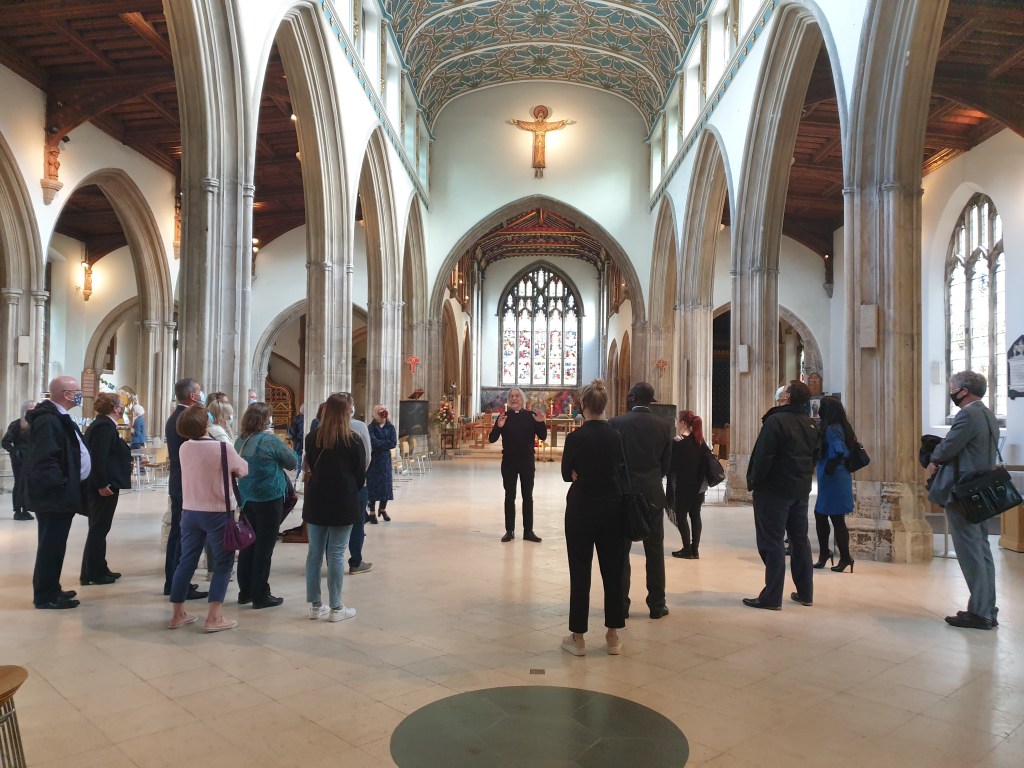
C and I, as cathedral bellringers, were invited to a lunchtime event hosted by the Dean for local business and cathedral groups.  It was the first event of its kind and entitled “How are we”? The idea was for people to meet, have a short guided tour of the cathedral from the Dean then just chat over a spot of lunch.  No sales pitch, no begging, no religious conversion therapy, just chat about how things are going as we crawl out of this pandemic.

C and I were slightly bemused to have been invited, but I later found out that several of the cathedral groups were also invited as part of the cathedral community.  It seemed we were the only ones to pitch up though.

There were about 30 people from the local council, businesses, retail and corporate. The tour started outside the south porch with the Dean explaining a little bit of the history of the building and pointing out where ancient met modern.  Inside we went to St Peter’s Chapel, where the Dean mentioned the space that gives opportunity for quiet reflection or intimate conversation.  He did mention, as it’s the chapel where all the war memorials are, that the bellringers (and thus pointed us out) were working with the cathedral to update the bellringers memorial. 

He then moved us across to St Cedd’s Chapel and explained a bit about Cedd and how he brought Christianity to the heathens and the Chapel at Bradwell.  Moving into the centre of the nave, the Dean pointed out some more architecture and art (apparently our cathedral is known as one of the most modern art cultured cathedrals).  He extolled the virtues of the vast open space and possibilities of different use.  As we moved up to the Alter he spoke of the Bishop’s seat, the only reason we are a cathedral.  I thought of Air Force One at that moment and how the US President’s plane is only called Air Force One when the President is on board and if they move to a different plane, that one changes its moniker.  If the Bishop’s seat was somewhere else, so would the cathedral be.

It was really interesting to hear some stories about how different parts of the building had evolved over time.  I had taken a few photos of the group listening to the Dean as we wandered around.

A sandwich lunch had been provided with tea and coffee and it wasn’t long before I assumed my usual position in pouring cups of hot beverage, wiping surfaces down, offering sandwiches around and refilling cups.  The person who has organised the event was trying to do everything herself so it seemed the obvious thing to do to help.  I knew where things were in the kitchen and not afraid to make myself useful, even though technically I was a guest.  The relief on her face was palpable.  She was trying to network with people, make sure the Dean stayed out of trouble and sort the refreshments out.  C busied himself chatting with the cathedral architect and someone else and seemed happy enough. 

As the event started to draw to a close, I started to gather up empty cups and abandoned plates and take them to the kitchen where one of the vergers started to load the dishwasher.  The Dean said his thank yous to everyone for coming and there seemed to be genuine appreciation of the event and desire to do something similar again.  The lady who’d organsied it was worried that it wasn’t going to be successful but given that nobody seemed to be in a terrible hurry to leave and were happy to continue networking and looking around, I told her that I thought it had been very successful.

Oddly, it was probably something that I would never have bothered to go to previously.  It just so happened that I had the day off work and C and I both thought it wouldn’t hurt to do a bit of networking.  I suggested that if they wanted to do something similar again, we could offer tours of the bell chamber, do a bit of demonstration ringing and get people to have a go.  Worth a try!

When things don’t take as long as you think they should

Image by John Collins from Pixabay

I have taken a couple of days off work to put together the flower, non-edible parts of a wedding cake that I’m commissioned with.  I’ve got another couple of days booked of to actually make and decorate the cake nearer the time.

I was eager to get on with it but needed the wire cutters which C told me required cleaning.  He still hadn’t finished in the shower before I made a start on covering the dummy cakes, and sorting through the silk flowers to arrange them.  I wanted to get on with it and be sure that I had enough flowers and that they would attach and fit properly. I needed those wire cutters.  Come on.  Get on with it.

The other problem was that the smaller of the cake dummies hadn’t been delivered yet so that might have meant starting, stopping and starting again. 

It seemed to take an age for C to get ready, then find the wire cutters and start to clean them.  Come on.  I wanted to get on with it.

As it happened, it all went smoothly.  The icing went on the larger dummy, to make sure that if there were any visible gaps, they’d be the same colour as the rest of the cake.  There were more than enough flowers so I made a couple of posies that could sit on the cake table at the venue.  It was easy to slot them all together and into the dummy.

It wasn’t long after I’d finished the first one, when the smaller dummy arrived courtesy of Hermes.  That meant I could crack straight on with it, and now knowing what I knew from the first one, it was quicker and easier to assemble the second.

From start to finish it actually only took an hour.  And I had two days booked off for this.  But it wasn’t the only thing that didn’t take as long as I thought it would today.

It is NHS, Social Care and Frontline Workers Day, a day to celebrate the 73rd birthday of the NHS and give thanks to all those who have done so much to help us during this pandemic, and to remember those who lost their lives because of it.  As part of that event, we were asked to ring bells at 8pm. 

C was on a zoom call, so I went down to chime a bell for five minutes by myself.  (We have guidelines about lone working, and I’d signed in and out, messaged C when I arrived and again when I left).  In order to make sure that I arrived in plenty of time, get parked, get into the cathedral and set up ready to chime, I left home at 7.40pm and drove there.  I signed in at 7.44pm! Now I’d have to wait around for quarter of an hour.

I was just contemplating whether or not to chime before the clock struck 8pm, as its been running three minutes late recently, or wait until it struck, three minutes late, then start chiming.  As I was decided what to do, I heard the mechanism run and the clock actually struck at 8pm on the dot.  Someone had obviously set it right again.  I chimed my bell for five minutes, before signing out, locking the door behind me, and messaging C to tell him I was on my way home.

It didn’t take me as long to get there as I thought it might.  Five minutes chiming didn’t take long, roughly five minutes, I’d say, then it didn’t take long to get out of the building and back home.  C was still on his call when I got back.

I now have a day to myself tomorrow without the worry of trying to put cake elements together.  I’ve done my #bellringing bit for the NHS.  What to do next?

What are you laughing at?

Laughter is the best medicine we’re told. It can reduce stress, improve blood flow and immunity and strengthen relationships. But do we do it often enough? Given all the grownupness we have to do and the many worries that may be invading our thoughts, possibly not.

Some research boffins in California found that kids who suffered severe pain had lesser pain when they watched Zoolander and other funny films. Even just smiling made a difference. Thinking about watching something funny later on in the day has been shown to raise peoples moods.

There’s also the long held belief that whatever facial expressions you have informs your brain as to what mood your in. The suggestion then is to fake it til you make it. Chuckling at something even if you don’t really find it guffawingly funny helps you to feel happier.

According to Dr Robert Provine we laugh 30 times more when in the company of others as its contagious and bonding.

As some who is introverted and has been accused of having a resting bitch face, looks like I’m in trouble! I do get a kick of seeing C laugh so hard at a TV programme that his eyes water. I end up laughing more at him than at what made him laugh in the first place.

I am trying to smile and laugh more often and find humour in things but it’ll take some time and multiple watches of Zoolander to turn this frown upside down.

Help a gal out and hit me with your most chicklesome viewing, listening and reading. TIA x

Date nights are back on

We are not the least bit interested in sport of any kind. Ok we could probably sit through an hour of tennis and I could watch a bit of athletics (mostly because I used to be quite good at it at school and its over and done with really quickly). So todays never ending barrage of “its coming home” when clearly the England team are about to throw it away, really does not make for entertaining viewing.

We decided therefore to do something we haven’t done for nearly two years and chance our arm by going to the cinema. Not that there was anything burning we wanted to watch but for something to do. We quite like going to the cinema in normal times.

C booked tickets online the day before and had to trog through a million and one questions about whether we wanted to preorder food or drink as you can’t get it on the day. We decided that we’d take our own and bought a box of wine gums earlier in the day. The coffee stand was open so we did get a drink before going to our screen.

When we arrived I had to scan in for Track & Trace at the cinema entrance. It would now think that I am in any one of the eight screens for the rest of the day. I wish there was a scan out option so it could understand when we were no longer there. They asked C if we’d booked online to which he replied affirmatively but they didn’t bother to check for the bar code.

We ordered drinks then made our way to the screen. There were probably only about 20-25 people in the screen so everyone was well spread out. C had mentioned that when he booked our seats the system then blocked out the seats around us as being unavailable which meant no one could get too close.

The usual preamble of adverts (note to self, lots of good things coming up in July) then an on screen recap of the social distancing and mask wearing rules. Apparently it was ok to take masks off whilst sitting down but if anyone needed to go out to the loo or anything, then masks back on.

There were very few people about at all really in what is usually a busy environment but I guess the impending overpaid idiots running around in shorts, falling over and dying should anyone get too close, had something to do with it.

When we came out of the cinema there were definitely more people heading into town to the pubs to no doubt get unnecessarily drunk and be idiots, whether “we” won or lost.

It was very nice to be able to do something sort of normal and have a bit of a date night, or late afternoon anyway. Well done to Odeon for making if feel safe.

How to create personal impact in 7 days

Image by Gerd Altmann from Pixabay

I was glancing along my “office” bookshelf earlier and came across a “Teach Yourself in a Week” book on personal impact by Christine Harvey.  It must have been several years since I last read it as I don’t recall it at all. It can help both in the workplace, but also when we consider #bellringing recruitment opportunities, when we are giving talks or presenting information about #bellringing.

The layout gives a bite sized topic for each day for seven days.  This one sets out:

Sunday – conquer non-verbal power

Monday – avoid embarrassment and discrediting yourself

Tuesday – structure your presentation to prove your point masterfully

Wednesday – make your point stick using incidents, analogies and humour

Thursday – grasp 13 ways to grab and hold attention

Friday – Build you fool-proof presentation planning matrix

Saturday – put icing on the cake of professionalism

Rome wasn’t built in a day but apparently we can learn in a week what experts learn in a lifetime. If only it were that simple. I thought I’d give it another read, one day at a time.

The first thing is to learn the three main aspects of impact: words, voice and non-verbal movement and actions. Harvey claims that the most accepted findings on what percentage impact each of these elements has is 7%, 38% and 55% respectively.  Therefore, it doesn’t matter what words you use, more the tone and what else you do that matters.  The five aspects of non-verbal impact are eye contact, stance, walking, gestures and projection of conviction with researchers finding that audiences give speakers 40% less effectiveness rating where there is no eye contact. So Rome wasn’t built in a day but if the Italian art of gesticular communication is anything to go by, this has a greater impact than a sedentary encounter.

The next thing to do is create credibility, personal, expert and reputable source credibility and draw upon your strengths to discuss any topic that comes your way. By providing credible facts or information this helps your listener take notice.

Then we can use emotional and logical proof to help get your point across. Using numbers or statistics, quotes and references give gravitas to your conversation. Using analogies, humour and incidents help create a picture, or a story.  It helps your audience make an emotional connection to your message that will stick with them.

In order to grab and hold attention it’s a good idea to have powerful opening, use questions, get the audience involved, use objects, create suspense and have a powerful close. I always try to do very little using Powerpoint or formal presentation styles, I’d much rather sit round a table with the audience and give them something to create that they can take away with them, especially if I’m teaching rather than presenting.

If you find yourself giving a more formal presentation its worth thinking about your main message, what are you trying to get across, plot the story so it flows.  Time your presentation so as not to go over any allotted time, or ramble on too long. Nothing so dull as someone droning on for longer than say, half an hour, about something you are not familiar with and can’t engage with. I usually find the Q&A session at the end more stressful.  Giving a presentation is easy enough if I’ve written it and know what the topic is, but you can’t foresee the sorts of questions you might be asked.  I will always admit if I don’t know the answer, or draw others in to help respond if possible, or even ask the questioner how they might tackle whatever problem they are enquiring about.

Having skim read this book again, I have refamiliarised myself with a number of useful pointers to employ next time I need to present or run a workshop (which will be quite soon apparently)!