Updating my CV

Thursday marks the official start of my new role, although you could argue I’ve been doing it part time over the last few months anyway.  My time as a service manager has ended, with this particular team after five years.

I have been fortunate over the last 20 years with the same employer to have had a variety of roles that have stretched me, challenged me, made use of my skills and knowledge.  I have been able to experience project management and service management, working in back office functions, and being very connected to clinical environments.  I have met a multitude of people from all sorts of different departments along the way.  I understand how things work around the organisation and, on most occasions, who to talk to, to get things done.

I have moved back into a project management role, which is much more up my street.  Process, structure, planned activity, and less people management are things I enjoy and am reasonably good at. 

As with most new roles, particularly in the same organisation, you start doing the work before you’ve actually officially started the role.  I have been quite deliberate in maintaining connection with my department as much as has been appropriate over the last few months, but can now take a step back and focus on my new tasks fully.  I will still need to do some things for my, now former team, as their structure gets sorted out and accesses to various systems are moved around.  Until someone is in post I’ll still need to authorise some things to help them out. 

On my last official day as their manager, I went over to see the team and deliver several tubs of chocolates for them as a thank you to them for their hard work and support over the years.  In return I was given a card and bunch of flowers.  It’s hard to know what to do when I haven’t been around them much over the last few months and given the projects that I’m involved in will impact on them, I’ll still be seeing them a fair bit as that progresses. 

I have now officially changed my email signature, and changed my details on my social media profiles.  It does feel a bit odd though, like cutting those apron strings.  I can legitimately not get involved in staffing or service issues and pass people on to others to deal with things that would only take me a few seconds to deal with probably. 

I have also updated my CV, which I do on a regular basis, just in case.  When I first started in the NHS 20 years ago, almost to the day, I started life as a Project Administrator at a Band 2. I did a six year stint as Research & Development Administrator before returning to the same project I started on but now as an Assistant Project manager, and finally as Acting Project Support Manager at the end of that project.  Then came my first foray into service management.  Not an easy one, going straight into Domestic Services, managing a team of over 250 staff who worked 24/7 and a £5.5m budget. I did that for five years before getting itchy feet and needing to move into a different service, where I became Health Records Manager with a smaller team of about 65 staff, who only worked Monday to Friday.  Alongside that latter role, I also supported the Document Ratification Group as Deputy Chair.  It was in December 2020 that I was first seconded back into more of project role, whilst still keeping an overview of the Health Records team, before the role I am now embarking on fully became available.

So as I move into a new year, I have a new role to get my teeth into.  I’m looking forward to the challenge.

Could the UK manage a four-day working week?

Image by ELG21 from Pixabay

I took a personal decision about 18 months ago to address my work/life balance and condense my full time, five day a week hours into full time, four days a week. This means longer days Monday to Thursday, but I have Fridays off.  It has been revolutionary. I am grateful to my boss and employer who agreed that I could do this.

I read recently that Iceland (the country not the frozen food shop) had been experimenting with workers being paid the same amount but only working four days https://www.bbc.co.uk/news/business-57724779   Other trials had been taking place in parts of Spain and in some companies in New Zealand.  The Icelandic trial workforce, based within a range of preschools, offices, hospitals and social care providers reduced their hours from 40 hours per week to 35 or 36 hours per week.  Now approximately 86% of the Icelandic workforce works a shorter week for the same pay.

The benefits of the trial showed that workers felt less stressed and therefore at less risk of burnout, and their work/life balance improved.  Workers felt healthier and moral and atmosphere in the workplace improved. The director of research said the study showed an overwhelming success with workers being just as productive in four days as they would have been in five, and that the public sector was ready for a step change.

I can certainly attest to feeling much less stressed knowing that I have Fridays off and that I can fit other parts of my life in more easily.  If we choose to go out, or visit our daughter or other family members, or just take some time to relax.  We can still get everything we need to get done over the course of the weekend but in less of a rush.  Even chores seem less stressful because we don’t have to rush to get them done so that we can have some down time.

According to https://www.opendemocracy.net/en/oureconomy/time-four-day-week-has-arrived/ the UK has one of the longest working weeks across Europe.  There is a group in the UK who are trying to get the government to move to a four-day week for the benefits outlined above, but also it thinks that it would reduce overall carbon footprint.  I think that it is now really possible to consider this given that we can work from home and use technology differently to do a lot of jobs.  I just wonder whether some employers would down grade jobs as they may not be able to sustain the same costs with lower output. For public sector roles most of the money required to pay salaries comes back in the form of income tax and national insurance contributions, so the overall cost to employers would be relatively low even if they did have to employ more staff to cover any shortfall.

Whereas I still work the same hours but condensed into four days, this means I get the same pay, the same annual leave and bank holiday entitlement, as its all calculated on the number of hours you work, not the number of days, or the days of the week you work.  I don’t mind doing slightly longer days, as I was generally doing those hours anyway before but just not getting paid for them. 

I would certainly recommend a four day week to anyone that can.

How do you engage with the unengagable?

Image by Terri Cnudde from Pixabay

That million dollar question all leaders want the magic answer to. 

I’ve done many a course and read many a book or article on how we should be engaging with people to get the most out of them and provide them with job/participation satisfaction.  We are told that we should include them in decision making, regularly communicate with them, and invite them to participate in projects that will allow them to share their expertise and grow their skills. We should be empowering them to make decisions.  We are reminded that a disengaged team can cause a drop in morale and performance and be disruptive.  https://jouta.com/blog/how-to-re-engage-a-disengaged-employee/

But there are some who just don’t want to be engaged with.  They want to be valued, they want to be appreciated and for their efforts to be noticed. They want reward for doing a good job (some even want reward for doing an adequate or poor job, or for simply turning up at all).  They want to feel listened to and communicated with.  They want to be involved.  That is, right up until the time when you invite them to be involved.

One thing I struggle with time and again is trying to get people to look wider than the work that is right in front of them, especially when they tell me that they are not happy, or feel undervalued.  I invite them to participate; I offer courses that support their current role and any development they might want.  I provide them with opportunities to use their knowledge and skills and to develop processes and procedures or plans that they will ultimately be responsible for. I provide open door opportunities to share ideas and talk freely.

But they just don’t want to play.

I’m not the sort to press gang unless absolutely necessary, I ask for volunteers. There are times when I have had to say “you and you are going to help with this” but I want to see who has a spark, who is interested, and who wants to be involved. I shouldn’t be the one suggesting all the process changes; I’m not doing the job.  I can see opportunities to improve efficiency or process, but ultimately they have to own and be accountable for it, so it makes sense that they help develop it.

We are reminded that people respond positively when they are empowered to make choices and decisions for themselves, yet when they are given the opportunity they don’t want to take it. Figuring out what matters to them and how to spread positive stories, exchange ideas openly, and disseminate best practice is all well and good but only works when morale is already high and people are generally happier. https://www.achievers.com/blog/how-to-convert-a-disengaged-employee-into-an-engaged-one/  In this current climate, that’s really hard to do in a virtual world.

I think it also depends on the example they are given.  Enthusiasm breads enthusiasm, contempt breads contempt.   I try to be as upbeat as I can and to understand frustrations others are going through trying to deliver their piece of work or part of the project.  I acknowledge that not everything can be done as perfectly as we might want it to be and sometimes corners might need to be cut in order to meet a more pressing need.  I understand that there are often outside pressures that affect how motivated they feel.  However, there are usually others in closer relationships that seem predetermined to be pessimistic about everything. Everything is a disaster, it’s not their fault, and it’s nothing to do with them, they are not responsible or accountable.  That kind of vibe tends to spread like wildfire and before you know it most of the team is feeling down.  They don’t realise that they vibe they are giving off is affecting how others feel and then it spirals. 

I know that it’s extremely hard to eternally upbeat about everything all the time, it would be exhausting, and I certainly have my days when I’m not motivated or interested at all.  But if I want a more optimistic team around and people to be more engaged, then it’s my responsibility as a leader to start that vibe, or to find help when I need it.  If I can change one person’s attitude, which can then spread to someone else, I’d be happy.

I want people to develop, I want them to be fulfilled in what they do, be satisfied at the end of the day they did all they could to use their strengths.  I want them to feel they have all the information they need about what’s going on in their immediate and wider world.  I want all these things for them and provide opportunities for that.  They just don’t seem interested in taking it. People complain about lack of development, I give them the opportunity to develop, they don’t want to take it. They complain about not knowing what’s going on, so I tell them but then they don’t listen or connect the dots with the relevance to them. I need to make more of an effort to ensure the message is put across in a ways that does demonstrate relevance to them.

Whilst it would be great to have one to ones with absolutely every person to determine what motivates them and how they could be better developed, communicated with etc, the practicalities are not so simple.  It might be that I wouldn’t need to do that with everyone, just take a few key people to one side and address their motivations, then through the wonders of osmosis everyone else will feel more engaged and valued.

Reflecting on some of the reasons why previous attempts to engage others hasn’t worked it is useful to consider these questions:

  1. Who in my team have I connected with the least? what gets in the way of connecting with them more?  
  2. Think about the people I connect with the least in my team, service users and peer group, and notice any similarities.
  3. Think about who in my team I enjoy connecting with and why?
  4. Think about those who I feel psychologically safe around and why? and those who I do not and why?. What are the differential factors?   

There are many tools to try but I still don’t have a solution for how to engage the unengagable.

Influential influence

As I move into the next phase of my career in the next few months, it will become much more important to be able to influence others outside my normal sphere of activity.  I’m already a middle manager with a wide network across the organisation, but the next step will take me into a higher stratosphere of connections.  I need to change up my influencing from my subordinates and peers to upper levels and very senior levels of the organisation.

The Centre for Creative Leadership offers four areas of advice for effective leaders to inspire, persuade and encourage by using the knowledge and skills of a group to help point people towards and common aim and bring about commitment to change.

1) organisational intelligence – being aware of not just the organisational structure bur the informal structure of the political landscape by networking to build strategic allies, consider context and goals before decided how and when to express an opinion, paying close attention to nonverbal clues, active listening, and considering how others might feel, and leaving others with a  good impression without coming across as too aggressive.

2) Team promotion – and a bit of authentic self-promotion without bragging or being selfish.  A bit of well placed self-promotion can provide visibility and opportunities for the team by providing some organisational pride, make capabilities and ideas more visible across the organisation, therefore improving collaboration.  Leaders need to put themselves in the spotlight and find ways to find an audience and sell their team’s story.

3) Trust building – without trust there is probably much less commitment from others, or access to tapping into the full creativity of the team.  Being able to leverage this is crucial when dealing with tough challenges or making strategic changes.  People look for leaders who show some vulnerability and inspire them, understand them and guide them.  It’s a careful balance between pushing people in to areas they are uncomfortable with whilst listening to their concerns and feedback.  Being tough but empathetic with others as they struggle, as well as demonstrating urgency and patience requires careful balance.

4) Leveraging networks – In order to influence others leaders need to cultivate networks.  As organisations shift and morph, leaders need to recognise personal networks must also be dynamic.  They need to be strategic about choosing how and when to tap into the right network.

Then there’s choosing the right influential tactic:

1) logic – taps into rational and intellectual positions, presenting the argument for the best choice of action based on organisational and personal benefits, appealing to the head.

2) emotional – connecting the message, goal or project to individual goals and values, tapping into personal feelings of well-being, service and belonging, tugging at the heart strings to gain support.

3) cooperative – collaborating, consulting and alliance building.  Working together to accomplish mutually important goals, extending the hand to help others.

An invitation landed in my inbox recently that gives me the opportunity to share a new framework that I created with very senior operational and corporate leads across the organisation.  Whilst doing this scares me half to death, I recognise that it’s the ideal opportunity for me to be able to share this piece of work with the very people who will need to be taking it forward in their parts of the organisation.  It’s my piece of work and I am proud of it, and the reception it has received so far. 

Next steps is to make it a reality.

Connections and reconnections

Reconnected with a former work colleague yesterday.  Haven’t spoken with them in years.  Paths went different directions and they are now self-employed and seemingly doing very well in a field that they are absolutely suited to.

I was feeling a bit meh about something said recently and spent a bit of time trying to research about not dwelling on things that I have no control over.  My former colleague has moved into the positive psychology sphere and that’s what their business revolves around.  I decided to reconnect with them on LinkedIn and see if they had any advice.

I find it really hard to connect with people generally.  I have a lot of acquaintances via #bellrining and work, but no one that I would say was a “close friend”.  In the past, I have rushed to help people at all times of day and night, who I thought were friends, to help them through marriage break ups and bouts of illness and depression, but no one has ever returned that favour.  Maybe they don’t see that I need any help, or think that I’m a strong enough person that doesn’t really need it, or they’re so wrapped up in their own issues they can’t see someone else’s.  Seemed to have been all take, so frankly, I let them go. Don’t get me wrong, I’m not a needy person, but every now and then I need reassurance just like anyone else.

This is why I hate those circulars that do the rounds every now and then on social media about “call me if you need me, I’ll always be there for you”  a) I shouldn’t need to call you, if you were really my friend and knew me well enough, you’d know when I needed help or support and b) no you won’t, even if I did call you’d make some excuse for not coming to see me or calling me or reaching out in some way.

I hate the way that I’m supposed to be mindfully of everyone else’s feelings but no one needs to be mindful of mine. How am I supposed to be honest, open and authentic when I have to hold back so much of what I really want to say?

I looked into advice on how to connect with people and it suggests:

  • Smile – genuinely and warmly.  That’s a difficult one to start with.  I hate my smile.  We even have a joke in the family about if I smiled no one would recognise me.  It’s not because I don’t want to or can’t but that it feels false, even when I don’t mean it to be.
  • Invite conversation – showing you are interested in other people by giving a little of yourself then asking about them e.g. “I enjoy reading historical fiction.  What sort of books do you enjoy?”  Obviously tailor it to the situation, but you get the idea.  Trouble is, I don’t like what most people like.  I don’t like sport of any kind and am actively turned off when someone starts talking about it.  I don’t watch what everyone else seems to be watching on tv.  There seems to be very little room for finding a common interest in most situations.
  • Offering compliments – might be something someone has done, or what they’re wearing.  I do do this, sparingly, otherwise it just gets a bit weird.
  • Putting yourself out there – push yourself to be sociable.  There are times when I’ve go to a works or #bellringing do because I’ve felt that I’ve had to be seen to be there when really I’d rather be at home with my own company.  I have offered invitations to coffee etc and sometimes they are taken up, but then it always ends up being me that organises it.  Sometimes it would be nice if the invitation was reciprocated.
  • Be yourself – this seems totally contradictory.  Myself would be at home, in my own company, minding my own business.  Yet the advice has just told me to go out there.  There are times when I feel a little bit more at ease with others, but that’s usually because it’s a meeting with a purpose, rather than just a social event.

Hit me with your favourite positivity sites and top tips for connecting with people.

Staring at a screen too long

With meetings, #bellringing, family gatherings, talks, plus the usual social media, emails, work etc, I find that I’m currently spending roughly 12 hours a day staring at a screen.  Small wonder my eyes are dried out at the end of the evening.

I work a 9.5hr day Monday to Friday and most evenings am either on a Zoom meeting, or a virtual #bellringing session.  On my non-working day I have, one, sometimes two virtual #bellringing sessions and more often than not a meeting in the afternoon on Zoom as well.  Then every other Sunday there’s the family Skype gathering.

Apparently, there’s a name for it now ‘digital eye strain’ or ‘computer vision syndrome’.  However, help it at hand with some top tips on how to reduce eye strain from All About Vision:

  1. Get an eye test and tell the optician how much time you spend on the computer or devices.
  2. Reduce excessive bright light.  Close blinds or curtains, use lower intensity light bulbs, and position the computer so that windows are at the side, not in front or behind.
  3. Consider an anti-glare screen for your monitor and have a more muted coloured wall to reduce glare from reflective surfaces.
  4. Upgrade your monitor with a flat-panel LED screen in anti-reflective surface.
  5. Adjust the brightness, text size and contrast, colour temperature or your screen.
  6. Blink.  When staring at a screen, people blink less frequently — only about one-third as often as they normally do. Blinking moistens your eyes to prevent dryness and irritation.
  7. Exercise your eyes by frequently looking away from the screen at a distant object and focus on it for at least 20 seconds.
  8. Take frequent breaks to help reduce neck, shoulder and back pain.  Get up and move around for 10 minutes every hour.
  9. Modify your workstation.  Check your posture and ensure that your chair is the right height with your feet comfortably on the floor.  Make sure that your screen is 20-24 inches away from your eyes with the centre of the screen 10-15 degrees below your eye level.
  10. Consider computer glasses.  Customised glasses which photochromic lenses.

I am conscious that my eyes are tired at the end of the day, and that I do probably need to get up and move about a bit more.

Maybe I will also try a digital detox day as well.  A day without any screen time at all.  Hmmmm!

6 people in your corner OR 5 mentors you need?

Several years back one thing I picked up, presumably from some talk or online article was the notion of having 6 people in your corner.  Basically, these represented 6 characters that would help and support your leadership journey.  They didn’t all have to be different people, although they could be, or some, or all of them could be the same person.

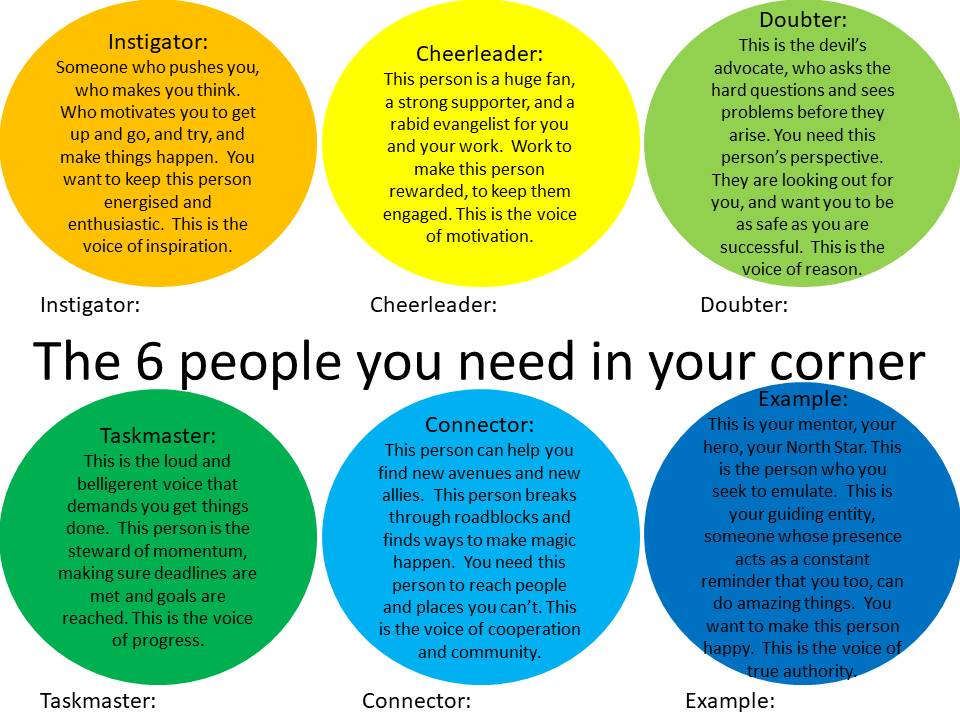
The 6 characters were:

The Instigator: Someone who pushes you, who makes you think.  Who motivates you to get up and go, and try, and make things happen.  You want to keep this person energised and enthusiastic.  This is the voice of inspiration.

The Cheerleader: This person is a huge fan, a strong supporter, and a rabid evangelist for you and your work.  Work to make this person rewarded, to keep them engaged. This is the voice of motivation.

The Doubter: This is the devil’s advocate, who asks the hard questions and sees problems before they arise. You need this person’s perspective.  They are looking out for you, and want you to be as safe as you are successful.  This is the voice of reason.

The Taskmaster: This is the loud and belligerent voice that demands you get things done.  This person is the steward of momentum, making sure deadlines are met and goals are reached. This is the voice of progress.

The Connector: This person can help you find new avenues and new allies.  This person breaks through roadblocks and finds ways to make magic happen.  You need this person to reach people and places you can’t. This is the voice of cooperation and community.

The Example: This is your mentor, your hero, your North Star. This is the person who you seek to emulate.  This is your guiding entity, someone whose presence acts as a constant reminder that you too, can do amazing things.  You want to make this person happy.  This is the voice of true authority.

Back in about 2009, when I first discovered this, I knew exactly who these people were.  Some of them wore multiple hats for me.  After about 2011 when I’d changed jobs, I really could not pinpoint anyone amongst my work colleagues that fitted any of those roles for me.  Happily, I am once again in the position where I can identify at least one person, even if it’s the same person, for each of those roles.

I’ve just read an article by Anthony Tjan on ideas.TED.com who suggests that we should have 5 mentors:

The Master of Craft: “If you know you want to be the best in your field — whether it’s the greatest editor, football quarterback, entrepreneur — ask, Who are the most iconic figures in that area?” says Tjan. This person can function as your personal Jedi master, someone who’s accumulated their wisdom through years of experience and who can provide insight into your industry and fine-tuning your skills. Turn to this person when you need advice about launching a new initiative or brainstorming where you should work next. “They should help you identify, realize and hone your strengths towards the closest state of perfection as possible,” he says.

The Champion of your cause: This mentor is someone who will talk you up to others, and it’s important to have one of these in your current workplace, says Tjan: “These are people who are advocates and who have your back.” But they’re more than just boosters — often, they can be connectors too, introducing you to useful people in your industry.

The Copilot: Another name for this type: Your best work bud. The copilot is the colleague who can talk you through projects, advise you in navigating the personalities at your company, and listen to you vent over coffee. This kind of mentoring relationship is best when it’s close to equally reciprocal. As Tjan puts it, “you are peers committed to supporting each other, collaborating with each other, and holding each other accountable. And when you have a copilot, both the quality of your work and your engagement level improve.”

The Anchor: his person doesn’t have to work in your industry — in fact, it could be a friend or family member. While your champion supports you to achieve specific career goals, your anchor is a confidante and a sounding board. “We’re all going to hit speed bumps and go through uncertainty in life,” says Tjan. “So we need someone who can give us a psychological lift and help us see light through the cracks during challenging times.” Because the anchor is keeping your overall best interests in mind, they can be particularly insightful when it comes to setting priorities, achieving work-life balance, and not losing sight of your values.

The Reverse Mentor: “When we say the word ‘mentor,’ we often conjure up the image of an older person or teacher,” says Tjan. “But I think the counterpoint is as important.” Pay attention to learning from the people you’re mentoring, even though they may have fewer years in the workplace than you. Speaking from his own experience, Tjan says, “Talking to my mentees gives me the opportunity to collect feedback on my leadership style, engage with the younger generation, and keep my perspectives fresh and relevant.”

They both cover a lot of the same ground but Tjan has some interesting other ideas.  I know who my Champion and Copilot are.  I think I am my own Anchor really.  I’m pretty clued up to my own values and setting personal priorities to achieve a good work-life balance.  I’m not sure who my Master of Craft is at the moment or my Reverse Mentor as I’m fairly disconnected with leading or mentoring anyone at the moment.

Do you know who you’d have in your corner or who are your 5 mentors?

Style Guru

Someone (you know who you are) came over to see me today and very kindly brought me belated birthday gifts.  They were brilliant, thank you.  However, it was what she was wearing that got most of my attention.

It looked like she’d just had her hair done, but she professes to have coloured it at home.  It looked like it had recently been cut too, but she swears not.  She was wearing a fabulous coat.  It was blue with white checked lines, a belt and collar.  To be honest, she looked very glamourous in it, not that she doesn’t always look fab, but this was really rather special.

All the while we sat and chatted I was thinking “I want that coat”.  I offered a very sincere compliment on it and how it looked on her and she told me where she’d bought it from.  I’m going to google it later.

But do I need another coat?  Probably not.  I have several lightweight jackets.  I have what I call my autumn jacket, one that is slightly thicker than but not as heavy as a winter jacket.  I have a winter jacket.  I have a winter coat.  I have a rain coat.  I have a posh long coat. I probably don’t need another one.  But it did look good.

It looked good on her, but would it have looked that good on me?  I don’t know.  We are different body shapes, height, hair colour and skin tone, so maybe it suited her style better. Maybe I’d just look like a beached whale in it.

I’m trying to inject some colour into my wardrobe as quite a significant amount of it is black or white.  I’m trying to find more stylish items rather than the functional or office style.  I’m buying more things I can mix and match with other things.  I’m trying to move away from the same old stuff.  I did actually see a photograph of someone in a bright pink trouser suit the other day and I thought she looked fantastic.  I actually felt that I wanted that suit too.  Last summer I did buy a bright blue suit, which is very different for me, and I wore it to work a few times and got some really nice compliments. 

I think the problem is I’m not really sure what my style is.  I like comfort but I like to be smart when I’m at work.  I used to wear skirts and dresses but for about 15 years or so I probably have only wore a skirt or dress a handful of times.  I have some long dresses that I wear to formal dinners, but that’s all I have in the wardrobe now.  Everything else is trousers.  I have a long body which makes some styles impossible to wear despite the fact that they might be flattering for my girth!

I think I like an urban casual look. Something fairly soft and comfy with an occasional edge to it. I’m slowly amassing that kind of wardrobe.  But every now and then I want a statement piece. Maybe the coat could be this years’ statement piece.

Lost Emails

I wondered whether it had all gone quiet, I was being ignored, or something was amiss.  I usually get about 20 emails a day to my various “home” accounts, excluding spam.  By that I mean my own email address, my Association emails addresses and my Central Council addresses.  For the last few weeks I’ve had significantly fewer.

Needing to be on a Zoom meeting I was concerned that 24 hours before the meeting I hadn’t had the Agenda and supporting papers, nor the link to the Zoom meeting.  A quick fire email to the right person and it seems that my name had dropped off of the email group so I hadn’t received what had been sent out. 

Because I was using my laptop, not the main PC with the main email stuff in, I had to log into my Gmail account, but the email that had been sent with the meeting information wasn’t there.  I was frantically trying to log into everything.  Outlook, Gmail, Office 365.  Depending on which of the aliases used, depends on where the email ends up. Ended up having to email it to myself from the home PC to the Gmail account.  Eventually got in, but not without some angst.

Whilst I was logging into various emails boxes, I also came across a couple of other emails that seemed to have been sitting in a Spam folder for one account but were not showing in any of the other redirected accounts. They were quite important emails too. I thought that all the email redirects were supposed to find their way into at least one of the 3 main email address locations. 

Apart from my work email address, of which I have 2, I have 6 other alias email addresses for various roles.  The majority of them get redirected via our main location but with the recent addition of Office 365 for some ringing activity, that seems to have thrown a spanner in the works.  Sometimes I get duplicates, sometimes I get none.  Sometimes I get someone else’s reply before I get the original message. Sometimes it takes 2 days for them to come through.

I’m reasonably IT literate, but this gets so confusing. 

Adrenaline Junky

Nothing like a crisis to get the adrenaline going.  Its all going a bit Pete Tong at the moment with former colleagues dying due to Covid-19 and staff off with either positive results or self-isolating, meaning that the service is about to fall on its knees.  However, a few strategically placed phone calls and lots of toing and froing has resulted in a bit of a plan that should help the situation a bit.  Also some positive clinical engagement, which was fantastic.

I’m not usually one that responds very well to instant and urgent changes, and trying to solve immediate problems.  I like to ruminate over things, check all the facts, formulate a plan, get everyone involved.  Time was not on our side so this week, and today in particular, have been very much making things up on the hoof, last minute conversations and plans, no time to overly consult, only with those that are critical, put a series of actions together and BAM! I can head in to the weekend slightly more relaxed about the prospects of the week ahead.

I feel surprisingly buzzy about it all to be honest.  The time has flown by, I’ve not been wondering what task to do next. I’ve jumped from one conversation to the next, to the next and to the next.  I don’t think I could sustain that level of activity or focus for too long, and admire those that do and those that work in environments that require that fast paced thinking and problem solving.

When adrenaline kicks in it stimulates our “flight or fight” responses.  When the body is flooded with adrenaline it helps focus and engages the brain, improving cognitive responses.  A bit like a massive caffeine hit.  Apparently, it can improve your eye sight as the pupils dilate, and improves respiration. Even after the triggering event there can be a residual feeling of high vigilance and excitement and can intensify those feelings.  As well as a burst of energy and strength the immune system gets a little boost too. (https://www.mentalfloss.com/article/71144/8-reasons-little-adrenaline-can-be-very-good-thing)

So, having started the day with the sad news of another colleague dying and not feeling like I wanted to really do much, at the end of the working day, I’m now bursting with energy and enthusiasm.  Just as well as I’m hosting a virtual #bellringing session tonight and had better be on my A game.