Reimagining your vision board

Image by Sh1ra from Pixabay

I’ve not really been one for vision boards.  At least not the physical sort that you cut out images from magazines or pin photos to of places you want to visit, the home you want to create, the relationships you want to have, career goals, health and happiness, what you want to learn etc.  Mine is more of a vague idea or general direction in my head with a To Do List of how I’m going to get there.

According to https://blog.mindvalley.com/vision-board/ creating a vision board is a great way to be clear about your goals and dreams and to motivate yourself to bring them about.  Some people even have vision board parties where everyone brings along their pictures and glue sticks and get creative over a bottle of wine.  It is described as a way of putting the law of attraction into practice by creating a powerful visualisation tool that helps you narrow down your desires through making choices.  The law of attraction magnetises and is supposed to attract you to the opportunities you need to turn your dreams into reality.

A vision board can be inspirational and aspirational but it doesn’t offer the knowledge of who to achieve it.  To do that you need to take inspired action. Research things on your board to determine how to make them happen.  The problem with vision boards is they are inanimate objects that have no power.  The power comes from your desire to know which direction to go in.  The main factor in creating your vision is to commit to falling in love with your life right now.

Back to my current podcast fave Tonya Leigh who suggested that what you focus on grows.  When you look for what you love and when you fall in love with what’s happening right now, things get better.

A picture on a vision board can be a catalyst to set things in motion, but it needn’t be a vision board, it could be a picture, or a piece of art, or something around your home or office space that inspires you.

TL suggested that vision boards only worked when you show up and live out that vision.  People talk about their dreams or take classes without ever doing the real work.  They read financial pages but don’t crunch the numbers.  They have a shelf of cook books with beautiful recipes that never get made.  They read fashion blogs but never buy that new outfit.  They attend conferences and retreats but never put what they learned into practice.  Some people create beautiful vision boards but don’t show up for their vision and wonder why nothing has changed.  They expected the vision board to do all the work for them instead of working on their vision.

TL suggested an alternative if you’re frustrated that your vision board isn’t working for you.  Rather than spending hours creating a master collage, use that time to live out your vision.  Put yourself out there and actually do it.

The call to action today is to stop pretending to live out your dreams and make a commitment to show up and live it.


Arena Tour

I was reading an article about 7 Arenas for Success by Chris Widener (2017), https://www.success.com/the-7-arenas-of-success/ In it he described the degree of our success is proportionately related to the degree that we balance certain areas of our life.  He offers 7 Arenas in which every person, business or organisation could and should operate:

  1. I Am: Arena of Values – what do you think is important?  What do you believe in? What do you want to accomplish? Are you clear that you are functioning within your core values? 
  2. I Should: Arena of Responsibility – what are your responsibilities?  Are you honourable and have high integrity?   Honest, hardworking and forthright? Do you make family a priority?  Do you give to charity, be it financially, time or possessions free of all expectation?
  3. I Could: Arena of Possibility – what are the possibilities of doing what you dream of, or doing something great?  Stop the treadmill and ask the question.
  4. I Would: Arena of Negotiation – possibilities come at a cost so you have to decide whether its worth it.  What are the ramifications? What changes or sacrifices will have to be made?  How long will it take?  Measure the cost of possibility and weed out those that are not good for you.
  5. I Want To: Arena of Vision – turning your passion into things that you can actually visualise. To dream drives you to attempt things you wouldn’t think of.
  6. I Will: Arena of Dedication – persevere.  Be determined.  It will be hard work, but it will be worth it. What are the obstacles that are stopping you?  How will you overcome them? What are the rewards that await you?
  7. I Do: Arena of Accomplishment – satisfaction of completion.  Time to take a rest, have a little celebration, a sense of fulfilment and set a new high bar.  What’s next?

I probably fluctuate throughout these 7 arenas from time to time.   There are activities and periods of time when I’m fully operating within my core beliefs and values and fully responsible and accountable.  I have dreams about what I might want out of life and a take small steps towards making that happen, like working a condensed week to allow me more time to dedicate to other areas of my life that I enjoy doing.

I’m not quite brave enough to go full pelt into what I dream of for many reasons.  Partly because it’s scary, and partly because doing so would actually impact other people in my life and that’s not what they’ve signed up for, although I’m 100% confident that they would support me in whatever I do.  Maybe that’s where I’ve negotiated a modified version of my possibilities, a halfway house.

I do persevere.  There are things that I’ve stuck with despite having doubts, issues, worries or being criticised by others.  And I do allow myself a moment of satisfaction or celebration every now and then when a job is done.  Just a small break, before tackling the next thing.

Having considered these arenas I wonder if instead of an arena tour whether I operate on a social club kind of level.  We’re about to update our Wills, maybe that’s an opportunity to reshape my arena tour.

Staring at a screen too long

With meetings, #bellringing, family gatherings, talks, plus the usual social media, emails, work etc, I find that I’m currently spending roughly 12 hours a day staring at a screen.  Small wonder my eyes are dried out at the end of the evening.

I work a 9.5hr day Monday to Friday and most evenings am either on a Zoom meeting, or a virtual #bellringing session.  On my non-working day I have, one, sometimes two virtual #bellringing sessions and more often than not a meeting in the afternoon on Zoom as well.  Then every other Sunday there’s the family Skype gathering.

Apparently, there’s a name for it now ‘digital eye strain’ or ‘computer vision syndrome’.  However, help it at hand with some top tips on how to reduce eye strain from All About Vision:

  1. Get an eye test and tell the optician how much time you spend on the computer or devices.
  2. Reduce excessive bright light.  Close blinds or curtains, use lower intensity light bulbs, and position the computer so that windows are at the side, not in front or behind.
  3. Consider an anti-glare screen for your monitor and have a more muted coloured wall to reduce glare from reflective surfaces.
  4. Upgrade your monitor with a flat-panel LED screen in anti-reflective surface.
  5. Adjust the brightness, text size and contrast, colour temperature or your screen.
  6. Blink.  When staring at a screen, people blink less frequently — only about one-third as often as they normally do. Blinking moistens your eyes to prevent dryness and irritation.
  7. Exercise your eyes by frequently looking away from the screen at a distant object and focus on it for at least 20 seconds.
  8. Take frequent breaks to help reduce neck, shoulder and back pain.  Get up and move around for 10 minutes every hour.
  9. Modify your workstation.  Check your posture and ensure that your chair is the right height with your feet comfortably on the floor.  Make sure that your screen is 20-24 inches away from your eyes with the centre of the screen 10-15 degrees below your eye level.
  10. Consider computer glasses.  Customised glasses which photochromic lenses.

I am conscious that my eyes are tired at the end of the day, and that I do probably need to get up and move about a bit more.

Maybe I will also try a digital detox day as well.  A day without any screen time at all.  Hmmmm!

Why we do what we do

I have the next week off work as annual leave. I have no plans, and no real thoughts about what to do with my time. I have a couple of reports to write and could bake something but other than that, because we can’t go very far due to lockdown, no other real thoughts about what to do. That got me thinking about why we do what we do (or not).

You could take Maslow’s hierarchy of needs and work through that systematically, but does that cover it? Yes, there are some basic needs that ought to be addressed: the need for food, shelter, sleep, company etc. We need our elements of security around employment, health and some material belongings. There is certainly a need for friendship, family, love and a sense of connection. But then we get on to the things that you could argue we don’t NEED, we just WANT. Respect, recognition, strength, and then self-actualisation – to be the best we can be.

There’s another school of thought that suggests a different solution to why we do what we do.

A sense of obligation – to share experience and knowledge, the obligation to serve others. A sense of duty, and pride – perhaps via volunteerism, a call to action, pride in a job well done and our want to succeed. We should be wary of the vice like self intention, cunningly disguised as “being in our best interests”, which only really offer temporary pleasure. Acts of kindness and our altruistic love for the benefit of others. Passion for our favourite activity or cause, our desire to do something. The desire to “tick the box”, perhaps something off our bucket list, but could lead on to somewhere else. Our destiny may be coloured by family tradition, a hobby or particular calling that other family members before us have excelled in. Yes, there’s a need to have a sense of fulfilment to keep us energised and empowered through our self-actualisation. But maybe we do it for others, to have something to share or for the “greater good”.

Tony Robbins, an author and podcaster, as well as being a mutli-billion dollar entrepreneur, in his TED Talk and book, describes 6 human needs – certainty, significance, variety, love/connection, growth and contribution – and how each influences our thoughts, feelings, behaviours and actions. By understanding what drives us, we can understand how to meet those needs. The same for people around us, once we know what drives them, we can help them meet their needs too.

At a very fundamental level, I know I need to be safe, secure, independent and have a sense of purpose. The narcissist in me does need some form of appreciation every now and then, but I certainly need feedback to make sure that I’m at least heading in the right direction and to help me achieve some personal growth. I need to be educated. I need to understand things and learn from them. I try to encompass all of that in my working, social and family life and am conscious that I don’t always get it right.

The 6 Domains of Resilience

The #MSEBUDDYNETWORK I’m part of at work is a great resource for being able to support colleagues who just feel that they need someone to listen to them, for somewhere safe to spout off, or to just reflect and recoup.

There have been some great resources shared throughout the programme and another such example was shared yesterday. Available via the NHS Leadership Academy (through whom I did my Elizabeth Garrett Anderson Senior Healthcare Leadership MSc) are some bite size learning snippets around health and wellbeing conversations specially focusing on resilience.

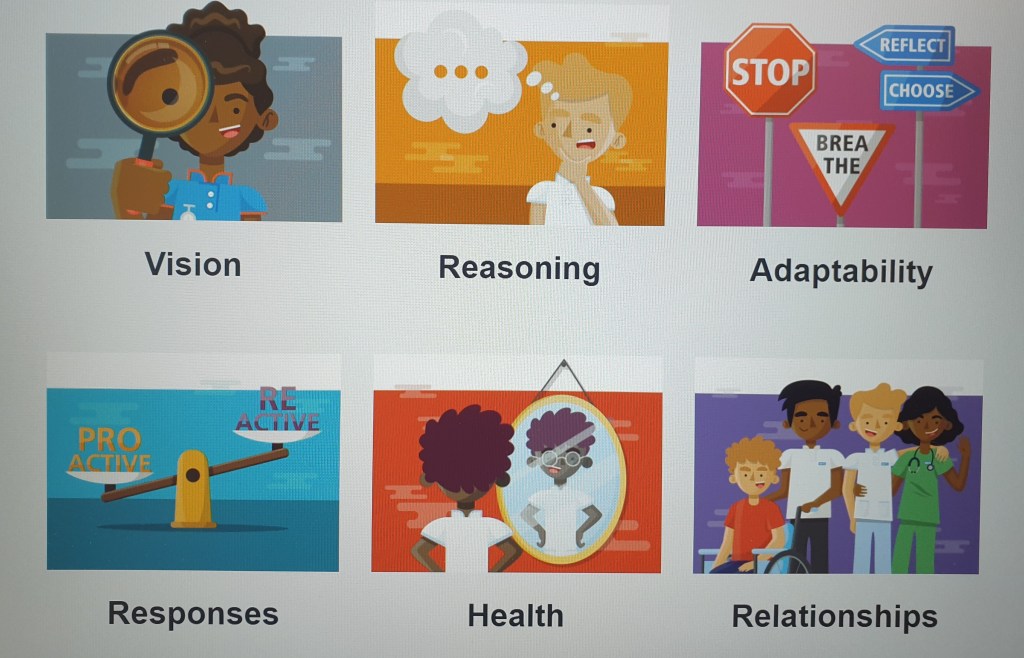
The resource was developed by Sonya Wallbank, a clinical psychologist and organisational development lead. It is broken down into 6 dimensions covering Vision, Reasoning,  Adaptability, Responses, Health and Relationships. Each dimension then goes on to explain its impact and offers suggestions to think about how we could focus our energies into improving them.

The resource is there to support facilitators of conversations and can be applied to your own experiences as well as used as a template to help others. My personal opinion is that we should not expect to help others where we cannot help ourselves first, so for me to support anyone else, I need to understand my own experience.

VISION: This is about setting personal goals and values and understanding why we do what we do and helping shift our anxieties and concerns into hope and curiosity. The questions posed are about asking yourself what you believe is your purpose in life, whether you are engaged in activities that bring out the best in you and inspire you, and what are your goals and how could you get nearer to them.

REASONING: This is our ability to problem solve, be resourceful and anticipate and plan for things and our reactions to set backs. The ask is to reflect on how you react to change in plans, what you need to be able to cope better with change or difficult circumstances, and how you could plan for a range of different potential scenaios.

ADAPTABILITY: Considering our ability to bounce back, be realistically optimistic and flexible about expectations and acceptance of change. You might need to consider how you adapt to last minute changes of plans, how to say “no” or “I could do that if…” instead of saying “yes“, and what could you achieve if you had a bit of extra help.

RESPONSES: How do we react emotionally, psychologically and biologically, to what’s going on around us. What are the things that you are worried about that you could do something about, what are the things that are outside of your control, do you need extra help to get you through this response?

HEALTH: How we feel plays a major part, how are we physically, financially and environmentally. Are there simple changes to lifestyle that could help, do you need help with controlling finances, are you OK in your work or home space?

RELATIONSHIPS: Our culture, team and other relationships all contribute to our resilience. Is there anything that leaders or colleagues could do to help make you feel safer in sharing ideas or opinions, where can you get support outside of your team, what networks and communities do you connect with and what will enable you to thrive.

Another great resource that enables us to help others. But as I said, in order to help others I need to be able to understand my own responses, so I’ll have a sit down and think.