3 Questions that will change your life

Image by Pezibear from Pixabay

There are defining moments in life that can change the course of your future.  It could be someone asking you what you want to be, not just things like being a mother, a wife/partner, in this job or that role, but what do you really want to be, how you want to show up in the world. Back to current podcast fave Tonya Leigh who offers three questions to ask yourself.

Who do you want to be? This can be daunting to try to answer.  Taking courage to decide who you want to be and letting go of every belief that says it’s not possible.  It’s not easy.  People will ask who you think you are, trying to be someone you’re not, but you are whoever you choose to be, if you have the courage, determination and grit to show up.

People will then start to see you showing up differently.  Even when you’re still confused and overwhelmed by it all, ask yourself What do you want? You need to get really honest with yourself about what you really want, and it can be hard to get out of the “I don’t know” funk.  But what if you did know?  What would you have to admit to yourself? If you have the courage to admit your answer it can be the momentum for your life to move in the direction you choose.  If you’re stuck in the “I don’t know” you don’t have to deal with the hard questions, you can stay exactly where you are, nice and comfortable.  As soon as you realise you do know you can start to move on. Practice believing in yourself and your dreams, start positioning yourself in those areas you want to be in, and even blag it for a while, but do so confidently, as if you belong there.

When you start to style your mind to create what you want, you can still have limited beliefs, still feel the need to prove yourself, earn your worth. When you observe others doing things like playing chess in the park, lovers kissing, picnicking with the kids, having coffee or reading a book by a fountain, you can see how they embrace the simple pleasures of life.  You don’t have to put those things off until “one day when”.  What if the real secret to life is enjoying and savouring every day as if it were your last?  What if there’s nothing to prove? How can you start making each day the most fabulous day ever? There are days when you are stressed and don’t do a great job, but you don’t have to be in a state of perpetual bliss, you’re only human.

If you ask yourself those three questions it will impact the quality of your life based on the quality of your answers.  It can spark new questions that require your brain to come up with new answers.  Admit to yourself who you want to be, what you want and how you can make today fabulous, then shape your thoughts and actions around your answers.

Who do I want to be? – someone who is taken seriously, someone who matters to somebody.   

What do I want? – a home that I can be comfortable in, to be myself without apology, to be able to say how I feel and what I need without fear of judgement or ridicule.

How will I make today the most fabulous day? – by sucking it all in, by being grateful for all I have and the things that others do for me, by being present.

How would you answer those three questions?
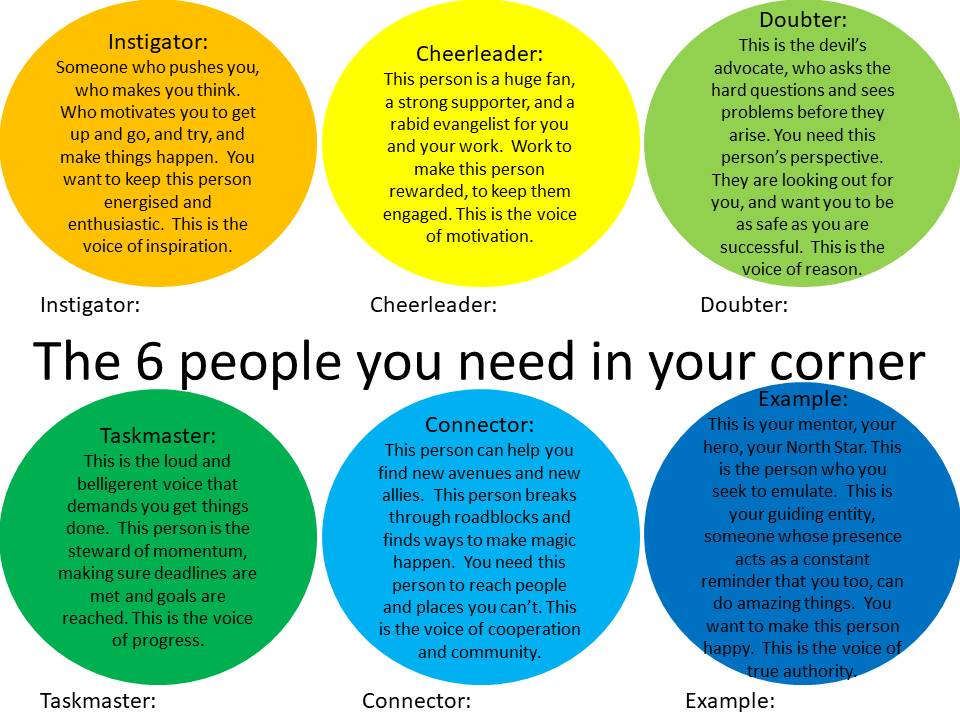
6 people in your corner OR 5 mentors you need?

Several years back one thing I picked up, presumably from some talk or online article was the notion of having 6 people in your corner.  Basically, these represented 6 characters that would help and support your leadership journey.  They didn’t all have to be different people, although they could be, or some, or all of them could be the same person.

The 6 characters were:

The Instigator: Someone who pushes you, who makes you think.  Who motivates you to get up and go, and try, and make things happen.  You want to keep this person energised and enthusiastic.  This is the voice of inspiration.

The Cheerleader: This person is a huge fan, a strong supporter, and a rabid evangelist for you and your work.  Work to make this person rewarded, to keep them engaged. This is the voice of motivation.

The Doubter: This is the devil’s advocate, who asks the hard questions and sees problems before they arise. You need this person’s perspective.  They are looking out for you, and want you to be as safe as you are successful.  This is the voice of reason.

The Taskmaster: This is the loud and belligerent voice that demands you get things done.  This person is the steward of momentum, making sure deadlines are met and goals are reached. This is the voice of progress.

The Connector: This person can help you find new avenues and new allies.  This person breaks through roadblocks and finds ways to make magic happen.  You need this person to reach people and places you can’t. This is the voice of cooperation and community.

The Example: This is your mentor, your hero, your North Star. This is the person who you seek to emulate.  This is your guiding entity, someone whose presence acts as a constant reminder that you too, can do amazing things.  You want to make this person happy.  This is the voice of true authority.

Back in about 2009, when I first discovered this, I knew exactly who these people were.  Some of them wore multiple hats for me.  After about 2011 when I’d changed jobs, I really could not pinpoint anyone amongst my work colleagues that fitted any of those roles for me.  Happily, I am once again in the position where I can identify at least one person, even if it’s the same person, for each of those roles.

I’ve just read an article by Anthony Tjan on ideas.TED.com who suggests that we should have 5 mentors:

The Master of Craft: “If you know you want to be the best in your field — whether it’s the greatest editor, football quarterback, entrepreneur — ask, Who are the most iconic figures in that area?” says Tjan. This person can function as your personal Jedi master, someone who’s accumulated their wisdom through years of experience and who can provide insight into your industry and fine-tuning your skills. Turn to this person when you need advice about launching a new initiative or brainstorming where you should work next. “They should help you identify, realize and hone your strengths towards the closest state of perfection as possible,” he says.

The Champion of your cause: This mentor is someone who will talk you up to others, and it’s important to have one of these in your current workplace, says Tjan: “These are people who are advocates and who have your back.” But they’re more than just boosters — often, they can be connectors too, introducing you to useful people in your industry.

The Copilot: Another name for this type: Your best work bud. The copilot is the colleague who can talk you through projects, advise you in navigating the personalities at your company, and listen to you vent over coffee. This kind of mentoring relationship is best when it’s close to equally reciprocal. As Tjan puts it, “you are peers committed to supporting each other, collaborating with each other, and holding each other accountable. And when you have a copilot, both the quality of your work and your engagement level improve.”

The Anchor: his person doesn’t have to work in your industry — in fact, it could be a friend or family member. While your champion supports you to achieve specific career goals, your anchor is a confidante and a sounding board. “We’re all going to hit speed bumps and go through uncertainty in life,” says Tjan. “So we need someone who can give us a psychological lift and help us see light through the cracks during challenging times.” Because the anchor is keeping your overall best interests in mind, they can be particularly insightful when it comes to setting priorities, achieving work-life balance, and not losing sight of your values.

The Reverse Mentor: “When we say the word ‘mentor,’ we often conjure up the image of an older person or teacher,” says Tjan. “But I think the counterpoint is as important.” Pay attention to learning from the people you’re mentoring, even though they may have fewer years in the workplace than you. Speaking from his own experience, Tjan says, “Talking to my mentees gives me the opportunity to collect feedback on my leadership style, engage with the younger generation, and keep my perspectives fresh and relevant.”

They both cover a lot of the same ground but Tjan has some interesting other ideas.  I know who my Champion and Copilot are.  I think I am my own Anchor really.  I’m pretty clued up to my own values and setting personal priorities to achieve a good work-life balance.  I’m not sure who my Master of Craft is at the moment or my Reverse Mentor as I’m fairly disconnected with leading or mentoring anyone at the moment.

Do you know who you’d have in your corner or who are your 5 mentors?

50 Ways to Enjoy Turning Fifty

My sister bought me this book for my birthday last week.  I thought I’d better take more than a cursory look at it.  It claims to have 50 ways to make this the best year EVER.  The book is set out in chapters based on making the most of turning 50, planning the best year EVER, implementing the plan, treating yourself well, having fun, looking back, looking within, expressing gratitude, putting things in order, eliminating what you don’t need, giving and looking forward. 

Each chapter has key questions to help you analyse yourself and figure how to make the most of turning 50, thought experiences to delve a little deeper and activities to do. It does say that you can dip in and out of the book, fast forward to the bits that most interest you and so on but being a pedant, I started at the beginning.  

Way #1 Accept your age. 

Thought experiment 1 asks you to make a list of people you admire who are over fifty and who are living terrific lives and make a note of what you admire about how this person is living their life.  OK, so first thing is to think of people over 50 who I admire.

I’m not going to list them all here because some of them might read this and either be embarrassed or disagree.  I’ve written each of them in the book.  Suffice to say that it includes C, my parents and siblings, a few former work colleagues, and some ringers I know. In some cases, I admire what they have achieved over adversity.  In others I admire what they’re currently doing with their lives, and if I’m honest, I’m probably a bit jealous of.  Some I admire because I wish I were more like them.

The key questions were what are some benefits of turning 50? and What are you looking forward to this year?

I guess benefits might include being that little bit wiser sometimes.  Having more opportunities to reflect on what I want out of life and trying to achieve a better work/life balance. Nearer to retirement age (although still some considerable way to go).  Looking forward to getting to see R again.  This year has been an exception and we haven’t been able to spend time together, so as soon as we can we’ll do that.  Can plan for the trip that we should have had for my 50th birthday.

Thought experiment 2: what concerns do you have about turning fifty?  What challenges are you experiencing or expecting? Which of those can’t you change? What constructive actions can you take regarding that item?

I’m not really bothered about turning 50.  It’s just a number.  I guess ill health, or my level of unfitness is probably going to be an issue at some point.  I’m feeling less tolerant of other people, which I need to reign in a bit sometimes and there are other things that I’d rather be doing with my time but have to work instead. I can’t change that for a few more years yet unless something amazing comes up, like winning the lottery.

Quick fire round

I’m not one for small talk. I find it difficult to think of what to say. Its probably something to do with my introversion. I find it frustrating when meetings start with lots of random conversations that have nothing to do with the meeting agenda. I understand the purpose. An ice breaker, or checking in on others wellbeing and so on. But then I get to the point of “can we get on with it now please”?

Just for funsies I was having a play with a random conversation starter generator to see if they were the sort of things you could talk about in a room full of strangers, or at the beginning of a meeting whilst everyone is getting settled. Try some out. Here are the first 10 questions the random conversation starter presented to me.

What is your biggest fear? Losing my child.

What is your dream job? Not sure really. Like making cakes but not sure if I’d want to do it for a living. Thought about opening a cafe once. I guess not needing to have a job might be a dream.

If you were asked to teach a class, what would you teach? Baking.

Do you prefer baths or showers? Bit personal that one. Showers.

If you could choose any era to live in what would it be? Toss up between Tudor, but only if I was at Court. Or early 1900s when so much exploration and new invention happening.

What is one thing that you would like to change about the world? I suppose I ought to go for something like ending poverty or hunger or climate crisis but a big thing that gets me riled is hypocrisy.

How would you know you were in love? If I couldn’t stop thinking about someone or wait to see them and my heart started beating faster.

What is the longest amount of time you’ve slept for? 2 days. I went home from work ill on a Monday and woke up on the Wednesday.

Do you recycle? Yes!!!!

Do you prefer cats or dogs? Neither but if pushed on the subject dogs. Cats are selfish and mean.

Hmmm. Some of them are hardly conversation starters as they have a one word response. I suppose the idea is to then ask follow up questions but for some conversation done. I’m not sure that some of them would be appropriate at the office either but hey, if the conversation stops, I’ll throw one in and see what happens. 🤣

What’s the weirdest question you’ve ever been asked when the conversation got stuck?

What’s stopping you from letting go?

Another one of those self-awareness quizzes (I’m getting quite in to them now) was all about what’s stopping you from letting things go and moving forward. This could be an incident that keeps holding you back, lack of self-confidence, lack of imagination, capability or opportunity.

So having answered the obligatory 10 questions – why do they feel the need after question 4 and question 8 to let you know that you are now 40% and 80% complete? – it spewed out my results:

Self-Awareness

Ruminating can become habitual, the go-to place for your mind to wander. But constantly rehashing old arguments, decisions or events keeps them live and fresh. Next time you find yourself sucked into an overthinking spiral, check in with how you feel. If your mood has taken a downturn or you’re feeling anxious, your thinking is not helping you resolve anything. Increasing self-awareness by making time every day to do a mindfulness exercise can help you get into the habit of observing the stories your mind is telling you without getting sucked into them. Try starting your day with a mindful shower – focus on feeling all the sensations and smells. When your mind wanders, observe where it has gone without comment or analysis, then bring yourself back to the present. It may also help to schedule daily ‘worry time’ and park your overthinking until a specific time of day, preferably when you’re relaxed and in a good frame of mind. If, when worry time comes around, you don’t want to go over old stuff, that’s a bonus.

I do actually go over things, again and again, and try to understand the different nuances of what has happened, why it happened, what could have been done differently, how I could have reacted differently.  I also spend a lot of time thinking about why am I spending so much time thinking about it.  I often tell myself to move on. 

I guess that I’m one of those who constantly beats myself up about things.  There’s always something I could have done better, or should have done that I didn’t, or did that I shouldn’t have, or that I really ought to give more time to. I replay conversations over in my mind multiple times.  “What if I’d have said this”? or “if they’d have said that I could have…” and so on.

I’m not sure that I want to schedule a daily worry time, as there are some days when I don’t overly worry about anything in particular, and I’m not sure that you can necessarily schedule it.  Things that will cause worry that are triggered by other things and can happen at any time.  I might be in the middle of one thing and something on the radio or that I’ve read will trigger my brain to relive a previous worry.

I try to learn from previous errors and hope not to repeat them (not always necessarily successfully) however, I do find it really hard to forget about them and move on, even when a solution has been found, agreed and implemented.  I will stew over it, even after some considerable time. 

I guess I need to learn how to deal with it in the moment, resolve whatever it is, and then move on.  Step away.  Park it.  Easier said than done.

How adventurous are you?

I do not think I’m the adventurous type at all.  I like home comforts. I like routine.  I like to know what I’m doing and when so that I can plan around it.  I’m not particularly great at trying new experiences.  Although I did do an abseil once.  I did go skiing when I was at school.  I do like to travel and see different places. And I did make my husband do husky sledging a few years back. But I’m not spontaneous, or good at thinking of what others might see as exciting things to do.

So, I thought I’d try and find out what the experts say about whether I’m an adventurous sort or not and turned to one of those on line quizzes that thinks its gets to know all about you and your preferences by asking you a mere 10 multiple choice questions.  According to the results:

You are excited by new experiences

Cosmopolitan, smart and savvy, above all, you get your kicks from interesting experiences. You flourish when your mind and senses are nourished and flounder in a cultural vacuum. The buzz of a new exhibit, the hush as the theatre curtain parts, or the flavours of a new cuisine all excite your palate and thrill your thoughts. For you, the conventional is dreary. Because you open yourself up to a wide array of artistic and intellectual interests, your world is ever expanding.

Well, as it happens, yes I do like the theatre.  We do try to at least make an annual trip to see a West End show each Christmas time (2020 being the exception) and if anything else takes our fancy in the mean time we’d go along.  I do like to learn new things and educate myself.  I enjoy certain types of museums and exhibits and enjoy a good National Trust property or English Heritage site.  I do like eating, so trying new things from time to time is good, and when we are on holiday abroad I do like to try something that might be considered local cuisine (so long as its not fish!).

So I might not be adventurous in the sense that I like to do extreme things like water sports (I have a phobia of water so that’s not going to work), or bungee jumping, or fast paced stuff, I’m more of a slow, steady adventurer. I’m less keen on the “let’s do something crazy” and go for more of the “let’s plan a nice trip out”. 

A while back I did do a year (and am probably still doing it) of saying “yes” to everything that came my way.  This was both exciting to take on new challenges but worrying as some of the things I was asked to do put me in the spotlight, somewhere I’m not comfortable with.  However, it did give me a chance to connect with new people, and has stretched my own learning and capacity. The downside is that I now get involved in lots of things that I can’t always give sufficient time to. So there’s a fine balance needed.

So, maybe I am unconventionally adventurous and my world is ever expanding, just slowly.

Magazine Questionnaires

Do you ever do those questionnaires in magazines? You know, the ones that tell you, depending on your score, what is in store for you in the coming year, what your personality traits are, or what your love life will have in store?

I remember as a kid the only magazine I bought with any regularity was Smash Hits. The only questionnaires they did worked out which pop star you were likely to marry. Of course you had to do the quiz over and over again until you got the answer you wanted. BTW, the only legitimate answer was Simon le Bon 😍

As I progressed (?) on to mags like Cosmopolitan the questionnaires were more along the lines of “how to make him fancy you” and “why your friends don’t like you much”. I guess they thought they were some sort of attempt at self help.

In the workplace over the years I’ve done many, many psychometric tests like Belbin, designed to find out your fundamental personality traits, then try to convince you how you and your colleagues could all work together in perfect harmony despite your differences. I’ve done Belbin so many times for different reasons. I still come out as ISTJ, the logistician. Introverted, observant, thinking and judging. I like facts and data. I like methodology and practicality. It means I’m honest and direct, strong willed, dutiful, responsible, practical. But on the flip side I can be stubborn, insensitive, always by the book, judgy, and self blaming when things fail.

Because I’m not spontaneous or outgoing I find it hard to make friends or trust people’s motives, or express emotions freely (until really pushed). This is the area I’m working on hardest and the moment and I don’t mind telling you, its bloody hard.

I did a magazine questionnaire this week in Psychologies Magazine about what kind of comfort do you need. Each question has 4 options to choose from then you count the times you’ve selected a particular response and it tries to explain what area you need to search in order to find solace.

Have you ever noticed there’s always at least one question where none of the answers is applicable?

Apparently, according to the number of hearts, diamonds, circles and squares I ticked, I have equal measure of hearts and squares. That means that I need to be looking for something spiritual and relational.

By spiritual it doesn’t mean finding God or some mystical thing, but could be in the form of rituals that allow time for reflection, and to connect with others. It suggests that I should focus on treating everyone with kindness, respect and lack of judgement and increase deep listening, filter out the gossip.

Relational suggests investing in meaningful connections with people and changing the relationship I have with myself. Being more compassionate with myself will, apparently, help me find comfort from others.

So, take my intovertedness and difficulty in making friends, insensitivity, stubbornness and self deprecation and just go out there and make meaningful connections. Just like that. Easy. Not.

Suggestions welcome.

Worth the wait?

Yesterday I ordered some books from Amazon which I hope arrive during the coming week, as I have some annual leave and therefore time to read them. Amazon told me that they should all arrive the following day.

Today Amazon tells me that my parcel should arrive today any time before 10pm. Thats going to be scary if the doorbell rings that late at night!

I have high hopes for these books. They will help me to understand and do better in the social media world. At least that’s what I’m hoping. I hope they are worth the wait.

According to logisticsmgepsupv.wordpress.com we spend around 6 months of our lives waiting in line for things, 43 days on hold with automated customer services, and 27 days waiting for a bus, 32 minutes per day waiting for a doctor, 28 minutes in a security line at the airport, 21 minutes for our significant other to get ready to go out, and 38 hours a year sitting in traffic. A Daily Mail survey suggested that we wait around 4 months of our lives waiting for the kettle to boil.

Sometimes the planning and experience associated with the waiting process can be extremely pleasurable. Like the smell around the house when you’re baking chocolate brownies. The creative processes of art, cooking, crafting, travel, and a myriad of other things can give as much pleasure during the creating or planning process as the final product does. And when you have that final product, it will be all the more sweet knowing the effort it took to create it.

As I’ve said before, I am an ongoing development as a human being and am trying to get as much pleasure out of the creation of the person I want to be, as much as what the end result might be.

Good things come to those who wait, apparently.

Why we do what we do

I have the next week off work as annual leave. I have no plans, and no real thoughts about what to do with my time. I have a couple of reports to write and could bake something but other than that, because we can’t go very far due to lockdown, no other real thoughts about what to do. That got me thinking about why we do what we do (or not).

You could take Maslow’s hierarchy of needs and work through that systematically, but does that cover it? Yes, there are some basic needs that ought to be addressed: the need for food, shelter, sleep, company etc. We need our elements of security around employment, health and some material belongings. There is certainly a need for friendship, family, love and a sense of connection. But then we get on to the things that you could argue we don’t NEED, we just WANT. Respect, recognition, strength, and then self-actualisation – to be the best we can be.

There’s another school of thought that suggests a different solution to why we do what we do.

A sense of obligation – to share experience and knowledge, the obligation to serve others. A sense of duty, and pride – perhaps via volunteerism, a call to action, pride in a job well done and our want to succeed. We should be wary of the vice like self intention, cunningly disguised as “being in our best interests”, which only really offer temporary pleasure. Acts of kindness and our altruistic love for the benefit of others. Passion for our favourite activity or cause, our desire to do something. The desire to “tick the box”, perhaps something off our bucket list, but could lead on to somewhere else. Our destiny may be coloured by family tradition, a hobby or particular calling that other family members before us have excelled in. Yes, there’s a need to have a sense of fulfilment to keep us energised and empowered through our self-actualisation. But maybe we do it for others, to have something to share or for the “greater good”.

Tony Robbins, an author and podcaster, as well as being a mutli-billion dollar entrepreneur, in his TED Talk and book, describes 6 human needs – certainty, significance, variety, love/connection, growth and contribution – and how each influences our thoughts, feelings, behaviours and actions. By understanding what drives us, we can understand how to meet those needs. The same for people around us, once we know what drives them, we can help them meet their needs too.

At a very fundamental level, I know I need to be safe, secure, independent and have a sense of purpose. The narcissist in me does need some form of appreciation every now and then, but I certainly need feedback to make sure that I’m at least heading in the right direction and to help me achieve some personal growth. I need to be educated. I need to understand things and learn from them. I try to encompass all of that in my working, social and family life and am conscious that I don’t always get it right.

Opening doors

When I get asked to give talks its one of the scariest things and takes me on a roller coaster ride.

My first question is why have they asked me? And the cynic in me replies “because they need to fill a slot and you’re an easy ask“. But maybe, just maybe, its because its a topic I know about and the person that’s asked knows that I can do a half decent job of it.

My first real worry then is what on earth have I got to say that anyone would want to listen to. I’m no one special. I haven’t done anything earth shattering brilliant or enlightening or entertaining. No one is going to want to hear me spout on about xyz when there are far more interesting and entertaining people who could do it.

Then there’s the “what am I actually going to talk about“. The latest ask hasn’t been too specific yet so I’ve asked the question. I could redo a talk I’ve given on a specific topic before, so I won’t have to prepare anything new, or do they want something different?

Then there’s the “how long have I got”? This is where, once I’ve written my talk I’ll time it to make sure it fits and I get all the main points across. I’ll read and re-read through it multiple times, including immediately before delivering it.

Then there’s the “oh my god, how many people will turn up? Supposing no one does?” Well, that’s not really under my control to do anything about. The one good thing about doing talks over Zoom is that you can change the view so you don’t have to see everyone’s faces and therefore don’t know if there’s one or one hundred people watching. Of course the trouble with doing that is then you miss out on any visual cues from the audience, like wanting to ask a question or wanting you to get a move on and shut up.

I generally don’t get nervous about giving talks, its the bit afterwards. Whilst I’m talking I know what I’m going to say, I’m well prepared, I’m in control. I’ve been to the loo, I’ve got a glass of water handy. But at the end when the facilitator opens things up to questions, that’s when I start getting nervous. What if someone asks a question I don’t know the answer to? Or worse still, I don’t even understand the question? The former can be resolved quite easily with a straight forward ,”you know, I don’t know the answer to that but I’m going to go away and find out, then I’ll let you know”. That’s all good if you actually do that, which I always make a point of on the rare occasions it happens. If I don’t even understand the question I’m not beyond asking them to rephrase it. Particularly if its quite a technical question, I’ll make a joke of it and ask them to dumb it down for those like me who are not technically minded.

The thing about giving talks is that they can open doors to lots of opportunity. An opportunity to meet new people, to listen to their questions and think about things from their perspective, to get involved in something else as a spin off, to be heard by someone who wants you to give your talk to a different group and start opening doors again with another different audience.

As much as I dread doing it for all the reasons above and want to say no, the chance of more doors opening and more new experiences happening is too great an attraction, however flattering the ask was in the first place.