How to find and live out your purpose

Image by burrough from Pixabay

Do you sometimes think if you could just figure out what your life’s purpose is, your life would be complete?  I have done occasionally.  I wonder what the point of me is, why am I here? What am I meant to be contributing to the world?

Purpose is the reason for which something is done or created, or for which something exists.  In figuring out what your purpose is, you get to decide why you exist, why you’re doing something.  Your purpose can be being intentional and deciding how you want to show up, who you want to be. 

There are those who in their early years have a clear view of who they want to be when they grow up, a doctor, a lawyer, a writer.  Most of us though probably don’t have a strong sense of who we want to be.  I’d never have thought I’d be doing what I am now.  I never really thought about what I wanted to be or do.  R had very clear views.  At first she wanted to be a forensic scientist and we helped her towards that route.  We looked at what she needed to do at University and worked it backwards through A levels and GCSEs.  When it became apparent that she probably wasn’t cut out for that, an opportunity arose for her to play with photography, and that’s where she excelled.  She was a natural at it. She did photography at A level and even her teacher said there was nothing more she could teach her, she needed to go to Uni to do it, and that’s what she did.  Unfortunately the world of photography is a difficult one to get into, particularly if you lack self-confidence, but she has eventually found a job that revolves around camera equipment and is happy taking photos for fun.  She’s even had a couple of commissions over the last few years.  She found her thing.

If you think about what has led you to this moment, you stop trying to find your purpose and focus on deliberately showing up as the person you want to be. It takes practice, but things will begin to change.  When you refocus energy from resisting your job or what you do now into creative energy you can think about other things you want to experience.  When we are curious about other opportunities and projects they lead to the next step, and the next, without necessarily knowing what the outcome will be. 

You may still not know what the ultimate outcome will be but your purpose will be whatever you want it to be and whoever you decide to be.  Beyond that you get to choose to involve yourself in things you’re curious about and that may take you down another route.  Take the pressure off yourself and decide who you want to be as a human being then live that out no matter where you are or what you’re doing. 

For me, I think I’ve taken choices, particularly at work, that have served my needs at the time.  I reduced my hours when R was at school and I took a job that was much lower banding than I was used to.  Not long into it, I started to see opportunities to make efficiencies, to make the process better and get more information out of it as a result.  That lead to promotion.  Eventually I went back to full time, and in a role that gave me opportunity to process and plan, and organise.  Over the course of the next six years, I got promoted three times based on my emerging capabilities.  As a result of that I was then head hunted for a job with a major increase in responsibilities.  From there I’ve used my abilities to plan, process map and monitor.  This has put me back into the project management world, which makes good use of those skills. 

I feel that my purpose is to organise things and people, and look at processes to try to improve them.  I also have a number of curiosities outside of work that I dabble in but so far have not taken the braver step into investing fully into them.  I am keen to learn and explore areas of unfamiliarity. 

I think I will always return to organising.  It’s what I do.  I must be my purpose.

What’s yours?

Discovering my creativity

Image by Anthony Arnaud from Pixabay

I have never been what might be traditionally considered a creative person.  I cannot draw or paint, I cannot write poetry or prose, I cannot create beautiful crafts or a tranquil garden. I have tried different crafting activities before, things like making my own cards, cross-stitching.  I did them both for a while but soon lost interest.  I make cakes from time to time but generally only if there is a need and I’m ok at making sugarpaste flowers, but cannot really do character moulding.  I don’t think I do this often enough for it to be classed as my creativity outlet.

Having a creative hobby is supposed to help boost brain activity and help us cope with stress and promote positivity and wellbeing.  How we think about our creativity though expands into it being something that you discover over time, or that you excel at but take for granted and do it without thinking.

An article I was reading recently suggested that we could discover our own creative outlet by asking what gives us meaning and brings joy, what situations are we drawn to, what makes us unique, what do our friends love about us and what we daydream about.  This might be cooking, gardening, listening to others, making people smile or being really organised.

Once you have discovered what your outlet is think about how you excel at that and what it looks like to you, being proud of the attributes you have and how they set you apart from others.  When we think outside the box and explore ways to expressing your talent we can discover different ways to experience this more often.

I have spent some time reflecting on these questions and I still haven’t found what my creativity is.  If any of you feel moved to respond to the question of what my friends love about me, then feel free to drop a comment. 

I am still exploring who I am and came across a short quiz (https://ideas.ted.com/quiz-whats-your-creative-type/ )that proposed to help discover what my creative type was, here’s the results:

Result: You’re an Artisan.

You believe that being creative is its own reward. You’re driven to find the right rhyme, brush stroke, chord progression or tap technique. You truly love what you do, and you feel grateful that you get to do it. You can sometimes get so immersed in what you’re doing that you forget about your loved ones. Your dedication to your work and your willingness to share the credit also make you a great collaborator.

Just remember: You have a tendency to fall down a creative rabbit hole when you’re endlessly deliberating and fussing about your artistic choices. You are generally good with external deadlines, but when you’re not given a deadline by a producer, editor or client, sometimes you can get lost. In these instances, you need to establish your own self-imposed deadline and — this is important — mini-deadlines too. You’ll have to fool yourself into thinking your work must be completed by a particular date. Ironically, practicing this self-deception shows that you’re being real with yourself and your tendencies.

https://bottomlineinc.com/life/self-improvement/the-five-creativity-types described the Artisan creative as:

  • happy to follow your creative pursuit even if no one ever knew about it or paid you for it.
  • live for those moments of flow when you are so absorbed in creating that you lose all awareness of time and place.
  • love the creative process even more than the finished product.

To maximize creativity and stay motivated…

  • Indulge your desire to study, deepen and perfect your craft. Having a greater repertoire of tools will increase your natural enjoyment of your art.
  • Collaborate. Artists whose skills are complementary to yours can boost your confidence and take your art in satisfying new directions.
  • Ask for fair compensation for your work—don’t just give it away. Artisans find the work itself so rewarding that they can happily put countless unpaid hours into their art—potentially putting themselves at financial risk.

I love to study and learn in an effort to whatever I do better, although don’t actually know what my “art” is.  I like to find like-minded people to bounce ideas off and finding out other opinions and views.  I am not money motivated, although it does come in handy.  Fair assessment I’d say.

Finding a kindred spirit

Image by Gerd Altmann from Pixabay

I was reading an article about Saira Khan, star of the 2005 series of The Apprentice and later Loose Women presenter, wellness fanatic and entrepreneur about how she felt that life was started at 50, breaking barriers and being her authentic self. Whilst there are obvious differences, like the fact she has a £2.3m house in Oxfordshire, she looks amazing and has an evolving business, the difference seems she seems content not to have to prove herself anymore.

We do both seem to have taken the opportunity of turning 50 to have a time of reflection and taking stock of where we are in life and what we want for ourselves, rather than for others. In her words “I can’t please everybody and I don’t want to please everybody”.  She clearly has an advantage over me in that she can afford to do what she wants, work how and when she wants and can afford all the niceties money can buy. However its not money, prestige or fame she’s interested in, rather not doing things she’s no longer happy doing, and looking after herself mentally and physically.

It seems that she had to work hard to get it and due to her upbringing created a persona of being loud, opinionated and assertive.  She felt that she had to be that way in order to break down religious, familial and workplace barriers.  She is clearly a confident person and doesn’t suffer fools gladly.  I can identify with some of the issues she faced and some of the ways she has responded and how others perceived her.

Obviously she was taking part in a photo shoot and interview so of course she was made to look glamorous, but it was her words that resonated most with me in expressing herself and what she wants personally.  Like me, she wants others to see that there is another side to her.  She’s not opinionated all the time.  She’s not shouty all the time.  She’s not assertive all the time.

Whilst I am fundamentally an introvert, there are groups of people who don’t see me that way.  They see me as assertive, firm, judgemental and not afraid to say what I think. Mostly, that’s so far from reality.  I don’t say half the things I think, or feel and sometimes that’s the right thing, but then I don’t say half the things I probably need to to the people who need to hear them.  I struggle with decisions in certain circumstances.  I need a level of validation and confirmation that I’m doing the right thing.  I try to do what’s right for everyone else sometimes to the detriment of what’s right for me.

Turning 50 has given me that opportunity to re-evaluate what I want for me, where I want to be in the next 5-10 years’ time, how I want to be comfortable in my own skin.  As I said before, I have considered things that I did in my younger days and let go for one reason or another, and reawakened what I had then that I want to return to now. It’s been quite liberating reinventing myself, although not everything I did 30 years ago I could get away with now. 

Am I making a good impression?

Image by Gerd Altmann from Pixabay

Must admit, this is something that evades me at times.  I have been told that I have a resting bitch face, and that a lot of people find me scary on first meeting me. There’s a number of reasons for that but I suppose the combination of those two things don’t make for a good first impression.

The Young Entrepreneur Council suggested 10 things that improve a first impression:

  1. Smile, it makes people happier  – something I’m not naturally good at.
  2. Be present, give the other person 100 % of your attention, put the phone away and listen.   I’m ok with that one.
  3. Be on time, be respectful of other people’s time – I am usually the other way, I turn up super early for things, I like to make sure technology is working if it’s a virtual meeting, or get there in plenty of time, I would rather be hanging about that be a minute late.
  4. Be authentic, be yourself – I am very much “what you see is what you get”. If I don’t agree with you, I’ll tell you, I don’t try to be something I’m not, it takes too much energy.
  5. Make eye contact, stand your ground but also so the other person they have your attention – I try to do this as much as possible but sometimes it’s difficult.  It can be a bit creepy or appear confrontational.  I worked with someone once who barely even opened her eyes when she spoke, let along looked you in the eye.  She used to do this weird fluttery thing (not in a flirty way) that I found intensely irritating.
  6. Show confident body language, moving slowly and confidently shows you take yourself seriously and confidently – I think I’m generally confident in how I move.
  7. Ask questions, this shows you’re listening – I do ask questions, sometimes those questions that everyone else is thinking but don’t want to ask in case it makes them look stupid, I’m not afraid of that.
  8. Put your phone away, be present – This is one of my pet hates.  When people constantly look at their phone during pre-arranged meetings, especially when they are the one who instigated the meeting.  It’s just rude.
  9. Show sincere interest, explore others’ uniqueness – I try really hard to explore people’s skills and knowledge, but also what they want and where they want to go.  I will help people progress, much to my own detriment when they go off for a better role elsewhere, but I’m pleased to have helped them on their way.
  10. Exude warmth, make someone feel warm and fuzzy when they’ve left. Exuding that feeling through being exceedingly kind, staying ultra-engaged in what the other person is saying and staying authentic, you will be seen as a trustworthy and all-around good person – I probably need to work on that one.  Some people leave a meeting with me with more knowledge, or supported, or valued, but I know I’m known for not being particularly warm and fuzzy.

I know that I can be judgy of other people, although I’m trying hard not to be so judgy, and I know others’ are judging me. How do I make them judge me with a good impression?

“Thanks for the Feedback”

Image by Gerd Altmann from Pixabay

One of the best ways to learn is from feedback from others but it is useful to get the right feedback from the right people at the right time. 

That’s not to say only as for feedback from those you know will give you a glowing report.  We need to invite those with whom we have had less favourable experiences with. The most useful feedback is from those who work most closely with you; those who can actually observe your behaviour frequently.

A few years ago as part of my Masters I had to do a 360 degree feedback session.  I invited several of my peers to give feedback, and that included someone, senior to me, who I thought I had a difficult relationship with.  I wanted to explore that more and find out whether my perception of our relationship was the same as hers.  To my surprise, she gave me really constructive, glowing feedback and even said that she was in awe of me.  This from someone I thought had it all together and was the most capable person I could imagine. When I explained that I had invited her to participate as I felt that we didn’t have the best working relationship she was totally shocked.  She felt that we got on really well and that as someone who reported in to her on certain tasks, I was the most reliable, capable person within the team.  From that moment on, my relationship with her only go better.  It is important though, that those who participate in giving feedback are encouraged to do so honestly and openly. 

When asking for open, honest feedback we need to be open to the results.  We might not always like what we see.  It can be too easy to become defensive or discount the negative comments.  It is worth noting though about how much value you place on that person’s opinion.  You may have invited them to provide feedback, but are they the person who has most influence, or the person that you really need to get on side?  After some negative feedback I received once, I shared it with a trusted colleague who asked me how much I needed to value that person’s view.  It is after all just one person’s view and should be taken alongside everyone else’s and not be given more credence over the majority view that you get back from everyone.

The whole point of getting the feedback is to learn from it and decide what, if anything needs to be changed for the better and what you need to carry on doing.  Picking out themes will help overcome the tendency to dwell on one comment.  Get the general vibe from all responses rather than stick to one.

Then of course, you need to put this learning into action.  Developing an action plan to help address some of the areas that need more work helps you understand your impact it has on others and what it means for you to become effective. Then plans need to be communicated with others, you might need buy in for your own line manager, or authorisation to attend a course. Monitoring progress and asking for further feedback along the way is also useful so that you and others can see progression.

One of the best books I’ve read on the subject of feedback is called Thanks for the Feedback by Douglas Stone and Sheila Heen.  I read it shortly after a disastrous confrontation which, had I been less self-aware, may have resulted in me walking out.  From it I developed an action plan to feedback to the person I had the confrontation with.  I knew I had to do things differently, but so did they.  The way they had treated and tried to humiliate me in front of others was unacceptable. 

I ended up with a sheet of A4 with three columns:

  • How you made me feel
  • What I’m going to do
  • What you’re going to do

This particular person was very big on feelings; that you can’t change how someone felt about something.  I told her exactly how she made me feel, warts and all.  I admitted that there were things I could have done better and I listed some of those, they also included things like not being taken for granted anymore and not putting up with poor senior leadership.  Then I shared with her a list of things that I thought she ought to do differently.  Again, she was keen on the phrase “if you want a different outcome, you need a different input”, something she tried to apply to other people, just not herself. She was truly shocked.  I think partly because I dared to suggest that she had also been in the wrong, but also I just don’t think she realised the impact that she’d had.

I came out of that situation a much stronger person.  I lost all respect for her as my senior and did what I had to do to get by, but as soon as the opportunity arose, I moved into another area so I did not have to have anything further to do with her. 

Feedback is useful to help identify our Blind Self, the areas that we don’t know about ourselves but others do, and can support a plan to move towards our Open Self, the area that both you and others know about you.

How do you engage with the unengagable?

Image by Terri Cnudde from Pixabay

That million dollar question all leaders want the magic answer to. 

I’ve done many a course and read many a book or article on how we should be engaging with people to get the most out of them and provide them with job/participation satisfaction.  We are told that we should include them in decision making, regularly communicate with them, and invite them to participate in projects that will allow them to share their expertise and grow their skills. We should be empowering them to make decisions.  We are reminded that a disengaged team can cause a drop in morale and performance and be disruptive.  https://jouta.com/blog/how-to-re-engage-a-disengaged-employee/

But there are some who just don’t want to be engaged with.  They want to be valued, they want to be appreciated and for their efforts to be noticed. They want reward for doing a good job (some even want reward for doing an adequate or poor job, or for simply turning up at all).  They want to feel listened to and communicated with.  They want to be involved.  That is, right up until the time when you invite them to be involved.

One thing I struggle with time and again is trying to get people to look wider than the work that is right in front of them, especially when they tell me that they are not happy, or feel undervalued.  I invite them to participate; I offer courses that support their current role and any development they might want.  I provide them with opportunities to use their knowledge and skills and to develop processes and procedures or plans that they will ultimately be responsible for. I provide open door opportunities to share ideas and talk freely.

But they just don’t want to play.

I’m not the sort to press gang unless absolutely necessary, I ask for volunteers. There are times when I have had to say “you and you are going to help with this” but I want to see who has a spark, who is interested, and who wants to be involved. I shouldn’t be the one suggesting all the process changes; I’m not doing the job.  I can see opportunities to improve efficiency or process, but ultimately they have to own and be accountable for it, so it makes sense that they help develop it.

We are reminded that people respond positively when they are empowered to make choices and decisions for themselves, yet when they are given the opportunity they don’t want to take it. Figuring out what matters to them and how to spread positive stories, exchange ideas openly, and disseminate best practice is all well and good but only works when morale is already high and people are generally happier. https://www.achievers.com/blog/how-to-convert-a-disengaged-employee-into-an-engaged-one/  In this current climate, that’s really hard to do in a virtual world.

I think it also depends on the example they are given.  Enthusiasm breads enthusiasm, contempt breads contempt.   I try to be as upbeat as I can and to understand frustrations others are going through trying to deliver their piece of work or part of the project.  I acknowledge that not everything can be done as perfectly as we might want it to be and sometimes corners might need to be cut in order to meet a more pressing need.  I understand that there are often outside pressures that affect how motivated they feel.  However, there are usually others in closer relationships that seem predetermined to be pessimistic about everything. Everything is a disaster, it’s not their fault, and it’s nothing to do with them, they are not responsible or accountable.  That kind of vibe tends to spread like wildfire and before you know it most of the team is feeling down.  They don’t realise that they vibe they are giving off is affecting how others feel and then it spirals. 

I know that it’s extremely hard to eternally upbeat about everything all the time, it would be exhausting, and I certainly have my days when I’m not motivated or interested at all.  But if I want a more optimistic team around and people to be more engaged, then it’s my responsibility as a leader to start that vibe, or to find help when I need it.  If I can change one person’s attitude, which can then spread to someone else, I’d be happy.

I want people to develop, I want them to be fulfilled in what they do, be satisfied at the end of the day they did all they could to use their strengths.  I want them to feel they have all the information they need about what’s going on in their immediate and wider world.  I want all these things for them and provide opportunities for that.  They just don’t seem interested in taking it. People complain about lack of development, I give them the opportunity to develop, they don’t want to take it. They complain about not knowing what’s going on, so I tell them but then they don’t listen or connect the dots with the relevance to them. I need to make more of an effort to ensure the message is put across in a ways that does demonstrate relevance to them.

Whilst it would be great to have one to ones with absolutely every person to determine what motivates them and how they could be better developed, communicated with etc, the practicalities are not so simple.  It might be that I wouldn’t need to do that with everyone, just take a few key people to one side and address their motivations, then through the wonders of osmosis everyone else will feel more engaged and valued.

Reflecting on some of the reasons why previous attempts to engage others hasn’t worked it is useful to consider these questions:

  1. Who in my team have I connected with the least? what gets in the way of connecting with them more?  
  2. Think about the people I connect with the least in my team, service users and peer group, and notice any similarities.
  3. Think about who in my team I enjoy connecting with and why?
  4. Think about those who I feel psychologically safe around and why? and those who I do not and why?. What are the differential factors?   

There are many tools to try but I still don’t have a solution for how to engage the unengagable.

A course, of course

I’ve been thinking for a while now about whether or not to do a formal course in public relations to support the work I do for the Central Council and at local level. All that I have learned so far has been on the job, immersive and quite often responsive., and because I have a full time day job, I’m not always picking up signals that require a response, or that could be utilised to our advantage.

I’ve been having a look around to see what’s on offer, and probably prefer an online course that allows me to work at my own pace around everything else I’m doing.  But of course, these courses come at a cost; some in the region of £1,500 – £2,500, depending on what level you want to study at.

I would be prepared to cough that up myself if I was absolutely confident that the course would give me the tools I need, in the sector I’m in and support what I have time to do.  I wouldn’t dream of asking anyone or organisation to fund it if there wasn’t that guarantee.  But how do you really know? 

I’ve read through the “Who this Course is For” and learning outcome pages, but they all seem to be very business orientated.  I’m looking at the charitable, local organisation sector, which is possibly different in parts.  And as I’m not likely to move into PR as a career, can I justify the expense, or should I just stick with winging it?

One of the main things I want to work on is my writing skills.  Seems odd for someone who brain dumps into a blog every day, but there we are.  I want to be able to write more engaging news stories so that the media will take up our stories and we gain more public awareness, and therefore greater recruitment prospects and also greater acceptance, acknowledgement and appreciation of what we do.

There is one course that I’ve seen that has reference to writing skills in it and it seems a bit cheaper than all the others. It seems to be from a reputable organisation https://collegeofmediaandpublishing.co.uk/product/public-relations-course/ and for £500 covers:

  • An intro to PR
  • Newswriting techniques
  • Writing effective news releases
  • Communicating with the media
  • Online PR
  • Handling a crisis
  • Using TV and radio
  • Organising a news conference
  • Law and reputation management
  • Using other PR tools
  • Running  a PR campaign

Each lesson includes a practical assignment and is marked and graded by tutor, and at the end you get a Level 4 Diploma (equivalent to the first year of a Bachelors degree) in Public Relations. 

I’m quite tempted.

Virtual Quarter Peals

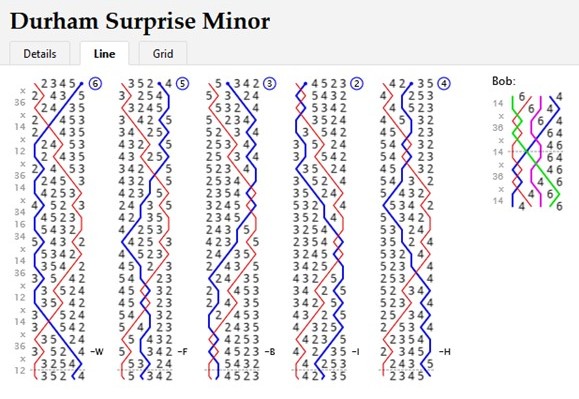
C and I were invited to ring in a virtual quarter peal with some friends to welcome a new grandchild for one of the ringers that we ring with every other week.  The method of choice was Durham Surprise Minor.

I have never rung this method on tower bells and have only learned it as a result of virtual #bellringing sessions and working our way through the standard surprise minor methods.  I did do my usual trick of volunteering for the treble to start with, but then thought that I had learned the method and should really try ringing it on an inside bell.  I opted for my next favourite starting position of the second.

I was rather pleased with my performance, as I knew where I was throughout the quarter peal and even knew when other bells should be dodging or elsewhere in the change.  At one point it got a bit hesitant, but I knew that I was dodging at the back and therefore two other bells needed to ring before me.  C was conducting it, and sitting next to me, heard me say that I was at the back (all other mics were on mute).  He was then able to sort the jumble out.  I feel that I acquitted myself well and was rather pleased to have achieved a quarter peal in a new method. This is now the 6th virtual quarter peal I’ve rung.

Being able to use Ringing Room for practicing old and new methods has been an absolute godsend during lockdown and I’ve been really chuffed that I’ve been able to learn methods that I wouldn’t get to ring in a tower usually.  This is generally because we don’t ring 6 very often and when we do, the people we ring with don’t tend to know many minor methods.  However, with a core of us now ringing these regularly in Ringing Room, maybe we can translate that into the tower when the time comes to returning to ringing properly.

For now, we have to be content with ringing a couple of real bells in our tower on a Sunday morning and ringing all sorts of interesting things in the virtual world.

Being in the Zone

I’ve just watched a 2 minute excerpt from a TED talk given by learning expert Eduardo Briceno on what he considers to be the key to high performance. https://www.ted.com/talks/eduardo_briceno_how_to_get_better_at_the_things_you_care_about?utm_source=linkedin.com&utm_medium=social&utm_campaign=social&utm_content=2021-3-18-cutdown

We all go through life trying to do the best we can, and equating that to #bellringing, we all turn up at practice night, or Sunday service ringing, or for a wedding or special practice, or quarter or peal attempt or, at the moment virtual practice, with full intention to do the best we can.  To ring the method accurately.  To strike our bell in the right place.  But at a practice night we’re there to try to learn new things as well and extend our repertoire (if we want to).

Briceno offers that sometimes, despite our best intentions we might not always get any better at the things we want to achieve, despite working hard at them.  What he learned from his research is that we should deliberately alternate between two different zones.

Learning Zone: here the goal is to improve.  So we undertake activities that help that improvement.  This could be attending a training day, reading around the subject, watching YouTube videos, asking others for advice, standing behind someone while they ring, asking for feedback and so on. Here, we spend time concentrating on what we haven’t mastered yet, and expect to make mistakes along the way knowing that we will learn from them.

Performance Zone: is where the goal is to do something as best as we can, to execute it.  Where we concentrate on what we already have mastered and try to minimise the mistakes.  This might be ringing for a special event or a peal attempt, or a striking competition.

Briceno suggests that we should be deliberately alternating between the two zones to purposefully build our skills in the learning zone in order to apply them in the performance zone.  Being clear about when we want to be in each of these zones, with what goal, focus and execution in mind helps us better perform and improve. The performance zone maximises our immediate performance, whilst our learning zone maximises our growth and future performance. The more time we spend in the learning zone the more we will improve in the performance zone.

To be able to spend more time in the learning zone we need to believe that we can improve, we must want to improve that particular skill, we must have an idea about what we can do to improve. Just performing the same method over and over again doesn’t necessarily help us improve. Without the process of practice, making mistakes, getting feedback and revision we will tend to stagnate in our current “safe” zone; methods that are familiar and easy, that we won’t feel like we’d be ridiculed for if we go wrong.  My favourite is “if in doubt, ring the Treble”, that way I’ll stand a better change of not going wrong, or mucking it up for everyone else. The trouble with that is, I don’t progress myself.

In our #bellringing context this could be the difference between learning the theory of a new method and practicing it on a practice night on using an ringing simulator, in order to perform it to the best of our ability of a Sunday morning, or during a striking competition, or a quarter peal or peal. I also know that I’m really bad at this too.  Often I might turn up to a practice having not put enough effort into the learning part, and then hash my way through it, or do enough to just get by without making too much of a pigs ear, but I haven’t learned it properly and will immediately forget it because I’ve not gone back over the bits I find difficult, or asked for help.

My latest thing is to try to learn to ring handbells.  I don’t particularly want to ring handbells quarters or peals, but I want to be able to hold my own if I were asked if I could ring something simple.  It’s been nearly 40 years since I learnt to ring a tower bell so going back to the beginning to ring handbells, to unlearn some of the things I’ve learned on tower bells and learn them in a different way, has been, so far, really quite difficult.  However, I must persevere if I am to reach a decent performance zone.  I must make that effort and spend that time in the learning zone, read, watch, listen, practice, make mistakes, get feedback, try again and eventually I will improve.

6 people in your corner OR 5 mentors you need?

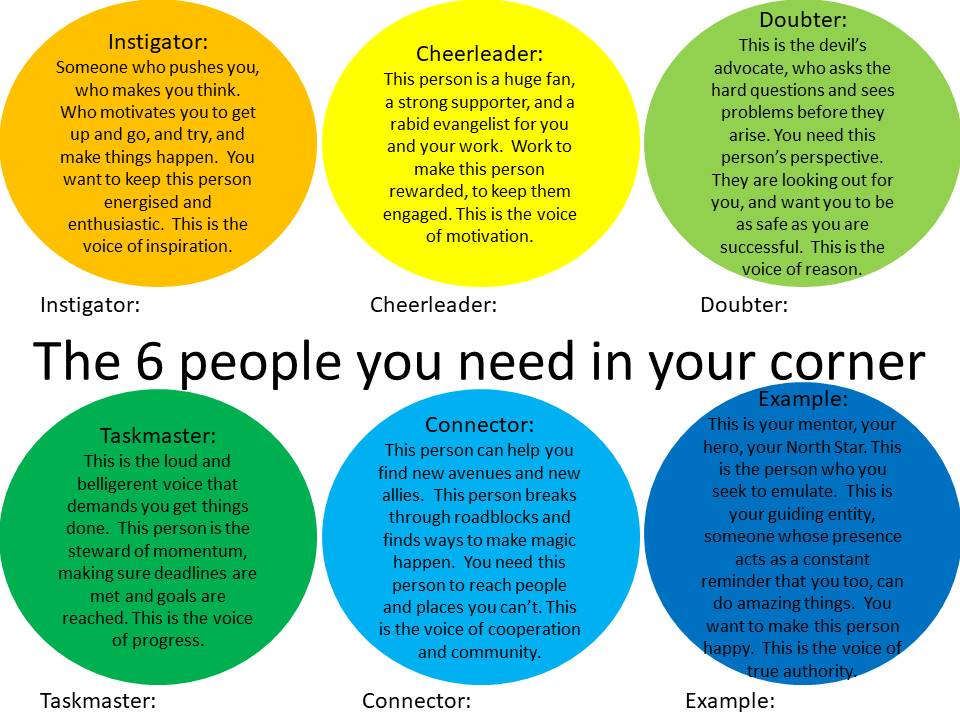
Several years back one thing I picked up, presumably from some talk or online article was the notion of having 6 people in your corner.  Basically, these represented 6 characters that would help and support your leadership journey.  They didn’t all have to be different people, although they could be, or some, or all of them could be the same person.

The 6 characters were:

The Instigator: Someone who pushes you, who makes you think.  Who motivates you to get up and go, and try, and make things happen.  You want to keep this person energised and enthusiastic.  This is the voice of inspiration.

The Cheerleader: This person is a huge fan, a strong supporter, and a rabid evangelist for you and your work.  Work to make this person rewarded, to keep them engaged. This is the voice of motivation.

The Doubter: This is the devil’s advocate, who asks the hard questions and sees problems before they arise. You need this person’s perspective.  They are looking out for you, and want you to be as safe as you are successful.  This is the voice of reason.

The Taskmaster: This is the loud and belligerent voice that demands you get things done.  This person is the steward of momentum, making sure deadlines are met and goals are reached. This is the voice of progress.

The Connector: This person can help you find new avenues and new allies.  This person breaks through roadblocks and finds ways to make magic happen.  You need this person to reach people and places you can’t. This is the voice of cooperation and community.

The Example: This is your mentor, your hero, your North Star. This is the person who you seek to emulate.  This is your guiding entity, someone whose presence acts as a constant reminder that you too, can do amazing things.  You want to make this person happy.  This is the voice of true authority.

Back in about 2009, when I first discovered this, I knew exactly who these people were.  Some of them wore multiple hats for me.  After about 2011 when I’d changed jobs, I really could not pinpoint anyone amongst my work colleagues that fitted any of those roles for me.  Happily, I am once again in the position where I can identify at least one person, even if it’s the same person, for each of those roles.

I’ve just read an article by Anthony Tjan on ideas.TED.com who suggests that we should have 5 mentors:

The Master of Craft: “If you know you want to be the best in your field — whether it’s the greatest editor, football quarterback, entrepreneur — ask, Who are the most iconic figures in that area?” says Tjan. This person can function as your personal Jedi master, someone who’s accumulated their wisdom through years of experience and who can provide insight into your industry and fine-tuning your skills. Turn to this person when you need advice about launching a new initiative or brainstorming where you should work next. “They should help you identify, realize and hone your strengths towards the closest state of perfection as possible,” he says.

The Champion of your cause: This mentor is someone who will talk you up to others, and it’s important to have one of these in your current workplace, says Tjan: “These are people who are advocates and who have your back.” But they’re more than just boosters — often, they can be connectors too, introducing you to useful people in your industry.

The Copilot: Another name for this type: Your best work bud. The copilot is the colleague who can talk you through projects, advise you in navigating the personalities at your company, and listen to you vent over coffee. This kind of mentoring relationship is best when it’s close to equally reciprocal. As Tjan puts it, “you are peers committed to supporting each other, collaborating with each other, and holding each other accountable. And when you have a copilot, both the quality of your work and your engagement level improve.”

The Anchor: his person doesn’t have to work in your industry — in fact, it could be a friend or family member. While your champion supports you to achieve specific career goals, your anchor is a confidante and a sounding board. “We’re all going to hit speed bumps and go through uncertainty in life,” says Tjan. “So we need someone who can give us a psychological lift and help us see light through the cracks during challenging times.” Because the anchor is keeping your overall best interests in mind, they can be particularly insightful when it comes to setting priorities, achieving work-life balance, and not losing sight of your values.

The Reverse Mentor: “When we say the word ‘mentor,’ we often conjure up the image of an older person or teacher,” says Tjan. “But I think the counterpoint is as important.” Pay attention to learning from the people you’re mentoring, even though they may have fewer years in the workplace than you. Speaking from his own experience, Tjan says, “Talking to my mentees gives me the opportunity to collect feedback on my leadership style, engage with the younger generation, and keep my perspectives fresh and relevant.”

They both cover a lot of the same ground but Tjan has some interesting other ideas.  I know who my Champion and Copilot are.  I think I am my own Anchor really.  I’m pretty clued up to my own values and setting personal priorities to achieve a good work-life balance.  I’m not sure who my Master of Craft is at the moment or my Reverse Mentor as I’m fairly disconnected with leading or mentoring anyone at the moment.

Do you know who you’d have in your corner or who are your 5 mentors?