Is #bellringing the pursuit of aimless joy?

Image by Pexels from Pixabay

I was reading an article about how a woman and her child walked round and round in circles in the deep snow like Winnie the Pooh and Piglet.  It had no purpose, barely counted as exercise and once more snow fell they’d do it all again.  Sometimes for over an hour.  #bellringing can be a bit like that.  We can go ringing, be it practice night, a quarter peal or peal attempt, a training day or service ringing.  Sometimes #bellringing can have no real purpose but we do it anyway.  When the child was asked why she was trudging in circles in the snow for ages, seemingly pointlessly, her simple answer was because it’s fun. #bellringing can be like that too!

Ask people who make sand sculptures, or balance stones, why they do that when they know their efforts will be lost to the elements, and they’ll tell you that it helps them shed stress, entertain others and in some cases “mess with people’s heads”.  #bellringing can be like that too! Once we’ve rung our bells, the sound is lost for ever (unless you’ve recorded it and uploaded it to YouTube). It was transitory; there and now gone.  But we do it for the fleeting joy of the activity itself.

We can spend a lot of time obsessing over personal goals and problems, feeling the weight of expectation and the fears that go with them.  #bellringing can trick us into take a break from all of that.  I often consider it therapy after a bad day at the office.  To be able to do something physical, that requires my full attention, and stretches my brain.  It can become a meditation, a moment to be in the present.  When we ring with others we can feel that we are part of something bigger but it’s equally as transient as our few moments or hours of #bellringing itself.

When we think of #bellringing vanishing into the larger scheme of space and time, along with any method mistakes we may make, we needn’t be afraid to try a new bell, a new method, have a go at conducting something for the first time.  In the few moments that follow, it becomes ephemeral and consigned to history.

When your brain refuses to engage

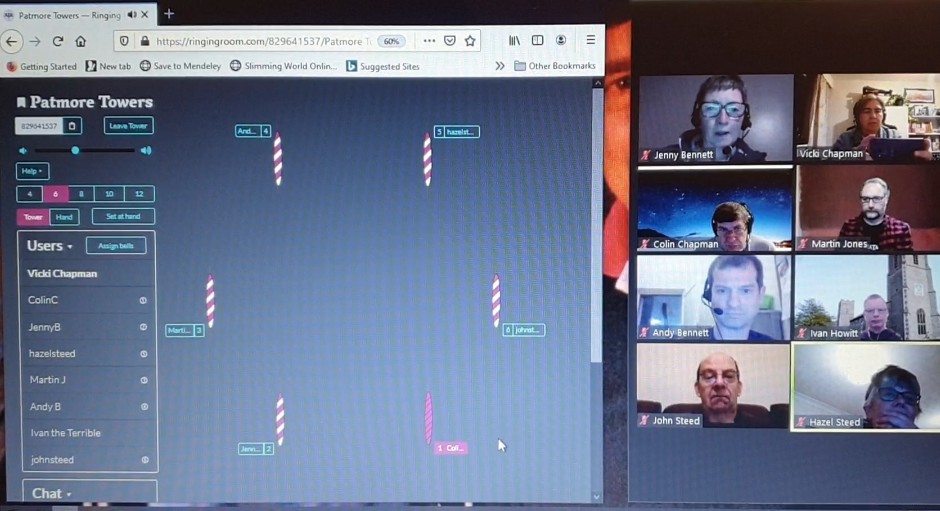
I run a friends and family virtual #bellringing session on a Thursday evening.  We have methods of the month, so we have four or five weeks to really get to grips with them.  This has been successful to varying degrees.  At the beginning of each month when we start new methods everyone is a bit tentative but its good to see that by the end of the month everyone is much more confident, and we can get plain courses round and even sometimes venture into touches.

For July I decided to try splicing two of the methods that we had previously rung rather than try to learn another new method.  This was to help consolidate our learning of the previous methods and introduce some people to the concept of splicing methods together and getting to know the lead end order.

I, for one cannot recite lead end order of methods, not even the ones I know very well.  Therefore, I do struggle a little when we splice some together, although I find it easier on tower bells than on virtual bells.  I totally understand the theory of the place bell that you are at backstroke when the method is changed, but for some reason really struggle to see it on Ringing Room in either 5ths or 6th place.  I can see it better in 2,d 3rds and 4ths. This inevitable means that I go the wrong way, and there’s a bit of a hiatus and/or clash as the bell doing to opposite work is trying to do what they should be doing. 

As with all of these new methods we are trying, I’m sure towards the end of the month it will be much improved.  What was noticeable last week was that on the Thursday evening I really struggled, yet on the Friday morning at a different practice but ringing the same things, I got it so much better.  Maybe it’s the difference between a practice in the evening after a day at work when my brain isn’t in gear, to first thing on a Friday morning, when its all fresh and keen.  I don’t know.

It was lovely to see our “sometimes” visitor Will this week who we haven’t seen for a couple of months.  He has an open invitation to come along when he can, so we never know if he’s going to show up or not, and he takes pot luck on what methods we are ringing, but it expert enough that it doesn’t matter to him.  Apart from C and myself, he’s never met any of the others in our Thursday night group in person, but it’s lovely that everyone is welcoming and friendly, and he joins in with the post ringing chat.  We’ve had some cracking conversations.

As with real ringing, there’s an element of apres ringing, in a virtual pub instead of the real thing, but C and I do take the opportunity to crack open a bottle of beer.  It’s almost like the real thing. 

Like so much else we are waiting for the chance to get back to real ringing, practice nights, quarters and peals… and the pub!

Coming Unstuck

Sometimes, I just don’t have any ideas.  I feel uninspired, unfocussed and generally “meh” about things.  Fortunately, this doesn’t happen frequently, but every now and then I feel like there’s nothing there.  I can talk with others, inspirational people, and still have nothing to contribute or feel that is worth sharing.

Clinical psychologist Dr Terry Singh suggests that to get unstuck we need to understand that getting unstuck is not the same as feeling better about something, or successfully changing, rather that is it the first step towards change. He suggests starting with focussing on the experience of being stuck, this could be something physiological, a tensing or chest tightening, that could lead on to feelings of anxiety. Knowing what you know about yourself, your feelings and experiences and so on is what helps you get unstuck. We need to delve deeply into those experiences; usually we only scratch the surface when we consider our experience of the moment. Think about what you are thinking, one or many thoughts, physical feelings, level of comfort/discomfort, emotions – present or absent and intensity.  Dr Singh says it’s important not to take shortcuts when we consider our experience.  Taking a closer look at the blind spots in our experience is the key to unlocking change. 

We need to look at our physical state and how that impacts our internal state and impacting our thoughts and emotions.  It could be something simple like drinking too much coffee first thing in the morning is not likely to help you if you have high anxiety levels. 

Getting unstuck is more nuanced.  Singh says “Paying attention to your experience is a skill just like riding a bike.  The more we practice paying attention to our experience in our daily lives, the better we get at it.  The better we get at it, the less likely we are to get stuck when faced with a problem”.

When I have moments of creative block I usually remove myself from the scene.  Take time out to do something else and forget about whatever it was I was stuck with and go back to it another time.  Some suggest that you should ignore your most creative time of day and do whatever it is you’re stuck on at your least creative time of day.  This might be because you could be more insightful at non-optimal times of the day.  The focused energy can sometimes crowd out the eureka moments.

For some, according to a study by researchers in Germany, turning lights down low helps with a sense of freedom and reduces inhibition, which in turn can increase creative and help us come up with new solutions.

One that I have done myself, so can testify to it actually working, is to share the idea with someone that you don’t always agree with.  They will be your harshest critic and argue and debate it with you.  Having to defend your ideas helps expose its weaknesses and offers different viewpoints. 

The best suggestion of all, not that I’m advocating we should all do it, is to get slightly tipsy.  Alcohol decreases focus, which would not be good if you had to do something highly analytical, but it’s great for brainstorming.  How many times have we heard that the “best ideas happen in the pub”.

Next time I get stuck for an idea, I crack open a beer!  Cheers.

The Instant Gratification Monkey

I was reading an online article from Tim Urban, who studied why procrastinators procrastinate.  He possets that they can’t help it.  In their brain the procrastinator has the Rational Decision Maker who steadily guides the mind in to doing what needs to be done, and then there’s the Instant Gratification Monkey who sideswipes things and sends the mind off wandering for some instant satisfaction for information or other, that takes us away from our steady path.

The Instant Gratification Monkey takes us off to play in what Urban calls the Dark Playground, that space where all the fun, new, shiny things hang out that distract us from what we should be doing. In the back of our minds though is this constant feeling of anxiety or regret for that looming deadline or that thing that we’ve been working towards for ages.  When that deadline approaches though, it’s time for a visit from the Panic Monster who scares us away from the Dark Playground back in to a sense of productivity to get things done.

Urban offers three steps to turn procrastination into motivation:

  1. recognise that you are procrastinating.  Being aware of something is usually the first step in resolving it. 
  2. Understand the reason for the procrastination.  Is it the task itself, or is it you? Is it that you aren’t enjoying it, not qualified for it, or feeling overwhelmed by it?
  3. Set objectives, tactics and rewards.  Depending on the reason for the procrastination in the first place it might be as simple as having a to do list if you’re feeling overwhelmed, or someone that holds you to account, or if you promise yourself a treat if you get that thing done.

There are times that I procrastinate.  It’s not usually because I don’t want to do something, more that I don’t want to do that particular thing right now.  I will send that email out but after I’ve watched this episode of that tv programme I like.  I will write that report just as soon as I’ve finished making lunch.  I will learn how to ring handbells properly, just as soon as I’ve written that report and sent that email.  Sometimes it can become a vicious cycle.

Other days, I can blast through even the most boring, or painful task without so much as a second thought.  It’s about the frame of mind that I’m in.  Sometimes, I find being in a particular place, or with particular people helps galvanise me into action.  Sometimes I just wake up and tell myself that today I’m going to power on through all that stuff and clear my to do list.

Today has definitely been one of the latter type of days.  I’ve finished the first draft of a strategy document.  I’ve documented a framework that I invented that supports that strategy.  I’ve been for a power walk.  I’ve read the next section on learning to ring handbells and had a few goes at it.  My Rational Decision Maker was in charge today.

I wonder if that means tomorrow I’ll be all out of juice and my Instant Gratification Monkey will be running the show.

The same only different

Some of the more advanced #bellringing methods are variations on a theme. The work that you do in one method often becomes part of the work that you do in another.  Quite often experienced ringers will describe methods as “so and so over thingy” (obviously using real methods names).  For the educated this makes it easier to put those two methods together to create a new one.  For the rest of us though its pure gibberish.  I understand that its relative to where the treble is.

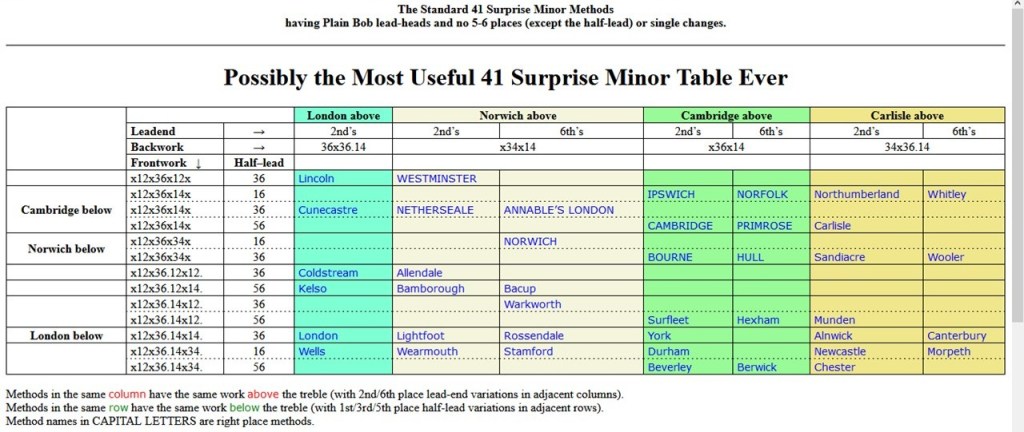
In the virtual #bellringing sessions that I run on a Thursday night we’ve been ringing York Surprise Minor and now moved on to Durham Surprise Minor. You can see a lot of similarities between the two. The experts in the group say that York is London below and Cambridge above.  That’s ok if you know London and Cambridge.  Durham is Wells below and Cambridge above.  Wells is Wells below and London above.  Confused?

There’s a really useful table at https://www.ringing.info/minor/minor_41.html and Complib gives you more information on what’s above and what’s below in each of the 41 Surprise Minor methods.

This week I’ve rung London below and Cambridge above, Wells below and Cambridge above, Wells and London.  I can’t learn them as one thing above and another below.  That just fries my brain. 

I can see that 5th place Wells is the same as 6ths place Durham and that 5ths place London is the same as 6ts s place York, which is, I suppose the same as the above and below bit, but I wouldn’t be able to figure that out without the line in front of me.

Mind…. blown!!

A different frame of mind

I think I’ve probably mentioned this before, but how we choose to respond to outside stimuli, pressures and events is entirely within our own undertaking.  We can choose to get wound up by things, or we can choose to let it go.

My first day back at work this week was horrid.  By the end of the day I was absolutely sure that the conversation when I got home was going to be around how much longer I would have to put up with this.  C was his usual stoic self and confirmed my worst fear that I would have to stick it out for a few more years yet.  Damn.  I felt exhausted after just 1 day back in the office.  I felt dejected.  I felt well and truly fed up.  This has a physical impact as well.  I was unmotivated to do anything else and I stuffed my face with crisps and chocolate. I felt physically sick at the prospect of having to go back the next day and deal with it all, all over again.

Fast forward a few days and I’m in a much better frame of mind.  The plans I put in place on Monday have had a positive result and things are looking ok for the coming week.  I’ve also made the conscious observation, out loud to others, about what I am currently employed to do versus what I get dragged back in to, through necessity, but that I shouldn’t really, and the impact that is having both on trying to deliver what it is I’m supposed to be doing, but also providing the right kind of support to those in the department.  A fuller conversation as to how that plays out is happening later this week.

My point being, my mind-set had changed.  I had chosen to not allow the frustrations at the beginning of the week to overshadow the rest of the week.  I packed that day away and moved on.  I’m not pretending it was an easy transition.  I still woke up on the Tuesday really not wanting to go to work.

According to the Mayo Clinic (https://www.mayoclinic.org/healthy-lifestyle/stress-management/in-depth/positive-thinking/art-20043950), whether you are a pessimist or an optimist can have an effect on your longer term mental health, but also has physical manifestations too.  Being more positive doesn’t mean that you gloss over the difficult things but that by approaching them in a more positive way can be more productive.  Making the best out of a bad situation.  Thinking positively can improve life span, reduce depression and distress, provide greater resistance to colds and better psychological and physical wellbeing, cardiovascular health and general better coping skills.

By focusing on positive thinking we can identify areas of life that may need changing, stopping to check on our thinking and finding ways to put a positive spin on it.  By being open to allowing yourself to have a laugh during difficult times can help you feel less stressed.  Following a healthy lifestyle is often cited, and probably the one I do least of.  Surrounding yourself with positivity will rub off on you and practicing positive self-talk will help you realise that you have a lot to be thankful for.

I’m heading to the end of this week with a much more positive outlook that I had at the beginning.

That was the week (or 2) that was

The end of my 2 weeks annual leave has arrived.  Monday morning sees the return to the office.  Have I had a good holiday?  Do I feel relaxed and rejuvenated?

Yes, I’ve had a good couple of weeks off, considering.  I don’t particularly feel relaxed or rejuvenated thought.  But I suspect that’s to do with the fact that we’re in lockdown and we can’t go anywhere or do anything or see anyone.

If we have been able to do things, I might have felt more energised.  As it was, I spent most of the week not venturing far from home.

The first week I took the opportunity to undertake an online Mindfulness course.  This was quite interesting and useful, but not something that I’ve suddenly found enlightenment from.  It did give me some focus for a few days.

I had 7 virtual #bellringing sessions during the fortnight, some which I ran. I watched a funeral online. I attended 4 meetings and 1 virtual dinner.  In between, I did some reading, played some games on my tablet and celebrated my 50th birthday, lockdown stylee.

I did spend some time, quite purposefully, doing not a lot.  C still did all the housework and cooking. 

This sort of gave me an insight to what life might be like at a time when I could give up paid work completely.  However, if that was the case, things would happen very differently.  I would see a fair distribution of household labour.  I would also probably do some form of exercise, whether down the gym or online stuff at home, or more walking at least.  I would definitely do more baking and cooking.  I do miss that a little bit.

I’ve had a good couple of weeks off and enjoyed not having to get up early and go to an office and get grief all day. I’m sure that feeling will be short lived when I open the office door.

Time to move on

Our virtual #bellringing practices on a Thursday evening with friends and family have had a bit of a progressive plan.  We started off with some simple “plain” minor methods i.e. where the treble plain hunts and worked our way up to surprise minor and then started introducing an 8 bell method as well.  We’ve had methods of the month for the past few months so we can consolidate our learning.

February saw us ringing York Surprise Minor and Kent Treble Bob Major, and for March we’re moving on to Durham Surprise Minor and Oxford Treble Bob Major.

A lot f the methods we played with I’ve never rung before, and some of the rest of the band haven’t either.  Its been quite a fascinating experiment.  Some of these methods I never would have thought that I’d ever ring.  I dare say, that when we get back to ringing in the real world, I’m unlikely to ring those methods in a tower.  The places we ring at regular just don’t ring that sort of thing. 

I would like to try and ring them in a proper tower, but suspect that that might require some engineering to get the right band and the right time. 

Some methods are transitory, they are stepping stones that help you understand more complex methods, and the likelihood of going back to them on a regular basis is minimal.  Some are very similar and are good to be spliced together for variation, you just need to remember which one is which.

My brain capacity isn’t good enough to retain all of these, so I suspect that if we were to try to ring them in a tower, I would have to relearn them all over again.

Still, its good fun, stretching the brain and having a go at things we don’t normally ring.

Every day’s a school day

It seems like it at the moment anyway.  Between doing my online mindfulness course, which has really challenged some thoughts and feelings, and learning methods for virtual #bellringing in Ringing Room sessions, of which I had 4 this week.

The first #bellringing session was a district practice which I didn’t need to learn anything new for but the session that I run on Thursdays we’re consolidating methods that we’ve been learning for February.  Some of those methods are repeated at a Friday morning session but sometimes something different.  Then every other Friday there’s another session that changes methods every time.  This week I needed to learn Newcastle and Alnwick Surprise Minor.  And in 2 weeks’ time, we’re aiming for London and Wells Surprise Minor, and I set new methods for our Thursday session at the beginning of the month.

Some of these methods I’ve never even looked at, always thinking they are beyond my capability but with the advent of Ringing Room, have been able to ring things that I wouldn’t normally get to ring in any of the towers that I would normally frequent.

Learning to ring takes time, even just the basics of handling a bell on your own, then you need to join in with others and make a meaningful sound.  Then you can move on to the more complicated stuff, but that tends to depend on others a bit more, as you can only ring to the standard of the most novice ringer in the band.  However, learning skills that require longer term commitment can be rewarding and stimulating for the brain.

A quick internet search shows that there are a multitude of sites that promote learning something new, from new skills, to new languages, to cooking and baking, knitting and creating videos.  I’ve always found learning something new to be rewarding.  It doesn’t necessarily make me an expert in it but it gives me better understanding, better skills, better adjustment and a wider range of things to do.

Having just completed the 6 week mindfulness course, I’m now looking around the site to find the next thing to dive into. 

Adrenaline Junky

Nothing like a crisis to get the adrenaline going.  Its all going a bit Pete Tong at the moment with former colleagues dying due to Covid-19 and staff off with either positive results or self-isolating, meaning that the service is about to fall on its knees.  However, a few strategically placed phone calls and lots of toing and froing has resulted in a bit of a plan that should help the situation a bit.  Also some positive clinical engagement, which was fantastic.

I’m not usually one that responds very well to instant and urgent changes, and trying to solve immediate problems.  I like to ruminate over things, check all the facts, formulate a plan, get everyone involved.  Time was not on our side so this week, and today in particular, have been very much making things up on the hoof, last minute conversations and plans, no time to overly consult, only with those that are critical, put a series of actions together and BAM! I can head in to the weekend slightly more relaxed about the prospects of the week ahead.

I feel surprisingly buzzy about it all to be honest.  The time has flown by, I’ve not been wondering what task to do next. I’ve jumped from one conversation to the next, to the next and to the next.  I don’t think I could sustain that level of activity or focus for too long, and admire those that do and those that work in environments that require that fast paced thinking and problem solving.

When adrenaline kicks in it stimulates our “flight or fight” responses.  When the body is flooded with adrenaline it helps focus and engages the brain, improving cognitive responses.  A bit like a massive caffeine hit.  Apparently, it can improve your eye sight as the pupils dilate, and improves respiration. Even after the triggering event there can be a residual feeling of high vigilance and excitement and can intensify those feelings.  As well as a burst of energy and strength the immune system gets a little boost too. (https://www.mentalfloss.com/article/71144/8-reasons-little-adrenaline-can-be-very-good-thing)

So, having started the day with the sad news of another colleague dying and not feeling like I wanted to really do much, at the end of the working day, I’m now bursting with energy and enthusiasm.  Just as well as I’m hosting a virtual #bellringing session tonight and had better be on my A game.