I’m one of those odd people who doesn’t like fruit, of any kind, and am quite fussy about vegetables, although I’m getting better at that one. The daft thing is though, that I like fruit flavoured things. I like strawberry, raspberry, citrus flavours, I just don’t like the fruits themselves. Sometimes it’s the texture (blueberries are like zits popping in your mouth), or the pips, or the smell, or in the case of bananas, there’s nothing right about those at all.
I am well aware that my snacking habits are very poor. I like cake, and biscuits and crisps and sweets, although I’m usually quite good at moderating intake. I am also well aware of the fact that I’m overweight, not particularly fit (and that’s another issue) and that as I get older my future self will not thank me for not looking after it properly.
So, today I’m starting an experiment. I read somewhere that you should taste something 21 times before you can actually determine whether or not you like it. I’m going to pick a fruit and make myself eat it for 21 days. I’ve chosen the strawberry to start with. Mainly because they often come in handy 100g sized pots.
The humble strawberry is a good source of vitamin C and manganese and contain vitamin B9 and potassium and are rich in antioxidants that may have benefits for heart health and blood sugar control. A 100g serving of strawbs contains 32 calories and only 0.3grams of fat, are low in carbs and can help reduce spikes in glucose and insulin and can help in the prevention of type 2 diabetes. https://www.healthline.com/nutrition/foods/strawberries#benefits
In the interests of balanced research and reporting, the strawberry is not all as innocent as it might sound. It can cause symptoms in people who have pollen-food allergy, causing itching and tingling in the mouth, hives, headaches and swelling of the lips, face, tongue or through. They may also interfere with thyroid gland function. As I already have chronic urticaria, it will be interesting to see if they affect that in any way, as I’ve just read that one of the things to avoid is strawberries! Oops. https://www.healthline.com/health/ciu/foods-to-eat-and-avoid
Day 1: I purchased a 100g pot of strawbs. Thought to myself “what the heck are you doing? You know you don’t like them? What a waste of money”. Then the other part of my brain kicked in and said “Do it, and tell yourself that you do like them. Finish the pot.” There were about 8 or 9 stawbs in the pot, some bigger than others that would require biting in two, some that could be shoved in as they were. I had them as my mid-morning snack. The first few that I popping in whole, I automatically screwed my face up. An instinctive reaction based on my previous assumed dislike. When I consciously noticed myself doing it, I then tried to consciously not do it. With 1 strawberry left, I made a concerted effort to not screw my face up. I made it. I got through the whole pot. Admittedly, some of them were followed with a swift swig of coffee. They left a weird acidic type feeling in my mouth and around my teeth. However, I did not feel any additional itchiness. I have told C all about it so that he can keep me accountable to it, and I’ll need to purchase some more.
As you know, I’m part of the #MSEBuddyNetwork where I work. A growing group of staff who offer support to others by way of listening and signposting people to other organisations or people for help and support.
This week on our usual Tuesday lunchtime catch up, we were joined by members of the second cohort of buddies, which was great. It not only shows that there is a need for this type of thing, but also that there are staff willing to act as Buddies and offer that support to their colleagues. Our Tuesday sessions are an opportunity for us as Buddies to get together and debrief, or share any concerns that we have. Its been really interesting to hear what some of the other Buddies are experiencing, and we are extremely careful not to go into any detail about particular conversations, to ensure privacy. It gives us the chance to help other Buddies out, to Buddy the Buddy, and to think about how we might respond if were found ourselves in a similar conversation.
Every so often someone external to the Buddy Network comes along to give a talk on a useful topic, or to share information about a group or organisation that might be able to offer extra guidance, or support to those in need. This week we learned about the “Here for You” initiative, a joint venture between Essex and Herts providers to support NHS staff mental health and wellbeing and offer in-reach and out-reach support, and can fast track to primary and secondary care where appropriate. Their model ranges from supporting compassionate leadership and management through increasing intensity to psychological support services.
One of the Buddy Network organisers shared an app that they had been made aware of during their Mental Health First Aid training called “Hub of Hope”. An app you can download on to your phone, and when you put in a location or postcode, it comes up with all sorts of organisations and places you can go to get further support for mental health concerns from its database of the UK’s leading mental health support organisations. It brings together local, national, peer, community, charity, private and NHS services in one place.
Whether we are dealing with colleagues at work, friends or family members, it is important to be able to access information, support and help when and where you need it. I would certainly recommend downloading the app, if not for you, then for someone you know.
An interesting question and one that does not reflect on your leadership style rather your leadership actions.
I’ve done many a leadership course, heck my entire BA (Hons) and MSc were based on leadership. A lot of literature covers the different leadership styles but I don’t recall at any point considering what my unique leadership contribution was.
We spent a lot of time dissecting Goleman’s Leadership Styles and deciding which most suited our personal style:
Commanding – “do as I say”, driven to achieve, works best in a crisis.
Visionary – “come with me” self-confident, empathetic, works best when changes need a new vision or clear direction.
Affiliate – “people come first” creating harmony and building emotional bonds, great for healing rifts and motivating people during stressful situations.
Democratic – “what do you think?” forging consensus from participation, inclusive, collaborative, great for getting buy-in and input from valuable sources.
Pacesetting – “do at my pace” high standards setting, conscientious, driven to achieve, great for getting quick results from a highly motivated team.
Coaching – “try this” developing others, empathetic and great for helping others improve and develop long-term strengths.
David Goleman “Leadership that Gets Results” Harvard Business Review March – April 2000
At some point during the exploration you come to realise that you are a bit of all of them and there’s a time and a place for each to come to the fore.
The difference with leadership contribution is not based on what leadership style you predominantly operate in, but what you actually do to contribute to the team/organisation etc. Thinking about what contribution have you made this year/month/week, what contribution do you want to make in the coming year, what lasting contribution do you want to leave your team/organisation with when you move on?
I would make that more simplistic by asking “how have I made things better”?
I have been with my currently employer for over 20 years now and have been fortunate enough to work in different departments that have given me different experiences and afforded me a wider understanding of how the whole organisation works. I have been involved in fantastic project management teams responsible for building multi million pound new hospital wings and centralising services which gave me greater knowledge of clinical and support services. I have managed two very large teams, one with over 250 staff that operated 24/7 and another of over 65 staff who are crucial to clinical functions.
During those opportunities, I would say that my unique contribution has been able to identify efficiencies from process mapping functions and designing out the bottlenecks that obstruct smooth operation of services. I have written strategy documents (doing another one at the moment) that impact on multiple parts of the organisation. I have written policies that support those strategies, and I have implemented changes to the way things are done that provide assurances, and make work practices more efficient and effective.
I am less keen on the managing people aspect of department/service management as I don’t think that’s where my strengths are. I am happiest reading, interpreting, reviewing, pulling apart, rethinking and redesigning. I do love a good process map, a set of statistics and a spreadsheet.
I still have a way to go before retirement but as I start to consider my latter working life and where I want to be in 5 or 10 years’ time I would prefer to utilise my unique contribution skills as several services that I connect with start to go through their restructure and consultations, to help define their purpose, strategy and policies. I hope that when the times comes for me to hang up my spreadsheets, that my unique contribution will have benefitted my teams, the organisation and ultimately our patients.
Some people just have it. The poise, the confidence, the strong measured voice using well-chosen words in a relaxed tone, they look and sound the part. They are indeed charm personified. They have “it”, that charisma that captivates and positively influences and connects to others on a physical, emotional and intellectual level. https://www.success.com/7-qualities-of-the-most-charming-people/
This week’s interesting read from Success Magazine offers 7 qualities that people with charisma possess and why it is important to try to emulate them:
They smile, sit or stand up straight, look people in the eye when they’re talking, instead of slumping or keeping a straight face all the time. Their body language gives out unconscious positive signals.
They can distil complex ideas into simple messages and don’t over complicate things, and are therefore more persuasive.
They have the innate ability to speak well and articulate their ideas well without preamble or waffle.
They are active listeners, making others feel special and heard.
They notice time and space and ensure that they are on time to meetings and provide the right time and space for a conversation.
They build rapport by adapting to others’ personalities.
They have something to say. Being great at listening and being persuasive doesn’t count if you have nothing to say.
We have come to expect more from people, we want them to be more understanding, empathetic, to empower others. Someone with charisma sees all problems as solvable and encourages others to step forward.
Sadly the article doesn’t offer advice or suggest ways for those of us with less charisma as to how we might improve. And some of these things would be more difficult to achieve if you were more of an introvert.
Be attentive, if you find your mind wandering during the dullest of meetings, pull it back and be present in the present.
Put people before rank. Engage with the person, not their job title. Take time to see the person within.
Be curious, ask questions, listen and be positive, draw people out and engage in a proper conversation with them.
Be aware of your tone of voice, friendly facial expression, open gestures and fully facing someone you’re having a conversation with.
Empower others by sharing a personal experience of your own. Give it that personal touch.
Be self-aware and don’t try to manipulate a connection. Others will see straight through it.
I know for sure that my face tends to give away too much if I’m bored by someone’s conversation, or I think they’ve said something ridiculous. Either that, or I go stony faced and have no expression at all and then people have no idea what I’m thinking and it unnerves them. I probably waffle a bit sometimes, other times I want to get to the point and move on.
I do try to be a good listener but there are certain subjects that my brain just totally switches off from, like sport and try as I might to be interested for the sake of others, I just can’t do it. Its all too easy now to be on a Zoom call, looking like you’re looking at the screen and paying attention, but all the while your reading emails or doing something else. A particular skill if you can touch type.
I guess on the charismatic scale of 0-10 I’m probably about a 2, about as charismatic as a cabbage (apologies to cabbages everywhere).
We had a brilliant day in Surrey with R, our daughter, who we haven’t seen since October. We walked along the river as far as Hampton Court Palace and back.
We bought sandwiches and picniced opposite some incredible Riverside properties. We almost got hit by a stray golf ball as the footpath takes you through the golf club. We saw nest building cootes and a small whirlwind across the longpond. We ate gelato in the park. A fab day and the weather was brilliant too.
I got a load of mumma hugs in before we left.
Our journey home was a bit more problematic. We were held up for about 2 hrs at a standstill on the motorway due to an accident, not too far in front of us ( we didn’t see it jappen) which closed both carriage ways.
Emergency vehicles were streaming past us. The Kent & Sussex Air ambulance landed just ahead. It was clear we were going to be here a while. Nothing to do about it so no point stressing. People were getting out of their cars to try and see what was going on. C got out at one point but to stretch his legs. People were bibbing their horns, flailing arms and getting obviously het up.
The bit that annoyed me most was the idiotic behaviour of other drivers who were just too damn inpatient. Some, started reversing up the on slip road we had just passed. This was the slip road that the emergency vehicles were coming from.
Even worse, some morons did a full aboutface and drove the wrong way back up the slip road. I only hope that they were met by a police car.
When we were finally moving we could see some of the extent of what had happened. Forensic vans were marking items on the ground. Someone was taking photos of a car on the other carriageway that didn’t look too damaged. Then we saw the motorcycle on the ground and what was left of a sports car on the back of a pickup. On the other side of the road was a set of green screens obviously keeping something from rubber neckers. I fear that someone did not go home today.
The impatience of drivers and motorcycles that weave in and out of traffic costs lives.
I am fortunate that I got to message R to tell her we arrived home safely.
On Friday we walked nearly 6 miles on a round trip to B&Q so C could get some metal straps for something that he was going to fiddle with. I think it had something to do with the front door but to be honest, I wasn’t really paying attention to him going into far too much detail about it.
I’m really looking forward to Sunday when we can finally go down to Surrey to see R. Haven’t seen her since the end of October apart from on family Skype or WhatsApp facetiming. We’ve missed Christmas, my birthday, C’s birthday, Easter and a whole bunch of other times. I need to see her in the flesh.
When we went into the first lockdown she came back home as all her flatmates at that time all went back to their families. It was great having her home. She has always enjoyed flowers and plants and took the opportunity to do a free online course in houseplant husbandry. Needless to say, for some years now, birthday and Christmas presents tended to include a houseplant of some description. It generally comes accompanied by a hand written set of information and instructions.
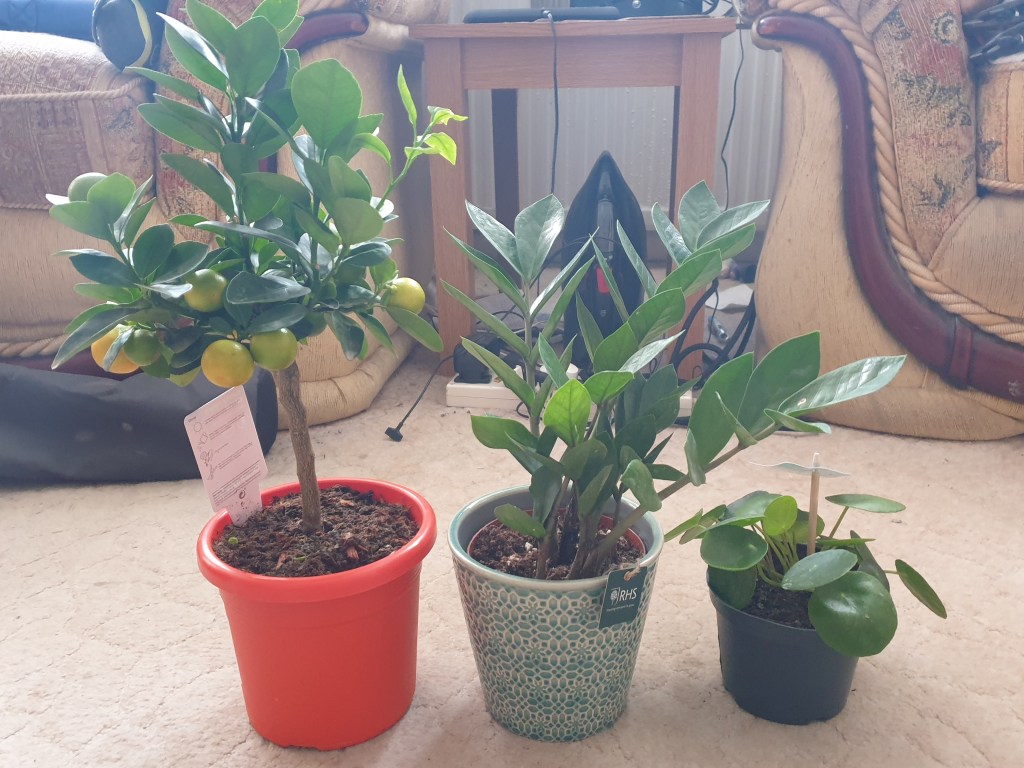
Anyway, as I knew we were going to see her and as we were at B&Q, I messaged her to see if there was anything she wanted. I sent her half a dozen photos of various plants. She questioned the prices of some. There was a snake plant she liked the look of until I told her it was £45!
She liked the look of a citrus plant but didn’t much care for the £18 price tag. But politely asked if we could get her a Chinese money plant for £8 “please and thank you, as my last one died”. Well, who are we to deny her. We have also bought her the citrus one, but drew the line at the snake plant!We still have a plant that we bought her for Christmas that we’ve managed not to kill off.
So, after Sunday service #bellringing we’ll head off with a trio of plants for our brilliant, funny, clever, intelligent, thoughtful, barmy nutcase. And I don’t care what the rules say. Mumma’s gonna hug.
One of the things on my To Do List is to update our entry on the Cathedral’s website. They are getting a new platform and whilst migrating things across, it has given them a chance to update things and make them look brighter with lots of fabulous photographs. I was asked to update the #bellringing entry, which to date, has been rather modest, and quite difficult to find.
I was looking around for information that others might find interesting and came across something written by I don’t know who, about the history of our bells. From early recording of possibly 4 bells, over the years we have augmented, had completely new casting and doubled from the 6 bells that were first recorded in 1768 to the unique set of 12 (+1) we have now. Here’s an extract:
The mediaeval church tower probably housed bells but little is known about them until the 16th century when, in 1560, bell metal was given by William Reynolds, William Mildmay and Richard Maryon, churchwardens. In 1586 a rope was made for the ‘great bell’, and by 1591 there appears to have been four bells.
Ringers were active in the 17th century for they rang in 1624 ‘when the Prince came home’ and were paid 5s. In 1685 the parishioners sought to put an embargo on the ringers’ pecuniary gains for they informed the churchwardens they should not “at any time upon a publick day of rejoycing give above seven shillings to any Ringers and if the Ringers of the Town refuse to ring upon such publick dayes of rejoyceing, it be ordered that ringers be not permitted to ring upon their own pleasure.”
The present Sunday Service band (currently 5 ringers plus others from neighbouring towers) regularly rings for morning services on Sundays (outside of pandemic times), as well as for Weddings and for other special occasions. The current custom is to attempt a Quarter Peal on the first Sunday evening of each month after the 3.30 evensong in order to provide a means of reinforcing what has been learnt during practices on Monday evenings. These quarters are on 8, 10 or 12 bells supported by ringers from other local towers. The band continues to do well in local and county striking competitions.
There are only two other rings of 12 bells in the and we can justly feel proud of our bells and the long history of ringing here.
From 6 to 8 bells
In 1768 Morant, the great local historian, recorded six bells at the church. Originally there appears to have been a ring of eight, but the parishioners gave two of them to a neighbouring church in exchange for their chimes. However in the 1770s there was an awakening to the art of change ringing, and on 11th July 1777 a new ring of eight cast by Thomas Mears was opened with a peal of Plain Bob Major to celebrate the occasion. In the space of a few years the Society of ringers was second to none in the eastern counties, gaining a reputation for ‘exactness of calling and striking’ far and wide, one noteworthy achievement being a ‘long length’ peal of 10,080 changes, in 5 hours and 50 minutes of non-stop ringing, at at another neighbouring church, in 1819.
10 Bells
In 1820 two new treble bells were added at the Cathedral, making ten in all, but the Society seems to have dwindled in the 1830s and there was no active resistance when the two new trebles were moved to the newly built church in a hamlet in 1841.
The bells continued to be rung for royal and civic occasions but it took the activities of the Association to shake the band out of its torpor. In 1881 the eight bells were rehung by Warner in time for the fourth meeting of the Association at the cathedral in 1882, where the Association has met annually ever since. The Association report for 1886 said: “The chief event of the year has been the recent restoration of the two trebles to their places at St. Mary’s. The county town and centre of the Association now possesses a good ring of ten bells, and all that is needed is a band of local ringers to do them justice.” This latter rather caustic comment was perhaps unjustified because it was too much to expect a competent band to emerge within so short a time of rehanging and augmenting to ten bells. There were 13 members in the band in 1887 but only two appear to have been accomplished 8-bell ringers: J. Parmenter, and William Rowland, senior, whose grandfather had been a member of the original Society. However, progress was made and by 1913 several leading ringers had emerged, including William Parmenter junior, E.E. Parmenter, Tower Captain, and Henry F. Cooper.
12 Bells
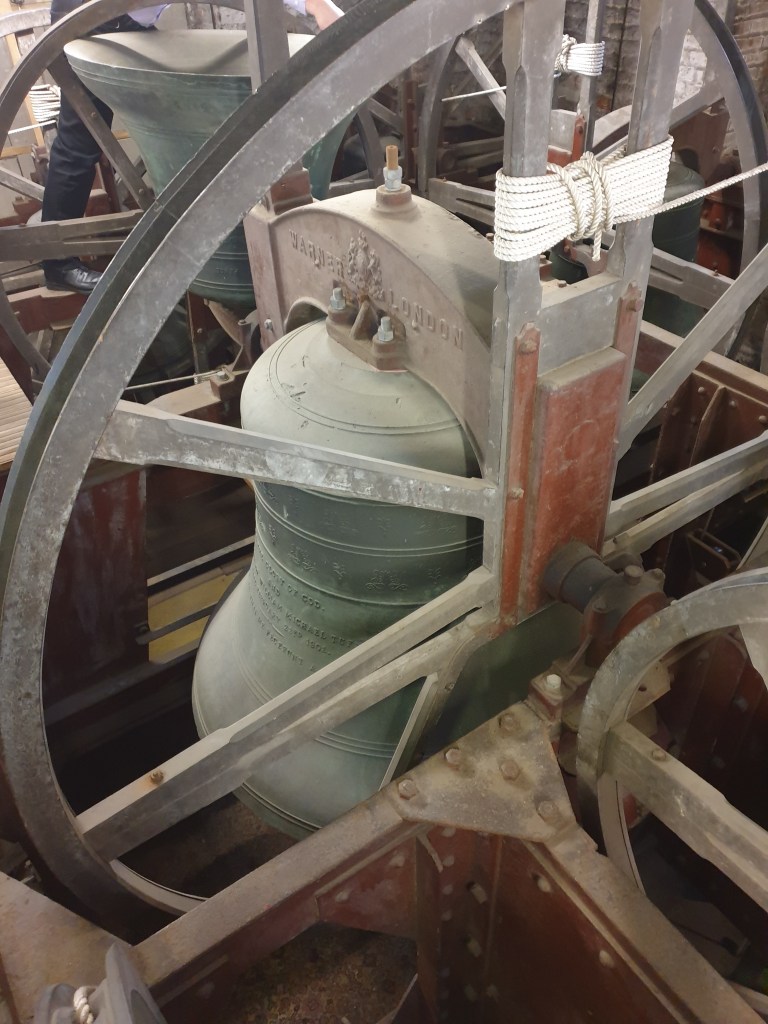
In 1912 an order was placed with the John Warner bell foundry (Cripplegate, London) to recast the ring of ten and rehang them in a steel frame, but with the offer of two more bells it was decided to cast a ring of twelve (we have the only complete ring of 12 Warner bells in the country, in a rare fabricated steel frame.)
The new tenor (34½ cwt) was the gift of Mrs. Arkwright in memory of her father, William Tufnell, and the treble was presented by the Association to celebrate the church’s elevation to Cathedral status.
The old ring of ten was lowered in April 1913 and on 27th September 1913 the new ring of twelve was dedicated by the Bishop amidst a large congregation including nearly 300 bellringers. The ringers sat down to a meal in the Corn Exchange afterwards and a photo of this all-male gathering is in the ringing chamber.
A new Guild of Change Ringers was formed and under the master, Henry Cooper, rang for the enthronement of the first Diocesan Bishop on 23rd April 1914, and a few weeks later the first peal (over 5000 different changes of non-stop ringing) was rung on the 12 bells, with six local men in the band.
After the First World War ringers continued to make progress in the exercise under the Master, the late Leslie (Jack) Clark who was Tower Captain for 50 years up to 1977, and some of their successes are recorded on the peal boards which hang in the ringing chamber. One great achievement was a peal of Grandsire Caters by the Sunday service band on 26th April 1932.
A 13th bell
In 1947 the Taylor (Loughborough) bellfoundry cast a thirteenth bell, a ‘flat-sixth’, making it possible to ring a lighter octave in F when the number of ringers present, or their capabilities, make it desirable. This bell was the gift of Frederick J. French in memory of his father, Henry French, who had been a chorister and ringer at the Cathedral. The donor died before the bell was installed but generations of ringers since have been grateful for the versatility of ringing it has made possible.
In 2007 as part of the Cathedral’s Major Works appeal, new adjustable sound control shutters were installed to replace the ‘temporary’ polythene sheeting fitted some 30 years earlier. In 2009 the worn frictional parts (bearings, pulleys, clappers), were replaced or repaired to make all the bells easier to ring and put them in a good situation for the next 50 years.
At some point we had a set of Ellacombe Chimes but these were removed at the time of the reordering of the church. The hammers still adorn the belfry floor. The ropes and frame having been removed at the same time.
It’s important that we keep records of what happens to our bells so that in the future, other generations can understand the importance of the bells and the lengths that others went to to make them available to us. At the moment we are only ringing 2 bells, just C and I on a Sunday morning, until such time as current restrictions are lifted and we can welcome our band and friends back.
Just doing another one of those short tests on the Psychologies Magazine website. This time on how honest are you? Sometimes I think I’m too honest for my own good and it can cause offence, but if you’re going to ask me if you butt looks big in that outfit, and I think it does, then I’ll tell you. If you didn’t want a truthful answer, then don’t ask the question. Sometimes, it is better to be economical with the truth but I personally don’t like being lied to and I try my utmost not to do it to anyone else.
Instead of the usual 10 questions, this test had 16, ranging from what you would tell a friend or partner about something that they’d bought, if you didn’t like it, to whether you’d confess to a driving accident whilst being on the phone or not going to see a friend or relative because you really don’t feel like it, but can’t bring yourself to tell them.
No surprises, but my results were:
You hate to lie
People who are good liars frighten you. You don’t admire them and you would even go as far as to say they’re dangerous. Their lack of morals shocks and worries you. You are the opposite. Your watch words are transparency and truth. You try to prove as often as possible that you are completely trustworthy. You reserve the right to say whatever you need to say, whether or not it pleases others. It’s courageous of you to be as honest as you are, but your quest for authenticity can sometimes come across as intransigence. You tend to be stubborn and demand that others share your values. Diplomacy is a good quality to have, and it demands a certain attitude to the truth – one that you have difficulty with. You fear lies because you don’t like the idea of someone lying to you. Are you afraid of being led down the garden path? Perhaps it brings back experiences from your past that you would rather forget. Lying is certainly not a positive thing, but perhaps lies could add nuance to your arguments or dress up reality when you want to be humane and not cause too much pain.
I wouldn’t have the brass nerve to say that I didn’t do something when I did, it would be my luck that there’s CCTV footage or something that proves that I did. Someone at work reversed into my car whilst I was stationary and when we both put insurance claims in, she suddenly accused me of driving in to her. Even filling out the forms I felt like I was being accused, even though I was absolutely telling it how it was. Of course the CCTV camera didn’t actually cover that part of the car park, and it was dark so no one else saw it, but did she also not hear me beeping the horn as I saw her coming at me? That prompted me to get dashcams, front and back, for my car. No one’s going to try that one again.
I do appreciate that sometimes it’s better to be economical, but in those circumstances I try not to say anything at all. Or if pushed I might say something like “well, its not my cup of tea but if you like it, that’s all that matters”.
I’m reminded of the line in the film The Nativity by the catholic priest talking to the teacher (which you have to say in an Irish accent) “a lie, is a lie, is a lie”.
Every Sunday during lockdown C and I have been ringing 2 bells at our tower ahead of the live streamed service. I record these on my phone camera and upload the video to my youtube channel, which has a grand total of 15 subscribers, mostly family! I only really do it for my own interest and to link to it on our #bellringing Twitter page so that the church and community can see what we do and that we’re doing our bit to keep the bells going. It always gets retweeted by the city community radio station and the diocesan account.
I send a link to my personal Facebook profile so that my #bellringing friends can watch it if they want to. I suspect no one is really bothered, but again, it’s just about keeping #bellringing out there.
Over the last couple of weeks it’s been surprising to hear that a number of people actually look forward to me posting our exploits. One of the first times I posted a clip of C and I making places and dodging, someone commented on our ringing as being a “master class in bell control”. I don’t know about that. Someone else said that they look out for the post every week and watch it. I guess it might be helping some people feel connected and offering something when so many other people can’t go out and ring their bells yet.
Off the back of all of that we’ve just been asked if an extract of one of my clips can be used as a training aid and a demonstration of good bell control. I’ve never really considered my bell control as being worthy of such interest.
Sometimes, our Sunday morning #bellringing isn’t so great. It can be surprisingly difficult to count to 3. We swap places for a whole pull, hand and back stroke, then back again 1,2,1. Then we dodge so the 2nd bell pulls in at hand stroke and the 1st bell holds off, then at back stroke the now 1st bell holds up and the 2nd bell pulls in. We do that 3 times so that the bell that started off life in 2nds place is now leading first, so we go back to making places, whole pull swap, then swap back again. Then we dodge the other way around so that the pull in and holding up is done the other way around. We do that 3 times, so now we’re back to where it all started. We continue doing that until it either starts to sound a bit scrappy, we lose count or we get bored.
We tend to fit in 3 sets of about 5 or 6 minutes each time. If the first attempt goes well, I won’t bother recording any more, but if it sounded rubbish, or the organ starts blasting part way through, or something else happens that means it wouldn’t be a good sound / visual, I’ll record each time and then pick the best one to upload.
If you go back to the beginning when I first started recording, I had to balance my phone on the table, or the cabinet in the corner, keep it propped up with something so it didn’t slide about or fall over, and put it on selfie mode so that I could see what it was focussing on and make sure everything was in the image. That meant that it looked like the bells had be rehung anticlockwise. Last Christmas C bought be a gimbal so that I can mount my phone steadily and have it record the right way round even with the screen facing you, it’s not on selfie mode that way. It also makes it easier to zoom in or position the view higher or lower, left or right. It would also mean that I could set it to track something moving, or have it perfectly balanced even if I was walking around holding it. At some point I’ll get some decent footage of the bells themselves.
It’s good to hear that my recording are being enjoyed, even if only by a few, and that someone feels that they are good example of bell control. I don’t think I’m in for a BAFTA or Oscar anytime yet though.
New Psychologies Magazine out means new 10 question quiz to do for funzies. This month’s topic is all about “What mental shift do you need to thrive?” Through questioning what your core values revolve around, what your default response is when asked how you are, when you feel most contented, what you find hard to make time for, when you feel most like yourself, your go to role within a group, what others think of you, how you react to uncertainty, how you were encouraged as a child and what knocks your self-esteem, the answer to how your mind-set may be holding you back in life is mystically revealed.
For me, the answers were the closest run thing of all the quizzes I’ve done. I had equal numbers of responses to 3 out of the 4 possible groups. I scored the same for self-awareness, self-enquiry and self-acceptance. When I read through the responses, I did identify bits of myself amongst them.
Self-awareness:
When much of the day is made up of tasks to tick off its natural to look at what has been achieved to construct a sense of self. That might be fine for now but problems arise when what fills the day doesn’t align with core values of offer a sense of meaning. Without self-awareness it’s easy for habit to shape experience of the world and affect connection with yourself. Are you doing too much to numb feelings of disquiet about the direction life is going, or about certain relationships? In answer to the question “who are you”? would you struggle to answer if you couldn’t list what you do? If life feels safe and stable, your gut instinct may tell you to avoid inviting disruption and uncertainty but could you allow a some space for daily stillness and curiosity about the weather pattern inside through mindfulness, yoga or a walk in nature? Just make sure it doesn’t also become a task to be ticked off a list. If it does, reduce it to simply pausing in the day and enquiring with curiosity: how am I reacting to this? what are my thoughts and emotions?
I very much focus on a list of things to do each day. If I get at least three quarters of the way through the list then I’m satisfied. It could include mundane daily things like getting out of bed (sometimes that’s difficult) as well as the actual work that needs doing, or things that need doing for #bellringing stuff I’m working on. I have a To Do list next to my laptop at home and almost every day I add something else to it. I have always found it really hard to think about who I am. I am a wife, a mother, a daughter, a sister, an aunt etc, I’m a manager, a PRO to varying degrees of success or failure. But who am I deep down? No idea. I exist. I do stuff.
Self-enquiry:
Those who are more concerned about the needs of others may find their sense of self is tenuous at times. Do you feel put on the spot when conversations turn to what you want? When your value and identity gets too closely bound with making others happy, your development may suffer. It’s OK if you struggle to define who you are, and you may feel different every day but if the thought of exploring yourself creates unease, it may be that you worry that if you take the time to probe your inner landscape, you’ll find a blank space. Humans are ever changing beings that respond to everything around them, including their relationships. The irony is that improving your relationship with yourself is the most effective way to be there for others. It’s OK to look to others to work out who you are, but if the energy of your key relationships is always focused on gaining approval, you may need to consciously make space for self-enquiry. For many, that means therapy and for others it could be more time spent on creative projects that offer self-expression.
Again, I do find it really hard to think about what I want, what are my passions and desires, what do I want to achieve or become. That changes all the time. One day I want to have my own cake business. Another day I want to be a full time PR person. Another day I want to stay where I am and run projects, or be in charge of a department or function. Another day I don’t want to have to go to work anymore and another day I don’t want to be at home all the time. I can never really answer questions like “what do I enjoy doing” or “what do you find fun”. The thought of therapy appals me. Not that I think it has stigma attached to it, I think it can be extremely useful for some people in certain situations. But I remember how horribly uncomfortable I was when I went to antenatal classes and they tried to the relaxation techniques. If anything, it wound me up more. I was better off left alone. The coaching sessions I’ve had that have asked what I want to achieve I’ve struggled to find an answer to. I don’t know. I don’t know what I want. I don’t know what I enjoy, I don’t know what I find fun.
Self-acceptance
When you see yourself as a work in progress, accepting yourself, flaws and all, can feel risky, as if you’ll never reach your potential. But if your self-image is based on not being enough, and your inner narrative hones in on what you see as your faults, you might feel you’ll never flourish. It’s true that the self is dynamic and we all change in response to our environment and the people we interact with, but a sense of self can provide a firm foundation for growth and make us more resilient. The key to allowing yourself to flourish lies in your relationship with yourself. Do you treat yourself in a way that you would never treat anyone else? Sometimes, self-criticism isn’t overt and lurks in seemingly harmless habits such as comparing your life to others on social media. There is nothing wrong with wanting to grow, learn and be your best self, but true personal development starts with self-acceptance. When you start where you are, you face the world without pretence, and show up just as you are. A journey of self-acceptance may take time, but its transformative effects can be life-changing.
I do see myself as a work in progress, and through what I’m beginning to read around and start to experiment with e.g. meditations etc, I am trying to find some inner acceptance of who I am. I know that I’m far from perfect. I do have a sense that I’m never quite good enough. But for who? Sometimes, I just not quite good enough as a wife, or mother, or sister, or daughter or boss, or friend, or leader. I don’t really compare my life to others on social media, I’m quite good at separating someone else’s life from mine. We have different experiences, different situations, different finances and different attitudes to what’s important. I’m not bothered about keeping up with the Jones’.
I guess I still have a lot of questions to ask myself, and need to give myself the freedom to really think about them, not just the superficial stuff on the surface.






 Bells, Bakes & Bettering Myself