Apparently this term was first coined in its current form by US President Abraham Lincoln during his Cooper Union Address in February 1860, but it may have been first voiced in the English Civil War by John Pym and recorded in Hansard in 1628 as “A word spoken in season is like an Apple of Gold set in Picture of Silver”, meaning that actions are more precious than words.
Today marked the first anniversary of the first UK lockdown of the Covid pandemic and organisations and people came together at 12noon to remember all of those who have died as a result of the virus, and to reflect on the tremendous work that the NHS and other front line services have done.
The Church of England partnered with Marie Curie to mark the first anniversary of the first lockdown in the UK with a national day of reflection to reflect on our collective loss due to Covid-19, support those who have been bereaved, and hope for a brighter future. Bellringers were invited by the Church to participate in this day by marking the end of the one minute silent reflection at 12 noon by tolling a bell.
At work, for the NHS, we had a virtual gathering that embraced the moment of silent reflection, and then words from our CEO and Chair. Later in the afternoon, I happened to be in the queue for a coffee and the CEO was in front of me. We exchanged smiles, and I said that I’d logged on and listened to the “broadcast”. She immediately described how they’d tried something new with the technology and that it hadn’t really worked how they’d wanted it to, so it wasn’t as slick as usual. I told her that that didn’t matter. What mattered is that we took a moment, and in a large acute NHS Trust, believe me that’s not easy, to stop, remember not just those patients we’ve lost, but also a number of colleagues and friends, to give thanks for the effort that the whole organisation has put in to help fight this virus. We were able to take a moment to think about others, and the impact that has had on ourselves, our friends and families, and our colleagues.
Whilst rummaging around some websites to do with work, I came across a new one today. It came about as I was following links within other sites and this particular one appealed to my nerdity. Diving down the rabbit hole of links within links, I found myself on The Open Data Institute website.
The site states that they help organisations, including governments, to make better decisions with the use of open and trustworthy data. It offers practical tips for open data, with guides, blogs, case studies and so on. It brings together commercial and non-commercial organisations and governments to consider global responses. It offers training events, online courses, talks and webinars.
I had a quick flick through the site and looked at what courses it had to offer and whether they would be appropriate for what I’m currently doing. I did find one that might be useful but for £100 minimum fee, I’m not going to pay that myself, and I couldn’t consider it a good use of public funds by asking work to pay for it.
There was a brief, free introductory online course on open data essentials. It has 16 different modules! I got as far as module 9 before bailing as it was time for dinner. I might go back to it another time.
It was quite interesting stuff and even talked about the different types of creative commons licences and what their usage is. This could be interesting from a #bellringing perspective when we want to use images and data to help with public relations to the external world. I’ll look into that one a bit more I think.
This morning C and I went #bellringing as usual. Just the 2 of us keeping things going during lockdown, making a noise and making sure the community doesn’t forget the church is there and the church doesn’t forget the bellringers are there.
When we arrived, we signed in as usual and there was an A4 enveloped waiting for us address to the Cathedral Bellringers, with a stamp on, so we know if wasn’t from the office. They’d usually email or phone me anyway.
First thoughts turn to it being a complaint. But about what? We’re only #bellringing for about 15 minutes, only 2 bells and only on a Sunday morning.
This particular letter had a covering letter and a covering, covering letter. It turns out that there’s someone from Berkshire who has severe autism, has written to us asking us to ring a full peal when lockdown ends. From the covering covering letter, which is from their parents, it seems that this person has been researching #bellringing, listening to #bellringing at churches that are local to them, and has even been looking around complib, the compositions library to find something suitable. Presumably the mathematics of it appeals to them.
The request is well worded and uses the correct terminology, although there are several things wrong with what they are actually asking us to do e.g., ring a full peal, un-muffled (both correct terminology), and the composition requested is 5040 Grandsire Triples composed by Alan S Burbidge (correct). Apparently, Burbidge’s composition is one of the trickier ones. The request has asked us to ring it on bells 2-9 of our 12 which would sound horrid. Not least to say that to ring a full peal will take some time to build up to, given that ringers haven’t been active for a year, we’ll need to build up some muscle tone and calluses again.
From the look of the letters, they appear to be photocopies, and given that its not from a local address, I’m assuming that other towers would have received something similar. It must have cost a small fortune in postage stamps.
Whilst there are many things that we cannot accommodate with the request, I have to say, that it was a lovely surprise receiving a request, in writing, the good old-fashioned way, asking for bells to be rung, rather than silenced.
I wonder how many other towers received a copy of the same letter?
Sometimes recipes require ingredients that I don’t like. Occasionally I’ll follow the recipe as written, try it and am surprised that it doesn’t taste like I’d expect. Sometimes I substitute the ingredient for something different.
I got around to baking the strawberry and banana loaf cake today. Now, I don’t like strawberries but I do like the flavour so I’m ok with that. But bananas. There is nothing about a banana I like. The smell, the taste, the texture. All disgusting. So why bother with using it?
The recipe called for one banana to be mushed into the cake batter. I took a punt and decided to go with it. If it turned out disgusting then C gets to eat the whole thing to himself.
The strawberries were freeze dried so I’m hoping that the flavour will be intensified enough to out do the banana. I won’t know until tomorrow when we taste it.
With meetings, #bellringing, family gatherings, talks, plus the usual social media, emails, work etc, I find that I’m currently spending roughly 12 hours a day staring at a screen. Small wonder my eyes are dried out at the end of the evening.
I work a 9.5hr day Monday to Friday and most evenings am either on a Zoom meeting, or a virtual #bellringing session. On my non-working day I have, one, sometimes two virtual #bellringing sessions and more often than not a meeting in the afternoon on Zoom as well. Then every other Sunday there’s the family Skype gathering.
Apparently, there’s a name for it now ‘digital eye strain’ or ‘computer vision syndrome’. However, help it at hand with some top tips on how to reduce eye strain from All About Vision:
Get an eye test and tell the optician how much time you spend on the computer or devices.
Reduce excessive bright light. Close blinds or curtains, use lower intensity light bulbs, and position the computer so that windows are at the side, not in front or behind.
Consider an anti-glare screen for your monitor and have a more muted coloured wall to reduce glare from reflective surfaces.
Upgrade your monitor with a flat-panel LED screen in anti-reflective surface.
Adjust the brightness, text size and contrast, colour temperature or your screen.
Blink. When staring at a screen, people blink less frequently — only about one-third as often as they normally do. Blinking moistens your eyes to prevent dryness and irritation.
Exercise your eyes by frequently looking away from the screen at a distant object and focus on it for at least 20 seconds.
Take frequent breaks to help reduce neck, shoulder and back pain. Get up and move around for 10 minutes every hour.
Modify your workstation. Check your posture and ensure that your chair is the right height with your feet comfortably on the floor. Make sure that your screen is 20-24 inches away from your eyes with the centre of the screen 10-15 degrees below your eye level.
Consider computer glasses. Customised glasses which photochromic lenses.
I am conscious that my eyes are tired at the end of the day, and that I do probably need to get up and move about a bit more.
Maybe I will also try a digital detox day as well. A day without any screen time at all. Hmmmm!
We all go through life trying to do the best we can, and equating that to #bellringing, we all turn up at practice night, or Sunday service ringing, or for a wedding or special practice, or quarter or peal attempt or, at the moment virtual practice, with full intention to do the best we can. To ring the method accurately. To strike our bell in the right place. But at a practice night we’re there to try to learn new things as well and extend our repertoire (if we want to).
Briceno offers that sometimes, despite our best intentions we might not always get any better at the things we want to achieve, despite working hard at them. What he learned from his research is that we should deliberately alternate between two different zones.
Learning Zone: here the goal is to improve. So we undertake activities that help that improvement. This could be attending a training day, reading around the subject, watching YouTube videos, asking others for advice, standing behind someone while they ring, asking for feedback and so on. Here, we spend time concentrating on what we haven’t mastered yet, and expect to make mistakes along the way knowing that we will learn from them.
Performance Zone: is where the goal is to do something as best as we can, to execute it. Where we concentrate on what we already have mastered and try to minimise the mistakes. This might be ringing for a special event or a peal attempt, or a striking competition.
Briceno suggests that we should be deliberately alternating between the two zones to purposefully build our skills in the learning zone in order to apply them in the performance zone. Being clear about when we want to be in each of these zones, with what goal, focus and execution in mind helps us better perform and improve. The performance zone maximises our immediate performance, whilst our learning zone maximises our growth and future performance. The more time we spend in the learning zone the more we will improve in the performance zone.
To be able to spend more time in the learning zone we need to believe that we can improve, we must want to improve that particular skill, we must have an idea about what we can do to improve. Just performing the same method over and over again doesn’t necessarily help us improve. Without the process of practice, making mistakes, getting feedback and revision we will tend to stagnate in our current “safe” zone; methods that are familiar and easy, that we won’t feel like we’d be ridiculed for if we go wrong. My favourite is “if in doubt, ring the Treble”, that way I’ll stand a better change of not going wrong, or mucking it up for everyone else. The trouble with that is, I don’t progress myself.
In our #bellringing context this could be the difference between learning the theory of a new method and practicing it on a practice night on using an ringing simulator, in order to perform it to the best of our ability of a Sunday morning, or during a striking competition, or a quarter peal or peal. I also know that I’m really bad at this too. Often I might turn up to a practice having not put enough effort into the learning part, and then hash my way through it, or do enough to just get by without making too much of a pigs ear, but I haven’t learned it properly and will immediately forget it because I’ve not gone back over the bits I find difficult, or asked for help.
My latest thing is to try to learn to ring handbells. I don’t particularly want to ring handbells quarters or peals, but I want to be able to hold my own if I were asked if I could ring something simple. It’s been nearly 40 years since I learnt to ring a tower bell so going back to the beginning to ring handbells, to unlearn some of the things I’ve learned on tower bells and learn them in a different way, has been, so far, really quite difficult. However, I must persevere if I am to reach a decent performance zone. I must make that effort and spend that time in the learning zone, read, watch, listen, practice, make mistakes, get feedback, try again and eventually I will improve.
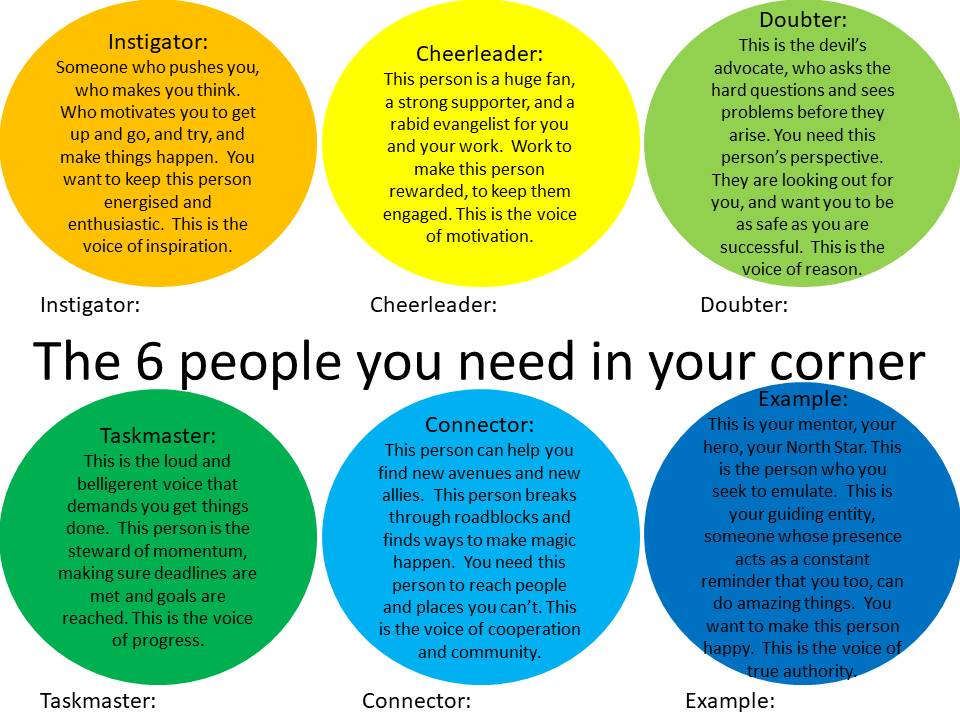
Several years back one thing I picked up, presumably from some talk or online article was the notion of having 6 people in your corner. Basically, these represented 6 characters that would help and support your leadership journey. They didn’t all have to be different people, although they could be, or some, or all of them could be the same person.
The 6 characters were:
The Instigator: Someone who pushes you, who makes you think. Who motivates you to get up and go, and try, and make things happen. You want to keep this person energised and enthusiastic. This is the voice of inspiration.
The Cheerleader: This person is a huge fan, a strong supporter, and a rabid evangelist for you and your work. Work to make this person rewarded, to keep them engaged. This is the voice of motivation.
The Doubter: This is the devil’s advocate, who asks the hard questions and sees problems before they arise. You need this person’s perspective. They are looking out for you, and want you to be as safe as you are successful. This is the voice of reason.
The Taskmaster: This is the loud and belligerent voice that demands you get things done. This person is the steward of momentum, making sure deadlines are met and goals are reached. This is the voice of progress.
The Connector: This person can help you find new avenues and new allies. This person breaks through roadblocks and finds ways to make magic happen. You need this person to reach people and places you can’t. This is the voice of cooperation and community.
The Example: This is your mentor, your hero, your North Star. This is the person who you seek to emulate. This is your guiding entity, someone whose presence acts as a constant reminder that you too, can do amazing things. You want to make this person happy. This is the voice of true authority.
Back in about 2009, when I first discovered this, I knew exactly who these people were. Some of them wore multiple hats for me. After about 2011 when I’d changed jobs, I really could not pinpoint anyone amongst my work colleagues that fitted any of those roles for me. Happily, I am once again in the position where I can identify at least one person, even if it’s the same person, for each of those roles.
I’ve just read an article by Anthony Tjan on ideas.TED.com who suggests that we should have 5 mentors:
The Master of Craft: “If you know you want to be the best in your field — whether it’s the greatest editor, football quarterback, entrepreneur — ask, Who are the most iconic figures in that area?” says Tjan. This person can function as your personal Jedi master, someone who’s accumulated their wisdom through years of experience and who can provide insight into your industry and fine-tuning your skills. Turn to this person when you need advice about launching a new initiative or brainstorming where you should work next. “They should help you identify, realize and hone your strengths towards the closest state of perfection as possible,” he says.
The Champion of your cause: This mentor is someone who will talk you up to others, and it’s important to have one of these in your current workplace, says Tjan: “These are people who are advocates and who have your back.” But they’re more than just boosters — often, they can be connectors too, introducing you to useful people in your industry.
The Copilot: Another name for this type: Your best work bud. The copilot is the colleague who can talk you through projects, advise you in navigating the personalities at your company, and listen to you vent over coffee. This kind of mentoring relationship is best when it’s close to equally reciprocal. As Tjan puts it, “you are peers committed to supporting each other, collaborating with each other, and holding each other accountable. And when you have a copilot, both the quality of your work and your engagement level improve.”
The Anchor: his person doesn’t have to work in your industry — in fact, it could be a friend or family member. While your champion supports you to achieve specific career goals, your anchor is a confidante and a sounding board. “We’re all going to hit speed bumps and go through uncertainty in life,” says Tjan. “So we need someone who can give us a psychological lift and help us see light through the cracks during challenging times.” Because the anchor is keeping your overall best interests in mind, they can be particularly insightful when it comes to setting priorities, achieving work-life balance, and not losing sight of your values.
The Reverse Mentor: “When we say the word ‘mentor,’ we often conjure up the image of an older person or teacher,” says Tjan. “But I think the counterpoint is as important.” Pay attention to learning from the people you’re mentoring, even though they may have fewer years in the workplace than you. Speaking from his own experience, Tjan says, “Talking to my mentees gives me the opportunity to collect feedback on my leadership style, engage with the younger generation, and keep my perspectives fresh and relevant.”
They both cover a lot of the same ground but Tjan has some interesting other ideas. I know who my Champion and Copilot are. I think I am my own Anchor really. I’m pretty clued up to my own values and setting personal priorities to achieve a good work-life balance. I’m not sure who my Master of Craft is at the moment or my Reverse Mentor as I’m fairly disconnected with leading or mentoring anyone at the moment.
Do you know who you’d have in your corner or who are your 5 mentors?
I’m reading an article in the most recent Psychologies Magazine about how regular time in nature contributes to wellbeing of mind, body and soul, and it suggests that even spending 5 or 10 minutes outdoors with nature can be beneficial in reducing anxiety and can make us feel happier.
I know that I don’t get to spend nearly enough time outside. I do try to go for a walk at lunchtime, but quite often, due to location, that around a housing estate or hospital grounds. We are fortunate that there are open fields behind the hospital and I get a move on I might just have time to go that way. I guess even in a housing estate, nature has its place in well-manicured (or even overgrown) gardens and hedgerow. You just need to look hard enough.
When we were kids we used to holiday most years in the wilds or North Wales. A beautiful spot with mountains to climb, trails to walk and forests to play in. In adult years, when we’ve been away, we’ve always had what we’ve called “long walk day”. A day put aside (hopefully with good weather) to go on a 5-10 mile trek. No distractions but the views around us. Taking in the sights and sounds of nature doing its thing.
Having to work most days means that going out for long walks or further afield is not easily achievable. However we are lucky that we have some nice park spaces quite nearby.
According to the 10 question quiz that always accompanies these articles the thing that I should find most benefit from time outdoors is grounding.
“If you crave calm or wish you feel more grounded and connect to what matters, upgrading the quality of the time you spend in nature ma provide the shift you need. It’s easy to spend time outdoors on autopilot, or use it as a way to being with others – but you’ll benefit most from spending at least some time in nature on your own, so you can tune into the stillness and connect with your inner calm. If your tendency is to live in your head, time in nature can be a much-needed way of paying attention to your physical self. Finding the ground beneath your feet may even be the first step tofinding a new direction in life.
You’ll get the most benefit by focussing on the here and now as you walk. Don’t give yourself a hard time if you can’ leave your emotional baggage behind but, when you become aware that you’re caught up in thinking, direct your focus outwards by noticing the colours, textures, sounds, smells and sensations. We can all benefit from a daily grounding ritual but, for chronic over thinkers, it can be life-changing”
Like most people, I haven’t had a proper holiday for nearly a year and a half now (since summer 2019), so when we are able to, I will relish the chance to get out and have some time to wander around new places and spaces to take in the sensations.
I was reading an online article from Tim Urban, who studied why procrastinators procrastinate. He possets that they can’t help it. In their brain the procrastinator has the Rational Decision Maker who steadily guides the mind in to doing what needs to be done, and then there’s the Instant Gratification Monkey who sideswipes things and sends the mind off wandering for some instant satisfaction for information or other, that takes us away from our steady path.
The Instant Gratification Monkey takes us off to play in what Urban calls the Dark Playground, that space where all the fun, new, shiny things hang out that distract us from what we should be doing. In the back of our minds though is this constant feeling of anxiety or regret for that looming deadline or that thing that we’ve been working towards for ages. When that deadline approaches though, it’s time for a visit from the Panic Monster who scares us away from the Dark Playground back in to a sense of productivity to get things done.
Urban offers three steps to turn procrastination into motivation:
recognise that you are procrastinating. Being aware of something is usually the first step in resolving it.
Understand the reason for the procrastination. Is it the task itself, or is it you? Is it that you aren’t enjoying it, not qualified for it, or feeling overwhelmed by it?
Set objectives, tactics and rewards. Depending on the reason for the procrastination in the first place it might be as simple as having a to do list if you’re feeling overwhelmed, or someone that holds you to account, or if you promise yourself a treat if you get that thing done.
There are times that I procrastinate. It’s not usually because I don’t want to do something, more that I don’t want to do that particular thing right now. I will send that email out but after I’ve watched this episode of that tv programme I like. I will write that report just as soon as I’ve finished making lunch. I will learn how to ring handbells properly, just as soon as I’ve written that report and sent that email. Sometimes it can become a vicious cycle.
Other days, I can blast through even the most boring, or painful task without so much as a second thought. It’s about the frame of mind that I’m in. Sometimes, I find being in a particular place, or with particular people helps galvanise me into action. Sometimes I just wake up and tell myself that today I’m going to power on through all that stuff and clear my to do list.
Today has definitely been one of the latter type of days. I’ve finished the first draft of a strategy document. I’ve documented a framework that I invented that supports that strategy. I’ve been for a power walk. I’ve read the next section on learning to ring handbells and had a few goes at it. My Rational Decision Maker was in charge today.
I wonder if that means tomorrow I’ll be all out of juice and my Instant Gratification Monkey will be running the show.
Sundays are described in various parts as a day of rest. I wish. I usually have just as much to do on a Sunday as any other day of the week. And just because it was Mothering Sunday, that didn’t make any difference.
C and I are currently ringing 2 bells on a Sunday morning at the Cathedral, just to keep the bells sounding and the world outside knowing that the church is still there and what day of the week it is for all those for whom it seems a bit samey. When we come home its time for a vat of coffee and we’ve taken to having a lump of garlic and herb focaccia from the bread stall in town, usually warmed up in the microwave.
Sundays in this house is also the day of ironing. Ironing only gets done on a Sunday and if we’re not home for any reason it doesn’t get done and has to wait until the next Sunday. C has caught up with all the washing so there were about 3 loads that needed ironing. I don’t like doing the ironing (or any housework really come to that) but cannot abide wearing things that haven’t been ironed. It was an agreement we came to when we first got together. I’d do the ironing or cook Sunday lunch, not both. I think I lost out on that one.
Ironing is so mind numbingly boring though, so I have to watch something on TV to keep me at it. However, that can’t be anything that requires too much attention otherwise I’ll burn the shirts! I usually watch some mindless nonsense on Netflix. This week’s trash of choice was the final view episodes of Fate, the Winx Saga. A teen who finds out that she’s a fire fairy attends a magical school only to find out that she’s probably the most powerful fairy ever. Lots of teenage angst, love, hate, rebellion etc. Far too many Harry Potter derivatives. Its not great, but it passes the time.
By the time ironing mountain has been cleared, lunch is ready. Todays was roast beef, followed by chocolate pudding.
Only then do I get to sit down. However, not to rest. To sit down means to go through emails. To produce posters for things that need advertising this week. To set up Doodlepolls for various meetings of various workgroups that I organise. Oh, and I needed to make my breakfasts and lunches for the working week ahead. Biscoff pancakes for brekkie and chickpea pilaf rice for lunches. Oh, and whack out a cake because it’s our wedding anniversary tomorrow and I’ve got some buttercream to use up.
Then it’s time for the 10 bell Ringing Room #bellringing practice.
Only when all of that is done, can I then sit down and do nothing. A nibble of some cheese and crackers with a sniff of something to drink it our usual Sunday evening wind down. Now I can stop, and rest a while.








 Bells, Bakes & Bettering Myself