Setting boundaries and sticking to them

Image by Andrew Martin from Pixabay

Both at work and at home there are certain boundaries that help us to maintain some semblance of balance and peace.  I am contracted to work so many hours per week and I acknowledge that when you start to become more senior, those boundaries can sometimes blur a little.  There are also times when things simply have to be done and its in everyone’s best interests to do them, but then I always make sure I get that time back somewhere.

I was having a conversation recently about the difficulty with working from home and setting those boundaries.  Working from home does provide some flexibility, and having had conversations with my boss, the only expectation is that you do your hours, and are within reach if needs be, how you split the day up is entirely up to you.  This is useful for those with children and other such demands on their time, allowing them time to deal with domestic issues, then catch up on the work later on.  I have heard of one very senior manager who actually has a tag line on her email signature that says she may have sent this email out of normal office hours, but there is no expectation for it to be responded to out of hours.  It suited her to deal with that type of activity later on in the evening, but she was well aware that others don’t.

I am, in the main, someone who sticks to the same office hours whether I’m working from the office or at home.  I can demarcate my time that way, and because I usually have so much going on in the evenings anyway, I need to shut work off and change brains.

I work a consolidated week, shunting full time hours into four days a week so I get Fridays off to do a multitude of other things. On the whole that’s non-negotiable, but I do appreciate that there may be times where other people’s availability is limited.  I would be happy to dial into a meeting if absolutely necessary, but I’ll claim that time back somewhere.  I am fortunate that my role allows flexibility, and there may also be times when it suits me better to have a different day of the week off, so would need to work the Friday to make the hours up.

I am very clear about turning the work phone and emails off out of hours.  Again, my role doesn’t require me to be on call (been there, done that).  If there was a major problem that required my immediate attention out of hours, then my boss has alternative means of being able to contact me.

Due to my all-consuming hobby, which could be a full time job in itself, there are times when I need to take calls, or go to meetings, or be somewhere.  I am incredibly fortunate that my boss recognises this and I will either take annual leave, or make time up if necessary.  There are certain times when that becomes a higher priority than being at the office. 

I could spend an awful lot of time supporting my hobby too but even that has to have it’s limits.  I am not necessarily going to answer emails within two minutes of receipt at 11pm.  It can wait until the following day.  Most of the time it has to wait until I get home from work anyway, unless its super urgent, which it rarely is. There are times where conversations have moved on during the day and by the time I get to it, the problem has either been resolved or there is no benefit to me wading in at that late hour.  Sometimes, I will put off that activity until my Friday off, or the weekend, or when I’m in the right frame of mind to deal with it. 

I think its very important to ensure that there are appropriate boundaries between work and play so that I know where my head needs to be at, but also others will know when the right time to contact me is.  Admittedly, sometimes those boundaries get a bit blurred, but as an exception, not a rule.
The dads in my life

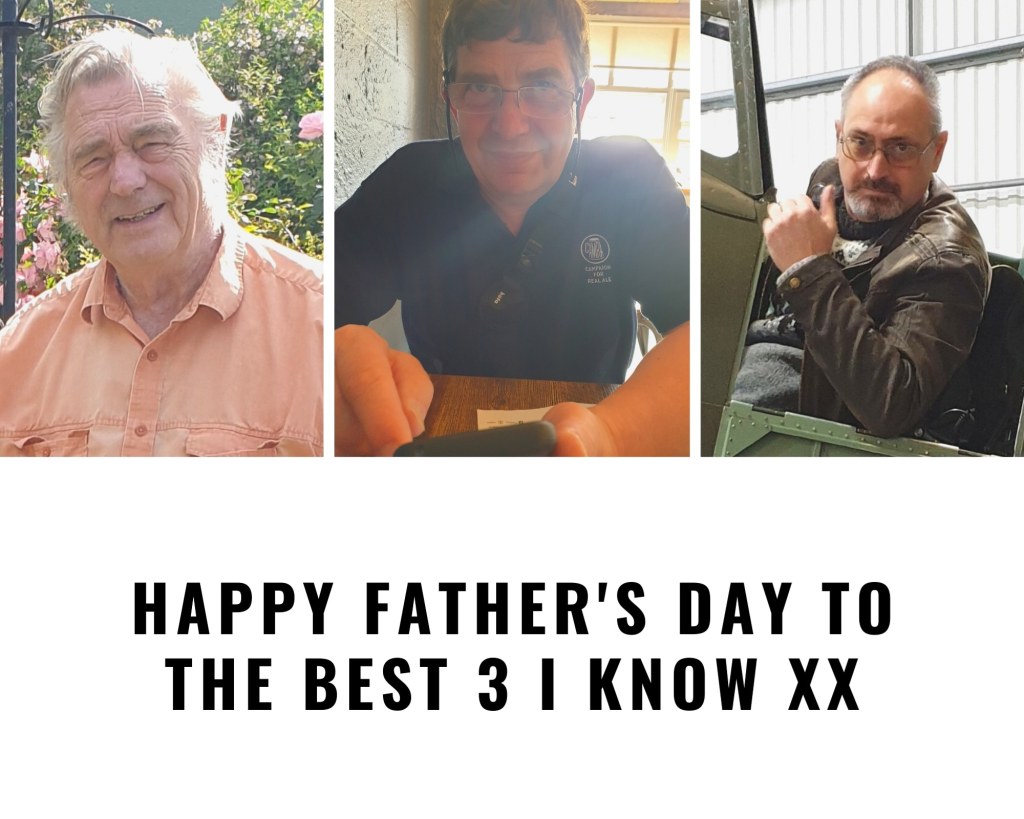
Sunday was Fathers Day. I know three who have very different stories but all have one thing in common. Me.

The first is my own father. I’ve known him all my life. He worked hard, provided and quietly supported. He took us all #bellringing when we reached the right sort of age. My resounding childhood memories of my dad include meeting us in Tesco on Thursday evenings after he’d finished work. We’d done most of the shopping and he arrived in time to pay the bill. I remember asking his permission to learn a new #bellringing method that I knew he didn’t know and it felt odd to learn something he didn’t know. Of course he said go for it and I haven’t looked back since. When I split up with my ex, he came all the way to Ipswich to collect me and my stuff. The only thing he asked was whether my ex had hurt me (physically). When I said no, he simply said that everything would be ok then. That’s all I needed. I have learned many lessons from my dad over the years.

My brother has had so much to deal with over the last few years. His life was tragically turned upside down yet he has dealt with it with such strength, I really don’t know how he’s done it. I’m not sure I would have been quite so together. He’s had some wonderful news more recently and I couldn’t be happier for him.

My husband is just incredible. He has two daughters from his first marriage and one from ours. All girls! He has done so much for all of them. He is such a practical but caring father. And soon to be grandad. He’s actually quite mushy about it in private. It was lovely to see him with his eldest recently, who is expecting her first child. He’s going to be a besotted grandad for sure. And guess what, another girl! I could not have asked for a better baby daddy to our own. Watching their relationship develop particularly as she’s got older has been interesting. She’s quite capable and independent, but he’ll go running to help her out at the drop of a hat.

Step-son-in-law is about to become a daddy and it will be lovely to see him develop as a father too.

Thank you to all the daddys in my life.

What to do when you can’t do what you intended to?

Those that know me well enough, know what the answer to that is.

We had booked tickets to visit our local RHS garden on Friday afternoon.  I had been looking forward to it for a few days.  The weather had been lovely all week and although it was due to be slightly cooler that was no bad thing.  However, things took a sudden turn.

Watching the weather forecast over the previous couple of days it started to become apparent that Friday’s weather was not going to be conducive to a lovely wander around the rose beds. In fact by Friday morning, the forecast promised thunderstorms and heavy rain all afternoon.

Always the optimists, we decided to leave making a final decision until lunchtime on Friday, who knows, the forecast has been known to be wrong, or it might suddenly brighten up. We didn’t really want to take the risk of being out in the open air should there be a sudden downpour and thunder and lightening (very, very frightening!). It was still quite warm and neither of us really fancied being trussed up in our raincoats getting hot and sweaty.  So, lovely afternoon walk cancelled.

What to do instead?

The previous morning, the lovely green baking box from BakedIn had arrived.  Seemed like the ideal opportunity to bake instead.  This month’s cake of choice was a chocolate ganache covered swiss roll.  I’ve only ever made swiss roll from scratch once, maybe twice before.  Always considered it a bit fiddly. 

Anyway, chocolate sponge baked, house smelling of chocolate (mmmmmmmmmm!!) Sponge rolled. Buttercream whipped, added some coffee to make it mocha flavoured.  Unroll sponge, spread buttercream, reroll sponge.  Then wait until completely cooled down before coating in chocolate ganache and drizzle with white chocolate. 

How we didn’t scoff the whole thing in one sitting, I’ll never know.

When I can’t do what I wanted or intended, I do the next best thing.  Bake.

What strengths feed your energy?

I joined up to a wellbeing group via work called Live Life Connected.  It has a series of sessions on topics ranging from finding your full potential, mastering good habits, your mindset (fixed or growth) and the latest session to drop is about identifying your strengths and how to use them to boost your energy.

As part of this session we were invited to conduct a short test to help identify our character strengths.  Then is spews out a report showing your top five character strengths, and then the lesser ones underneath.

My top strength came out as Love of Learning.  I totally agree with this.

Mastering new skills, topics, and bodies of knowledge, whether on one’s own or formally; related to the strength of curiosity but goes beyond it to describe the tendency to add systematically to what one knows.”

I do like to read, research and investigate things.  I will read the 126 page document.  I will go down that google rabbit hole to find out more.

In at number two was Honesty.  What you see is what you get.  I don’t always get it right, but I’m learning.

Speaking the truth but more broadly presenting oneself in a genuine way and acting in a sincere way; being without pretence; taking responsibility for one’s feelings and actions.

Number three was Fairness.

“Treating all people the same according to notions of fairness and justice; not letting feelings bias decisions about others; giving everyone a fair chance.”

It has been commented on before by colleagues that I am a firm but fair manager.

Fourth on the list was Judgment

Thinking things through and examining them from all sides; not jumping to conclusions; being able to change one’s mind in light of evidence; weighing all evidence fairly.

I have said many times before, I do like to have all the information in front of me before I made a decision, where possible.

And completing my top five character strengths was Forgiveness.

“Forgiving those who have done wrong; accepting others’ shortcomings; giving people a second chance; not being vengeful.”

Hmmm, now this is a tricky one.  I can forgive, but I rarely forget.

There were another fourteen characteristics, then at the other end of the scale the bottom five character strengths were:

Gratitude – “Being aware of and thankful for the good things that happen; taking time to express thanks.”  Its not that I am unaware or unappreciative, more I don’t outwardly express gratitude.

Perseverance – “Finishing what one starts; persevering in a course of action in spite of obstacles; “getting it out the door”; taking pleasure in completing tasks.” I usually do, however sometimes I get side tracked by something new and shiny, or someone else starts taking over so I give up showing any interest in it.

Love – “Valuing close relations with others, in particular those in which sharing & caring are reciprocated; being close to people.” I do value those around me but I’m not into all that mushy stuff.  I give as good as I get with relationships.  If someone doesn’t want to put the effort into me, I’m not going to put the effort into them.

Zest – “Approaching life with excitement and energy; not doing things halfway or halfheartedly; living life as an adventure; feeling alive and activated..” I don’t very often get excited about much.  That’s not to say that I haven’t done some exciting stuff like going skiing when I was 12, or husky sledging a few years ago, or every time I get to see my daughter.  I just don’t go all stupid with it.

Spirituality – “Having coherent beliefs about the higher purpose and meaning of the universe; knowing where one fits within the larger scheme; having beliefs about the meaning of life that shape conduct and provide comfort.” Nope, not me.  You make your own destiny and luck.

If you want to investigate your own character strengths take the short test at https://www.viacharacter.org/survey/account/register

“If we always do what we’ve always done, then we will always get what we have always got”

Image by Arek Socha from Pixabay

That quote is possibly attributed to Henry Ford.  In the context I want to explore it is about thinking creatively about #bellringing publicity and recruitment opportunities.  As part of a talk I did last year, I then wrote out the main points of the talk and they can be read in sections as part of the joint Association of Ringing Teachers (ART) and Central Council’s Recovery & Survival Toolkit.  If you’re a real insomniac you can also watch a recording of my talk.

Sometimes as bell ringers we are not terribly inventive with how we reach out.  We trot out the same talk, or the same set of generic display boards that don’t appeal directly to the audience we are trying to engage with. Here were my thoughts on thinking creatively for publicity and recruitment opportunities.

Basically, to start with, anything goes. You might have to rule some of it out due to cost, or health and safety etc, but don’t let that stop your creative juices from flowing. Try to get out of the habit of “We already tried that and it didn’t work”. It didn’t work then, but things and people have moved on, so it might work now. And the other one is “We don’t do things like that around here”.

Be imaginative with imagery, don’t be afraid to use something contemporary and different from the usual picture of someone pulling on the end of a rope that doesn’t appear to be attached to anything, or a bell that looks seems disconnected to the action. Do we want to continue to use the same stuffy images of bell ringers and ringing as we’ve always done, or are we trying to reach new audiences by using evocative images that connect to our objective?

Make sure that you know what the project goals are and keep them in mind. Are you trying to recruit, are you trying to raise funds?

Make sure you have all the facts to hand. If you are raising funds for a restoration project, make sure that you know how much you need to raise, what the project actually entails and so on.

Use your own experiences and expertise to fill in the story, you know the people, the bells, the local community, previous momentous events and inspired.

Look for combinations that tie in with what your objectives are:

  • Is the local school having a fete if so could you take along some handbells or a mini ring? Is the town centre having a celebratory day?
  • Did you know that a lot of counties have a County Day? Could you use this day to organise ringing in all your local towers or your whole Guild with have a go sessions included as a mass recruitment opportunity?

If you find yourself stuck for ideas, or going over the same thing again and again, sleep on it, take a break, do something else for a while. They say our best ideas often come when we least expect them.

Keep a checklist of all your ideas and the pros and cons of each. You can extend it to include the activities involved in each idea, the costs and time associated with each idea.

Always run your ideas by someone else. Preferably someone not connected with it or a non-ringer:

  • Does it make sense?
  • Does it grab attention?

Particularly if you are writing an article or producing a leaflet or other materials, always get someone to proofread it before sending it off.

Come up with ideas together. Creativity sparks creativity. Someone may have the nub of an idea but someone else may be able to see how that could develop and become a bigger and better idea, but be careful, don’t make the team too large otherwise you’ll never get anything done and may spin around in “group think” where no new ideas are generated.

and other individual sections that may help at https://ringingteachers.org/survival-and-recovery-toolbox/successful-pr and other useful resources at https://cccbr.org.uk/resources/publicity-material/

Why should you bother to volunteer?

Image by Gerd Altmann from Pixabay

Bell ringers are volunteers.  We generally give our time freely for service or civic ringing and only occasionally get paid a nominal amount for #bellringing for weddings and funerals.  Those of us who are tower officers, district officers, association officers, or on one of the Central Council’s workgroups, or part of the executive team, volunteer, free of charge.  Should we?  That’s a question for another day, today I shall focus on why we volunteer in the first place.

The NCVO, National Council for Voluntary Organisations, defines volunteering as…

“…any activity that involves spending time, unpaid, doing something that aims to benefit the environment or someone (individuals or groups) other than, or in addition to, close relatives. Central to this definition is the fact that volunteering must be a choice freely made by each individual.

This can include formal activity undertaken through public, private and voluntary organisations as well as informal community participation and social action. Everyone has the right to volunteer and volunteering can have significant benefits for individuals.”  https://www.ncvo.org.uk/policy-and-research/volunteering-policy

Some may see volunteering as an obligation.  Something they feel compelled to do as an act of duty, or they feel morally bound to do. I personally feel obligated to give something back to the hobby that has done so much for me other the years.  Very many people have given up their time and talents to teach me how to ring, to help me learn a new method, to ring a quarter peal or a peal, to understand the wider picture of the ringing community.  I feel I owe it to them to pass that on to the next generation.

Having pride and a sense of duty might drive some on. They want to be a part of something, like neighbourhood watch, or a climate change group, they have a call to action to do something positive, something that they are enthused about and take pride in a job well done at the end of the day, say of clearing rubbish from the beach.  Others take pride in the success of achievement, having said that you were there, or part of something, or achieved something.

If we’re not careful volunteering can give us a false sense of ourselves.  We might see it as an opportunity to brag, “oh yes, I volunteered to save the whales” or “I volunteered to help patients at the local hospital”.  Whilst the work itself may have been valuable to those on the receiving end, we’re kidding ourselves if we are thinking its in our best interests, and it may only offer us a temporary sense of pleasure, before we start to feel it as a chore.

I’ll admit there are times when I’ve gone right off ringing.  I do quite a lot at tower, district, association and Central Council level.  If I’m not actually ringing, I’m at a meeting about ringing, or writing a report or article about ringing, or answering emails and phone calls about ringing, or being interviewed about ringing, or trying to promote ringing.  It’s like having another full time job outside of my day job.  There are sometimes when I really feel the need to not do anything to do with ringing at all for a few days. 

Sometimes we do things out of love for someone or something else.  We might volunteer to do the elderly neighbours shopping or cut their grass.  We might volunteer at an animal shelter because we love dogs or cats, or whatever.

This sense of altruism is when we have absolutely no interest in the consequences to ourselves, it might cost a bit of money, or take time out of our busy day, or take us in a different route, but have a selfless concern with the wellbeing of others.

When we are passionate, or enthusiastic about something, it is much easier to get involved in its activities.  If we’re passionate about #bellringing, it’s any easy thing to start to help with some of the maintenance, or making the tea for the district meeting, or become an officer, or more. When we have the desire to want to do something, we are more likely to do it voluntarily. 

Volunteering often leads on to something else.  You may start off volunteering in a particular role so that you can gain some experience, and once you have that experience, it will help you apply for a paid post in that role.  If you have volunteering listed on your CV or your further education application form, it shows that you are willing to help out, that you have other interests, that you can multi-task and plan.

Bell ringers get in to it through destiny or family tradition.  My dad learned to ring when he was a teenager, and when my siblings and I all reached the age of 11 we were taken up the tower and given a lesson.  The three of us girls took to it, but my brother didn’t.  My husband also rings, and my step-daughter learned to ring.  She went on the meet her husband as a ringer too.  Our daughter learnt to ring.  She doesn’t do it now she’s left home, but she understands the rules when she does come home that that’s what we do, and she’ll come along and make herself useful on the end of a rope.  She even went to stay with her aunt for a week and they took her out to their practices so she probably rang more in that week than she had all year.

There also used to be a tradition with church choirs that when boys voices broke and they had to withdraw for the younger voices but weren’t quite settled for the gentlemen choir, the natural progress was to push them into the tower so that they were still involved in the church.

As mentioned earlier, some people want others to notice what they do.  They advertise, all too easily on social media, that they helped out with this, or they raised funds for that, but there main purpose is to get “likes” and comments along the lines of “oh well done you, that was so nice of you”.  It makes them look good in front of others.

Having a shared hobby with others where you get mutual benefits that go with socialising, achieving things as part of a team and something that you can share with others when you talk about #bellringing is true altruism. Doing something for the greater good might not necessarily mean doing something you enjoy, or necessarily want to do, but realising that by helping out it will make it easier for everyone.  This could be helping clean the belfry and the tower, or organising the social events. 

The many benefits of volunteering have been well documented. It can help you make friends, learn new skills, advance your university application or career, and even help you feel happier and healthier by connecting you with others and your community. For some it enables them to bring their skills and experience to the service of the wider community, whilst for others it enables them to branch out and use skills which may have been under-employed in their working life. With busy lives, it can be difficult to find time to volunteer; however the benefits can be enormous, providing vital support to a worthwhile cause and heling others

The wide range #bellringing activities mean that volunteering can be very diverse and satisfying. It covers many areas including engineering, education, publicity and promotion, library services, the media, historical research, event management and the technical development of ringing.

How are you giving back through volunteering?

How to increase the chances of your article being read

Image by Gerd Altmann from Pixabay

How many times have you seen the subject heading of an email, an article, or newsletter and dreaded opening it or reading on, because you can already imagine what it might contain?  Or just by looking at the subject heading decided not to open it at all and hit the delete key?

A number of people I connect with write on behalf of their local organisation, particularly in #bellringing circles.  They may need to write an email to their members, or their wider community to engage with activities, or recruit new ringers.  They may want to write an article in the local newsletter, or their Association newsletter, or even for The Ringing World.

Carole Seawert came up with some top tips on how a great subject line could increase the chances of your email, article or newsletter being read:

1) engage curiosity – Don’t open this email.  How many times have we heard the story of if you want some news spread write “confidential” on the top and leave it by the photocopier?  That’s a sure fire way for everyone to have heard about it, right?

2) engage FOMO – fear of missing out.  “Only 2 spaces left”. “Last chance”. “Offer closes today”.

3) pain points and a solution – “veggie food your kids will love.”

4) enticing special offers – priority access etc.

5) helpful resources – 10 top tips on how to get your article read.

6) short cut solutions – learn who to write engaging content in 2 minutes.

7) personalise – “John, here’s something you won’t want to miss”.

8) include effective key words like “congratulations”, “upgrade” and “ thank you

9) pose a question that inspires further enquiry – “do you want a 2 for 1 offer on xxx”?

10) KISS – keep it short and simple. No more than fifty characters.

I am not a fan of numbers 1, 7 and 9 personally.

Unless the email was from a colleague or someone I knew was probably messing about, if I received an email that said “Don’t open this email”, I would think “OK then” and delete it straight away.

Number 7 implied some kind of pre-existing relationship, which may be ok with some people but I still wouldn’t expect my name to be in the subject heading.  If I don’t know the person or the organisation, I would not be impressed that they were trying to engage on first name terms.  Someone came to the door canvassing once and called me by my full first name, which was on the electoral role, but a name that I never go by, so I corrected them and said “that’s Mrs C…… to you”. They did not know me had no right to expect any level of intimacy.

If I received an email or saw an article posed in the way number 9 suggested, as it is a closed question my response would be a simple “no”, regardless of what was on offer, and again, I would delete it straight away.

Clearly some of Seawert’s suggestions were targeted at sales so may not be relevant in the circumstances I would be writing for, but there were some useful points to consider.

How it feels to let someone else make decisions for you

I recently bit the bullet and signed up to one of those online personal shopper sites in an attempt to revitalise my wardrobe from fusty versions of black.  I dutifully filled in all the questions about my age, outfit preferences, activities, and what I wanted to get out of a personal shopper that I didn’t think I currently had for my clothes.  The good news is I’m not stuck with it, I only signed up for the “occasional” offer, rather than once a month or once a quarter. I wanted to see what someone else would come up with first before committing any further.

I placed an order at the beginning of the month and off it went.  It says to allow 14 days for your personal shopper to select and send outfits for you.  So far, my order has been acknowledged. It took nearly 2 weeks for the status to change to “Your Personal Shopper is preparing your outfits”.  That was 6 days ago. 

Checking the tracking status of the order, it was confirmed receipt of by the delivery company on 9th June, was in transit on 10th June and now on 14th June is in transit again.  So the delivery company have had it nearly a week as well. There is currently no sign of the package being “out for delivery”.

I am obviously intrigued to find out what someone else, who doesn’t know me at all has selected for me and whether or not I would keep or return the items, but if its going to take this long every time, I’m not sure it will be worth the wait.

Someone else will consider what I might like, will source it and ship it, so I don’t need to go to the shops, wander around looking for things, queue up and pay then take it all home. It will be interesting to see how they interpret my style.

Sizes may also be an issue. Depending on the make of garment the same size could either fit or cut off circulation. I have quite long legs so getting trousers the right length is always an issue.

Letting someone else made decisions for me has been quite liberating although I’m anxious about what might turn up. I’m not usually goid with letting someone else make decisions on my behalf.

When is a cake not a cake?

It’s been far too hot recently to want to spend much time in the kitchen, and thankfully I don’t do the cooking in our household anymore.  But I would hate to be a professional baker or chef when its hot outside. 

I love baking cakes when I get the time and of course, I love eating them too.  But during the summer months my favourite kind of cake often does not require any baking at all.  I do love a cheesecake.  I could eat cheesecake every day.  Its another type of cake I don’t get to make very often.

C and I sort of follow a Slimming World diet in as much as we use either their recipes, or Pinch of Nom or similar.  I try to count calories, but I like food too much and often see that I have exceeded my recommended daily amount. Small wonder I’m not actually loosing much weight, just the odd pound here and there.

This past week we have been using the recipes from the July Slimming World magazine and I was happy to see that one of the recipes was for a vanilla and chocolate cheesecake.  We don’t often have homemade desserts, generally don’t have the time to make them but not one to miss out on the opportunity of cheesecake, I decided that I would make our dessert for Sunday lunch. 

I made the cheesecake on Saturday afternoon, so it had plenty of time to set.  It was a chilled one rather than a baked one, so no slaving over a hot oven.  There’s always that moment of apprehension when you loosen the springform pan sides and hold your breath hoping that it won’t slip and slide all over the place.  Fortunately, it had set very well.  And I’d remembered to put a sheet of baking paper under the biscuit crumb to avoid it getting stuck to the bottom of the tin, meaning I could slide it easily on to a plate.  Just to make sure though, I didn’t take it out of the tin until Sunday morning. 

Perfect.

As there’s only the two of us at home, the next question is how many servings we should cut it in to.  The recipe says eight, even if we were generous, we’d only make it six.  But given that there’s only the two of us, we have a whopping quarter of it each.  Somewhat negates the Slimming World part, right? What’s the point of dragging it out over several days, it won’t keep that long, will it?  That’s our excuse and we’re sticking to it.

This particular cheesecake tasted very nice but the consistency was a bit strange.  It was more of a panna cotta style wobbly rather than a light, fluffy filling. Maybe that was the combination of cream cheese, yoghurt and quark, with the gelatine. 

Anyway, it satisfied by cheesecake craving for now.

Am I my own worst enemy when it comes to embracing success?

Another Psychologies Magazine test recently about what is stopping me from reaching my full potential. After the obligatory ten questions my results suggested that I fear success itself.

“Do you feel success is for other people? You might be talented and hard-working but, if you are prone to self-sabotage or lack motivation just as things start to go well, chances are you’re subconsciously keeping yourself in the ‘striving’ zone, with your goals just out of reach. When you do achieve, impostor syndrome can creep in, telling you it was a fluke or luck, rather than your own talent that brought success. There may be a difference between how you present yourself to others and how you feel. Fear of success can be bigger than fear of failure because, if you get to the top, you’ve got to stay there, and ‘prove’ you deserve it.

The key to closing the confidence gap is knowing your strengths, then crafting your working life to make the most of them. It may also help to find a mentor who has succeeded, despite starting from a similar place to you. If no one springs to mind, choose someone famous, read their biography or follow them on social media. Also, spend time with people who believe in themselves – confidence is contagious.”

I am totally sabotaged by imposter syndrome; I’ve mentioned that here before.  I also feel that when I’ve praised for doing something well, I feel embarrassed about it and that I was only doing my job, or that it was a team effort, not honestly acknowledging the hard work and effort that I’ve put in.  Doing that is big headed and an ego trip right?

In the past I have wondered about taking promotions based on whether I feel I am worthy of it, not whether I could do it or not, as I fully understand that you grow into roles and there should not be any expectation that I should be perfect in the job from day one.  I sometimes look at my pack packet and wonder how I managed to command that level of salary.  But then I think I have earned it through my years of effort, for my skills and knowledge.  And then I go back to thinking that its just a desk job, it’s not like I’m actually saving lives, or solving climate change, or doing mega worthwhile things.  And then I flip back to someone has to do my job so it may as well be me as much as anyone else. Then I wonder whether I could or should be doing something else, or altering the work-life balance again, or doing a job for another organisation all together. 

Sometimes I think I have peaked and reached as far as I can go, or should that be, as far as I want to go, who needs the extra grief?  But then something else comes around the corner and nudges at going just that little bit farther.  Then I think I should get out while I can, before someone notices that I’m a fraud, that I don’t know what I’m doing or talking about.  Then I think that I can do this, and I am the subject expert in this.  But I’m not an expert, am I?  I only play at being an expert.  Someone’s going to catch me out.

How do I stop this self-doubting all the time and acknowledge that I am where I am because I have skills and knowledge without it coming across as arrogant?