Last night had a clash of #bellringing diaries. I should have been at an advanced district practice but also needed to be at a Central Council exec meeting.
This clash now happens very month. Last year it wasn’t a problem because we weren’t running the advanced practices. However we decided to put them back on the virtual agenda this year and try them out. Last month was the first one and as I set up the Zoom I kinda needed to be there so sent my apologies to the CC meeting.
This month though I needed to be at the CC meeting as I was on the Agenda. I did set up the advanced practice zoom session but needed to hand it over to someone else to run.
It was an interesting experiment. C attended the advanced practice on the PC next to me on my laptop attending the CC meeting. We both glanced over at the other several times and at one point were both talking to our respective meetings at the same time.
I missed out on practicing Little Bob Major and Yorkshire Surprise Major and the fact that they finished soon after 9pm. My meeting went on until 10:20pm.
Next month I’ll probably go to the advanced practice and give apologies to the CC meeting. I’ll probably end up alternating.
With meetings, #bellringing, family gatherings, talks, plus the usual social media, emails, work etc, I find that I’m currently spending roughly 12 hours a day staring at a screen. Small wonder my eyes are dried out at the end of the evening.
I work a 9.5hr day Monday to Friday and most evenings am either on a Zoom meeting, or a virtual #bellringing session. On my non-working day I have, one, sometimes two virtual #bellringing sessions and more often than not a meeting in the afternoon on Zoom as well. Then every other Sunday there’s the family Skype gathering.
Apparently, there’s a name for it now ‘digital eye strain’ or ‘computer vision syndrome’. However, help it at hand with some top tips on how to reduce eye strain from All About Vision:
Get an eye test and tell the optician how much time you spend on the computer or devices.
Reduce excessive bright light. Close blinds or curtains, use lower intensity light bulbs, and position the computer so that windows are at the side, not in front or behind.
Consider an anti-glare screen for your monitor and have a more muted coloured wall to reduce glare from reflective surfaces.
Upgrade your monitor with a flat-panel LED screen in anti-reflective surface.
Adjust the brightness, text size and contrast, colour temperature or your screen.
Blink. When staring at a screen, people blink less frequently — only about one-third as often as they normally do. Blinking moistens your eyes to prevent dryness and irritation.
Exercise your eyes by frequently looking away from the screen at a distant object and focus on it for at least 20 seconds.
Take frequent breaks to help reduce neck, shoulder and back pain. Get up and move around for 10 minutes every hour.
Modify your workstation. Check your posture and ensure that your chair is the right height with your feet comfortably on the floor. Make sure that your screen is 20-24 inches away from your eyes with the centre of the screen 10-15 degrees below your eye level.
Consider computer glasses. Customised glasses which photochromic lenses.
I am conscious that my eyes are tired at the end of the day, and that I do probably need to get up and move about a bit more.
Maybe I will also try a digital detox day as well. A day without any screen time at all. Hmmmm!
You know when you know you have something, and you know where you last saw/used it, but for the life of you can’t find it when you need it next? That was me and a set of colouring pens.
Now, we’re not talking anything deep and philosophical or anything like that. We’re talking a set of colouring pens that I wanted, because I wanted to use a different colour, other than blue or black biro, to mark something off so that it was more visible.
I’ve had a set of colouring pens for ages, and I kept them with the squared paper that I used to write out #bellringing methods when I was learning something new. Every bell was assigned its own colour and I would draw out each lead end so I could see when a different place bell started. I’ve kind of moved on from doing that so much these days and use other methods for learning new methods that seem to work.
The pens however, were last seen with the squared paper, on the pile of books and magazines that are in the cubby hole to the left of where I sit on the sofa. That’s where they’ve always been and had no need to be moved anywhere else.
I have a nice new set up in our study with a new desk, chair, my laptop set up and my Holhem gimble ready and poised, and a nice shiny new stationery holder. The stationery holder currently has my post it notes, my favourite couple of writing pens, a calculator, my business card holder safely ensconced. There’s any empty slot shouting out for something to fill it. The colouring pens would do marvellously, and then they would be at hand for me to mark off things on my events calendar. But where the heck are they?
Having decided to look for said colouring pens two minutes before a video conference meeting was due to start, and not finding them instantly, I sat wondering for a while as the attendees for the meeting arrived. Hmmmph!
Meeting over, I then had several actions as a result and some other things to immediately attend to, so the search for the illusive colouring pens dropped out of my mind for a while. Then I went to sit down in my spot on the sofa and suddenly remembered that I had a mission to accomplish. Find those ruddy colouring pens. They’ve got to be there somewhere.
Books and magazines start to get launched out of the way. They can’t be far. They shouldn’t be anywhere else. They shouldn’t be this far down the heap. After a full on three minutes of frustration, I flopped back in my sofa seat. Grrrr. Where are those blasted pens?
Oh, hang on. There’s a couple of books in the pile that have fallen over. I’ll just put them upright again. Oh, and hallelujah! There are the prodigal pens. Hiding in the blackness of under the small coffee table that nestles amongst all these books and magazines. Hoorah!
I happily skip (well, more like lumber) off back to the study, tip the pens out of their zipped, plastic casing and decide upon which colour to use as my marker. Then, rather satisfyingly, plop them all into the waiting vacant slot in my stationery holder. Having used the red pen to mark off my events calendar, I add that to the collection, then sit back to admire my handy work.
Nothing like a crisis to get the adrenaline going. Its all going a bit Pete Tong at the moment with former colleagues dying due to Covid-19 and staff off with either positive results or self-isolating, meaning that the service is about to fall on its knees. However, a few strategically placed phone calls and lots of toing and froing has resulted in a bit of a plan that should help the situation a bit. Also some positive clinical engagement, which was fantastic.
I’m not usually one that responds very well to instant and urgent changes, and trying to solve immediate problems. I like to ruminate over things, check all the facts, formulate a plan, get everyone involved. Time was not on our side so this week, and today in particular, have been very much making things up on the hoof, last minute conversations and plans, no time to overly consult, only with those that are critical, put a series of actions together and BAM! I can head in to the weekend slightly more relaxed about the prospects of the week ahead.
I feel surprisingly buzzy about it all to be honest. The time has flown by, I’ve not been wondering what task to do next. I’ve jumped from one conversation to the next, to the next and to the next. I don’t think I could sustain that level of activity or focus for too long, and admire those that do and those that work in environments that require that fast paced thinking and problem solving.
When adrenaline kicks in it stimulates our “flight or fight” responses. When the body is flooded with adrenaline it helps focus and engages the brain, improving cognitive responses. A bit like a massive caffeine hit. Apparently, it can improve your eye sight as the pupils dilate, and improves respiration. Even after the triggering event there can be a residual feeling of high vigilance and excitement and can intensify those feelings. As well as a burst of energy and strength the immune system gets a little boost too. (https://www.mentalfloss.com/article/71144/8-reasons-little-adrenaline-can-be-very-good-thing)
So, having started the day with the sad news of another colleague dying and not feeling like I wanted to really do much, at the end of the working day, I’m now bursting with energy and enthusiasm. Just as well as I’m hosting a virtual #bellringing session tonight and had better be on my A game.
When I get asked to give talks its one of the scariest things and takes me on a roller coaster ride.
My first question is why have they asked me? And the cynic in me replies “because they need to fill a slot and you’re an easy ask“. But maybe, just maybe, its because its a topic I know about and the person that’s asked knows that I can do a half decent job of it.
My first real worry then is what on earth have I got to say that anyone would want to listen to. I’m no one special. I haven’t done anything earth shattering brilliant or enlightening or entertaining. No one is going to want to hear me spout on about xyz when there are far more interesting and entertaining people who could do it.
Then there’s the “what am I actually going to talk about“. The latest ask hasn’t been too specific yet so I’ve asked the question. I could redo a talk I’ve given on a specific topic before, so I won’t have to prepare anything new, or do they want something different?
Then there’s the “how long have I got”? This is where, once I’ve written my talk I’ll time it to make sure it fits and I get all the main points across. I’ll read and re-read through it multiple times, including immediately before delivering it.
Then there’s the “oh my god, how many people will turn up? Supposing no one does?” Well, that’s not really under my control to do anything about. The one good thing about doing talks over Zoom is that you can change the view so you don’t have to see everyone’s faces and therefore don’t know if there’s one or one hundred people watching. Of course the trouble with doing that is then you miss out on any visual cues from the audience, like wanting to ask a question or wanting you to get a move on and shut up.
I generally don’t get nervous about giving talks, its the bit afterwards. Whilst I’m talking I know what I’m going to say, I’m well prepared, I’m in control. I’ve been to the loo, I’ve got a glass of water handy. But at the end when the facilitator opens things up to questions, that’s when I start getting nervous. What if someone asks a question I don’t know the answer to? Or worse still, I don’t even understand the question? The former can be resolved quite easily with a straight forward ,”you know, I don’t know the answer to that but I’m going to go away and find out, then I’ll let you know”. That’s all good if you actually do that, which I always make a point of on the rare occasions it happens. If I don’t even understand the question I’m not beyond asking them to rephrase it. Particularly if its quite a technical question, I’ll make a joke of it and ask them to dumb it down for those like me who are not technically minded.
The thing about giving talks is that they can open doors to lots of opportunity. An opportunity to meet new people, to listen to their questions and think about things from their perspective, to get involved in something else as a spin off, to be heard by someone who wants you to give your talk to a different group and start opening doors again with another different audience.
As much as I dread doing it for all the reasons above and want to say no, the chance of more doors opening and more new experiences happening is too great an attraction, however flattering the ask was in the first place.
The Association training day was held on Saturday. In a parallel universe we would have been meeting together and physically ringing, with pub lunches and some great camaraderie.
With lockdown we’ve moved it to a digital format instead. Whilst we’re not all meeting together, or physically #bellringing, or having a lovely pub lunch, we have been able to meet in small virtual groups using Zoom, we were able to ring using RingingRoom and were able to offer both a lunchtime talk and an evening talk. We may not have been able to do that in the real world.
Considering that only a few months back we were feeling bereft about not being able to ring, the organisers were able to put a great programme together thanks to a few people’s efforts. Yes we’re not meeting face to face but there doesn’t seem to be anything that we can’t do online.
When we are able to get back to the tower together, our learning, experience sharing and skills will have helped us and will put us on a great place to move forward.
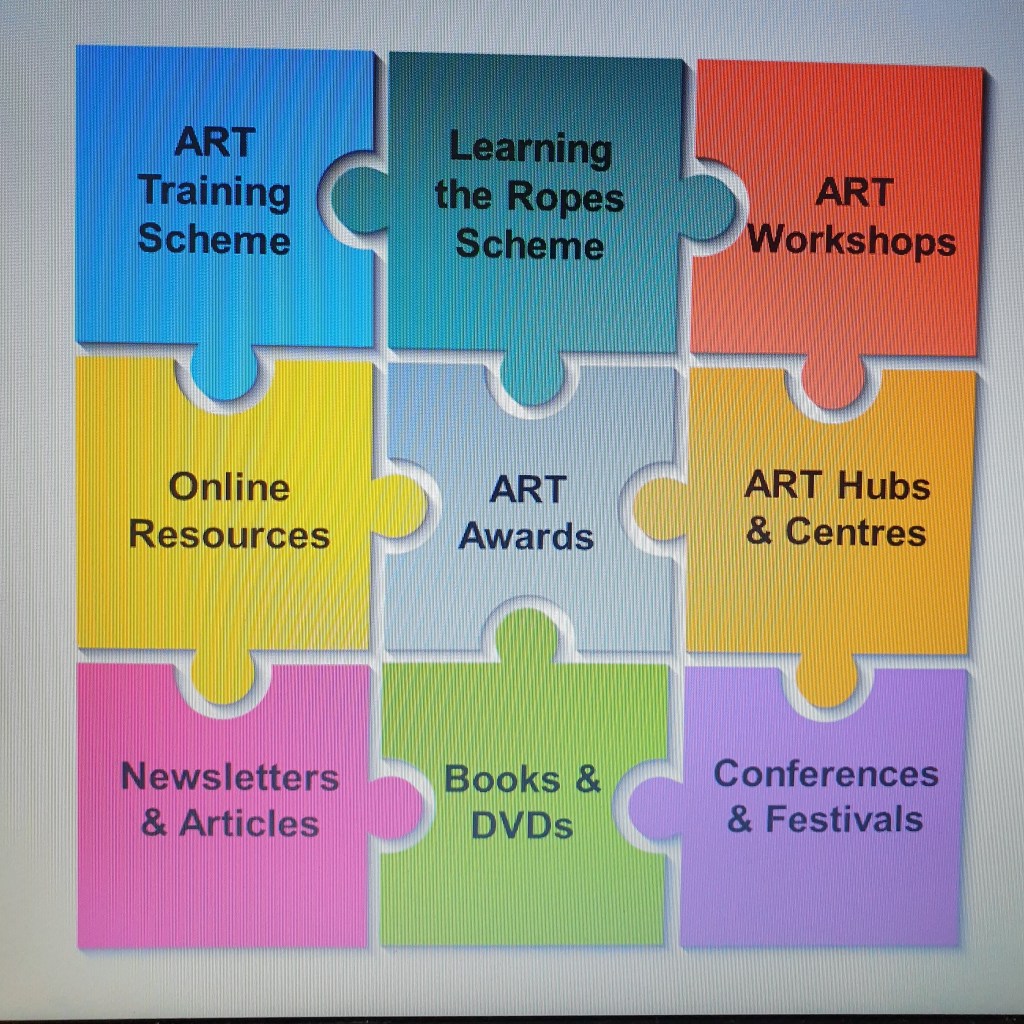
When we look at the survival and recovery of #bellringing there are some fantastic resources to support a safe return to the tower and much more to come.
There were 2 fabulous talks during the day, the first on the Association of Ringing Teachers and Central Council of Church Bellringers collaboration on survival and recovery. The second was about the Birmingham School of Bellringing and how it teaches from bell handling up to method ringing. I recorded and uploaded both to our Youtube channel.
An excellent way to spend the day training, learning and sharing.
Most of Saturday daytime was taken up by attending the virtual meeting of the Central Council of Church Bellringers Executive and Workgroup leads meeting. Although technically neither of those things, I am generally invited in my role as Public Relations Officer so that I have some idea of what’s going on.
The Exec and I meet once a month (the Exec meet otherwise as Trustees at different times so I’m not party to discussions I shouldn’t be), then once a quarter there’s a larger meeting that includes the Workgroup leads too. Saturday was that day.
On these occasions some element of logistics is required with regard to lunch and other refreshment throughout the day. C and I have it well sorted.
Before the meeting started in the morning I put in my lunch order, as there’s only half an hour break allocated. This time C sourced vegetable samosa, garlic and herb focaccia and a custard doughnut whilst he was in town, from the bread stall in the High Street. The samosa and bread were duly served warmed up at the alloted time.
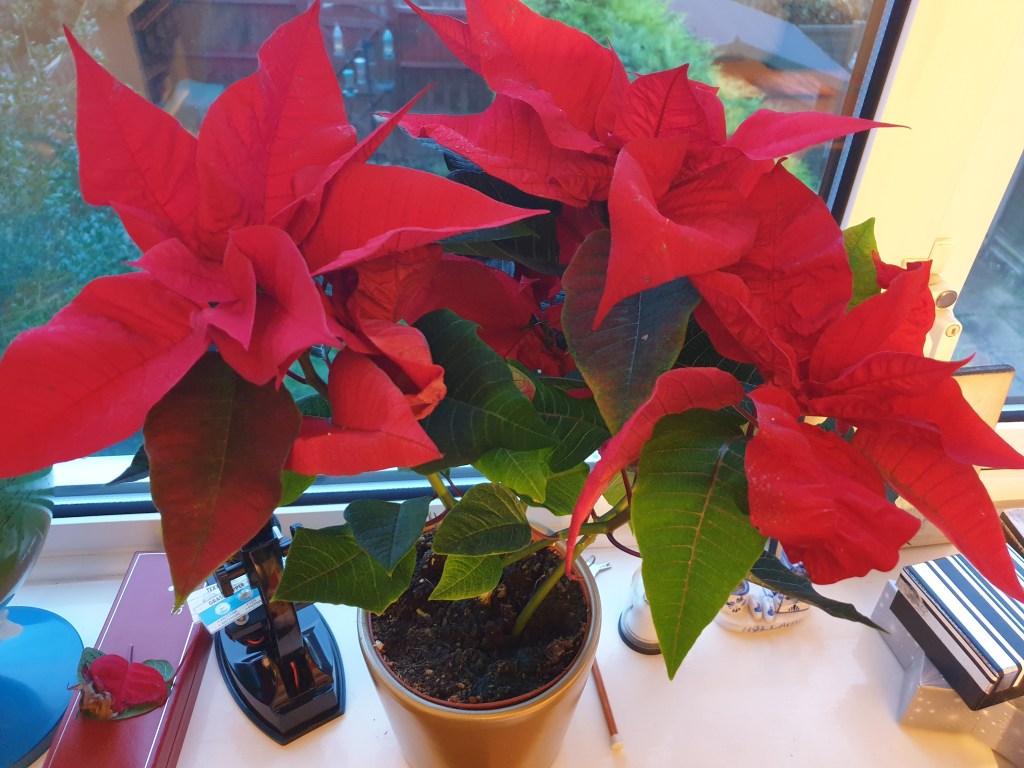
C had also sourced a poinsettia whilst he was out, which made its way on to the windowsill during the course of the early part of the meeting, before the lunch break.
At lunchtime the afternoon cuppa order was placed and timing agreed. At the alloted time, whilst I was on screen, my mint tea accompanied by a chocolate orange brownie that I’d made yesterday was delivered, in full view of the other participants on the video call.
This prompted 2 participants to message me privately, via the chat function. One simply said “you’relucky” the other put in their order for “tea with milk and no sugar“.
A little while later the first messager advised that his tea cuppa had now arrived. I replied to say that mine had come with the brownie, which was met with raised eyebrows and mouth gaping, and a tiny spec of jealousy me thinks!
I’m lucky that C helps me facilitate attending these meetings by picking up the domestic slack. Its all in the planning you know.
Time is money. Good time management is really important in this busy world of ours. But with the increase in reliance on technology is it really helping us be more efficient with our time management?
You could argue that with the advent of video conferencing, the hours spent travelling to and from meetings now become time we could spend being more productive. The trouble with video conference meetings though is they also block out much of the interaction.
Sometimes there’s a glitch and someone can’t get logged in. Or someone arrives late and interrupts the flow by announcing their late attival. Sometimes the details of the meeting are changed but not communicated to everyone. Sometimes the right people aren’t invited to the meeting.
One such occurrence that does wind me up is the system we use at work for meetings. In itself it works fine. But if you are attending the meeting because someone else has forward the invite to you, you don’t get any updates.
I planned most of my working day around a meeting that was due to take place at 2pm. The agenda had been emailed round earlier in the day so I’d read all of the attachments carefully to make sure I had some vague idea about what the meeting was for. I made sure that I went to lunch earlier so that I would be back in good time. I passed messages on to other people to action knowing that I would be in a meeting for a couple of hours so unable to action them myself. Got my whole day pretty much mapped out.
I logged into the call and it said I was the only participant. Fair enough I was prompt, so I’ll give everyone else a chance to log in. After about 3 minutes waiting I’m starting to think this is a bit ominous, so I email a colleague who is supposed to be on the same call. No response from her. Then I check her e-diary to see that she has had a cancellation for the meeting. I double checked my diary but no cancellation received. Then I noticed my invite to the meeting was forwarded. I wasn’t on the original list in invitees.
It seems that the video conferencing software can’t pick up forwardees, so they won’t get any updates. I guess there’s no reason why it should. And no one else thought to pass the message on. But again, why would they?
I have spent the next 10 minutes trying to either get logged into a meeting, thinking I was inept at the logging in process, then trying to determine what was going on. I suppose, given the fact that I’d passed a number of actions on to others, I do at least have the time to spend investigating the issue, but that’s beside the point. I later found out that another party who had also had the invite forwarded had recieved the cancellation. So how did that work? Further investigation required and/or a call logged with IT me thinks.
I watched a TEDxNHS talk back in January featuring Rachel Pilling and Dan Wadsworth that explained if you took 15 seconds to do something now that could save someone else 30 minutes later, then that person did the same, and so on, just imagine how much time would be released and how much less frustrating life would be. http://www.youtube.com/watch?v=wDqNHIKavVE&app
I guess I need someone to give me a 15 second masterclass on this video conferencing system as I clearly don’t have it set up properly.
Our back room has been a bit of a tip for quite some time. It used to be step daughter #1’s bedroom. We eventually moved the main PC down and created a one person workspace.
Over time both of us has needed workspace and have had to take it in turns on the main PC or one person on a laptop in the lounge. That’s OK for short meetings and quick pieces of work, but not conducive to longer periods of time when we’ve both wanted to get on with something.
With the Covid-19 situation suggesting that people should work from home if they could, there just wouldn’t be a sensible place for me to do that. I also want a place to put all my #bellringing workbooks etc. And I could be on an evening conference meeting and C could still use the main PC for whatever he wanted to get on with.
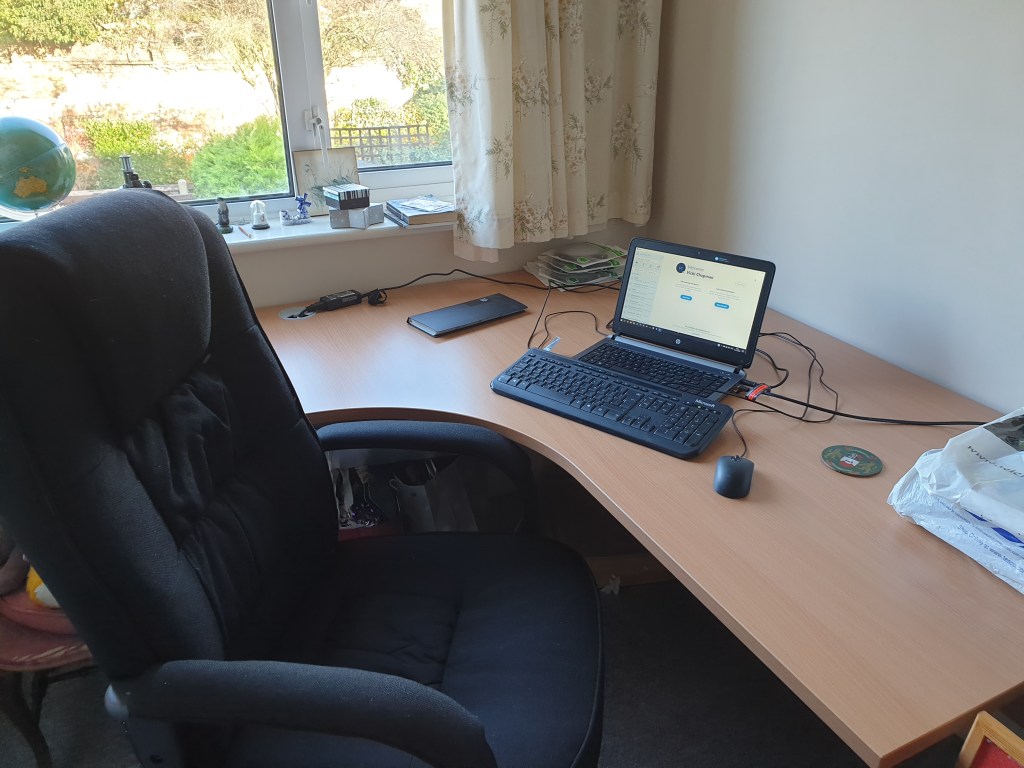
We finally agreed that I should have my own desk space so purchased desk and chair, and set about tidying up the junk.
This weekend has seen a couple of trips to the tip and a lot of sorting of boxes and files, but finally created enough space to get the desk installed. I now have my own workspace and comfy chair. I’m actually quite looking forward to doing some work from here.
I also get the window seat, so can watch the birds come and go and gaze out of the window. I mean, concentrate really hard.
One of the things I dread when I go back to work after some annual leave is the size of the email in box. I refuse to log in when I’m on leave or my day off. If I’m not at work, I’m not at work.
To some in managerial positions that might seem like sacrilege. Surely if you’re a manager you should be available all the time. Well, no. I’m available the hours to which I am contracted to and for what you pay me, and if the work you are asking me to do falls outside of that, then we need to have a serious conversation.
I have done my fair share of ridiculous hours, weekends, nights, earlies etc. Been on call, been on conference meetings, and been in for meetings on my day off and all sorts. The trouble is, the more you do it, the more it becomes expected, and the more you get in the habit of doing it, and don’t switch off.
I do make some concessions. If a meeting absolutely has to take place on my day off and its imperative that I’m there, I will of course support it if I can. But I ensure I get that time back.
I have so much else going on in life outside of work too that I can’t afford to do it. My brain would explode.
There should be nothing that either can’t be dealt with by someone else, or that can’t wait until I get back.
My role as a manager and leader is to equip my staff to be self sufficient and confident to deal with most eventualities, and I should not be a bottleneck in the way.
So, 305 emails in the inbox after 1 week off. A chunk of those are routine and can be dispatched fairly promptly. That took me down to 206 by lunchtime. Then there’s the ones that I do need to read but don’t necessarily have to do anything with or about. Then there’s the ones that do require input.
By the end of the first day back I’ve got them down to a manageable 31. And don’t forget, more were coming in throughout the day too.
Another day tomorrow and another new bunch of emails to wade through.






 Bells, Bakes & Bettering Myself