Why are you so hard on yourself?

Image by Gerd Altmann from Pixabay

Are you one of those people who are kind to everyone else but rarely to yourself?  Apparently, most of us are like this.  I know I am.  I will sit with others whilst they go through drama and trauma, but when I have my own to deal with, I tend to brush it under the carpet.

In a recent Psychologies Magazine ten question quiz, I wanted to find out what was standing in the way of my self-compassion. Turns out, and not really surprisingly, what is draining my self-compassion is self-doubt.

The questions asked what we do when things go wrong, what we feel are the benefits of self-compassion, what our most common cause of stress is, what we wished for more of, how we allowed self-compassion to show itself, when we needed support from a friend, what we think of self-compassion, when we feel happiest what how life would be easier if we were better at something.

For once, my results came out almost exclusively as one of the four possible responses, although there were a couple of questions where none of the answer options really fitted for me. The other reasons were self-pity, self-sabotage and self-neglect.  Reading through their descriptions, I found some elements that I also resonated with. The self-doubt summary was:

“You have an ambivalent view of self-kindness.  You know it’s a good thing and may encourage loved ones to be kinder to themselves, but you apply different rules to yourself.  At the heart of your resistance is a fear that being kind means accepting yourself as you are now. That self-acceptance is the foundation of self-compassion is a tricky concept for those who see themselves as a work in progress, but research shows that people who score highly in self-compassion have the greatest motivation for self-improvement.  It is a myth that being hard on yourself fosters drive.

When you hold back from loving and accepting yourself until you’re a ‘better’ person, you give yourself the message that you’re not enough. That undermining self-belief acts as a brake for even the most focused attempts to achieve.  If this is an old story don’t you owe it to yourself to try something new?  Talk to yourself as compassionately as you would a friend and shift your mental focus to spotlight the best in yourself and what is going well, then watch yourself flourish”.

I know that I have embarked on a bit of a mission of self-improvement but it doesn’t make me feel that I am not enough.  I am merely trying to recognise where I have room for development of self-awareness which actually includes learning more about my self-worth.  I don’t think it’s the same as thinking I’m not good enough. I am good enough and I am worthy, I just need to figure out how to show that.

I certainly don’t sit around feeling sorry for myself or play the victim, and I try not to get too close to those who wallow in their own pity party. 

I can self-sabotage at times.  I am aware of what I need to be doing to stay fit and healthy, to take on less and create space to breathe, but I do find myself saying yes to things even when they fill me with dread. 

I did resonate with the self-neglect description of assuming I’m ok when I’m not and having a default setting of self-reliance and self-sufficiency out of feeling there is no one to rely on. If I don’t let anyone get to close, I won’t get let down or hurt, therefore I won’t ask for help with perhaps I should.

Are you a pitier, doubter, sabotager or neglecter?
Need a lesson in resilience?

Image by Gerd Altmann from Pixabay

Disappointment is part and parcel of everyday life when our expectations don’t align with reality. This could be anything from a meal that you’ve been anticipating all day not tasting so good; birthday celebrations that had to be cancelled because of Covid; or someone’s action or inaction.

You can’t remove disappointment from life completely, but you can learn to deal with it better and even come back stronger for it.

In an article in Health & Wellbeing Magazine we are told that disappointment is an internal emotion powered by shame related to expectations and sometimes regret. It can feel like loss associated with lack of achievement or a missed opportunity; something we feel we want but can’t have and thwarted goals.

The article’s experts said that disappointment can have some benefits.  It can help us focus on those aspects of our lives that help us learn and grow by highlighting what is meaningful to us. It can reveal your passion for something, provide opportunities for personal development and make you stronger in the long run.

Getting bad news is a hard pill to swallow, particularly when it knocks our confidence.  Feeling sorry for ourselves is a perfectly normal response.  If we embrace that feeling it can make getting over it easier.  Take time to feel the hurt, upset or shock.  Blocking it out isn’t good for our mental or physical health and it can invalidate our true feelings, having a negative impact on self-worth.  We shouldn’t be worried about having difficult feelings as they can teach us a lot. We need time to process things and understand what caused us to feel this way.

Being there for other people going through disappointment takes strength of character. It can be too easy to fall into the trap of over empathising with the other person which can leaving us feeling drained.  We may need to listen to our own needs and protect ourselves in order to be in the best place to help others. We may need to set boundaries by asking what the other person needs and then consider if we are the right person to give it to them.

Trying to avoid disappointment all the time detracts from what we really want.  Learning to cope with difficult feelings is through experiencing them and surviving them.  Once you’ve had a disappointing experience it can give us opportunities to find different ways to work towards resolving it. Reflect on what we feel disappointed about and how we show that disappointment to ourselves and others.  Do we need to adjust our expectations, or negotiate?  Putting things in perspective goes a long way to find hope in times of trouble.  Will is still matter this time next year?  In ten years?

The article suggested that we learn from the experience, consider what went wrong, why and how this could be prevented from happening again.  Life doesn’t always follow the path we’d like it to, so let go of the reins a bit and live in the now.

6 people in your corner OR 5 mentors you need?

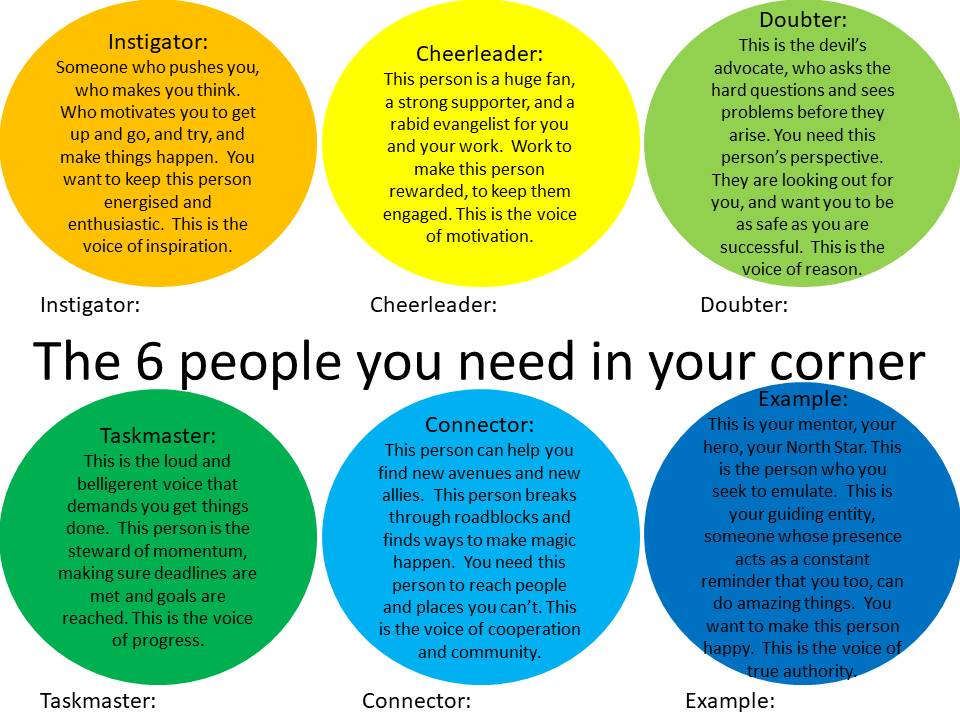
Several years back one thing I picked up, presumably from some talk or online article was the notion of having 6 people in your corner.  Basically, these represented 6 characters that would help and support your leadership journey.  They didn’t all have to be different people, although they could be, or some, or all of them could be the same person.

The 6 characters were:

The Instigator: Someone who pushes you, who makes you think.  Who motivates you to get up and go, and try, and make things happen.  You want to keep this person energised and enthusiastic.  This is the voice of inspiration.

The Cheerleader: This person is a huge fan, a strong supporter, and a rabid evangelist for you and your work.  Work to make this person rewarded, to keep them engaged. This is the voice of motivation.

The Doubter: This is the devil’s advocate, who asks the hard questions and sees problems before they arise. You need this person’s perspective.  They are looking out for you, and want you to be as safe as you are successful.  This is the voice of reason.

The Taskmaster: This is the loud and belligerent voice that demands you get things done.  This person is the steward of momentum, making sure deadlines are met and goals are reached. This is the voice of progress.

The Connector: This person can help you find new avenues and new allies.  This person breaks through roadblocks and finds ways to make magic happen.  You need this person to reach people and places you can’t. This is the voice of cooperation and community.

The Example: This is your mentor, your hero, your North Star. This is the person who you seek to emulate.  This is your guiding entity, someone whose presence acts as a constant reminder that you too, can do amazing things.  You want to make this person happy.  This is the voice of true authority.

Back in about 2009, when I first discovered this, I knew exactly who these people were.  Some of them wore multiple hats for me.  After about 2011 when I’d changed jobs, I really could not pinpoint anyone amongst my work colleagues that fitted any of those roles for me.  Happily, I am once again in the position where I can identify at least one person, even if it’s the same person, for each of those roles.

I’ve just read an article by Anthony Tjan on ideas.TED.com who suggests that we should have 5 mentors:

The Master of Craft: “If you know you want to be the best in your field — whether it’s the greatest editor, football quarterback, entrepreneur — ask, Who are the most iconic figures in that area?” says Tjan. This person can function as your personal Jedi master, someone who’s accumulated their wisdom through years of experience and who can provide insight into your industry and fine-tuning your skills. Turn to this person when you need advice about launching a new initiative or brainstorming where you should work next. “They should help you identify, realize and hone your strengths towards the closest state of perfection as possible,” he says.

The Champion of your cause: This mentor is someone who will talk you up to others, and it’s important to have one of these in your current workplace, says Tjan: “These are people who are advocates and who have your back.” But they’re more than just boosters — often, they can be connectors too, introducing you to useful people in your industry.

The Copilot: Another name for this type: Your best work bud. The copilot is the colleague who can talk you through projects, advise you in navigating the personalities at your company, and listen to you vent over coffee. This kind of mentoring relationship is best when it’s close to equally reciprocal. As Tjan puts it, “you are peers committed to supporting each other, collaborating with each other, and holding each other accountable. And when you have a copilot, both the quality of your work and your engagement level improve.”

The Anchor: his person doesn’t have to work in your industry — in fact, it could be a friend or family member. While your champion supports you to achieve specific career goals, your anchor is a confidante and a sounding board. “We’re all going to hit speed bumps and go through uncertainty in life,” says Tjan. “So we need someone who can give us a psychological lift and help us see light through the cracks during challenging times.” Because the anchor is keeping your overall best interests in mind, they can be particularly insightful when it comes to setting priorities, achieving work-life balance, and not losing sight of your values.

The Reverse Mentor: “When we say the word ‘mentor,’ we often conjure up the image of an older person or teacher,” says Tjan. “But I think the counterpoint is as important.” Pay attention to learning from the people you’re mentoring, even though they may have fewer years in the workplace than you. Speaking from his own experience, Tjan says, “Talking to my mentees gives me the opportunity to collect feedback on my leadership style, engage with the younger generation, and keep my perspectives fresh and relevant.”

They both cover a lot of the same ground but Tjan has some interesting other ideas.  I know who my Champion and Copilot are.  I think I am my own Anchor really.  I’m pretty clued up to my own values and setting personal priorities to achieve a good work-life balance.  I’m not sure who my Master of Craft is at the moment or my Reverse Mentor as I’m fairly disconnected with leading or mentoring anyone at the moment.

Do you know who you’d have in your corner or who are your 5 mentors?

Natural Wellbeing

I’m reading an article in the most recent Psychologies Magazine about how regular time in nature contributes to wellbeing of mind, body and soul, and it suggests that even spending 5 or 10 minutes outdoors with nature can be beneficial in reducing anxiety and can make us feel happier.

I know that I don’t get to spend nearly enough time outside.  I do try to go for a walk at lunchtime, but quite often, due to location, that around a housing estate or hospital grounds.  We are fortunate that there are open fields behind the hospital and I get a move on I might just have time to go that way. I guess even in a housing estate, nature has its place in well-manicured (or even overgrown) gardens and hedgerow.  You just need to look hard enough.

When we were kids we used to holiday most years in the wilds or North Wales.  A beautiful spot with mountains to climb, trails to walk and forests to play in.  In adult years, when we’ve been away, we’ve always had what we’ve called “long walk day”.  A day put aside (hopefully with good weather) to go on a 5-10 mile trek. No distractions but the views around us.  Taking in the sights and sounds of nature doing its thing.

Having to work most days means that going out for long walks or further afield is not easily achievable. However we are lucky that we have some nice park spaces quite nearby.

According to the 10 question quiz that always accompanies these articles the thing that I should find most benefit from time outdoors is grounding.

“If you crave calm or wish you feel more grounded and connect to what matters, upgrading the quality of the time you spend in nature ma provide the shift you need.  It’s easy to spend time outdoors on autopilot, or use it as a way to being with others – but you’ll benefit most from spending at least some time in nature on your own, so you can tune into the stillness and connect with your inner calm.  If your tendency is to live in your head, time in nature can be a much-needed way of paying attention to your physical self.  Finding the ground beneath your feet may even be the first step to finding a new direction in life.

You’ll get the most benefit by focussing on the here and now as you walk.  Don’t give yourself a hard time if you can’ leave your emotional baggage behind but, when you become aware that you’re caught up in thinking, direct your focus outwards by noticing the colours, textures, sounds, smells and sensations.  We can all benefit from a daily grounding ritual but, for chronic over thinkers, it can be life-changing”

Like most people, I haven’t had a proper holiday for nearly a year and a half now (since summer 2019), so when we are able to, I will relish the chance to get out and have some time to wander around new places and spaces to take in the sensations.

The Instant Gratification Monkey

I was reading an online article from Tim Urban, who studied why procrastinators procrastinate.  He possets that they can’t help it.  In their brain the procrastinator has the Rational Decision Maker who steadily guides the mind in to doing what needs to be done, and then there’s the Instant Gratification Monkey who sideswipes things and sends the mind off wandering for some instant satisfaction for information or other, that takes us away from our steady path.

The Instant Gratification Monkey takes us off to play in what Urban calls the Dark Playground, that space where all the fun, new, shiny things hang out that distract us from what we should be doing. In the back of our minds though is this constant feeling of anxiety or regret for that looming deadline or that thing that we’ve been working towards for ages.  When that deadline approaches though, it’s time for a visit from the Panic Monster who scares us away from the Dark Playground back in to a sense of productivity to get things done.

Urban offers three steps to turn procrastination into motivation:

  1. recognise that you are procrastinating.  Being aware of something is usually the first step in resolving it. 
  2. Understand the reason for the procrastination.  Is it the task itself, or is it you? Is it that you aren’t enjoying it, not qualified for it, or feeling overwhelmed by it?
  3. Set objectives, tactics and rewards.  Depending on the reason for the procrastination in the first place it might be as simple as having a to do list if you’re feeling overwhelmed, or someone that holds you to account, or if you promise yourself a treat if you get that thing done.

There are times that I procrastinate.  It’s not usually because I don’t want to do something, more that I don’t want to do that particular thing right now.  I will send that email out but after I’ve watched this episode of that tv programme I like.  I will write that report just as soon as I’ve finished making lunch.  I will learn how to ring handbells properly, just as soon as I’ve written that report and sent that email.  Sometimes it can become a vicious cycle.

Other days, I can blast through even the most boring, or painful task without so much as a second thought.  It’s about the frame of mind that I’m in.  Sometimes, I find being in a particular place, or with particular people helps galvanise me into action.  Sometimes I just wake up and tell myself that today I’m going to power on through all that stuff and clear my to do list.

Today has definitely been one of the latter type of days.  I’ve finished the first draft of a strategy document.  I’ve documented a framework that I invented that supports that strategy.  I’ve been for a power walk.  I’ve read the next section on learning to ring handbells and had a few goes at it.  My Rational Decision Maker was in charge today.

I wonder if that means tomorrow I’ll be all out of juice and my Instant Gratification Monkey will be running the show.

A different frame of mind

I think I’ve probably mentioned this before, but how we choose to respond to outside stimuli, pressures and events is entirely within our own undertaking.  We can choose to get wound up by things, or we can choose to let it go.

My first day back at work this week was horrid.  By the end of the day I was absolutely sure that the conversation when I got home was going to be around how much longer I would have to put up with this.  C was his usual stoic self and confirmed my worst fear that I would have to stick it out for a few more years yet.  Damn.  I felt exhausted after just 1 day back in the office.  I felt dejected.  I felt well and truly fed up.  This has a physical impact as well.  I was unmotivated to do anything else and I stuffed my face with crisps and chocolate. I felt physically sick at the prospect of having to go back the next day and deal with it all, all over again.

Fast forward a few days and I’m in a much better frame of mind.  The plans I put in place on Monday have had a positive result and things are looking ok for the coming week.  I’ve also made the conscious observation, out loud to others, about what I am currently employed to do versus what I get dragged back in to, through necessity, but that I shouldn’t really, and the impact that is having both on trying to deliver what it is I’m supposed to be doing, but also providing the right kind of support to those in the department.  A fuller conversation as to how that plays out is happening later this week.

My point being, my mind-set had changed.  I had chosen to not allow the frustrations at the beginning of the week to overshadow the rest of the week.  I packed that day away and moved on.  I’m not pretending it was an easy transition.  I still woke up on the Tuesday really not wanting to go to work.

According to the Mayo Clinic (https://www.mayoclinic.org/healthy-lifestyle/stress-management/in-depth/positive-thinking/art-20043950), whether you are a pessimist or an optimist can have an effect on your longer term mental health, but also has physical manifestations too.  Being more positive doesn’t mean that you gloss over the difficult things but that by approaching them in a more positive way can be more productive.  Making the best out of a bad situation.  Thinking positively can improve life span, reduce depression and distress, provide greater resistance to colds and better psychological and physical wellbeing, cardiovascular health and general better coping skills.

By focusing on positive thinking we can identify areas of life that may need changing, stopping to check on our thinking and finding ways to put a positive spin on it.  By being open to allowing yourself to have a laugh during difficult times can help you feel less stressed.  Following a healthy lifestyle is often cited, and probably the one I do least of.  Surrounding yourself with positivity will rub off on you and practicing positive self-talk will help you realise that you have a lot to be thankful for.

I’m heading to the end of this week with a much more positive outlook that I had at the beginning.

Making the most of time

No surprises but there are 24 hours in a day. How we spend them is our choice. Whether we spend them wisely is debatable. Some people profess to be really good at time management whilst others feel that there isn’t enough time to get everything done. Is time slipping away from us or are we wasting it?

The latest dossier in Psychologies Magazine goes into some detail about where commitment lies, understanding procrastination, understanding how we currently spend our time and prioritising what’s important. It offers some advice on timekeeping tips for the proverbial laters. Then comes the inevitable 10 question test to determine what stops you making the most of your time.

My results indicated the dominant trait of overthinking, putting hours into mulling over events, conversations, decisions and tasks. This leads to being overwhelmed and worry that others seem to be more productive. Others may be unaware the extent of the overthinking because the outward impression is one of calm. It suggests that I should schedule worry time and limit it to 15 minutes.

A close second was overcommitment, a difficulty in saying no to opportunity and helping others. But if that time does not align with core values it will undermine wellbeing. The challenge here is to find space in my life to connect with the people I love and nurture new connections. Resist the urge to fill all the time up.

Both easier said than done. Today for example. First day back at work after 2 weeks off. By midday I was already feeling that I’d had enough. I didn’t want to be there. By the end if the day I was starting to seriously consider my get out strategy. I had a meeting in the evening I had a zoom call which was fine, not anything stressful, just a bit of preplanned for something which may, or may not, be happening next week.

I’ll try and give tomorrow a fresh start and not worry about the things that I can’t do anything about. And it’ll be C’s birthday so I intend to spend the evening with him and not worrying about what else still needs to be done.

50 Ways to Enjoy Turning Fifty

My sister bought me this book for my birthday last week.  I thought I’d better take more than a cursory look at it.  It claims to have 50 ways to make this the best year EVER.  The book is set out in chapters based on making the most of turning 50, planning the best year EVER, implementing the plan, treating yourself well, having fun, looking back, looking within, expressing gratitude, putting things in order, eliminating what you don’t need, giving and looking forward. 

Each chapter has key questions to help you analyse yourself and figure how to make the most of turning 50, thought experiences to delve a little deeper and activities to do. It does say that you can dip in and out of the book, fast forward to the bits that most interest you and so on but being a pedant, I started at the beginning.  

Way #1 Accept your age. 

Thought experiment 1 asks you to make a list of people you admire who are over fifty and who are living terrific lives and make a note of what you admire about how this person is living their life.  OK, so first thing is to think of people over 50 who I admire.

I’m not going to list them all here because some of them might read this and either be embarrassed or disagree.  I’ve written each of them in the book.  Suffice to say that it includes C, my parents and siblings, a few former work colleagues, and some ringers I know. In some cases, I admire what they have achieved over adversity.  In others I admire what they’re currently doing with their lives, and if I’m honest, I’m probably a bit jealous of.  Some I admire because I wish I were more like them.

The key questions were what are some benefits of turning 50? and What are you looking forward to this year?

I guess benefits might include being that little bit wiser sometimes.  Having more opportunities to reflect on what I want out of life and trying to achieve a better work/life balance. Nearer to retirement age (although still some considerable way to go).  Looking forward to getting to see R again.  This year has been an exception and we haven’t been able to spend time together, so as soon as we can we’ll do that.  Can plan for the trip that we should have had for my 50th birthday.

Thought experiment 2: what concerns do you have about turning fifty?  What challenges are you experiencing or expecting? Which of those can’t you change? What constructive actions can you take regarding that item?

I’m not really bothered about turning 50.  It’s just a number.  I guess ill health, or my level of unfitness is probably going to be an issue at some point.  I’m feeling less tolerant of other people, which I need to reign in a bit sometimes and there are other things that I’d rather be doing with my time but have to work instead. I can’t change that for a few more years yet unless something amazing comes up, like winning the lottery.

Freedom in sight

So today our Prime Minister has set out a road map to ending the UK lockdown completely by 21st June. To be honest I’m not sure how I feel about that.

Outdoor gatherings of up to 6 people could take place from 29 March. That means people will start mixing long before many have had both vaccine jabs. Therefore increasing the risk of spreading again.

Non essential shops like hairdressers etc and outdoor hospitality could be open again by 12 April. That’s good news for R and her flatmate who’ll be able to return to work. It also means that beer gardens will be open again so the idiots whose “first thing I’m gonna do is go down the pub” mentality will again be people gathering who haven’t had both jabs, increasing the risk.

From 17 May 2 households might be able to mix indoors. That means we’ll be able to go and see R for the first time since about November. It also means a possible return to ringing more than just 2 bells.

Then all restrictions could be lifted by 21 June. That is provided the 4 tests on vaccine take up, vaccine efficacy, infection rates and new variants get passed. There will still be great numbers of people that won’t have had the 2 vaccine jabs yet.

Whilst I want there to be people at work and people being able to see family members, its the idiots who go too far by flouting the rules and are purely selfish about it all that puts it all at risk again.

Please let’s not see a return to stupidity.

Every day’s a school day

It seems like it at the moment anyway.  Between doing my online mindfulness course, which has really challenged some thoughts and feelings, and learning methods for virtual #bellringing in Ringing Room sessions, of which I had 4 this week.

The first #bellringing session was a district practice which I didn’t need to learn anything new for but the session that I run on Thursdays we’re consolidating methods that we’ve been learning for February.  Some of those methods are repeated at a Friday morning session but sometimes something different.  Then every other Friday there’s another session that changes methods every time.  This week I needed to learn Newcastle and Alnwick Surprise Minor.  And in 2 weeks’ time, we’re aiming for London and Wells Surprise Minor, and I set new methods for our Thursday session at the beginning of the month.

Some of these methods I’ve never even looked at, always thinking they are beyond my capability but with the advent of Ringing Room, have been able to ring things that I wouldn’t normally get to ring in any of the towers that I would normally frequent.

Learning to ring takes time, even just the basics of handling a bell on your own, then you need to join in with others and make a meaningful sound.  Then you can move on to the more complicated stuff, but that tends to depend on others a bit more, as you can only ring to the standard of the most novice ringer in the band.  However, learning skills that require longer term commitment can be rewarding and stimulating for the brain.

A quick internet search shows that there are a multitude of sites that promote learning something new, from new skills, to new languages, to cooking and baking, knitting and creating videos.  I’ve always found learning something new to be rewarding.  It doesn’t necessarily make me an expert in it but it gives me better understanding, better skills, better adjustment and a wider range of things to do.

Having just completed the 6 week mindfulness course, I’m now looking around the site to find the next thing to dive into.