Draw things out, don’t push them in.

Our #MSEBuddyNetwork session yesterday was led by Chris Sheepshanks, a developer of organisational coaching programmes. He was very engaging and a real find.

He talked about coaching as being a tool to help others draw things out, rather than for you to push your ideas on to others. He said that a good coachong session should help the individual have a greater awareness of what they are doing in order to take responsibility for their actions leading to understanding what choices can be made to move forward.

Chris mentioned 5 principles:

1 -Slow down to speed up. We usually spend more time deciding what needs to be done and doing it that we don’t give enough time to reflecting and connecting in order to find our own purpose. Coaching should help people have a better conversation with themselves by facilitating pause and reflect.

2- Sustained high performance. We spend so much time on trying to achieve what it is we want to achieve without giving thought to learning, growing, stretching and developing ourselves. We need to find enjoyment in what we do and find a sense of purpose.

3 – Get comfortable being uncomfortable. Its easy to do what you’ve always done and natural to stay there but we won’t learn anything if that’s where we stop. Learning gives us a slight touch of discomfort and vulnerability but a good coach should be careful not to push too hard and risk over exposing or withdrawal.

4 – Trust & Rapport. To truly have a transformative conversation there needs to be a strong sense of trust between coach and coachee that supports an honest and openness with others.

5 – Enable Others to Play a Better Inner Game. Tim Galway says that everyone has the potential to perform but that not everyone performs to their potential. The interference that stops that by way of fear and self-doubt it what stops us.

I think that last point is significant for me. I’ve spoken before about my imposter syndrome holding me back and sometimes I do go for the easy option of familiarity and being comfortable, or even putting things in the “too difficult ” box and put off having to deal with it.

Having thought about this a bit, I am currently in the process of taking stock, to increase my awareness of what I’m doing and why, and take responsibility for learning, growing and developing in to what I want to manifest. Then I’ll make a decision on what direction to go in based on informed choices. For now, that might be taking some time to slow down to reflect and connect, in order to speed up.
Weighing in on Mindful eating

A number of years ago I joined Weight Watchers to try to lose weight before step-daughter #1’s wedding. Through diligence, planning, counting and going to a pop up class at work, with some colleagues, I managed to lose nearly 4 stones. I got down to a size 10, something I hadn’t been for very, very, very many years, and some would say was possibly too much. Once the wedding was over though I had no goal to aim for, so my love of food started slipping. I didn’t plan so much, I didn’t count so much, and gradually all of that weight I’d lost, and then some, crept back on.

A couple of years ago my boss and I decided to start Slimming World instead, but neither of us could attend a class in the evening due to other commitments, so we just used the app. Things started off OK and I lost a few pound here and there. I even got to my half stone loss award. So far so good. But there wasn’t anything driving the need to lose weight, other than the fact that I was heavier than I should have neen according to my BMI. The trouble is, I like food. And beer. And wine. Although I should say that I don’t drink regularly or in large quantities. Usually one pint and I’m done. So the weight has just been bobbing along the same line, give or take a pound or two here and there.

For me, the most significant issue has been lack of tangible reason for REALLY putting some effort in to losing weight. We eat well, and varied diet. Only problem is I don’t like fruit, of any description in any form. We do follow SW recipes, but we do indulge in treats and nibbles and naughty but nice food. Life’s too short, right?

There’s lots of empirical evidence that suggests that being on the heavier side increases your risk of heart disease, diabetes and so on. And now they’re linking obesity to a higher risk of contracting Covid-19. I don’t get easily swayed by things like that, there’s always some bandwagon to jump on. One week it’s don’t eat chocolate, the next they’re telling you that dark chocolate is good for you, in small quantities. And many other examples.

I think that if you want to diet, or exercise, or whatever, you should only be doing it for yourself and not to impress anyone else or jump on some gimmicky bandwagon.

I do want to lose a bit of weight but I’m not going to give up everything I enjoy about food and drink, to fit some stereotype of femininity or social construct. I will put a bit more effort back into counting and planning and if I lose a few pounds, hurrah.

Embrace the average

I was listening to an old episode of The High Low Podcast yesterday and they were discussing being distinctly average. If you type in “being average” into a Google search the first raft of responses are about how we shouldn’t settle for average, we should strive for being the best, the biggest, the highest paid, the most (insert noun of your choice). This implies that being average somehow isn’t quite good enough. Well I’m here to say that being average is just fine. It’s fine for you, where you are in life at this moment of time.

I’ve never really been supremely brilliant at anything particularly. I’m OK at stuff and reasonably good at some stuff and rubbish at other staff. We can’t all be brilliant at everything. I don’t particularly see this as a negative thing and its not something that bothers me.

I do the best of my ability at that time, in those circumstances. I’ve got to where I’ve got in a contrived workplace hierarchy through hard work and learning. I do believe that we should strive to be our best self, but that might by being average in terms of how the outside world relates.

I personally feel that Average is the new Great. Living your own life, the way you want to. I don’t aspire to be a CEO, I don’t aspire to have a massive house and garden and fancy stuff. I don’t aspire to be a jet setter, an influencer, marathon runner, or a fashionista.

I love the fact that I have some authority and some responsibility in all walks of my life. I have a home, car and a safe environment, which in some areas is what others aspire to. I make the occasionally good cake but I make some naff ones too. I can ring some methods including some surprise royal and maximus methods, but can’t ring some of the more basic methods or five or six bell methods. I can cook edible food but I’m not a gastronomic genius. I’m a parent of a well grounded, independent 23 year old but I didn’t get it right every time. I have some good days and some bad days.

According to Tim Denning, Its OK to be average, and average is a state of mind. What matters is the difference we make.

Embrace and celebrate being average 🍾

Start with you

I am a member of the #MSEBuddyNetwork at work, a group of staff who are here to listen and support colleagues. Whilst I was on leave last week I missed out on the session about Respect. Thankfully the slides and supporting documents are circulated afterwards so I was able to catch up on the conversation.

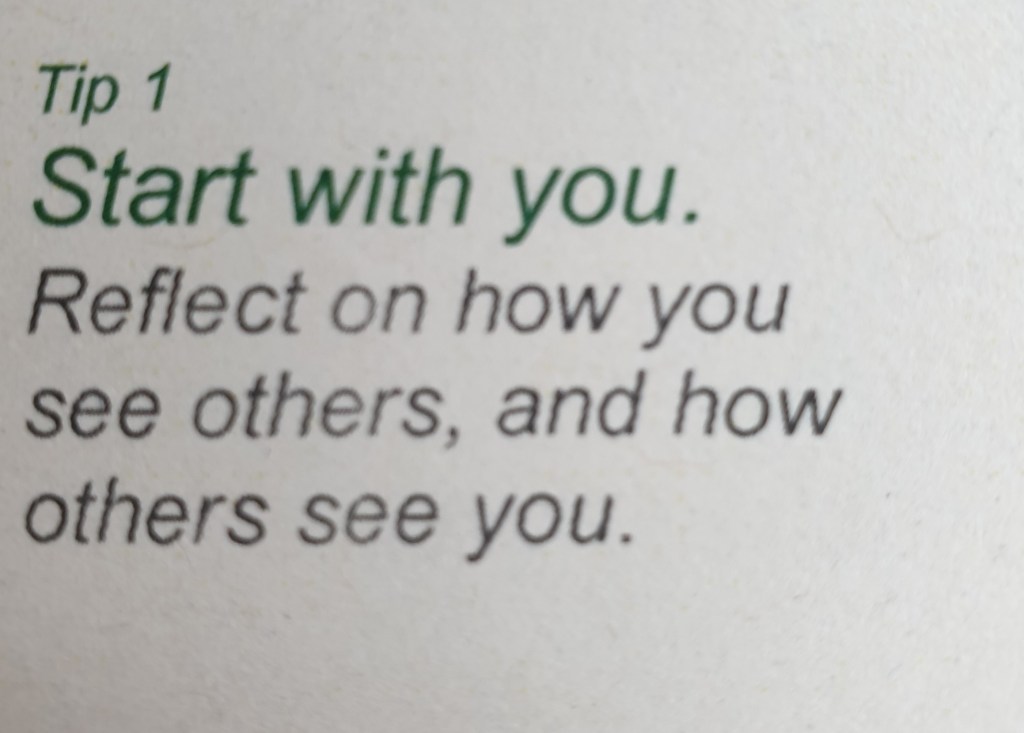
One of the supporting documents circulated was 30 Tips For Respect. A matrix of ideas to help put into focus what we should be thinking about with regards to respecting others. Tip 1 was entitled Start with You and went on to describe that you should reflect on how you see others and how others see you. This got me thinking about a piece of work I’d done during my Masters on What is it Like to be on the Receiving End of Me?

I tried to find the relevant documents that I’d collected and written at the time but I must have put them somewhere very safe and forgotten where.

Anyway, this was pulled in to very sharp focus during a conversation I had with a member of my staff. We have had to instigate shift patterns since the start of distancing restrictions as I have 66 staff crammed into a small space. In order to keep them socially distanced I can only have half of them in at any one time. Over time this has started to cause problems with people’s mental and physical health and some have been referred for support. The advice that they had been given contradicts the regulations of social distancing and therefore it has not been possible to act on some of that advice. The person I was speaking to was having a hard time understanding why she couldn’t revert to her previous hours and that it seemed that I, as the manager, didn’t seem to understand what people were thinking. We had a really good honest and frank chat about what I have been doing to try to get their issues and working arrangements sorted and she acknowledged that she felt better for having had the conversation with me. She then said “you need to tell everyone what you’ve just told me, it doesn’t matter that it’s still not resolved and you haven’t got all the answers, but people would feel better knowing that something was actually being escalated”.

I thanked her for her honesty and said that I would reflect on what she’d said but that I wasn’t going to rush straight in now. I would give the matter further thought but have said that if she feels others would feel better for knowing more about what I’ve been doing and escalating with senior managers and directors then I will do that.

It was a great example of listening to and respecting others’ needs and reflecting on my own behaviours and what its like to be on the receiving end of me.