What no bells?

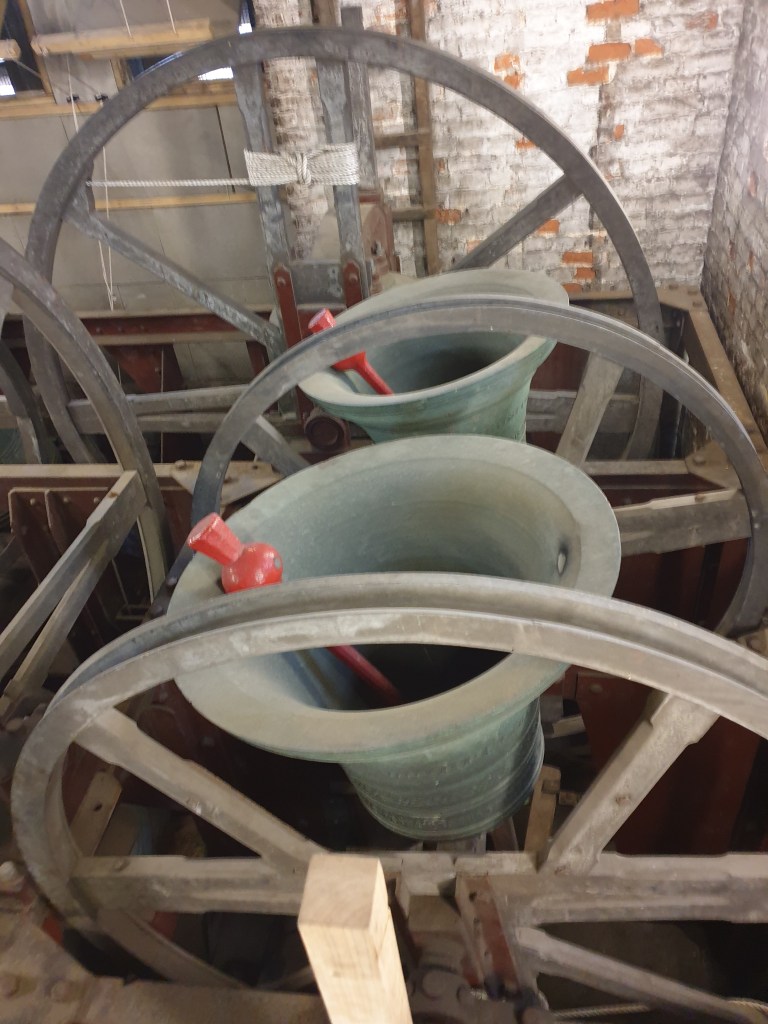
Although there has been no group #bellringing for such a long time now C and I have been going to the Cathedral and ringing two bells just to keep things going.

This week however we are away visiting E&M so not able to go to ring. In ordinary times we would go with E&M to their tower to ring on Sunday bit as they’re not back ringing yet either, we had the morning off.

An odd feeling to not go ringing but after yesterday’s marathon walk around Hardwick Hall we were all exhausted and enjoyed a couple of extra hours sleep.

I am looking forward to returning to the Cathedral next weekend when we will have a couple of extra of ringers for the first time in many, many months. The rules still only allow six people with social distancing, masks and good ventilation but it will be fantastic to hear more than ding and dong and try real ringing methods.

As we head into June and the possibility of no restrictions after the 21st (fingers tightly crossed) we may also be able to start practices again. I know many towers already have but because we are very reliant on people from other towers supporting our practice we’ve decided to hold off for a while.

It will be interesting to see and hear how we get on when trying to raise and ring the heavy bells for the first time in 16 months. Managing people’s expectations of what they could and should ring might be a challenge.

From what I’ve read on social media from other towers it seems that there has been a positive community reaction to bells being rung again but then I upoose no one is going to share any negative responses they’ve had.

I always share details of what ringing we are planning and what we’ve done on our Twitter account and tag local radio, the diocrsan office, the cathedral, local city sites as well. Some are really positive and like and share our posts which is lovely.

I want to build a closer relationship with the cathedral and diocesan offices and local community sites so that they start to fully consider the advantages that bellringers bring to church and community.

I’ve already had conversations with the cathedral office about a diocesan wide ring to mark the enthronement of our new Diocesan Bishop later on in the year and look forward to some closer links.


Lost and found

You know when you know you have something, and you know where you last saw/used it, but for the life of you can’t find it when you need it next?  That was me and a set of colouring pens.

Now, we’re not talking anything deep and philosophical or anything like that.  We’re talking a set of colouring pens that I wanted, because I wanted to use a different colour, other than blue or black biro, to mark something off so that it was more visible.

I’ve had a set of colouring pens for ages, and I kept them with the squared paper that I used to write out #bellringing methods when I was learning something new.  Every bell was assigned its own colour and I would draw out each lead end so I could see when a different place bell started.  I’ve kind of moved on from doing that so much these days and use other methods for learning new methods that seem to work.

The pens however, were last seen with the squared paper, on the pile of books and magazines that are in the cubby hole to the left of where I sit on the sofa.  That’s where they’ve always been and had no need to be moved anywhere else. 

I have a nice new set up in our study with a new desk, chair, my laptop set up and my Holhem gimble ready and poised, and a nice shiny new stationery holder.  The stationery holder currently has my post it notes, my favourite couple of writing pens, a calculator, my business card holder safely ensconced.  There’s any empty slot shouting out for something to fill it.  The colouring pens would do marvellously, and then they would be at hand for me to mark off things on my events calendar.  But where the heck are they?

Having decided to look for said colouring pens two minutes before a video conference meeting was due to start, and not finding them instantly, I sat wondering for a while as the attendees for the meeting arrived.  Hmmmph!

Meeting over, I then had several actions as a result and some other things to immediately attend to, so the search for the illusive colouring pens dropped out of my mind for a while.  Then I went to sit down in my spot on the sofa and suddenly remembered that I had a mission to accomplish.  Find those ruddy colouring pens.  They’ve got to be there somewhere. 

Books and magazines start to get launched out of the way.  They can’t be far.  They shouldn’t be anywhere else.  They shouldn’t be this far down the heap.  After a full on three minutes of frustration, I flopped back in my sofa seat.  Grrrr.  Where are those blasted pens? 

Oh, hang on.  There’s a couple of books in the pile that have fallen over.  I’ll just put them upright again.  Oh, and hallelujah!  There are the prodigal pens. Hiding in the blackness of under the small coffee table that nestles amongst all these books and magazines.  Hoorah!

I happily skip (well, more like lumber) off back to the study, tip the pens out of their zipped, plastic casing and decide upon which colour to use as my marker.  Then, rather satisfyingly, plop them all into the waiting vacant slot in my stationery holder.  Having used the red pen to mark off my events calendar, I add that to the collection, then sit back to admire my handy work.

The simple pleasures!

Making your voice heard

Have you ever felt like you’re talking to deaf ears?  You’ve been trying to tell someone something for ages and they’re just not listening?  And then they even have the cheek to say that you never told them?

Just lately, I feel that I’ve been telling people what’s been going on but the message just isn’t getting through.  Messages either aren’t being recognised for their content, or not being considered important enough to disseminate, therefore others aren’t finding out, and feel like nothing is being done.

Case in point today.  For the last, who knows how many months, I’ve been telling a group of people what I am doing to help alleviate a situation for a larger group of people.  That larger group of people have not had that information shared with them, so are getting up in arms about things appearing not to be happening. Because the larger group of people are getting irate, they’re taking it out on the smaller group, who are complaining that they are being got at.  I’ve explained so many times that if they bothered to share the information that I’d given them with the larger group, the larger group would be more satisfied and aware of what is happening on their behalf.

Other recent situations have involved one person complaining that things they are responsible for aren’t working properly, so I’ve given advice on things they might like to try instead to see if it improves things (and I know they do because those same things have been employed elsewhere and worked well).  They don’t bother doing anything different and come back again complaining still that things aren’t working right. 

Am I speaking Martian?

I’ve had times when I’ve felt that I’m just not being heard. What’s given me the strength to speak up was having read a book called “Thanks for the Feedback” by Douglas Stone and Sheila Heen.  It gave me some practical tools to apply which ultimately gave me the courage to speak up for myself and get my point across. 

Things that I have learned about trying to get my point across is that people need to be understood, be clear on what their own issues are, but also be clear on what my concerns are.  People need to be educated rather than blamed or accused of something.  It gets a far better response. Having clear expectations means that there should be no room for misunderstanding, and clearly people I’ve come in to contact with either need it repeating multiple times until it sinks in, or in writing so that I can refer them back to it.

Yet still some people don’t, or won’t listen.

Changing the Goal Posts

Things are always changing. How many of us has had a job description that bears no resemblance to the role that we actually do? How many times have we decided on a particular course of action then something has come along and meant that we had to go in a different direction, whether wanted or not? For those who project manage, how many times has the scope of your project changed, and resulted in having to adopt different technologies or processes or had to be scaled back or scaled up? How many times has our personal circumstances changed over the years? Change happens all the time. Its how we respond to those changes that makes the difference.

My personal circumstances have changed over the years from being a child, leaving school for the workplace, changing jobs, changing partners, becoming a wife and a mother, going back to higher education, becoming responsible for the delivery of projects, becoming responsible for the delivery of service, becoming responsible for a team of staff, being responsible for bellringing activities locally, nationally and internationally.

If you’re not used to change though it can be uncomfortable. Kubler Ross’s change cycle likens the change process to the same phases that a person might go through the grief cycle: first the shock that something might actually happen followed by the denial that it will happen, the “how many times have I heard that one” scenario. This is followed by the frustration and anger when we realise that things are going to be different and then the depression of things that are happening that may be out of our control and the lack of energy to get involved with it. But then things start to look up again when we start to engage with what’s going on and start to get curious. Then we start to feel more positive about the situation as we learn more about it and experiment with how the new situation is going to work then we become fully integrated with the new ways of life. Of course, how long we individually spend in each of these zones is a purely personal thing and we don’t move on until we are ready no matter how hard someone else pushes.

Some people struggle with change as they fear that they may be losing something. It might be that they will no longer be the acknowledged expert in that field, or that they may be replaced by technology or a younger, cheaper model, or that they might not be able to cope with the change, particularly where new technology is involved. Where regular routine is changing some people might be fearful of a change in security or safety. People are likely to be more resistant to change if they are not involved in the process from the start. As well as being anxious, they can become downright obstructive.

Having a positive attitude to change means that we spend less time in the frustration, anger and depressing phases because our mindset is already moving on to finding what the positives are and how we can be involved and engaged with the change, and learn what the benefits are going to be. Looking to the past and accepting it for what it was is only useful if we learn from it and move on. Accepting and embracing change early on allows you to adapt more quickly and be more flexible. The more often we encounter change, the easier it becomes to adjust.

I find that resisting change takes far too much energy. Even if I don’t necessarily agree with the change that is being put forward, more often that not, its going to happen anyway, so I may as well accept that and make the best out of it. Who knows where it could lead ?

Sunday rituals

Rituals are good for giving us the power to keep us grounded, stabilised and focused. They can provide a sense of confidence and security and can help alleviate grief and stress and can increase happiness. Doing things on a regular basis gives us a sense of familiarity in a world when there is so much going on around us.

Sundays in this house is very ritualistic. Fortunately for the two of us we can still go #bellringing on our own, so up and out first thing. When we get back home we split the chores. Something we agreed from the start is that I would either cook Sunday lunch or do the ironing but not both. He picked cooking so I get landed with the ironing.

Ironing is not my favourite pastime so I need some distraction in order to get through it. Generally this comes in the form of a vat of coffee, using a huge mug I’ve had for years. Because I don’t have breakfasts on Sundays by the time we get home from ringing I’m hungry, so have a snack of some sort with my coffee.

Then I’ll put a film or Netflix series on so that I can watch that whilst I’m ironing but it can’t be anything that requires too much concentration otherwise I’d burn his shirts. He’s busy cooking a Sunday roast by this point.

Then, after lunch I prepare my breakfasts and lunches for the working week ahead. This week I’ve made Biscoff pancakes for breakfasts 😋 and I’ll have ham rolls for lunch.

Every other week we have a family Skype and catch up with everyone, and sometimes I have either a meeting or virtual #bellringing session in the early evening.

Then its time to settle down. Often we’ll have cheese and crackers for supper, sometimes accompanied by a glass of Baileys. There’s usually a dodgy old film or TV show on that we’ll settle in to before wrapping myself in my sofa blanket and having a nap.

The simple pleasures in life and the familiarity of ritual allows me to rest and recover ready for the week ahead. Once I’m under my sofa blanket, do not disturb!

Opening doors

When I get asked to give talks its one of the scariest things and takes me on a roller coaster ride.

My first question is why have they asked me? And the cynic in me replies “because they need to fill a slot and you’re an easy ask“. But maybe, just maybe, its because its a topic I know about and the person that’s asked knows that I can do a half decent job of it.

My first real worry then is what on earth have I got to say that anyone would want to listen to. I’m no one special. I haven’t done anything earth shattering brilliant or enlightening or entertaining. No one is going to want to hear me spout on about xyz when there are far more interesting and entertaining people who could do it.

Then there’s the “what am I actually going to talk about“. The latest ask hasn’t been too specific yet so I’ve asked the question. I could redo a talk I’ve given on a specific topic before, so I won’t have to prepare anything new, or do they want something different?

Then there’s the “how long have I got”? This is where, once I’ve written my talk I’ll time it to make sure it fits and I get all the main points across. I’ll read and re-read through it multiple times, including immediately before delivering it.

Then there’s the “oh my god, how many people will turn up? Supposing no one does?” Well, that’s not really under my control to do anything about. The one good thing about doing talks over Zoom is that you can change the view so you don’t have to see everyone’s faces and therefore don’t know if there’s one or one hundred people watching. Of course the trouble with doing that is then you miss out on any visual cues from the audience, like wanting to ask a question or wanting you to get a move on and shut up.

I generally don’t get nervous about giving talks, its the bit afterwards. Whilst I’m talking I know what I’m going to say, I’m well prepared, I’m in control. I’ve been to the loo, I’ve got a glass of water handy. But at the end when the facilitator opens things up to questions, that’s when I start getting nervous. What if someone asks a question I don’t know the answer to? Or worse still, I don’t even understand the question? The former can be resolved quite easily with a straight forward ,”you know, I don’t know the answer to that but I’m going to go away and find out, then I’ll let you know”. That’s all good if you actually do that, which I always make a point of on the rare occasions it happens. If I don’t even understand the question I’m not beyond asking them to rephrase it. Particularly if its quite a technical question, I’ll make a joke of it and ask them to dumb it down for those like me who are not technically minded.

The thing about giving talks is that they can open doors to lots of opportunity. An opportunity to meet new people, to listen to their questions and think about things from their perspective, to get involved in something else as a spin off, to be heard by someone who wants you to give your talk to a different group and start opening doors again with another different audience.

As much as I dread doing it for all the reasons above and want to say no, the chance of more doors opening and more new experiences happening is too great an attraction, however flattering the ask was in the first place.

Password Reset

Again, things came in pairs today.

I’m working from home at the moment and have a work laptop. For the last few days its been pinging me a reminder that I’ll need to reset my login password soon. It even counts down the days until the current password expires and suggests that you could do it earlier if you want to.

Why oh why then, was I completely annoyed when this morning I was asked to enter a new password and had to think of a new one. I’ve had a week to think of one. And it’s always when you want to get on with something, so it throws you off your train of thought. And then, the only ones that you think you’ll remember are ones you’ve had before that the system won’t allow you to use again. And it has to be a minimum number of characters, contain at least one number and one non-alphanumeric character. And they still expect you to be able to remember it without writing it down.

And that’s just the front log in screen. Everything you want to access in a different system also requires a password. But with a different number minimum character length, so you can’t use the same one. Then it’ll tell you that’s its too similar to previous passwords so think of another.

Then there’s the system that requires you to enter a new password, but then its going to send you a new verification code so you can’t access the system until you’ve had that email. And that email may take 24 hours to get to you.

This was the second password reset request of the day.

I need to get into this stuff to be able to get on with work. I understand the need to ensure everything is secure but surely once you’re in the main front door system, you should be allowed to access everything within it without the need for 27 different sets of log on details.

Start as you mean to go on

New Years Day morning. A new year ahead that hasn’t been written yet. C made a cooked brunch. I could get used to that 😋.

This year will mark a significant birthday for me. The day this blog is uploaded will mark 50 days until I turn 50. I don’t have any issues with turning 50, it is but a number after all.

The 12 months before I turned 40 I kept a daily diary. I did think of doing something similar for the year that I turned 50 but somehow never got round to it. I guess you could say that I’ve used this blog as a sort of diary, although there’s lots that I haven’t written in a blog that I would have written in a diary.

Starting a new year and a new decade of life gives me the opportunity to start afresh and start as I mean to go on. I could get used to C cooking me breakfast every day but thats not practical or too good for my health. I could take this opportunity to establish some new habits. Start or do more of the things that I ought to do better and drop things that I should not, do less of or that self sabotage.

I read somewhere on line recently that it can take from 18 to 254 days to form a new habit and an average of 66 days for a new behavior to become automatic. Now, I’m not one for New Years resolutions, but I have 50 days to do 50 things that will have a positive habit forming effect on my life to take me into my 50s.

Where to start? Drop me some suggestions 👇

A Fortunate Find

As you know I’ve moved to a new role and a new office. The desk I’m now occupying used to be inhabited by someone else.

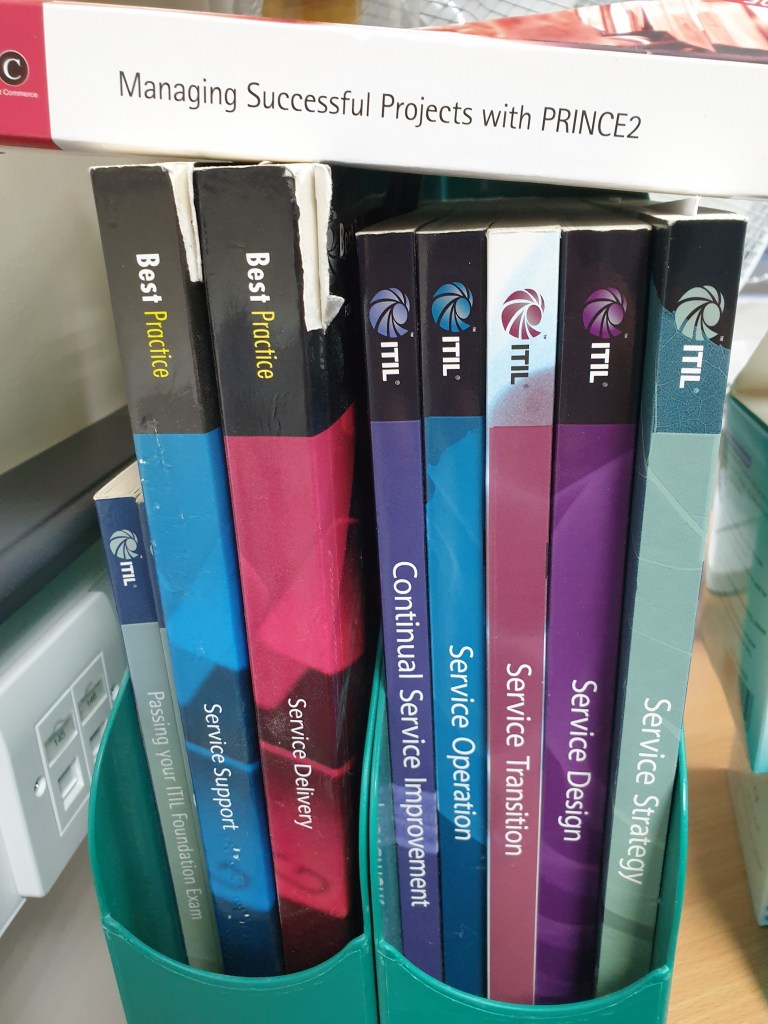
I was reluctant at first to move anything that belonged to the previous inhabitant, as I wasn’t sure whether they’d ever be back, or swoop in one day to reclaim their territory. However, I have since found out that said person has left the organisation altogether. Therefore, the assumption can be made that they no longer wish to claim their abandoned items. I felt vindicated then for going through it all and taking mugs and coffee pots to the kitchen and sorting through some papers and books. Amongst the books were a Prince 2 manual, slightly more up to date than my 25 year old copy, and a set of books on service strategy design, transition, operation and implementation.

Such a fortuitous find as I am now in the world of writing service strategies!!

I’ve been having a bit of a read through them and they will definitely come in handy. One book has already helped me formulate a number questions to ask. I’m sure they will become very useful in the next few months.

Is it a sign of the “meant to be”? Only if you believe in that sort of thing.

When 2 worlds colide

The trouble with starting a new job is finding your feet and who to talk to. In areas where you are less familiar you are more reliant on the information you can glean from others, and to which you must have faith that they’re telling you everything.

The trouble is you don’t know what you don’t know, and therefore don’t know what questions to ask of whom.

The first functioning day in the new job was to start a list of people to talk to over the coming weeks, then try to persuade them that its worth their while talking to me. I’ve started to set up the beginnings of a project plan, listed all the people that I’ve so far been advised to talk to, then attempt to book time in their diaries over the next 2 weeks. Its important to get in early to determine who I’m going to need to interact with regularly, and who I only need to check in with from time to time.

I’ve got a call booked with our Exec to make sure that we’re all expecting the same things and to put some solid definition around the project. I’ve got my Prince2 manual at the ready and have already set up a high level project plan.

I apply a project planning style to most things in my life, particularly around #bellringing as there’s so much going on sometimes its difficult to keep track of it.

Also interrelated are some guidance in PR writing around knowing the audience, hooking interest of those you want to engage with by writing an attractive headline, using words that are relatable, using action words that motivate them to want to talk to you, spell out the benefits of getting them to talk to you, telling the story of what the objective is then ending with a call to action, in this case persuading investment in service development.

Who knew the two worlds were so similar?