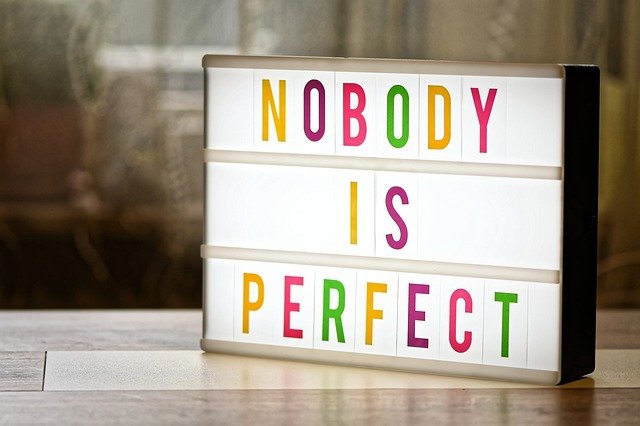
It’s ok not to be perfect

Try telling that to a perfectionist!  We all have lists of flaws we measure ourselves against that can take over other traits.  We ask ourselves do I talk too much, am I too sensitive, am I doing enough, happy enough, am I meeting my own high expectations of myself?  This month’s Woman & Home magazine offered some suggestions on how we can be kinder to ourselves and accept our success regardless of our imperfections.

Live in the present – be honest with yourself and understand who you are rather than who you think you are supposed to be.  Make a decision that you are enough and focus on what you have now rather than fixate on a future fantasy ideal.  Find the balance between ambition and appreciation by celebrating the little wins.

Let down your walls – we all have a flawed personality that might try to tame but our needs, feelings and opinions are just as valid as anyone else’s. If we keep trying to people please and holding back in case other people don’t like it, we’ll end up very lonely.  Experiment showing vulnerability by picking one or two trusted friends to confide in, and tell them how you are really feeling.  Make your own needs a priority and stop ignoring yourself to please others.

Challenge your inner critic – when you hear your inner critic, make a note of those thoughts and learn to unpick and question them.  Reframe thoughts as they happen.  Cultivate positivity to enable you to turn your inner critic into your inner cheerleader and flip negative thoughts into positive ones.  Focus on those things that have gone well.  When you hear negative chatter tell it to stop and dispute the evidence and give it a good grilling.

Adjust your expectations – instead of needing to feel popular we should be truly faithful to ourselves.  Instead of falling into a comparison trap about what you should have, use your own compass to navigate life and regain control of thought patterns.  Set your own standards, choose different benchmarks for success and identify small achievable goals.  Learn to fail. Shift how you think of failure and see it as an opportunity to learn.  Revise your expectations.  Real life doesn’t always go to plan and we have to overcome obstacles.  This is where we’ll find strength and a sense of accomplishment.

Flaws can be flags – our perceived flaws can be a prompt to highlight feelings that need to be addressed.  Our feelings can leave us feel unworthy of the good things in life.  Remind yourself that feelings aren’t facts.  Reframe your guild or whatever flaw is holding you back.  Address the guilt, consider what the belief is and what you have actually done/not done.  Hold yourself accountable but with compassion and perspective.  Change the way you think about it or talk about it until you can let it go.

Time to reign in the perfectionist and reframe my flaws.

Are you a social butterfly or does it fill you with anxiety?

Image by Ronny Overhate from Pixabay

Having spent a large proportion of this last weekend in company, socialising, meeting new people and being on my best behaviour, it’s been a baptism of fire getting back into the socialising game after the enforced absence by Covid-19.  As an introvert, not spending time in large groups, at parties and such has not been a hardship, but all of a sudden, I had to be out there, pleasant, polite and sociable, something I do struggle with sometimes.

In the latest quick fire Psychologies Magazine quiz, it looks at finding out the mind-set needed to reconnect with socialising. My responses to the ten questions gave equal score to hearts and squares meaning my results were a combination of self-criticism and perfectionism.

“Self-criticism

You care about others, which gives the impression that you’re a natural socialiser – but your compassion extends to everyone but yourself.  People may be surprised to learn how much you overthink your relationships and question whether people genuinely want to see you.  When you’re hard on yourself, it’s difficult to believe that other people aren’t also tuned into your perceived faults and failings. It’s no wonder you feel socially anxious, unless it’s with people you think accept you without judgment.  It’s good to question yourself and ask how you could have done things differently, but overthinking every interaction is not helpful, and setting unrealistic expectations of yourself sends a constant message that you’re not good enough.

You feel on safe ground when you know you’re needed or the focus is on someone else, so you may be the one who organises birthday gatherings for others.  You can feel frustrated when no one does the same for you, even when you insist that you don’t want a fuss.  Self-compassion is the key to adding ease to your interactions.  Turn your inner critic into your personal coach and venturing out of your social comfort zone – and asking for what you need – will feel possible.”

I do spend time thinking about how I interact with others, how I come across, but also whether I feel someone should be afforded my attention.  I agree with the final paragraph.  I usually find myself either organising the events, or things when I get there.  I am mostly found in the kitchen, clearing up.  I hold my hand up to saying I don’t want a fuss made for me, but then being disappointed that no-one bothers.  C did an excellent job of making my 50th birthday as good as it could have been during lockdown.  I am hoping that we’ll get to do it properly next year instead and I hope that I’ll be able to accept a fuss being made of me for a few days.

“Perfectionism

If perfectionism is your default mode, you may have always given more thought than most to how you come across to others, perhaps ruminating after social events about whether you said or did the right thing.  In the age of social media, those with perfectionist tendencies also have a way to compare and despair at their fingertips, fuelling social anxiety.  Part of you may know that scrolling through aspirational images is undermining your confidence about your life – but it’s addictive and an easy way to numb yourself if you’re not feeling great. You may also put effort into posting carefully curated images, only to worry that the real you will disappoint.

Comparing yourself with others is a natural instinct that helps give us perspective on where we’re at and how we’re doing – but comparing yourself with people you wouldn’t normally come across in real life is rarely helpful, and it can instil the message that you’re not good enough or that you need to change how you live your life.  Changing your relationship with yourself is the key to making socialising easier.  Start by asking how different your life would be if you decided to accept and love yourself for who you are.”

I made my brother and wife’s wedding cake and spent the whole time wondering whether they felt it was good enough, what other people genuinely thought about it, rather than just being nice.  I knew where all the imperfections were.  I don’t tend to compare myself with others particularly.  I appreciate that everyone has different experiences, different social and economic abilities and there is no point trying to keep up with someone else.  That’s doesn’t stop me looking at lifestyle magazines and how elegant ladies adorn themselves, those with fabulous homes are able to decorate.  I am very capable of recognising that it’s a different lifestyle to the one I have.  Whilst I could make some changes to my home or my appearance, I will only do so for my own benefit rather that attempt to keep up with some fashion or other.

Whilst I had a fabulous time at the wedding, I chatted with strangers and people I hadn’t seen in a long time, I danced and metaphorically let my hair down, I am still anxious about socialising and am keeping to social distancing and mask wearing wherever possible.  I don’t like people getting in my personal space and will leave that person or situation if I start to feel compromised.  Maybe I need to go to more parties and let my hair down more often.