E by ‘eck, I’ve been playing with me e-bells

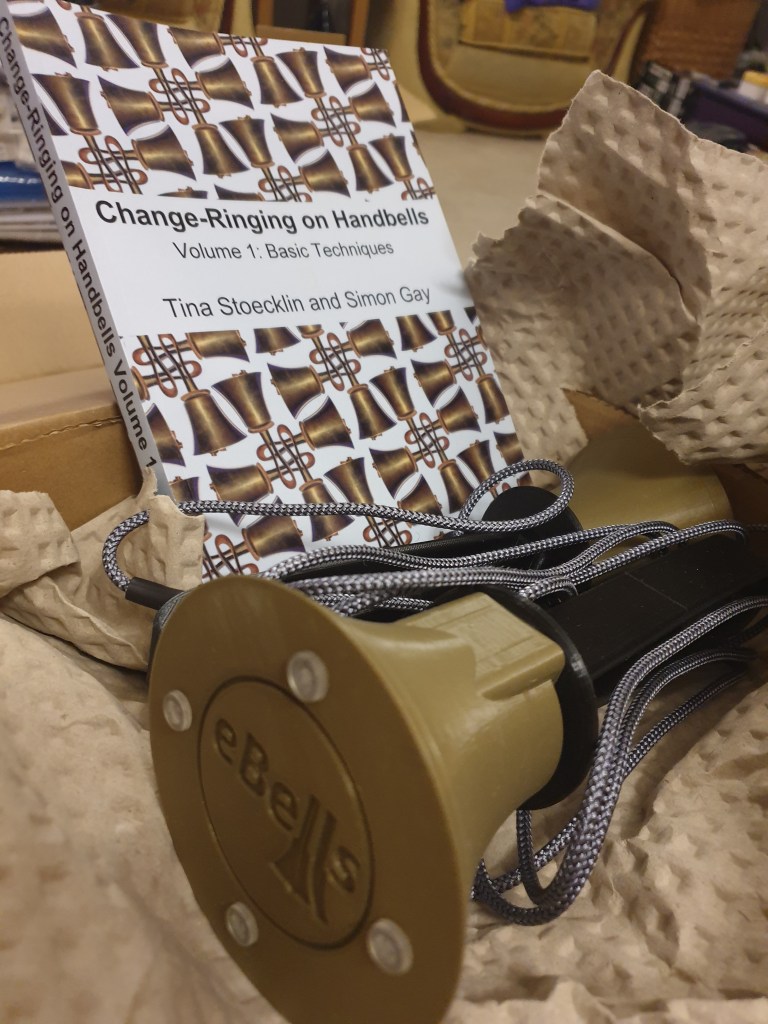
As you know, I bought C a pair of e-bells for his birthday last week.  I also bought myself a set and the companion book.  I learnt how to ring Plain Bob Minor about 2 years ago now but that was the last time I rang handbells. 

Today was the first opportunity we had to properly play with them.  He’d already set up all the software on the PC and on my laptop so we were ready to plug in and play. 

I had a few goes on my own connected to Abel to start with and started off with Plain Hunt Minimus.  Two pairs of bells swap the order in which they ring. I found the explanation in the book extremely helpful in getting what my brain already knows about Plain Hunt Minimus on tower bells should look like.  First and 2nd place bells sway and the 3rd and 4th place bells swap.  Then the bells in 2nds and 3rds place swap whilst the other two stay in the same position.  Keep alternating this until you get back into rounds.  Very simple and straight forward instruction.

I did ok at that so upped the anti by trying Plain Hunt Minor, that’s with three pairs of bells.  The good thing about Abel is that it will ring the other bells you don’t.  The bad news is it won’t wait for you like real ringers often do (even though they shouldn’t). 

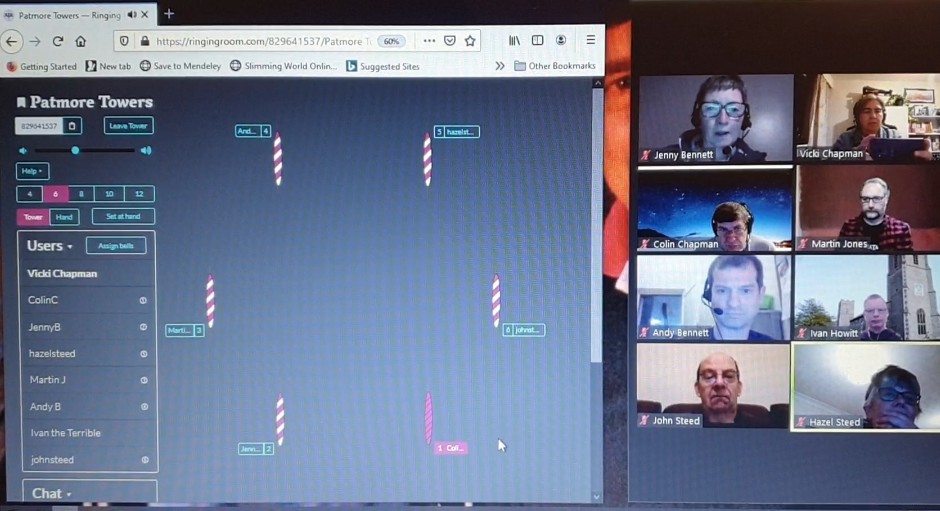
C was getting himself set up on the PC at this point so we decided to try ringing together.  We moved across to Ringing Room to try that now that they have Wheatley installed.  Wheatley does the same thing as Abel, i.e. rings all the unassigned bells but you have to tell it what to do.  There were a few technical issues, but we had several goes and I tried it on different pairs of bells.  I rang 1-2 to start with and got quite proficient at that, then rang 5-6 which is the next easiest pair as the bells course each other (follow each other up and down the pattern).  Then I had a go on 3-4 which is a bit more complicated as the bells move apart and back together again in opposite directions.  That was slightly less well executed.

Then we moved on to Handbell Stadium, the virtual handbell ringing platform.  Took a bit of getting used to setting it up but once there, I had a go on my own ringing Plain Hunt Minor again.  Then C decides we should ring together.  We rang Plain Hunt Minimus together and then he decides that we’ll move straight on to Plain Bob Minimus.  This means that I have to remember to dodge as well as plain hunt.  3/4 down was ok but I seemed to struggle a bit with 3/4 up.  Eventually got the hang of it.

The key for me is regular practice at it otherwise I’ll forget and we’ll be back to the beginning every time.  C went back to practicing by himself and was ringing touches of Plain Bob Minor, but that’s because he’s clever and can ring handbells anyway.

Long way to go yet but had quite good fun and was quite pleased with my progress.  Don’t think I’ll be ringing with a mixed group, or any quarters any time soon though.

Top tips

I’m on LinkedIn, the professional network on the internet that allows you to connect and strengthen professional relationships and learn new skills.  You can follow organisations and groups in much the same was a Facebook and Twitter and other social media sites. 

One of the groups that I follow for interest and to support #bellringing activities, rather than work related, is about Public Relations and in particular this group focuses on internal communications.  In fact its called The Institute of Internal Communication. Each week a contributor called Carole Searwert, a copywriter and newsletter writer posts an article called Top Tips Tuesday which gives you some pointers that you might find useful.  Admittedly, most of it relates to the business world rather than the small, social charity, activity type world, but occasionally there’s something that make sense.

This week’s top tips were all about How to Grow Your Newsletter List.  In the #bellringing community, we tend to use newsletters quite a lot to keep in touch with our ringers, let them know what’s going on and what’s been coming up.  We have them at all levels.  Some districts do their own.  Most association’s probably have one.  The Central Council of Church Bellringers (CCCBR) and the Association of Ringing Teachers (ART) are currently issuing a joint one on survival and recovery strategies.  ART have two of their own, Tower Talk and ART Works for slightly different audiences. 

Most newsletters are usually quite well done.  Lots of uplifting news and case studies, information that may help, updates on what’s been going on and useful contacts or diary information.  Hopefully they come with lots of bright shiny photos too.  Invariably these days they come in digital format, but some are still produced in paper, and some are both.

I contribute to many a newsletter and have at some time or other been featured in all of the above.  But how do we know whether what we produce gets read?  How can we increase our readership? 

The article offers 10 suggestions, some of which are business orientated, but the things that I picked up that might be useful in a #bellringing newsletter context were:

  • Offering an interesting “lead magnet” as a sign up incentive.  Now, this relates particularly to getting new business sign ups, however, the suggestions offered actually could form part of your regular newsletter offering e.g. “how to tips”, a cheat-sheet (in our case maybe an article that explains a particular method like the way I learned Double Norwich Court Bob Major as first, treble bob, last, near, full, far) accompanied by some diagrams.
  • Include a sign up link in your email signature.  This I thought was interesting mainly from a Central Council perspective and I shall be offering it up to see if it works. 
  • Add a “forward to a friend” button (obviously for digital newsletters).  Again, I’m thinking Central Council and local Association websites News Page at the bottom of every article so that if someone likes it and thinks that a friend ought to read it, they can easily forward the link.
  • Promote your newsletter on your social media to raise awareness.  Sounds a bit obvious but do we actually do it?  Probably not consistently.

A two minute read at lunch time has now just turned into an evening’s work to see if it’s feasible.

Succumbing to the inevitable

C used to ring handbells fairly regularly and notched up several quarter peals in years gone by. When his mum died he spent some of the inheritance on a set of 12 handbells. Sadly, those handbells haven’t seen much light. We did have a couple of goes once but I was totally rubbish and couldn’t get my head around it.

I always admire the fact that he could pick up pair of handbells and without too much trouble join in something.

A couple of years ago I was a student on a handbell training course and with proper instruction, helpful advice and lots of patience I did manage to get through Plain Bob Minor on all pairs. It completely did my brain in but I was pleased to have done it. It always seemed like one of those things I should have a proper go at. I’ve not rung handbells since then.

Since lockdown handbell ringing has really enjoyed a resurgence. Its the one thing that people could meet in small groups outside, when that was allowed. Then came along the creation of Handbell Stadium the virtual version of handbell ringing with Men in Black avatars. The next upgrade came with the creation of e-bells. Realistic looking, feeling and weighted handbells that plug into your computer that you synchronise with Handbell Stadium for a more realistic experience, rather than pushing keys.

So, eventually C decided that he’d like a pair of e-bells for his birthday. I ordered two sets and the companion book Change Ringing on Handbells by Tina Stoeklin and Phil Gay. They arrived today, excellent service given he left it late to tell me that’s what he wanted. I’ll leave him to do the technical set up and I’ll have a few goes on my own with my two new avatar friends before I join in with anyone else.

Don’t think you’ll be seeing me featured on Bellboard any time soon though.

What is your true passion?

Time for another check in on motivations in life via Psychologies Magazine. This weeks quick quiz of choice was to find out what my true passion is.

This is something that I’ve struggled to answer in the past. I don’t know what I want to do or be. I’m not entirely sure what my skills are, or wants and needs out of life. I’m not even sure that I could fully answer the question about what I enjoy most. So, after 8 deep and meaningful questions, the outcome to identify my true passion is….

Your core values centre on lifelong learning

You’re extremely motivated to get more knowledge under your belt, whether that’s academic learning, or through personal growth and self-development. You feel the most like ‘you’ when you’re acquiring new skills. You have a ‘growth mindset’ approach to life – you keep an open mind, and you never assume that you’re an expert at anything, because you know there is always more that can be learned. Therefore, it’s understandable that you may struggle more than most if you’ve been in the same job for a while, or feel as if your career isn’t offering any new challenges. The upside to this is that you become more motivated than most to embark on further education. You have the dedication to put in the time and effort to get professional qualifications that will support your ambition, either by advancing your career, or opening the door to a new one.

To be fair, I’ve done a number of these short quizzes now and have to say that most of them do seem to have some resonance. I do enjoy learning new things, even at an academic level. I did my Bachelors Degree when I was 40 and my Masters at 45. I’ve done a number of online courses both around academic study and personal growth and self-development. I would certainly never claim to be an expert at anything but have a decent awareness or appreciation for a number of things. I can quiet easily sit and read a 131 page long-term plan document in order to get that golden nugget I need from it. I will study a policy document, in fact I’ll write a fair number of them too. I don’t have a problem reading a text book to learn how to do something better. I am quite happy spending all day listening to speakers at conferences, work related or not. You’ll always find something out you didn’t know before, or be sign posted somewhere else to expand you understanding of an area. I’ll quite often have pen and paper to hand when I listen to certain podcasts as they often refer to other writers or articles or programmes that might be interesting.

The one great thing I’ve always said about #bellringing is that you won’t know everything. There’s always a new method to learn, or a teaching technique that you suddenly find helpful, or a resource that you could utilise that you hadn’t before. And if you think that you do know everything there is to know, that’s when you start to share it with others and help them learn and reach their potential.

I was never particularly academic at school. I did ok and enough to get by with some decent O level grades (now that ages me). I didn’t quite get enough to be able to A levels and therefore never had the opportunity to go to university in earlier years. I did feel that that held me back somewhat. One job I had, I ended up doing 3 people’s roles and doing the work of the manager, but I was told by the Director that I couldn’t have that job (and therefore salary) because I didn’t have a degree. Despite the fact that I’d been doing the role for a number of years. Suffice to say that was enough to spur me on both in terms of finding a different job, but reigniting my education.

I went on to complete 3 NVQs in Business Administration and Business Management, before enquiring about support for a degree. Once I’d got the learning bug I was off. I acknowledge that I was extremely fortunate in that my employer paid my university fees and allowed me study leave, and my family were supportive. My daughter at the time was starting on her GCSEs and we sort of became study buddies when we both got out laptops out to work. My Bachelor’s Degree in Business Management took 5 years to complete as it was part time whilst I was working full time and had family and #bellringing commitments. Then I went straight into my Masters course in Senior Healthcare Leadership which was another 2 years. I’m always interesting in courses that come up at work, but have to acknowledge that others may benefit from them and I’ve had my turn. I’m always happy to learn more. And, crucially, I like to share my new knowledge with colleagues. No point in keeping all that new stuff to yourself if you don’t help others.

I hope I continue to find new things to learn, expand my horizons, provide me with new opportunities.

The same only different

Some of the more advanced #bellringing methods are variations on a theme. The work that you do in one method often becomes part of the work that you do in another.  Quite often experienced ringers will describe methods as “so and so over thingy” (obviously using real methods names).  For the educated this makes it easier to put those two methods together to create a new one.  For the rest of us though its pure gibberish.  I understand that its relative to where the treble is.

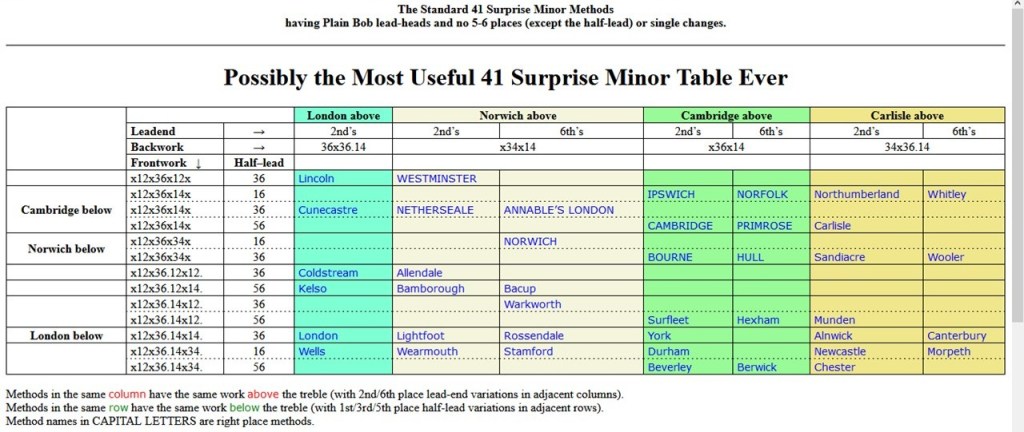
In the virtual #bellringing sessions that I run on a Thursday night we’ve been ringing York Surprise Minor and now moved on to Durham Surprise Minor. You can see a lot of similarities between the two. The experts in the group say that York is London below and Cambridge above.  That’s ok if you know London and Cambridge.  Durham is Wells below and Cambridge above.  Wells is Wells below and London above.  Confused?

There’s a really useful table at https://www.ringing.info/minor/minor_41.html and Complib gives you more information on what’s above and what’s below in each of the 41 Surprise Minor methods.

This week I’ve rung London below and Cambridge above, Wells below and Cambridge above, Wells and London.  I can’t learn them as one thing above and another below.  That just fries my brain. 

I can see that 5th place Wells is the same as 6ths place Durham and that 5ths place London is the same as 6ts s place York, which is, I suppose the same as the above and below bit, but I wouldn’t be able to figure that out without the line in front of me.

Mind…. blown!!

Making the most of time

No surprises but there are 24 hours in a day. How we spend them is our choice. Whether we spend them wisely is debatable. Some people profess to be really good at time management whilst others feel that there isn’t enough time to get everything done. Is time slipping away from us or are we wasting it?

The latest dossier in Psychologies Magazine goes into some detail about where commitment lies, understanding procrastination, understanding how we currently spend our time and prioritising what’s important. It offers some advice on timekeeping tips for the proverbial laters. Then comes the inevitable 10 question test to determine what stops you making the most of your time.

My results indicated the dominant trait of overthinking, putting hours into mulling over events, conversations, decisions and tasks. This leads to being overwhelmed and worry that others seem to be more productive. Others may be unaware the extent of the overthinking because the outward impression is one of calm. It suggests that I should schedule worry time and limit it to 15 minutes.

A close second was overcommitment, a difficulty in saying no to opportunity and helping others. But if that time does not align with core values it will undermine wellbeing. The challenge here is to find space in my life to connect with the people I love and nurture new connections. Resist the urge to fill all the time up.

Both easier said than done. Today for example. First day back at work after 2 weeks off. By midday I was already feeling that I’d had enough. I didn’t want to be there. By the end if the day I was starting to seriously consider my get out strategy. I had a meeting in the evening I had a zoom call which was fine, not anything stressful, just a bit of preplanned for something which may, or may not, be happening next week.

I’ll try and give tomorrow a fresh start and not worry about the things that I can’t do anything about. And it’ll be C’s birthday so I intend to spend the evening with him and not worrying about what else still needs to be done.

That was the week (or 2) that was

The end of my 2 weeks annual leave has arrived.  Monday morning sees the return to the office.  Have I had a good holiday?  Do I feel relaxed and rejuvenated?

Yes, I’ve had a good couple of weeks off, considering.  I don’t particularly feel relaxed or rejuvenated thought.  But I suspect that’s to do with the fact that we’re in lockdown and we can’t go anywhere or do anything or see anyone.

If we have been able to do things, I might have felt more energised.  As it was, I spent most of the week not venturing far from home.

The first week I took the opportunity to undertake an online Mindfulness course.  This was quite interesting and useful, but not something that I’ve suddenly found enlightenment from.  It did give me some focus for a few days.

I had 7 virtual #bellringing sessions during the fortnight, some which I ran. I watched a funeral online. I attended 4 meetings and 1 virtual dinner.  In between, I did some reading, played some games on my tablet and celebrated my 50th birthday, lockdown stylee.

I did spend some time, quite purposefully, doing not a lot.  C still did all the housework and cooking. 

This sort of gave me an insight to what life might be like at a time when I could give up paid work completely.  However, if that was the case, things would happen very differently.  I would see a fair distribution of household labour.  I would also probably do some form of exercise, whether down the gym or online stuff at home, or more walking at least.  I would definitely do more baking and cooking.  I do miss that a little bit.

I’ve had a good couple of weeks off and enjoyed not having to get up early and go to an office and get grief all day. I’m sure that feeling will be short lived when I open the office door.

Time to move on

Our virtual #bellringing practices on a Thursday evening with friends and family have had a bit of a progressive plan.  We started off with some simple “plain” minor methods i.e. where the treble plain hunts and worked our way up to surprise minor and then started introducing an 8 bell method as well.  We’ve had methods of the month for the past few months so we can consolidate our learning.

February saw us ringing York Surprise Minor and Kent Treble Bob Major, and for March we’re moving on to Durham Surprise Minor and Oxford Treble Bob Major.

A lot f the methods we played with I’ve never rung before, and some of the rest of the band haven’t either.  Its been quite a fascinating experiment.  Some of these methods I never would have thought that I’d ever ring.  I dare say, that when we get back to ringing in the real world, I’m unlikely to ring those methods in a tower.  The places we ring at regular just don’t ring that sort of thing. 

I would like to try and ring them in a proper tower, but suspect that that might require some engineering to get the right band and the right time. 

Some methods are transitory, they are stepping stones that help you understand more complex methods, and the likelihood of going back to them on a regular basis is minimal.  Some are very similar and are good to be spliced together for variation, you just need to remember which one is which.

My brain capacity isn’t good enough to retain all of these, so I suspect that if we were to try to ring them in a tower, I would have to relearn them all over again.

Still, its good fun, stretching the brain and having a go at things we don’t normally ring.

Every day’s a school day

It seems like it at the moment anyway.  Between doing my online mindfulness course, which has really challenged some thoughts and feelings, and learning methods for virtual #bellringing in Ringing Room sessions, of which I had 4 this week.

The first #bellringing session was a district practice which I didn’t need to learn anything new for but the session that I run on Thursdays we’re consolidating methods that we’ve been learning for February.  Some of those methods are repeated at a Friday morning session but sometimes something different.  Then every other Friday there’s another session that changes methods every time.  This week I needed to learn Newcastle and Alnwick Surprise Minor.  And in 2 weeks’ time, we’re aiming for London and Wells Surprise Minor, and I set new methods for our Thursday session at the beginning of the month.

Some of these methods I’ve never even looked at, always thinking they are beyond my capability but with the advent of Ringing Room, have been able to ring things that I wouldn’t normally get to ring in any of the towers that I would normally frequent.

Learning to ring takes time, even just the basics of handling a bell on your own, then you need to join in with others and make a meaningful sound.  Then you can move on to the more complicated stuff, but that tends to depend on others a bit more, as you can only ring to the standard of the most novice ringer in the band.  However, learning skills that require longer term commitment can be rewarding and stimulating for the brain.

A quick internet search shows that there are a multitude of sites that promote learning something new, from new skills, to new languages, to cooking and baking, knitting and creating videos.  I’ve always found learning something new to be rewarding.  It doesn’t necessarily make me an expert in it but it gives me better understanding, better skills, better adjustment and a wider range of things to do.

Having just completed the 6 week mindfulness course, I’m now looking around the site to find the next thing to dive into. 

Analysis Paralysis

I’m doing an online course in mindfulness and wellbeing at the moment and have been fortunate to spend all of the day going through the next module, which has been discussing, amongst other things, the merits of whether mindfulness teachers need to be qualified or regulated in some way, and whether attending an 8 week intensive mindfulness course is sufficient for someone to set themselves up as a mindfulness teacher. Don’t panic, I’m not going to be opening up a clinic any time soon.

Being scientifically objective about mindfulness is difficult in that it is difficult to measure one person’s experiences against another’s.  We all come pre-programmed with inbuilt prejudices and life experiences that cause us to be open or judgemental about ideas.  We all have unconscious biases that impact our opinion as to whether a therapy has been helpful or not.

Connection to a teacher is important.  Without a rapport and mutual understanding student and teacher may not settle into a place of trust.  People attend mindfulness based stress relief (MBSR) or mindfulness cognitive behavioural therapy (MCBT) for a multitude of reasons, but it is important to recognise that many of them do so because they have been referred as part of a treatment therapy for depression or stress/anxiety, trauma or PTSD. However, even those of us who are seemingly quite resilient and able to cope with most things could end up being triggered by regressing into something that we had long ago put away, dealt with, coped with or moved on from, as part of mindfulness practice.

Is someone who has been on an 8 week course sufficiently qualified and experienced enough to handle that?

If I were in the situation of needing support to such a level, I would be wanting to find out more about the person delivering the sessions.  In a business environment we are taught to use the PESTLE analysis tool to investigate the political, economic, social, technological, legal and environmental aspect of a business before investing or setting up a new business.  If I were looking for a teacher who was going to be helping me explore the deeper parts of my brain, and help me find ways to cope and recover I would want to know that the teacher had done those same sorts of analysis on the subject of mindfulness and not just got a certificate of attendance.