Influential influence

As I move into the next phase of my career in the next few months, it will become much more important to be able to influence others outside my normal sphere of activity.  I’m already a middle manager with a wide network across the organisation, but the next step will take me into a higher stratosphere of connections.  I need to change up my influencing from my subordinates and peers to upper levels and very senior levels of the organisation.

The Centre for Creative Leadership offers four areas of advice for effective leaders to inspire, persuade and encourage by using the knowledge and skills of a group to help point people towards and common aim and bring about commitment to change.

1) organisational intelligence – being aware of not just the organisational structure bur the informal structure of the political landscape by networking to build strategic allies, consider context and goals before decided how and when to express an opinion, paying close attention to nonverbal clues, active listening, and considering how others might feel, and leaving others with a  good impression without coming across as too aggressive.

2) Team promotion – and a bit of authentic self-promotion without bragging or being selfish.  A bit of well placed self-promotion can provide visibility and opportunities for the team by providing some organisational pride, make capabilities and ideas more visible across the organisation, therefore improving collaboration.  Leaders need to put themselves in the spotlight and find ways to find an audience and sell their team’s story.

3) Trust building – without trust there is probably much less commitment from others, or access to tapping into the full creativity of the team.  Being able to leverage this is crucial when dealing with tough challenges or making strategic changes.  People look for leaders who show some vulnerability and inspire them, understand them and guide them.  It’s a careful balance between pushing people in to areas they are uncomfortable with whilst listening to their concerns and feedback.  Being tough but empathetic with others as they struggle, as well as demonstrating urgency and patience requires careful balance.

4) Leveraging networks – In order to influence others leaders need to cultivate networks.  As organisations shift and morph, leaders need to recognise personal networks must also be dynamic.  They need to be strategic about choosing how and when to tap into the right network.

Then there’s choosing the right influential tactic:

1) logic – taps into rational and intellectual positions, presenting the argument for the best choice of action based on organisational and personal benefits, appealing to the head.

2) emotional – connecting the message, goal or project to individual goals and values, tapping into personal feelings of well-being, service and belonging, tugging at the heart strings to gain support.

3) cooperative – collaborating, consulting and alliance building.  Working together to accomplish mutually important goals, extending the hand to help others.

An invitation landed in my inbox recently that gives me the opportunity to share a new framework that I created with very senior operational and corporate leads across the organisation.  Whilst doing this scares me half to death, I recognise that it’s the ideal opportunity for me to be able to share this piece of work with the very people who will need to be taking it forward in their parts of the organisation.  It’s my piece of work and I am proud of it, and the reception it has received so far. 

Next steps is to make it a reality.

Third sector well-being

Third sector organisations are voluntary and community organisations which includes charities, associations, self-help groups and community groups, social enterprises etc. They are neither public nor private and are independent from government.  They usually play a role in history and culture and are value driven to improve public welfare, the environment or well-being.  Any surpluses are reinvested in the pursuit of their aims.  https://www.nao.org.uk/successful-commissioning/introduction/what-are-civil-society-organisations-and-their-benefits-for-commissioners/

#bellringing fits firmly into that sector.  We are there for the benefit of the church and communities we ring in. The social and well-being advantages of #bellringing are clear, it can give people a sense of purpose, an opportunity to socialise with others, a new hobby and sparks offshoot new interests in history, architecture, even engineering.  Getting out and about, meeting new people, developing new skills are all transferable to the workplace and great for young people to add to their higher education applications.  Societies are often charities, or at least their bell restoration fund is a registered charity.

As far as well-being goes, #bellringing ticks all 5 areas:

  1. Connecting with other people.  Bellringing is a team activity.  It requires connection with others and leads to other social activities like outings, pubs, and other non-ringing social activities;
  2. Being physically active.  You need to be able to climb spiral staircases (often), being able to raise arms above your head repeatedly.  There is a gentle cardio rhythm to it.  Its not all about brute strength.
  3. Learning new skills.  It can take about 15 hours to learn how to handle a bell on your own, that’s before you add other ringers into the mix, then there are more and more complex methods to learn, if you want to.  There really is no limit.
  4. Giving to others.  This is a sense of community.  Doing your bit for the church or for a community activity such as ringing for Armistice or a local event or celebration.
  5. Paying attention to the present moment.  This is essential.  You need to concentrate on your bell handling, your method ringing and everything in between. You can’t afford to let your mind wander.

Perhaps we should lobby to get #bellringing offered on prescription for people who are lonely or feeling a bit low.  We should be offering it out as adult education classes, young people’s after school activities or holiday activities.  Some already do this but wouldn’t it be great if we could spread that net wider. 

I’ve signed up to attend a webinar for third sector organisations on Better Community Engagement for Charities to see if there is anything we can learn.

Hmmm, thinking caps on.

A course, of course

I’ve been thinking for a while now about whether or not to do a formal course in public relations to support the work I do for the Central Council and at local level. All that I have learned so far has been on the job, immersive and quite often responsive., and because I have a full time day job, I’m not always picking up signals that require a response, or that could be utilised to our advantage.

I’ve been having a look around to see what’s on offer, and probably prefer an online course that allows me to work at my own pace around everything else I’m doing.  But of course, these courses come at a cost; some in the region of £1,500 – £2,500, depending on what level you want to study at.

I would be prepared to cough that up myself if I was absolutely confident that the course would give me the tools I need, in the sector I’m in and support what I have time to do.  I wouldn’t dream of asking anyone or organisation to fund it if there wasn’t that guarantee.  But how do you really know? 

I’ve read through the “Who this Course is For” and learning outcome pages, but they all seem to be very business orientated.  I’m looking at the charitable, local organisation sector, which is possibly different in parts.  And as I’m not likely to move into PR as a career, can I justify the expense, or should I just stick with winging it?

One of the main things I want to work on is my writing skills.  Seems odd for someone who brain dumps into a blog every day, but there we are.  I want to be able to write more engaging news stories so that the media will take up our stories and we gain more public awareness, and therefore greater recruitment prospects and also greater acceptance, acknowledgement and appreciation of what we do.

There is one course that I’ve seen that has reference to writing skills in it and it seems a bit cheaper than all the others. It seems to be from a reputable organisation https://collegeofmediaandpublishing.co.uk/product/public-relations-course/ and for £500 covers:

  • An intro to PR
  • Newswriting techniques
  • Writing effective news releases
  • Communicating with the media
  • Online PR
  • Handling a crisis
  • Using TV and radio
  • Organising a news conference
  • Law and reputation management
  • Using other PR tools
  • Running  a PR campaign

Each lesson includes a practical assignment and is marked and graded by tutor, and at the end you get a Level 4 Diploma (equivalent to the first year of a Bachelors degree) in Public Relations. 

I’m quite tempted.

Virtual Quarter Peals

C and I were invited to ring in a virtual quarter peal with some friends to welcome a new grandchild for one of the ringers that we ring with every other week.  The method of choice was Durham Surprise Minor.

I have never rung this method on tower bells and have only learned it as a result of virtual #bellringing sessions and working our way through the standard surprise minor methods.  I did do my usual trick of volunteering for the treble to start with, but then thought that I had learned the method and should really try ringing it on an inside bell.  I opted for my next favourite starting position of the second.

I was rather pleased with my performance, as I knew where I was throughout the quarter peal and even knew when other bells should be dodging or elsewhere in the change.  At one point it got a bit hesitant, but I knew that I was dodging at the back and therefore two other bells needed to ring before me.  C was conducting it, and sitting next to me, heard me say that I was at the back (all other mics were on mute).  He was then able to sort the jumble out.  I feel that I acquitted myself well and was rather pleased to have achieved a quarter peal in a new method. This is now the 6th virtual quarter peal I’ve rung.

Being able to use Ringing Room for practicing old and new methods has been an absolute godsend during lockdown and I’ve been really chuffed that I’ve been able to learn methods that I wouldn’t get to ring in a tower usually.  This is generally because we don’t ring 6 very often and when we do, the people we ring with don’t tend to know many minor methods.  However, with a core of us now ringing these regularly in Ringing Room, maybe we can translate that into the tower when the time comes to returning to ringing properly.

For now, we have to be content with ringing a couple of real bells in our tower on a Sunday morning and ringing all sorts of interesting things in the virtual world.

Can’t be in 2 places at once

Last night had a clash of #bellringing diaries. I should have been at an advanced district practice but also needed to be at a Central Council exec meeting.

This clash now happens very month. Last year it wasn’t a problem because we weren’t running the advanced practices. However we decided to put them back on the virtual agenda this year and try them out. Last month was the first one and as I set up the Zoom I kinda needed to be there so sent my apologies to the CC meeting.

This month though I needed to be at the CC meeting as I was on the Agenda. I did set up the advanced practice zoom session but needed to hand it over to someone else to run.

It was an interesting experiment. C attended the advanced practice on the PC next to me on my laptop attending the CC meeting. We both glanced over at the other several times and at one point were both talking to our respective meetings at the same time.

I missed out on practicing Little Bob Major and Yorkshire Surprise Major and the fact that they finished soon after 9pm. My meeting went on until 10:20pm.

Next month I’ll probably go to the advanced practice and give apologies to the CC meeting. I’ll probably end up alternating.

Diving Down a Rabbit Hole

Whilst rummaging around some websites to do with work, I came across a new one today.  It came about as I was following links within other sites and this particular one appealed to my nerdity. Diving down the rabbit hole of links within links, I found myself on The Open Data Institute website.

The site states that they help organisations, including governments, to make better decisions with the use of open and trustworthy data. It offers practical tips for open data, with guides, blogs, case studies and so on.  It brings together commercial and non-commercial organisations and governments to consider global responses.  It offers training events, online courses, talks and webinars.

I had a quick flick through the site and looked at what courses it had to offer and whether they would be appropriate for what I’m currently doing.  I did find one that might be useful but for £100 minimum fee, I’m not going to pay that myself, and I couldn’t consider it a good use of public funds by asking work to pay for it.

There was a brief, free introductory online course on open data essentials.  It has 16 different modules!  I got as far as module 9 before bailing as it was time for dinner.  I might go back to it another time.

It was quite interesting stuff and even talked about the different types of creative commons licences and what their usage is.  This could be interesting from a #bellringing perspective when we want to use images and data to help with public relations to the external world.  I’ll look into that one a bit more I think.

Data nerdity satisfied for today.

Being in the Zone

I’ve just watched a 2 minute excerpt from a TED talk given by learning expert Eduardo Briceno on what he considers to be the key to high performance. https://www.ted.com/talks/eduardo_briceno_how_to_get_better_at_the_things_you_care_about?utm_source=linkedin.com&utm_medium=social&utm_campaign=social&utm_content=2021-3-18-cutdown

We all go through life trying to do the best we can, and equating that to #bellringing, we all turn up at practice night, or Sunday service ringing, or for a wedding or special practice, or quarter or peal attempt or, at the moment virtual practice, with full intention to do the best we can.  To ring the method accurately.  To strike our bell in the right place.  But at a practice night we’re there to try to learn new things as well and extend our repertoire (if we want to).

Briceno offers that sometimes, despite our best intentions we might not always get any better at the things we want to achieve, despite working hard at them.  What he learned from his research is that we should deliberately alternate between two different zones.

Learning Zone: here the goal is to improve.  So we undertake activities that help that improvement.  This could be attending a training day, reading around the subject, watching YouTube videos, asking others for advice, standing behind someone while they ring, asking for feedback and so on. Here, we spend time concentrating on what we haven’t mastered yet, and expect to make mistakes along the way knowing that we will learn from them.

Performance Zone: is where the goal is to do something as best as we can, to execute it.  Where we concentrate on what we already have mastered and try to minimise the mistakes.  This might be ringing for a special event or a peal attempt, or a striking competition.

Briceno suggests that we should be deliberately alternating between the two zones to purposefully build our skills in the learning zone in order to apply them in the performance zone.  Being clear about when we want to be in each of these zones, with what goal, focus and execution in mind helps us better perform and improve. The performance zone maximises our immediate performance, whilst our learning zone maximises our growth and future performance. The more time we spend in the learning zone the more we will improve in the performance zone.

To be able to spend more time in the learning zone we need to believe that we can improve, we must want to improve that particular skill, we must have an idea about what we can do to improve. Just performing the same method over and over again doesn’t necessarily help us improve. Without the process of practice, making mistakes, getting feedback and revision we will tend to stagnate in our current “safe” zone; methods that are familiar and easy, that we won’t feel like we’d be ridiculed for if we go wrong.  My favourite is “if in doubt, ring the Treble”, that way I’ll stand a better change of not going wrong, or mucking it up for everyone else. The trouble with that is, I don’t progress myself.

In our #bellringing context this could be the difference between learning the theory of a new method and practicing it on a practice night on using an ringing simulator, in order to perform it to the best of our ability of a Sunday morning, or during a striking competition, or a quarter peal or peal. I also know that I’m really bad at this too.  Often I might turn up to a practice having not put enough effort into the learning part, and then hash my way through it, or do enough to just get by without making too much of a pigs ear, but I haven’t learned it properly and will immediately forget it because I’ve not gone back over the bits I find difficult, or asked for help.

My latest thing is to try to learn to ring handbells.  I don’t particularly want to ring handbells quarters or peals, but I want to be able to hold my own if I were asked if I could ring something simple.  It’s been nearly 40 years since I learnt to ring a tower bell so going back to the beginning to ring handbells, to unlearn some of the things I’ve learned on tower bells and learn them in a different way, has been, so far, really quite difficult.  However, I must persevere if I am to reach a decent performance zone.  I must make that effort and spend that time in the learning zone, read, watch, listen, practice, make mistakes, get feedback, try again and eventually I will improve.

6 people in your corner OR 5 mentors you need?

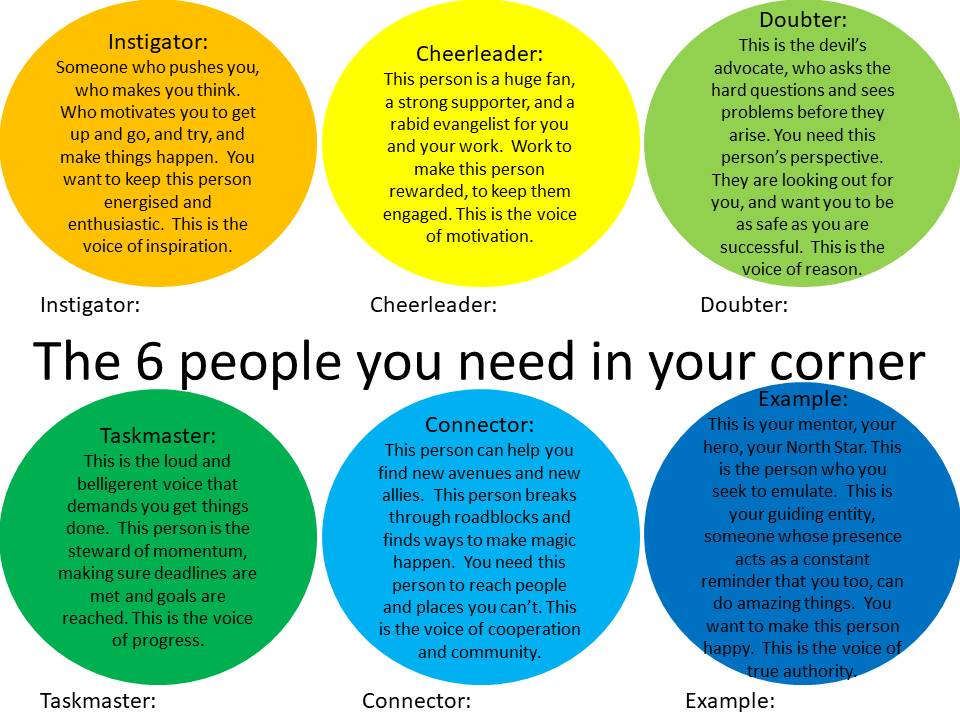
Several years back one thing I picked up, presumably from some talk or online article was the notion of having 6 people in your corner.  Basically, these represented 6 characters that would help and support your leadership journey.  They didn’t all have to be different people, although they could be, or some, or all of them could be the same person.

The 6 characters were:

The Instigator: Someone who pushes you, who makes you think.  Who motivates you to get up and go, and try, and make things happen.  You want to keep this person energised and enthusiastic.  This is the voice of inspiration.

The Cheerleader: This person is a huge fan, a strong supporter, and a rabid evangelist for you and your work.  Work to make this person rewarded, to keep them engaged. This is the voice of motivation.

The Doubter: This is the devil’s advocate, who asks the hard questions and sees problems before they arise. You need this person’s perspective.  They are looking out for you, and want you to be as safe as you are successful.  This is the voice of reason.

The Taskmaster: This is the loud and belligerent voice that demands you get things done.  This person is the steward of momentum, making sure deadlines are met and goals are reached. This is the voice of progress.

The Connector: This person can help you find new avenues and new allies.  This person breaks through roadblocks and finds ways to make magic happen.  You need this person to reach people and places you can’t. This is the voice of cooperation and community.

The Example: This is your mentor, your hero, your North Star. This is the person who you seek to emulate.  This is your guiding entity, someone whose presence acts as a constant reminder that you too, can do amazing things.  You want to make this person happy.  This is the voice of true authority.

Back in about 2009, when I first discovered this, I knew exactly who these people were.  Some of them wore multiple hats for me.  After about 2011 when I’d changed jobs, I really could not pinpoint anyone amongst my work colleagues that fitted any of those roles for me.  Happily, I am once again in the position where I can identify at least one person, even if it’s the same person, for each of those roles.

I’ve just read an article by Anthony Tjan on ideas.TED.com who suggests that we should have 5 mentors:

The Master of Craft: “If you know you want to be the best in your field — whether it’s the greatest editor, football quarterback, entrepreneur — ask, Who are the most iconic figures in that area?” says Tjan. This person can function as your personal Jedi master, someone who’s accumulated their wisdom through years of experience and who can provide insight into your industry and fine-tuning your skills. Turn to this person when you need advice about launching a new initiative or brainstorming where you should work next. “They should help you identify, realize and hone your strengths towards the closest state of perfection as possible,” he says.

The Champion of your cause: This mentor is someone who will talk you up to others, and it’s important to have one of these in your current workplace, says Tjan: “These are people who are advocates and who have your back.” But they’re more than just boosters — often, they can be connectors too, introducing you to useful people in your industry.

The Copilot: Another name for this type: Your best work bud. The copilot is the colleague who can talk you through projects, advise you in navigating the personalities at your company, and listen to you vent over coffee. This kind of mentoring relationship is best when it’s close to equally reciprocal. As Tjan puts it, “you are peers committed to supporting each other, collaborating with each other, and holding each other accountable. And when you have a copilot, both the quality of your work and your engagement level improve.”

The Anchor: his person doesn’t have to work in your industry — in fact, it could be a friend or family member. While your champion supports you to achieve specific career goals, your anchor is a confidante and a sounding board. “We’re all going to hit speed bumps and go through uncertainty in life,” says Tjan. “So we need someone who can give us a psychological lift and help us see light through the cracks during challenging times.” Because the anchor is keeping your overall best interests in mind, they can be particularly insightful when it comes to setting priorities, achieving work-life balance, and not losing sight of your values.

The Reverse Mentor: “When we say the word ‘mentor,’ we often conjure up the image of an older person or teacher,” says Tjan. “But I think the counterpoint is as important.” Pay attention to learning from the people you’re mentoring, even though they may have fewer years in the workplace than you. Speaking from his own experience, Tjan says, “Talking to my mentees gives me the opportunity to collect feedback on my leadership style, engage with the younger generation, and keep my perspectives fresh and relevant.”

They both cover a lot of the same ground but Tjan has some interesting other ideas.  I know who my Champion and Copilot are.  I think I am my own Anchor really.  I’m pretty clued up to my own values and setting personal priorities to achieve a good work-life balance.  I’m not sure who my Master of Craft is at the moment or my Reverse Mentor as I’m fairly disconnected with leading or mentoring anyone at the moment.

Do you know who you’d have in your corner or who are your 5 mentors?

The Instant Gratification Monkey

I was reading an online article from Tim Urban, who studied why procrastinators procrastinate.  He possets that they can’t help it.  In their brain the procrastinator has the Rational Decision Maker who steadily guides the mind in to doing what needs to be done, and then there’s the Instant Gratification Monkey who sideswipes things and sends the mind off wandering for some instant satisfaction for information or other, that takes us away from our steady path.

The Instant Gratification Monkey takes us off to play in what Urban calls the Dark Playground, that space where all the fun, new, shiny things hang out that distract us from what we should be doing. In the back of our minds though is this constant feeling of anxiety or regret for that looming deadline or that thing that we’ve been working towards for ages.  When that deadline approaches though, it’s time for a visit from the Panic Monster who scares us away from the Dark Playground back in to a sense of productivity to get things done.

Urban offers three steps to turn procrastination into motivation:

  1. recognise that you are procrastinating.  Being aware of something is usually the first step in resolving it. 
  2. Understand the reason for the procrastination.  Is it the task itself, or is it you? Is it that you aren’t enjoying it, not qualified for it, or feeling overwhelmed by it?
  3. Set objectives, tactics and rewards.  Depending on the reason for the procrastination in the first place it might be as simple as having a to do list if you’re feeling overwhelmed, or someone that holds you to account, or if you promise yourself a treat if you get that thing done.

There are times that I procrastinate.  It’s not usually because I don’t want to do something, more that I don’t want to do that particular thing right now.  I will send that email out but after I’ve watched this episode of that tv programme I like.  I will write that report just as soon as I’ve finished making lunch.  I will learn how to ring handbells properly, just as soon as I’ve written that report and sent that email.  Sometimes it can become a vicious cycle.

Other days, I can blast through even the most boring, or painful task without so much as a second thought.  It’s about the frame of mind that I’m in.  Sometimes, I find being in a particular place, or with particular people helps galvanise me into action.  Sometimes I just wake up and tell myself that today I’m going to power on through all that stuff and clear my to do list.

Today has definitely been one of the latter type of days.  I’ve finished the first draft of a strategy document.  I’ve documented a framework that I invented that supports that strategy.  I’ve been for a power walk.  I’ve read the next section on learning to ring handbells and had a few goes at it.  My Rational Decision Maker was in charge today.

I wonder if that means tomorrow I’ll be all out of juice and my Instant Gratification Monkey will be running the show.

Budding growth

As Public Relations Officer for both my local #bellringing Association and for the Central Council of Church Bell Ringers I’m always on the lookout for ways to get our messages out there and increase awareness of what we do.

I was reading an article online the other day about growing followership and there were two amazingly simple tips that could make a world of difference.

  1. Include a sign-up link in your email signature.  So, my emails signatures for both now carry not only a link to our website, but also to our social media pages, and for the Central Council a link to our mailing list sign up page. That was easy.  My signature is now quite large, but I hope it will draw people I correspond with to find out more about us.
  2. Include a “forward to a friend” link on each page/article on the website.  As it happened, we had a local Association Comms team meeting last night and I mentioned it.  I have no idea how complicated it is to set up or not, but before the evening was out, our Webmaster had added a link in the footer of our website and emailed me to test it.  I clicked on the link, up popped a blank email with a link to the relevant page ready for me to forward to anyone I might think would be interested.  I’ve also sent a request for a similar link on the Central Council website.  Hopefully, it will be just as easy.

Two simple tips that have potential to increase awareness, get more engagement with our social media and spread the word.

It was also quite good fun having a look at some of the analytics from our website for quarter 1, again appealing to my inner nerd.  There needs to be a bit more work on extracting relevant ones and interpreting them into meaningful data, but given that we only set it running recently, it will be great to track hits to the website during promotional campaigns.  I can get the analytics from our social media sites and its all encouraging.