6 Ways to beat burnout

Image by Ronald Plett from Pixabay

We all have very busy lives.  Work, home, social, family, friends.  Almost all of our waking hours are filled with activity or interaction.  Sometimes, one or more of those things escalates creating a shift in our energy.  We may have a project at work that is coming to a critical stage and requires more hours and effort.  We may be dealing with a family situation that takes time and emotional effort.  This can leave us feeling drained and burnt out.  Particularly if we’re burning the candle at both ends on a regular basis, or what we’re doing is particularly stressful.   When we are emotionally stressed this has a greater impact on our physical wellbeing.

Burnout expert Rosie Millen writes in Top Sante magazine and offers six tips on how to beat burnout:

  1. Write down your thoughts – for each thought ask if that negative thought became a reality, what would happen.  Write down the worst case scenario, the best case scenario and what is most likely to actually happen.  You are more likely to realise that you’re able to deal with each thought.
  2. Talk – taking with family or friends is a great way to reduce the intensity of your worries.
  3. Focus on good – spend time focussing on what you have and the good things in life, rather than what you don’t have and can’t do.  List three things you have achieved each day and three things you are grateful for at that precise moment in your life.  Just thinking about these can improve your mood.
  4. Ask yourself “is it useful”? – when you next have a negative thought, ask yourself this question.  More often than not, it isn’t.
  5. Distract and interrupt – when you sense a negative thought emerging, distract yourself by doing something else and step away from the situation.  Go for a walk, make a brew, bake a cake (my personal favourite activity). Shift your perspective.
  6. Meditate – take time to focus on your breathing helps reduce stress levels.  Meditation can help anxiety, depression and pain.  Try deep breathing exercises a couple of times throughout your day.

My personal response to most things is to sleep.  If I’m stressed I’ll sleep, if I’m overwhelmed I’ll sleep, if I’m worried I’ll sleep.  I haven’t found anything yet that stops me from sleeping.  I have a lot going on most of the time and sometimes I feel it getting a bit on top of me.  As I mentioned the other day, occasionally, I’ll just down tools and step away, then get back to it when I’m in the right head space. 

Sleep may well be my response mechanism to tiredness and burnout.  Perhaps, subconsciously, I think that if I’m asleep I can’t worry about it, or it can’t hurt me. As a woman of a certain age, one of the signs of menopause is lack of sleep, but that’s not something I’m experiencing so far!

Another trick I use is to break things down into smaller, more manageable things.  I’ll write that email today, then I’ll finish the report tomorrow. 

I also manage my phone and emails quite well at home.  I might read the messages, but won’t necessarily rush to answer it straight away, unless of course it is urgent.  C sometimes comes in from the study and tells me at about 11pm that I have emails to read.  My usual response is, “tomorrow”.  Anyone who emails that late in the day cannot expect an instant reply. My phone may ping in to the evening, but most of it is social media alerts.  I don’t pick my phone up every time.  I’ll check it just before going to bed just to make sure there hasn’t been some catastrophe, and I certainly don’t take my phone to the bedroom.  Anyone that needs to get hold of me in an emergency has other ways of being able to get hold of me, and anyone who can’t, doesn’t need to.

I also try to make time to plan.  I know that’s not always possible, but when it is, I’ll take time to read, make notes, develop thoughts and ideas, consider options and responses.  I try not to knee jerk react to things where I can.

What’s your top tip for beating burnout?

Being in the Zone

I’ve just watched a 2 minute excerpt from a TED talk given by learning expert Eduardo Briceno on what he considers to be the key to high performance. https://www.ted.com/talks/eduardo_briceno_how_to_get_better_at_the_things_you_care_about?utm_source=linkedin.com&utm_medium=social&utm_campaign=social&utm_content=2021-3-18-cutdown

We all go through life trying to do the best we can, and equating that to #bellringing, we all turn up at practice night, or Sunday service ringing, or for a wedding or special practice, or quarter or peal attempt or, at the moment virtual practice, with full intention to do the best we can.  To ring the method accurately.  To strike our bell in the right place.  But at a practice night we’re there to try to learn new things as well and extend our repertoire (if we want to).

Briceno offers that sometimes, despite our best intentions we might not always get any better at the things we want to achieve, despite working hard at them.  What he learned from his research is that we should deliberately alternate between two different zones.

Learning Zone: here the goal is to improve.  So we undertake activities that help that improvement.  This could be attending a training day, reading around the subject, watching YouTube videos, asking others for advice, standing behind someone while they ring, asking for feedback and so on. Here, we spend time concentrating on what we haven’t mastered yet, and expect to make mistakes along the way knowing that we will learn from them.

Performance Zone: is where the goal is to do something as best as we can, to execute it.  Where we concentrate on what we already have mastered and try to minimise the mistakes.  This might be ringing for a special event or a peal attempt, or a striking competition.

Briceno suggests that we should be deliberately alternating between the two zones to purposefully build our skills in the learning zone in order to apply them in the performance zone.  Being clear about when we want to be in each of these zones, with what goal, focus and execution in mind helps us better perform and improve. The performance zone maximises our immediate performance, whilst our learning zone maximises our growth and future performance. The more time we spend in the learning zone the more we will improve in the performance zone.

To be able to spend more time in the learning zone we need to believe that we can improve, we must want to improve that particular skill, we must have an idea about what we can do to improve. Just performing the same method over and over again doesn’t necessarily help us improve. Without the process of practice, making mistakes, getting feedback and revision we will tend to stagnate in our current “safe” zone; methods that are familiar and easy, that we won’t feel like we’d be ridiculed for if we go wrong.  My favourite is “if in doubt, ring the Treble”, that way I’ll stand a better change of not going wrong, or mucking it up for everyone else. The trouble with that is, I don’t progress myself.

In our #bellringing context this could be the difference between learning the theory of a new method and practicing it on a practice night on using an ringing simulator, in order to perform it to the best of our ability of a Sunday morning, or during a striking competition, or a quarter peal or peal. I also know that I’m really bad at this too.  Often I might turn up to a practice having not put enough effort into the learning part, and then hash my way through it, or do enough to just get by without making too much of a pigs ear, but I haven’t learned it properly and will immediately forget it because I’ve not gone back over the bits I find difficult, or asked for help.

My latest thing is to try to learn to ring handbells.  I don’t particularly want to ring handbells quarters or peals, but I want to be able to hold my own if I were asked if I could ring something simple.  It’s been nearly 40 years since I learnt to ring a tower bell so going back to the beginning to ring handbells, to unlearn some of the things I’ve learned on tower bells and learn them in a different way, has been, so far, really quite difficult.  However, I must persevere if I am to reach a decent performance zone.  I must make that effort and spend that time in the learning zone, read, watch, listen, practice, make mistakes, get feedback, try again and eventually I will improve.

6 people in your corner OR 5 mentors you need?

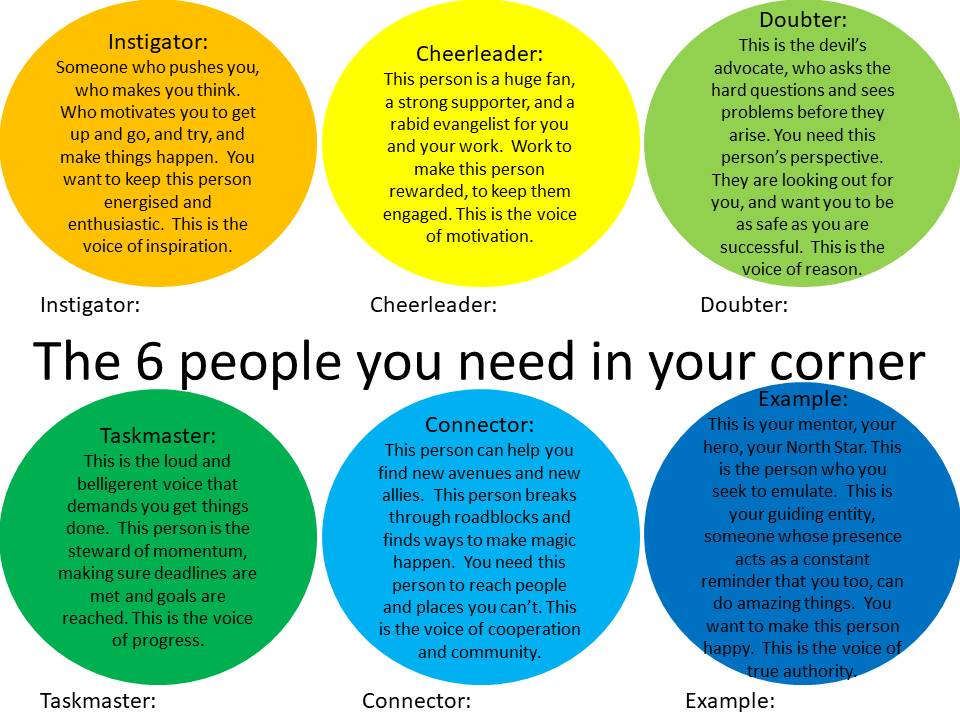
Several years back one thing I picked up, presumably from some talk or online article was the notion of having 6 people in your corner.  Basically, these represented 6 characters that would help and support your leadership journey.  They didn’t all have to be different people, although they could be, or some, or all of them could be the same person.

The 6 characters were:

The Instigator: Someone who pushes you, who makes you think.  Who motivates you to get up and go, and try, and make things happen.  You want to keep this person energised and enthusiastic.  This is the voice of inspiration.

The Cheerleader: This person is a huge fan, a strong supporter, and a rabid evangelist for you and your work.  Work to make this person rewarded, to keep them engaged. This is the voice of motivation.

The Doubter: This is the devil’s advocate, who asks the hard questions and sees problems before they arise. You need this person’s perspective.  They are looking out for you, and want you to be as safe as you are successful.  This is the voice of reason.

The Taskmaster: This is the loud and belligerent voice that demands you get things done.  This person is the steward of momentum, making sure deadlines are met and goals are reached. This is the voice of progress.

The Connector: This person can help you find new avenues and new allies.  This person breaks through roadblocks and finds ways to make magic happen.  You need this person to reach people and places you can’t. This is the voice of cooperation and community.

The Example: This is your mentor, your hero, your North Star. This is the person who you seek to emulate.  This is your guiding entity, someone whose presence acts as a constant reminder that you too, can do amazing things.  You want to make this person happy.  This is the voice of true authority.

Back in about 2009, when I first discovered this, I knew exactly who these people were.  Some of them wore multiple hats for me.  After about 2011 when I’d changed jobs, I really could not pinpoint anyone amongst my work colleagues that fitted any of those roles for me.  Happily, I am once again in the position where I can identify at least one person, even if it’s the same person, for each of those roles.

I’ve just read an article by Anthony Tjan on ideas.TED.com who suggests that we should have 5 mentors:

The Master of Craft: “If you know you want to be the best in your field — whether it’s the greatest editor, football quarterback, entrepreneur — ask, Who are the most iconic figures in that area?” says Tjan. This person can function as your personal Jedi master, someone who’s accumulated their wisdom through years of experience and who can provide insight into your industry and fine-tuning your skills. Turn to this person when you need advice about launching a new initiative or brainstorming where you should work next. “They should help you identify, realize and hone your strengths towards the closest state of perfection as possible,” he says.

The Champion of your cause: This mentor is someone who will talk you up to others, and it’s important to have one of these in your current workplace, says Tjan: “These are people who are advocates and who have your back.” But they’re more than just boosters — often, they can be connectors too, introducing you to useful people in your industry.

The Copilot: Another name for this type: Your best work bud. The copilot is the colleague who can talk you through projects, advise you in navigating the personalities at your company, and listen to you vent over coffee. This kind of mentoring relationship is best when it’s close to equally reciprocal. As Tjan puts it, “you are peers committed to supporting each other, collaborating with each other, and holding each other accountable. And when you have a copilot, both the quality of your work and your engagement level improve.”

The Anchor: his person doesn’t have to work in your industry — in fact, it could be a friend or family member. While your champion supports you to achieve specific career goals, your anchor is a confidante and a sounding board. “We’re all going to hit speed bumps and go through uncertainty in life,” says Tjan. “So we need someone who can give us a psychological lift and help us see light through the cracks during challenging times.” Because the anchor is keeping your overall best interests in mind, they can be particularly insightful when it comes to setting priorities, achieving work-life balance, and not losing sight of your values.

The Reverse Mentor: “When we say the word ‘mentor,’ we often conjure up the image of an older person or teacher,” says Tjan. “But I think the counterpoint is as important.” Pay attention to learning from the people you’re mentoring, even though they may have fewer years in the workplace than you. Speaking from his own experience, Tjan says, “Talking to my mentees gives me the opportunity to collect feedback on my leadership style, engage with the younger generation, and keep my perspectives fresh and relevant.”

They both cover a lot of the same ground but Tjan has some interesting other ideas.  I know who my Champion and Copilot are.  I think I am my own Anchor really.  I’m pretty clued up to my own values and setting personal priorities to achieve a good work-life balance.  I’m not sure who my Master of Craft is at the moment or my Reverse Mentor as I’m fairly disconnected with leading or mentoring anyone at the moment.

Do you know who you’d have in your corner or who are your 5 mentors?

Natural Wellbeing

I’m reading an article in the most recent Psychologies Magazine about how regular time in nature contributes to wellbeing of mind, body and soul, and it suggests that even spending 5 or 10 minutes outdoors with nature can be beneficial in reducing anxiety and can make us feel happier.

I know that I don’t get to spend nearly enough time outside.  I do try to go for a walk at lunchtime, but quite often, due to location, that around a housing estate or hospital grounds.  We are fortunate that there are open fields behind the hospital and I get a move on I might just have time to go that way. I guess even in a housing estate, nature has its place in well-manicured (or even overgrown) gardens and hedgerow.  You just need to look hard enough.

When we were kids we used to holiday most years in the wilds or North Wales.  A beautiful spot with mountains to climb, trails to walk and forests to play in.  In adult years, when we’ve been away, we’ve always had what we’ve called “long walk day”.  A day put aside (hopefully with good weather) to go on a 5-10 mile trek. No distractions but the views around us.  Taking in the sights and sounds of nature doing its thing.

Having to work most days means that going out for long walks or further afield is not easily achievable. However we are lucky that we have some nice park spaces quite nearby.

According to the 10 question quiz that always accompanies these articles the thing that I should find most benefit from time outdoors is grounding.

“If you crave calm or wish you feel more grounded and connect to what matters, upgrading the quality of the time you spend in nature ma provide the shift you need.  It’s easy to spend time outdoors on autopilot, or use it as a way to being with others – but you’ll benefit most from spending at least some time in nature on your own, so you can tune into the stillness and connect with your inner calm.  If your tendency is to live in your head, time in nature can be a much-needed way of paying attention to your physical self.  Finding the ground beneath your feet may even be the first step to finding a new direction in life.

You’ll get the most benefit by focussing on the here and now as you walk.  Don’t give yourself a hard time if you can’ leave your emotional baggage behind but, when you become aware that you’re caught up in thinking, direct your focus outwards by noticing the colours, textures, sounds, smells and sensations.  We can all benefit from a daily grounding ritual but, for chronic over thinkers, it can be life-changing”

Like most people, I haven’t had a proper holiday for nearly a year and a half now (since summer 2019), so when we are able to, I will relish the chance to get out and have some time to wander around new places and spaces to take in the sensations.

The Instant Gratification Monkey

I was reading an online article from Tim Urban, who studied why procrastinators procrastinate.  He possets that they can’t help it.  In their brain the procrastinator has the Rational Decision Maker who steadily guides the mind in to doing what needs to be done, and then there’s the Instant Gratification Monkey who sideswipes things and sends the mind off wandering for some instant satisfaction for information or other, that takes us away from our steady path.

The Instant Gratification Monkey takes us off to play in what Urban calls the Dark Playground, that space where all the fun, new, shiny things hang out that distract us from what we should be doing. In the back of our minds though is this constant feeling of anxiety or regret for that looming deadline or that thing that we’ve been working towards for ages.  When that deadline approaches though, it’s time for a visit from the Panic Monster who scares us away from the Dark Playground back in to a sense of productivity to get things done.

Urban offers three steps to turn procrastination into motivation:

  1. recognise that you are procrastinating.  Being aware of something is usually the first step in resolving it. 
  2. Understand the reason for the procrastination.  Is it the task itself, or is it you? Is it that you aren’t enjoying it, not qualified for it, or feeling overwhelmed by it?
  3. Set objectives, tactics and rewards.  Depending on the reason for the procrastination in the first place it might be as simple as having a to do list if you’re feeling overwhelmed, or someone that holds you to account, or if you promise yourself a treat if you get that thing done.

There are times that I procrastinate.  It’s not usually because I don’t want to do something, more that I don’t want to do that particular thing right now.  I will send that email out but after I’ve watched this episode of that tv programme I like.  I will write that report just as soon as I’ve finished making lunch.  I will learn how to ring handbells properly, just as soon as I’ve written that report and sent that email.  Sometimes it can become a vicious cycle.

Other days, I can blast through even the most boring, or painful task without so much as a second thought.  It’s about the frame of mind that I’m in.  Sometimes, I find being in a particular place, or with particular people helps galvanise me into action.  Sometimes I just wake up and tell myself that today I’m going to power on through all that stuff and clear my to do list.

Today has definitely been one of the latter type of days.  I’ve finished the first draft of a strategy document.  I’ve documented a framework that I invented that supports that strategy.  I’ve been for a power walk.  I’ve read the next section on learning to ring handbells and had a few goes at it.  My Rational Decision Maker was in charge today.

I wonder if that means tomorrow I’ll be all out of juice and my Instant Gratification Monkey will be running the show.

A different frame of mind

I think I’ve probably mentioned this before, but how we choose to respond to outside stimuli, pressures and events is entirely within our own undertaking.  We can choose to get wound up by things, or we can choose to let it go.

My first day back at work this week was horrid.  By the end of the day I was absolutely sure that the conversation when I got home was going to be around how much longer I would have to put up with this.  C was his usual stoic self and confirmed my worst fear that I would have to stick it out for a few more years yet.  Damn.  I felt exhausted after just 1 day back in the office.  I felt dejected.  I felt well and truly fed up.  This has a physical impact as well.  I was unmotivated to do anything else and I stuffed my face with crisps and chocolate. I felt physically sick at the prospect of having to go back the next day and deal with it all, all over again.

Fast forward a few days and I’m in a much better frame of mind.  The plans I put in place on Monday have had a positive result and things are looking ok for the coming week.  I’ve also made the conscious observation, out loud to others, about what I am currently employed to do versus what I get dragged back in to, through necessity, but that I shouldn’t really, and the impact that is having both on trying to deliver what it is I’m supposed to be doing, but also providing the right kind of support to those in the department.  A fuller conversation as to how that plays out is happening later this week.

My point being, my mind-set had changed.  I had chosen to not allow the frustrations at the beginning of the week to overshadow the rest of the week.  I packed that day away and moved on.  I’m not pretending it was an easy transition.  I still woke up on the Tuesday really not wanting to go to work.

According to the Mayo Clinic (https://www.mayoclinic.org/healthy-lifestyle/stress-management/in-depth/positive-thinking/art-20043950), whether you are a pessimist or an optimist can have an effect on your longer term mental health, but also has physical manifestations too.  Being more positive doesn’t mean that you gloss over the difficult things but that by approaching them in a more positive way can be more productive.  Making the best out of a bad situation.  Thinking positively can improve life span, reduce depression and distress, provide greater resistance to colds and better psychological and physical wellbeing, cardiovascular health and general better coping skills.

By focusing on positive thinking we can identify areas of life that may need changing, stopping to check on our thinking and finding ways to put a positive spin on it.  By being open to allowing yourself to have a laugh during difficult times can help you feel less stressed.  Following a healthy lifestyle is often cited, and probably the one I do least of.  Surrounding yourself with positivity will rub off on you and practicing positive self-talk will help you realise that you have a lot to be thankful for.

I’m heading to the end of this week with a much more positive outlook that I had at the beginning.

Making the most of time

No surprises but there are 24 hours in a day. How we spend them is our choice. Whether we spend them wisely is debatable. Some people profess to be really good at time management whilst others feel that there isn’t enough time to get everything done. Is time slipping away from us or are we wasting it?

The latest dossier in Psychologies Magazine goes into some detail about where commitment lies, understanding procrastination, understanding how we currently spend our time and prioritising what’s important. It offers some advice on timekeeping tips for the proverbial laters. Then comes the inevitable 10 question test to determine what stops you making the most of your time.

My results indicated the dominant trait of overthinking, putting hours into mulling over events, conversations, decisions and tasks. This leads to being overwhelmed and worry that others seem to be more productive. Others may be unaware the extent of the overthinking because the outward impression is one of calm. It suggests that I should schedule worry time and limit it to 15 minutes.

A close second was overcommitment, a difficulty in saying no to opportunity and helping others. But if that time does not align with core values it will undermine wellbeing. The challenge here is to find space in my life to connect with the people I love and nurture new connections. Resist the urge to fill all the time up.

Both easier said than done. Today for example. First day back at work after 2 weeks off. By midday I was already feeling that I’d had enough. I didn’t want to be there. By the end if the day I was starting to seriously consider my get out strategy. I had a meeting in the evening I had a zoom call which was fine, not anything stressful, just a bit of preplanned for something which may, or may not, be happening next week.

I’ll try and give tomorrow a fresh start and not worry about the things that I can’t do anything about. And it’ll be C’s birthday so I intend to spend the evening with him and not worrying about what else still needs to be done.

Sitting with adversity

I’ve just completed a free, online 6 week course in Demystifying Mindfulness course via Future Learn (www.furturelearn.com).  The course covered the “science of mindfulness, how it works and why from a political, psychological and philosophical perspective”.  Throughout the course were a series of Mindfulness Labs, opportunities to practice a meditation technique. Something not so long ago I would have said was nonsense. One of the ones that resonated with me most was the one on Sitting with Adversity.

Usually throughout a meditation the participant is encouraged to let go of thoughts and feelings and concentrate on breath or sounds.  In this particular one though we were actively encouraged to invite a difficult situation, thought or feeling and to acknowledge its existence, to sit alongside it, before considering “each in breath a new beginning and each out breath a letting go”.

So many situations to choose from. I may well have to come back to this meditation several times to get through them all.  However, at the end of the 15 minutes or so, I felt much calmer about the situation I had been thinking about.  I chose to lessen its hold over me and consider what was within my personal means of being able to do about it.  In the end, I chose to let it be what it will be.

Even coming to terms with that simple statement of letting something be what it will be and making a conscious decision to not let it affect me in the way it had been, was enough to lighten to load.

I have done several short courses via Future Learn and would thoroughly recommend it as a way of broadening horizons and dipping into something before deciding whether or not its something you want to pursue further.

Adrenaline Junky

Nothing like a crisis to get the adrenaline going.  Its all going a bit Pete Tong at the moment with former colleagues dying due to Covid-19 and staff off with either positive results or self-isolating, meaning that the service is about to fall on its knees.  However, a few strategically placed phone calls and lots of toing and froing has resulted in a bit of a plan that should help the situation a bit.  Also some positive clinical engagement, which was fantastic.

I’m not usually one that responds very well to instant and urgent changes, and trying to solve immediate problems.  I like to ruminate over things, check all the facts, formulate a plan, get everyone involved.  Time was not on our side so this week, and today in particular, have been very much making things up on the hoof, last minute conversations and plans, no time to overly consult, only with those that are critical, put a series of actions together and BAM! I can head in to the weekend slightly more relaxed about the prospects of the week ahead.

I feel surprisingly buzzy about it all to be honest.  The time has flown by, I’ve not been wondering what task to do next. I’ve jumped from one conversation to the next, to the next and to the next.  I don’t think I could sustain that level of activity or focus for too long, and admire those that do and those that work in environments that require that fast paced thinking and problem solving.

When adrenaline kicks in it stimulates our “flight or fight” responses.  When the body is flooded with adrenaline it helps focus and engages the brain, improving cognitive responses.  A bit like a massive caffeine hit.  Apparently, it can improve your eye sight as the pupils dilate, and improves respiration. Even after the triggering event there can be a residual feeling of high vigilance and excitement and can intensify those feelings.  As well as a burst of energy and strength the immune system gets a little boost too. (https://www.mentalfloss.com/article/71144/8-reasons-little-adrenaline-can-be-very-good-thing)

So, having started the day with the sad news of another colleague dying and not feeling like I wanted to really do much, at the end of the working day, I’m now bursting with energy and enthusiasm.  Just as well as I’m hosting a virtual #bellringing session tonight and had better be on my A game.

What’s stopping you from letting go?

Another one of those self-awareness quizzes (I’m getting quite in to them now) was all about what’s stopping you from letting things go and moving forward. This could be an incident that keeps holding you back, lack of self-confidence, lack of imagination, capability or opportunity.

So having answered the obligatory 10 questions – why do they feel the need after question 4 and question 8 to let you know that you are now 40% and 80% complete? – it spewed out my results:

Self-Awareness

Ruminating can become habitual, the go-to place for your mind to wander. But constantly rehashing old arguments, decisions or events keeps them live and fresh. Next time you find yourself sucked into an overthinking spiral, check in with how you feel. If your mood has taken a downturn or you’re feeling anxious, your thinking is not helping you resolve anything. Increasing self-awareness by making time every day to do a mindfulness exercise can help you get into the habit of observing the stories your mind is telling you without getting sucked into them. Try starting your day with a mindful shower – focus on feeling all the sensations and smells. When your mind wanders, observe where it has gone without comment or analysis, then bring yourself back to the present. It may also help to schedule daily ‘worry time’ and park your overthinking until a specific time of day, preferably when you’re relaxed and in a good frame of mind. If, when worry time comes around, you don’t want to go over old stuff, that’s a bonus.

I do actually go over things, again and again, and try to understand the different nuances of what has happened, why it happened, what could have been done differently, how I could have reacted differently.  I also spend a lot of time thinking about why am I spending so much time thinking about it.  I often tell myself to move on. 

I guess that I’m one of those who constantly beats myself up about things.  There’s always something I could have done better, or should have done that I didn’t, or did that I shouldn’t have, or that I really ought to give more time to. I replay conversations over in my mind multiple times.  “What if I’d have said this”? or “if they’d have said that I could have…” and so on.

I’m not sure that I want to schedule a daily worry time, as there are some days when I don’t overly worry about anything in particular, and I’m not sure that you can necessarily schedule it.  Things that will cause worry that are triggered by other things and can happen at any time.  I might be in the middle of one thing and something on the radio or that I’ve read will trigger my brain to relive a previous worry.

I try to learn from previous errors and hope not to repeat them (not always necessarily successfully) however, I do find it really hard to forget about them and move on, even when a solution has been found, agreed and implemented.  I will stew over it, even after some considerable time. 

I guess I need to learn how to deal with it in the moment, resolve whatever it is, and then move on.  Step away.  Park it.  Easier said than done.