Empathy, empathy, they’ve all got it empathy

OK, really bad pun on the Carry On film where Kenneth Williams plays Julius Caeser and utters those immortal words “infamy, infamy, they’ve all got it infamy”!

Anyone who has been on a leadership course will have been told that a leader needs to have multiple skills in order to be effective.  They must be good at influencing others, planning, building and maintaining relationships, finding ways to improve things, set the direction of the team, create the vision and delivery the strategy.  There are so many things that a leader must be good at or develop in order for perceived success.

With the sphere of building and maintaining good relationships comes the essential skill of empathy in order to achieve engagement, happiness and performance.

These days, especially post-pandemic (yes, I am aware it’s not over yet but the way people are behaving they seem to think it is), people are suffering more from the stresses of the workplace.  You could read this into any walk of life where there is a leadership role, e.g. a voluntary position.  There has been a decline in mental health with 67% of people in a global study experiencing increase anxiety and stress. People are more openly admitting to being sad, irritable, and having more trouble concentrating, taking longer to think things through and finding it harder to juggle their responsibilities. An article in Forbes by Tracy Brower stated that more people suffer from sleep deprivation due to stress and that people experience more negative feelings that spill over into their personal lives when they get an “off” email at work.  When people experience rudeness at work it can have a negative affect on performance, turnover and customer/patient experience.

Being more empathetic during tough times can be a powerful contribution to positive experiences both for individuals and teams.

When people receive more empathy from their leaders they are more innovative, engaged and less likely to want to leave the team or organisation. People feel more included and find a better work/life balance, and therefore more able to cope with juggling their responsibilities.

Brower stated that leaders can demonstrate empathy in two ways:

  1. Consider someone else’s thoughts through cognitive empathy. Think if you were in the other person’s position what would they be thinking.
  2. Use emotional empathy.  Think what it would feel like to be in the other person’s position.

Leaders don’t need to be experts in mental health.  Its enough to check in, ask questions and take cues from what’s being said, or not said.  Where there is alignment between what the leader says and does, there is a greater feeling of trust and engagement from others. Empathy in action is understanding someone else’s problems and doing something to help. Its considering another person’s perspective with compassion.

Empathy is something that I have awoken to more during the last couple of years.  Empathy, empathy, we can all show empathy.

5 Ways to raise your conversation vibration

Image by dandelion_tea from Pixabay

Do you spend time creating conversations on purpose?  What you talk about in your own mind, and with others, reflects a lot about your life.  Do you spend time talking about your past and problems, or about your dreams and vision?

It is important to create and monitor your conversations on purpose, to avoid stagnant and repetitive conversations.  You can get fixated on what’s happening at a given moment that you forget to think about growth, inspiration, positivity and joyful interactions.

According to podcast fave Tonya Leigh to upgrade the quality of your conversations you need to take risks and be involved in conversations that expand beyond those you usually have.  By committing to elevate the conversations in your own life you can become connected to wonderful people who can give you excellent advice and support.

No matter what you’re currently going through or struggling with you should measure the quality of the conversations you have.  You are the sum of those conversations you have with the people around you.  So when you talk with inspirational people you share your passions, visions, obstacles and solutions, share the struggles but from a place of wanting to be stronger knowing when you’re open you can gain incredible insight.

TL suggested five ways to raise your conversation vibration:

  1. Refuse to get sucked into non-productive conversations.  Others who complain or are negative don’t help those committed to dreams and growth.
  2. Invest in creating a circle of likeminded people.  The return on investment in joining groups can be immense when you are connected to incredible minds and hearts, with others also investing in their personal growth.
  3. Uplevel your virtual conversations.  The internet is full of people who enjoy discussing ideas and solutions. Find them but have some rules around how long you spend on the computer and check in with how you feel about the conversations you join and whether they are draining or supporting you.  Be responsible for the energy you bring to the conversation too.  Curate the conversations you want to have that fill your dreams and excite you.
  4. Find a Bestie who whispers in your ear even if they don’t know you exist.  This could be books, videos, podcasts.  People you’ve never met, or ever likely to, can help inspire and motivate you.  Think about where you are right now and what you’re dreaming about creating and who is having those conversations about it.
  5. Create the conversations you crave, don’t wait for them to happen.  You can change the subject, or leave the room if the conversation is not serving you.  You can bring topics up that you are passionate about. Talk about what went well and what you’re excited about. Surround yourself with people who will help you figure out how to make it work.  Curate conversations about where you want to be and a brighter future.

SL asks that you make a commitment to raising conversation standards and become the person who elevates the conversations that impact you own life and those of the people around you.

Do your conversation represent the person you want to be, your dreams and desires and how you want to be known?

I am rubbish at conversations.  I’m no good at small talk.  I can often go on for too long about something I should have shut up about already, or not expand enough about something that needed more air time.  I don’t really have anyone close that I can have the conversations I want to have about my personal growth without them thinking I’m going cuckoo, having a midlife crisis, or can offer any real constructive support with. 

So I’m stuck with the podcasts (hence the almost daily dose of TL), books and videos.  I’ve found a few social media sites that offer basic level support but it’s all very generic.  I tried reaching out to a couple of former colleagues, who would totally understand it and we all agreed that we’d meet up but when I sent them suggested dates, they never bothered to come back to me, so I guess they weren’t that committed to supporting me after all. 

I’m not at the stage where I want to invest ££s in attending personal development coaching sessions.  I can’t justify the expense in my own mind yet.  I’m sure those who deliver such coaching would tell me that it would be totally worth the investment, and I’m sure I’d get something out of it, but they tend to be very expensive.  Coaching sessions I’ve had in the past haven’t really helped me figure things out.  I’ve spent a lot of time supplying the answers myself instead of getting support on what to work on.  One person just kept telling me to think about what I’d say to someone else, and how she knew I already knew the answers within me.  Simply repeating that didn’t help at all when I wanted practical advice on what to do.

For now I’ll just have to keep having those conversations in my head.

6 people in your corner OR 5 mentors you need?

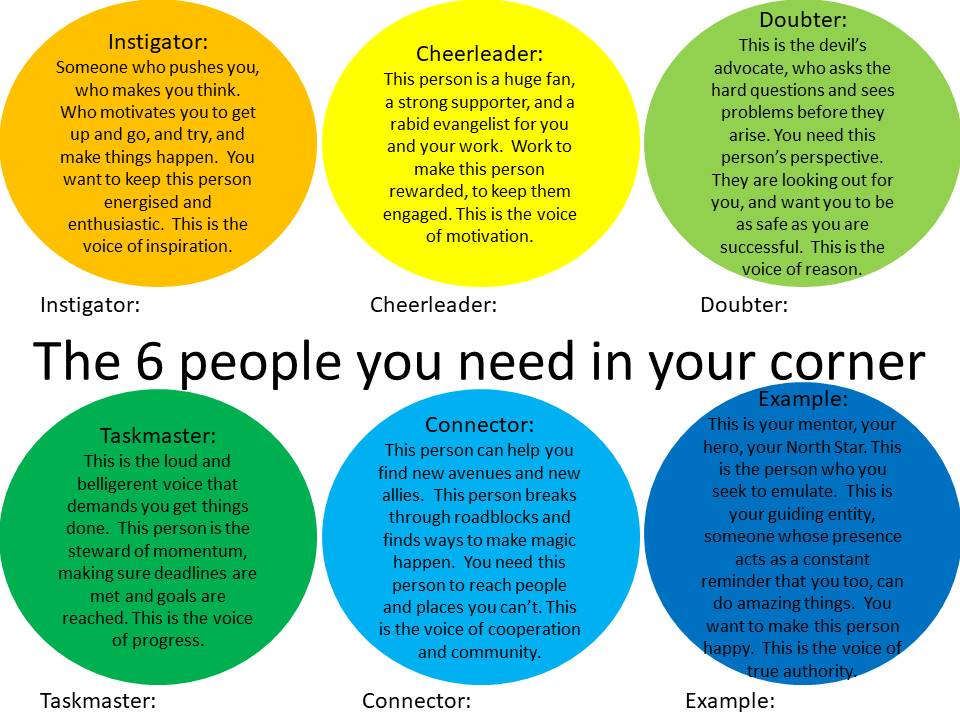
Several years back one thing I picked up, presumably from some talk or online article was the notion of having 6 people in your corner.  Basically, these represented 6 characters that would help and support your leadership journey.  They didn’t all have to be different people, although they could be, or some, or all of them could be the same person.

The 6 characters were:

The Instigator: Someone who pushes you, who makes you think.  Who motivates you to get up and go, and try, and make things happen.  You want to keep this person energised and enthusiastic.  This is the voice of inspiration.

The Cheerleader: This person is a huge fan, a strong supporter, and a rabid evangelist for you and your work.  Work to make this person rewarded, to keep them engaged. This is the voice of motivation.

The Doubter: This is the devil’s advocate, who asks the hard questions and sees problems before they arise. You need this person’s perspective.  They are looking out for you, and want you to be as safe as you are successful.  This is the voice of reason.

The Taskmaster: This is the loud and belligerent voice that demands you get things done.  This person is the steward of momentum, making sure deadlines are met and goals are reached. This is the voice of progress.

The Connector: This person can help you find new avenues and new allies.  This person breaks through roadblocks and finds ways to make magic happen.  You need this person to reach people and places you can’t. This is the voice of cooperation and community.

The Example: This is your mentor, your hero, your North Star. This is the person who you seek to emulate.  This is your guiding entity, someone whose presence acts as a constant reminder that you too, can do amazing things.  You want to make this person happy.  This is the voice of true authority.

Back in about 2009, when I first discovered this, I knew exactly who these people were.  Some of them wore multiple hats for me.  After about 2011 when I’d changed jobs, I really could not pinpoint anyone amongst my work colleagues that fitted any of those roles for me.  Happily, I am once again in the position where I can identify at least one person, even if it’s the same person, for each of those roles.

I’ve just read an article by Anthony Tjan on ideas.TED.com who suggests that we should have 5 mentors:

The Master of Craft: “If you know you want to be the best in your field — whether it’s the greatest editor, football quarterback, entrepreneur — ask, Who are the most iconic figures in that area?” says Tjan. This person can function as your personal Jedi master, someone who’s accumulated their wisdom through years of experience and who can provide insight into your industry and fine-tuning your skills. Turn to this person when you need advice about launching a new initiative or brainstorming where you should work next. “They should help you identify, realize and hone your strengths towards the closest state of perfection as possible,” he says.

The Champion of your cause: This mentor is someone who will talk you up to others, and it’s important to have one of these in your current workplace, says Tjan: “These are people who are advocates and who have your back.” But they’re more than just boosters — often, they can be connectors too, introducing you to useful people in your industry.

The Copilot: Another name for this type: Your best work bud. The copilot is the colleague who can talk you through projects, advise you in navigating the personalities at your company, and listen to you vent over coffee. This kind of mentoring relationship is best when it’s close to equally reciprocal. As Tjan puts it, “you are peers committed to supporting each other, collaborating with each other, and holding each other accountable. And when you have a copilot, both the quality of your work and your engagement level improve.”

The Anchor: his person doesn’t have to work in your industry — in fact, it could be a friend or family member. While your champion supports you to achieve specific career goals, your anchor is a confidante and a sounding board. “We’re all going to hit speed bumps and go through uncertainty in life,” says Tjan. “So we need someone who can give us a psychological lift and help us see light through the cracks during challenging times.” Because the anchor is keeping your overall best interests in mind, they can be particularly insightful when it comes to setting priorities, achieving work-life balance, and not losing sight of your values.

The Reverse Mentor: “When we say the word ‘mentor,’ we often conjure up the image of an older person or teacher,” says Tjan. “But I think the counterpoint is as important.” Pay attention to learning from the people you’re mentoring, even though they may have fewer years in the workplace than you. Speaking from his own experience, Tjan says, “Talking to my mentees gives me the opportunity to collect feedback on my leadership style, engage with the younger generation, and keep my perspectives fresh and relevant.”

They both cover a lot of the same ground but Tjan has some interesting other ideas.  I know who my Champion and Copilot are.  I think I am my own Anchor really.  I’m pretty clued up to my own values and setting personal priorities to achieve a good work-life balance.  I’m not sure who my Master of Craft is at the moment or my Reverse Mentor as I’m fairly disconnected with leading or mentoring anyone at the moment.

Do you know who you’d have in your corner or who are your 5 mentors?

Style Guru

Someone (you know who you are) came over to see me today and very kindly brought me belated birthday gifts.  They were brilliant, thank you.  However, it was what she was wearing that got most of my attention.

It looked like she’d just had her hair done, but she professes to have coloured it at home.  It looked like it had recently been cut too, but she swears not.  She was wearing a fabulous coat.  It was blue with white checked lines, a belt and collar.  To be honest, she looked very glamourous in it, not that she doesn’t always look fab, but this was really rather special.

All the while we sat and chatted I was thinking “I want that coat”.  I offered a very sincere compliment on it and how it looked on her and she told me where she’d bought it from.  I’m going to google it later.

But do I need another coat?  Probably not.  I have several lightweight jackets.  I have what I call my autumn jacket, one that is slightly thicker than but not as heavy as a winter jacket.  I have a winter jacket.  I have a winter coat.  I have a rain coat.  I have a posh long coat. I probably don’t need another one.  But it did look good.

It looked good on her, but would it have looked that good on me?  I don’t know.  We are different body shapes, height, hair colour and skin tone, so maybe it suited her style better. Maybe I’d just look like a beached whale in it.

I’m trying to inject some colour into my wardrobe as quite a significant amount of it is black or white.  I’m trying to find more stylish items rather than the functional or office style.  I’m buying more things I can mix and match with other things.  I’m trying to move away from the same old stuff.  I did actually see a photograph of someone in a bright pink trouser suit the other day and I thought she looked fantastic.  I actually felt that I wanted that suit too.  Last summer I did buy a bright blue suit, which is very different for me, and I wore it to work a few times and got some really nice compliments. 

I think the problem is I’m not really sure what my style is.  I like comfort but I like to be smart when I’m at work.  I used to wear skirts and dresses but for about 15 years or so I probably have only wore a skirt or dress a handful of times.  I have some long dresses that I wear to formal dinners, but that’s all I have in the wardrobe now.  Everything else is trousers.  I have a long body which makes some styles impossible to wear despite the fact that they might be flattering for my girth!

I think I like an urban casual look. Something fairly soft and comfy with an occasional edge to it. I’m slowly amassing that kind of wardrobe.  But every now and then I want a statement piece. Maybe the coat could be this years’ statement piece.

Quick fire round

I’m not one for small talk. I find it difficult to think of what to say. Its probably something to do with my introversion. I find it frustrating when meetings start with lots of random conversations that have nothing to do with the meeting agenda. I understand the purpose. An ice breaker, or checking in on others wellbeing and so on. But then I get to the point of “can we get on with it now please”?

Just for funsies I was having a play with a random conversation starter generator to see if they were the sort of things you could talk about in a room full of strangers, or at the beginning of a meeting whilst everyone is getting settled. Try some out. Here are the first 10 questions the random conversation starter presented to me.

What is your biggest fear? Losing my child.

What is your dream job? Not sure really. Like making cakes but not sure if I’d want to do it for a living. Thought about opening a cafe once. I guess not needing to have a job might be a dream.

If you were asked to teach a class, what would you teach? Baking.

Do you prefer baths or showers? Bit personal that one. Showers.

If you could choose any era to live in what would it be? Toss up between Tudor, but only if I was at Court. Or early 1900s when so much exploration and new invention happening.

What is one thing that you would like to change about the world? I suppose I ought to go for something like ending poverty or hunger or climate crisis but a big thing that gets me riled is hypocrisy.

How would you know you were in love? If I couldn’t stop thinking about someone or wait to see them and my heart started beating faster.

What is the longest amount of time you’ve slept for? 2 days. I went home from work ill on a Monday and woke up on the Wednesday.

Do you recycle? Yes!!!!

Do you prefer cats or dogs? Neither but if pushed on the subject dogs. Cats are selfish and mean.

Hmmm. Some of them are hardly conversation starters as they have a one word response. I suppose the idea is to then ask follow up questions but for some conversation done. I’m not sure that some of them would be appropriate at the office either but hey, if the conversation stops, I’ll throw one in and see what happens. 🤣

What’s the weirdest question you’ve ever been asked when the conversation got stuck?