That quote is possibly attributed to Henry Ford. In the context I want to explore it is about thinking creatively about #bellringing publicity and recruitment opportunities. As part of a talk I did last year, I then wrote out the main points of the talk and they can be read in sections as part of the joint Association of Ringing Teachers (ART) and Central Council’s Recovery & Survival Toolkit. If you’re a real insomniac you can also watch a recording of my talk.
Sometimes as bell ringers we are not terribly inventive with how we reach out. We trot out the same talk, or the same set of generic display boards that don’t appeal directly to the audience we are trying to engage with. Here were my thoughts on thinking creatively for publicity and recruitment opportunities.
Basically, to start with, anything goes. You might have to rule some of it out due to cost, or health and safety etc, but don’t let that stop your creative juices from flowing. Try to get out of the habit of “We already tried that and it didn’t work”. It didn’t work then, but things and people have moved on, so it might work now. And the other one is “We don’t do things like that around here”.
Be imaginative with imagery, don’t be afraid to use something contemporary and different from the usual picture of someone pulling on the end of a rope that doesn’t appear to be attached to anything, or a bell that looks seems disconnected to the action. Do we want to continue to use the same stuffy images of bell ringers and ringing as we’ve always done, or are we trying to reach new audiences by using evocative images that connect to our objective?
Make sure that you know what the project goals are and keep them in mind. Are you trying to recruit, are you trying to raise funds?
Make sure you have all the facts to hand. If you are raising funds for a restoration project, make sure that you know how much you need to raise, what the project actually entails and so on.
Use your own experiences and expertise to fill in the story, you know the people, the bells, the local community, previous momentous events and inspired.
Look for combinations that tie in with what your objectives are:
Is the local school having a fete if so could you take along some handbells or a mini ring? Is the town centre having a celebratory day?
Did you know that a lot of counties have a County Day? Could you use this day to organise ringing in all your local towers or your whole Guild with have a go sessions included as a mass recruitment opportunity?
If you find yourself stuck for ideas, or going over the same thing again and again, sleep on it, take a break, do something else for a while. They say our best ideas often come when we least expect them.
Keep a checklist of all your ideas and the pros and cons of each. You can extend it to include the activities involved in each idea, the costs and time associated with each idea.
Always run your ideas by someone else. Preferably someone not connected with it or a non-ringer:
Does it make sense?
Does it grab attention?
Particularly if you are writing an article or producing a leaflet or other materials, always get someone to proofread it before sending it off.
Come up with ideas together. Creativity sparks creativity. Someone may have the nub of an idea but someone else may be able to see how that could develop and become a bigger and better idea, but be careful, don’t make the team too large otherwise you’ll never get anything done and may spin around in “group think” where no new ideas are generated.
A topic of conversation at this morning’s virtual #bellringing session attempted to explain the difference between place bell order and coursing order. The explanation may have been perfectly fine, but for at least two of us, our failure to comprehend, left us dazed and more confused.
Place bells could have two meanings (why would we want to make it easy):
is a way to understand at what point in the change a bell strikes. Typically, starting with rounds: 1,2,3,4,5,6 bell number 3 is in 3rds place. Now if we were to mix the order of the bells up a bit by ringing a method, the order the bells strike might be 1,3,5,2,4,6 so now bell number 3 has moved and bell number 5 is now in 3rds place, i.e. it’s the bell that strikes 3rd in the change.
Is to describe the piece of work a particular bell in that place starts with and what it might be doing next. E.g. 3rds place bell in Plain Bob Minor goes out to the back, plain hunts down to the front and makes 2nds next time. Understanding that comes with a whole bunch of learning the different parts of work in the method. So if the ringing was getting a bit scrappy and someone told at you that you are 3rds place bell, it should help you get back on track by knowing what the work that 3rds place bell does.
Lead end order is the order of the place bells in a plain course of any given method. So, using Plain Bob Minor again, the order the bells do the work can be described as 2,4,6,5,3 (we ignore the treble for these purposes as it plain hunts without doing the method work). We could therefore say that 2nds place bell becomes 4ths place, which becomes 6ths place, then 5ths place and 3rds place. It defines the order of work to be rung.
Not to be confused with coursing order. This is where the bells follow each other around. Your course bell is the bell that follows you down to the lead. The bell that takes you off the lead is known as your after bell. In the above example if you were ringing the 5th, your course bell would be the 6th and your after bell would be the 3rd. Coursing order is cyclical, so the bells will always cycle round the method in that way until a call is made.
Coursing order becomes particularly important when you start to ring touches of methods, a way of shortening or extending the piece of ringing by adding things called “bobs” or “singles” (there are other calls as well, but we’ll not worry about those here). This is called Transposition. Its’ what clever conductors use to know what order the bells should be in when a call is made. Every time a call is made, it changes the order of the bells. Transposition helps you work out what the new coursing order is.
I’m not going to try and explain that here because much cleverer people that I have explained it elsewhere but if you’re really intrigued here’s a couple to start with:
For the first time in about 7 months we are looking forward to having other ringers in the tower with us for Sunday service #bellringing. There is still only likely to be 4 of us this week but it will make a real change to hear more bells than the usual ding and dong C and I have been doing.
Sticking to the guidance issued by the Central Council the most we can have in the tower is 6 people for no longer than 45 minutes, with masks and good ventilation.
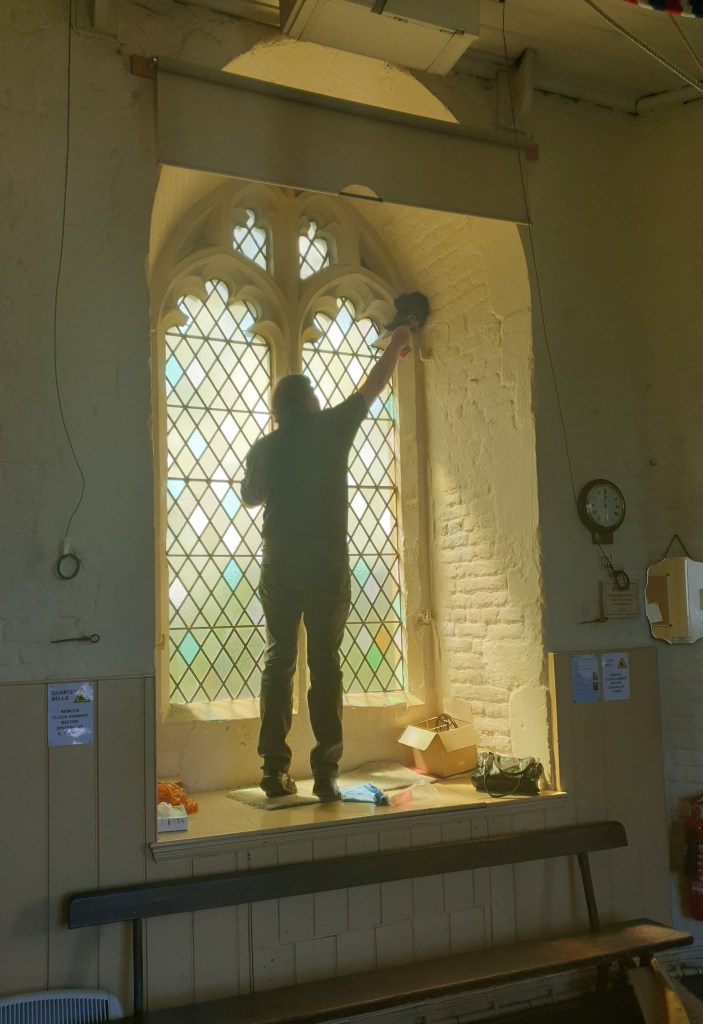
In preparation C and I did a bit of a spring clean. We took some cleaning equipment with us, including the ostrich feather duster I blagged from conference about 6 years ago. C was in charge of the high dusting on account of his longer reach.
Whilst he did that I tackled the spiral staircase from the ringing room down to ground level, some 52 steps. That job hadn’t been done for a very long time indeed. Probably not since our deputy tower captain’s late wife last did it. I wore a mask and had glasses on to protect from breathing too much dust and cobwebs in.
I left C to do the rest of the vacuuming whilst I did my best to resemble a chimney sweep.
When I came back upstairs I hadn’t realised how dirty I’d got until I happened to see myself in the mirror. I was filthy. It was in my hair, all over my face, on my glasses and some had got through the mask so my face was covered. My neck and decolletage were covered. I had to blow my nose a dozen times before the black stuff stopped coming out.
It took us nearly an hour to complete our mission but we were very pleased to have done it.
Afterwards we bought some lunch and strawberries, cherries, grapes and raspberries from the High Street farmers market and sat in the park in the sunshine. A well earned repost.
Hopefully we’ll be up to six ringers next week but for now I’m excited at the prospect of four.
You will have read before about this virtual #bellringing platform called Ringing Room that enables bell ringers from all over the world to ring together in a virtual world, given we have not been able to ring much in the real world.
I started using Ringing Room in May 2020. It had been around for a few months already by then and the developers were still making changes to it, enhancing the user experience, fixing bugs etc. I even managed to get it featured on the BBC 10pm News in June. It has revolutionised ringing from being able to ring with our friends, meeting new friends, ringing with people from anywhere and everywhere, and ringing things we never thought we could in a tower. There are even several groups of new ringers who have only ever rung in Ringing Room and never stepped foot in a tower and tried real bells.
The development is ongoing, and Wheatley was introduced more recently. Wheatley is basically a bot that will ring all of the others bells unassigned to people, so if you want to ring something on 8 bells but only 6 people are there, Wheatley will fill in the gaps. I think Wheatley will be greatly missed when we go back to tower ringing and meet one or two short!
The developers were rightly rewarded earlier this year by winning a large financial prize at the Association of Ringing Teachers awards. And still the platform goes from strength to strength. What started off as a big of a hobby experience rapidly has been the saving grace of ringers everywhere. It has 5 servers in 4 different countries. I ring in 2 or 3 regular sessions per week, with the occasional extra practice every now and then, so get good use out of it.
Ringing Room is free to use. It doesn’t spam you with emails once you’ve signed up. It doesn’t bug you if you haven’t visited the site in a while. It quietly sits there, ready when you are. Every now and then I remember to send a donation. There is a facility to do this on the Ringing Room site, but again, it’s a button that quietly sits there, doesn’t shout out at you, doesn’t draw your attention to it, makes no expectation and there’s no pressure.
I was about to make a donation again when I saw a new option – to become a Patron by making a regular contribution. Being able to donate regularly would be easier for me, so I wouldn’t forget, but also provide the developers with a more regular stream of income to support the platform and future developments. There were 3 options, £3 per month, £10 per month and £20 per month. There was still the option to make a one of donation of any amount. I had no hesitation in supporting the £20 per month option. The value I get out of it is more than worth it. Patrons would also get access to exclusive voting privileges on new features to be added to the platform.
There are I don’t know how many thousands of users of Ringing Room now, and if each of them made a small contribution to the upkeep and development of the platform, it would be a small way towards thanking the developers for the extraordinary work they have done in creating Ringing Room.
Some people might think that Ringing Room will have its day once we are able to get back into towers to ring real bells, but I for one fully intend to keep using it, even if its for my own practice. I don’t think I’m alone in that thought.
Although there has been no group #bellringing for such a long time now C and I have been going to the Cathedral and ringing two bells just to keep things going.
This week however we are away visiting E&M so not able to go to ring. In ordinary times we would go with E&M to their tower to ring on Sunday bit as they’re not back ringing yet either, we had the morning off.
An odd feeling to not go ringing but after yesterday’s marathon walk around Hardwick Hall we were all exhausted and enjoyed a couple of extra hours sleep.
I am looking forward to returning to the Cathedral next weekend when we will have a couple of extra of ringers for the first time in many, many months. The rules still only allow six people with social distancing, masks and good ventilation but it will be fantastic to hear more than ding and dong and try real ringing methods.
As we head into June and the possibility of no restrictions after the 21st (fingers tightly crossed) we may also be able to start practices again. I know many towers already have but because we are very reliant on people from other towers supporting our practice we’ve decided to hold off for a while.
It will be interesting to see and hear how we get on when trying to raise and ring the heavy bells for the first time in 16 months. Managing people’s expectations of what they could and should ring might be a challenge.
From what I’ve read on social media from other towers it seems that there has been a positive community reaction to bells being rung again but then I upoose no one is going to share any negative responses they’ve had.
I always share details of what ringing we are planning and what we’ve done on our Twitter account and tag local radio, the diocrsan office, the cathedral, local city sites as well. Some are really positive and like and share our posts which is lovely.
I want to build a closer relationship with the cathedral and diocesan offices and local community sites so that they start to fully consider the advantages that bellringers bring to church and community.
I’ve already had conversations with the cathedral office about a diocesan wide ring to mark the enthronement of our new Diocesan Bishop later on in the year and look forward to some closer links.
This quote from Oprah Winfey popped into my timeline the afternoon in which a group of us had failed to score a quarter peal in the morning. We had met with the intention of going for a quarter peal of Yorkshire Surprise Major on the understanding that as it was one person’s first attempt at a quarter of a Surprise Major method, if it came a cropper, it would be no big deal. It also happened to be the conductor’s birthday so it would have been a nice thing to attempt as a compliment.
We had been virtually #bellringing for nearly 45 minutes and we were only two leads away from the end when the conductor’s technology failed, therefore bringing our attempt round to a premature end. Whenever I ring in a quarter peal, as I’m sure most people do, I ring with the absolute intent of scoring it, and although the one ringer was less experienced at ringing Surprise Major methods, they had been given advice on which bell to ring and what would happen and equipped themselves very well. We were all of the mind that we would go for it and see how far we got.
It does seem sometimes happen that if quarters or peals are lost there needs to be a post-mortem and an attempt at determining what or who was at fault. Most people feel quite down if they don’t score it, and if you were the person who went wrong and caused the pile up, you’d probably feel really bad for the rest of the band. It tends to be more irksome if ringing in a real tower and people had to travel a distance to ring with, what some might consider, nothing to show for it.
Disappointing though it was not to have scored the quarter to mark the conductor’s birthday, there was no bad feeling afterwards at all. Everyone was congratulated for getting that far, especially the person with less experience. There was a feeling of “well that was jolly good practice” and “it proved you can do it”. There were also calls for rearranging it soon so that we could score it and get that first quarter of Surprise Major in the bag.
It makes a real difference when you ring with people who are non-judgemental and who appreciate just ringing together for the pleasure of ringing and helping someone less experienced along the way. We decided not to resume ringing for the rest of the duration of the practice time but had a good chat about everything else instead. It was a pleasure just to have everyone’s company.
We may have failed to score the quarter but we enjoyed the attempt and the process of how we got to even attempt it.
In ordinary times May Day Bank Holiday would be fully taken up with the #bellringing AGM. We would need to be at the Cathedral by 9am, usually C would be running the pre-service #bellringing, then the service and then the meeting, following by a quick lunch somewhere and the afternoon towers to ring at in whichever district’s turn it was to host, and the epic bellringers tea.
As we are having our 2nd lockdown AGM over video conference, it meant none of the before meeting activities, no lunch out somewhere nice and no towers to ring at afterwards, although someone had organised a virtual #bellrinigng session for anyone that wanted to join.
This has however, afforded us time to do some other stuff. Before the AGM started, I made a batch of lemon viennese whirl biscuits with homemade lemon curd (see yesterday’s blog entry) with white chocolate buttercream. Utterly delicious. I have also made some tuna scotch eggs that required eggs to be boiled, potatoes to be boiled and mashed, bread to be crumbed, and then all assembled before baking. These will be for my lunches for the rest of the week, with some salad.
In the meantime, C perpared and baked some bread rolls. He put the ingredients in the bread machine first thing, and once mixed, rolled them, proved them then baked.
The oven was well utilised.
After the meeting we adjourned to Ringing Room for some virtual #bellringing. We tried some rounds on 16 just for funzies, but it came a cropper, so stuck to 8 bell ringing after that with a plain course of Stedman Triples, just over half a course of Cambridge Surprise Major (didn’t quite get to the end), then a course of Bristol Surprise Major which was pretty good. I then ducked out as I still had some things to get done and other Central Council bits to get out of the way today. C said that they ran some Double Norwich Court Bob Majory after I’d left.
Without the afternoon ringing tour and tea, I had time to make Biscoff pancakes I do in advance ready for my breakfasts for the week ahead. I ping them in the microwave at work for about 1 minute 30 seconds to warm up again. If I’m working from home, I add another dollop of Biscoff spread so it goes all runny and adds extra yumminess.
All in all a Bank Holiday baking bonanza, with a bit of #bellringing business thrown in for good measure. Quite an enjoyable day.
Third sector organisations are voluntary and community organisations which includes charities, associations, self-help groups and community groups, social enterprises etc. They are neither public nor private and are independent from government. They usually play a role in history and culture and are value driven to improve public welfare, the environment or well-being. Any surpluses are reinvested in the pursuit of their aims. https://www.nao.org.uk/successful-commissioning/introduction/what-are-civil-society-organisations-and-their-benefits-for-commissioners/
#bellringing fits firmly into that sector. We are there for the benefit of the church and communities we ring in. The social and well-being advantages of #bellringing are clear, it can give people a sense of purpose, an opportunity to socialise with others, a new hobby and sparks offshoot new interests in history, architecture, even engineering. Getting out and about, meeting new people, developing new skills are all transferable to the workplace and great for young people to add to their higher education applications. Societies are often charities, or at least their bell restoration fund is a registered charity.
As far as well-being goes, #bellringing ticks all 5 areas:
Connecting with other people. Bellringing is a team activity. It requires connection with others and leads to other social activities like outings, pubs, and other non-ringing social activities;
Being physically active. You need to be able to climb spiral staircases (often), being able to raise arms above your head repeatedly. There is a gentle cardio rhythm to it. Its not all about brute strength.
Learning new skills. It can take about 15 hours to learn how to handle a bell on your own, that’s before you add other ringers into the mix, then there are more and more complex methods to learn, if you want to. There really is no limit.
Giving to others. This is a sense of community. Doing your bit for the church or for a community activity such as ringing for Armistice or a local event or celebration.
Paying attention to the present moment. This is essential. You need to concentrate on your bell handling, your method ringing and everything in between. You can’t afford to let your mind wander.
Perhaps we should lobby to get #bellringing offered on prescription for people who are lonely or feeling a bit low. We should be offering it out as adult education classes, young people’s after school activities or holiday activities. Some already do this but wouldn’t it be great if we could spread that net wider.
I’ve signed up to attend a webinar for third sector organisations on Better Community Engagement for Charities to see if there is anything we can learn.
According to https://www.english-heritage.org.uk/visit/whats-on/st-georges-day/9-things-you-didnt-know-about-st-george/ for some reason England adopted a guy who was born in what is now Turkey and died in what is now Israel. He wasn’t a knight in shining armour either. He was a warrior on horseback or an officer in the Roman army. He is described as a martyr for his Christian faith but was probably executed for refusing to make an offering to a pagan deity. And he never came to England. It seems that he had a reputation for virtue and holiness across Europe and England adopted his saints day in the 9th century. He was popular with King Edward I, Edward III, but the George Cross wasn’t adopted to represent England until Henry VIII’s reign.
The addition of a dragon wasn’t until several centuries after George’s death. The dragon may have just been a symbolic portrayal of good versus evil. Pope Gelasius canonised George in AD494 and his feast day of 23rd April was thought to be the date of his martyrdom. St George’s day then became popularly adopted in England in 1415.
Shakespeare, whose birthday is also 23rd April, called on the popularised supposed protection of St George in Henry V, where the king cries out “Once more unto the breach, dear friends. God for Harry! England, and St. George”
So just for fun, during the evening’s Ringing Room virtual #bellringing practice, we rang St George Bob Minor and The Dragon Bob Minor, spliced. St George and The Dragon. Geddit?
A few years ago there was a campaign to get St George’s Day more celebrated and to have #bellrinigng as a way of celebrating England’s national day, and making as much of it as we seem to make of St Patrick’s Day. It did get some traction, however in 2020 of course, we were in lockdown, couldn’t ring and couldn’t celebrate. The Ring for England website http://ringingforengland.co.uk/ hasn’t been updated since 2019, so I don’t know whether the person leading the project has given up, or just didn’t bother with it in 2020, or indeed is no longer with us.
At a recent Central Council Public Relations Workgroup meeting we discussed using saints days as opportunities to promote ringing. St Andrew’s day in Scotland is well celebrated and there was enthusiasm for including St David’s Day and St Patrick’s Day as well.
But for now “Once more unto the breach, dear friends”.
One of the things on my To Do List is to update our entry on the Cathedral’s website. They are getting a new platform and whilst migrating things across, it has given them a chance to update things and make them look brighter with lots of fabulous photographs. I was asked to update the #bellringing entry, which to date, has been rather modest, and quite difficult to find.
I was looking around for information that others might find interesting and came across something written by I don’t know who, about the history of our bells. From early recording of possibly 4 bells, over the years we have augmented, had completely new casting and doubled from the 6 bells that were first recorded in 1768 to the unique set of 12 (+1) we have now. Here’s an extract:
The mediaeval church tower probably housed bells but little is known about them until the 16th century when, in 1560, bell metal was given by William Reynolds, William Mildmay and Richard Maryon, churchwardens. In 1586 a rope was made for the ‘great bell’, and by 1591 there appears to have been four bells.
Ringers were active in the 17th century for they rang in 1624 ‘when the Prince came home’ and were paid 5s. In 1685 the parishioners sought to put an embargo on the ringers’ pecuniary gains for they informed the churchwardens they should not “at any time upon a publick day of rejoycing give above seven shillings to any Ringers and if the Ringers of the Town refuse to ring upon such publick dayes of rejoyceing, it be ordered that ringers be not permitted to ring upon their own pleasure.”
The present Sunday Service band (currently 5 ringers plus others from neighbouring towers) regularly rings for morning services on Sundays (outside of pandemic times), as well as for Weddings and for other special occasions. The current custom is to attempt a Quarter Peal on the first Sunday evening of each month after the 3.30 evensong in order to provide a means of reinforcing what has been learnt during practices on Monday evenings. These quarters are on 8, 10 or 12 bells supported by ringers from other local towers. The band continues to do well in local and county striking competitions.
There are only two other rings of 12 bells in the and we can justly feel proud of our bells and the long history of ringing here.
From 6 to 8 bells
In 1768 Morant, the great local historian, recorded six bells at the church. Originally there appears to have been a ring of eight, but the parishioners gave two of them to a neighbouring church in exchange for their chimes. However in the 1770s there was an awakening to the art of change ringing, and on 11th July 1777 a new ring of eight cast by Thomas Mears was opened with a peal of Plain Bob Major to celebrate the occasion. In the space of a few years the Society of ringers was second to none in the eastern counties, gaining a reputation for ‘exactness of calling and striking’ far and wide, one noteworthy achievement being a ‘long length’ peal of 10,080 changes, in 5 hours and 50 minutes of non-stop ringing, at at another neighbouring church, in 1819.
10 Bells
In 1820 two new treble bells were added at the Cathedral, making ten in all, but the Society seems to have dwindled in the 1830s and there was no active resistance when the two new trebles were moved to the newly built church in a hamlet in 1841.
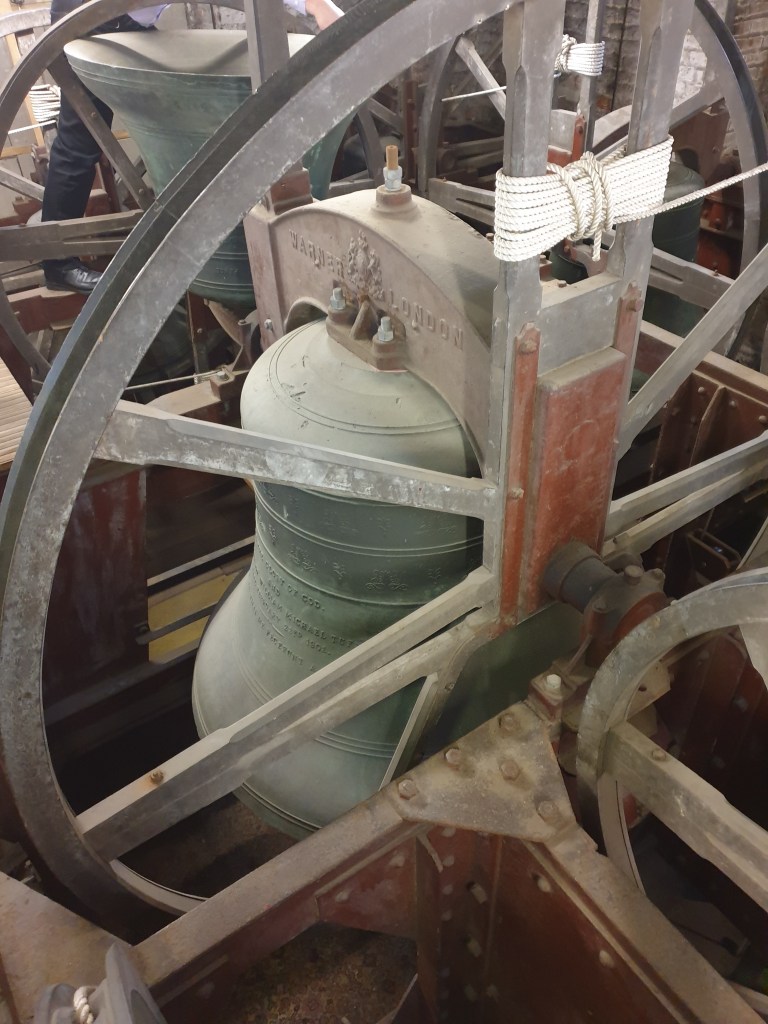
The bells continued to be rung for royal and civic occasions but it took the activities of the Association to shake the band out of its torpor. In 1881 the eight bells were rehung by Warner in time for the fourth meeting of the Association at the cathedral in 1882, where the Association has met annually ever since. The Association report for 1886 said: “The chief event of the year has been the recent restoration of the two trebles to their places at St. Mary’s. The county town and centre of the Association now possesses a good ring of ten bells, and all that is needed is a band of local ringers to do them justice.” This latter rather caustic comment was perhaps unjustified because it was too much to expect a competent band to emerge within so short a time of rehanging and augmenting to ten bells. There were 13 members in the band in 1887 but only two appear to have been accomplished 8-bell ringers: J. Parmenter, and William Rowland, senior, whose grandfather had been a member of the original Society. However, progress was made and by 1913 several leading ringers had emerged, including William Parmenter junior, E.E. Parmenter, Tower Captain, and Henry F. Cooper.
12 Bells
In 1912 an order was placed with the John Warner bell foundry (Cripplegate, London) to recast the ring of ten and rehang them in a steel frame, but with the offer of two more bells it was decided to cast a ring of twelve (we have the only complete ring of 12 Warner bells in the country, in a rare fabricated steel frame.)
The new tenor (34½ cwt) was the gift of Mrs. Arkwright in memory of her father, William Tufnell, and the treble was presented by the Association to celebrate the church’s elevation to Cathedral status.
The old ring of ten was lowered in April 1913 and on 27th September 1913 the new ring of twelve was dedicated by the Bishop amidst a large congregation including nearly 300 bellringers. The ringers sat down to a meal in the Corn Exchange afterwards and a photo of this all-male gathering is in the ringing chamber.
A new Guild of Change Ringers was formed and under the master, Henry Cooper, rang for the enthronement of the first Diocesan Bishop on 23rd April 1914, and a few weeks later the first peal (over 5000 different changes of non-stop ringing) was rung on the 12 bells, with six local men in the band.
After the First World War ringers continued to make progress in the exercise under the Master, the late Leslie (Jack) Clark who was Tower Captain for 50 years up to 1977, and some of their successes are recorded on the peal boards which hang in the ringing chamber. One great achievement was a peal of Grandsire Caters by the Sunday service band on 26th April 1932.
A 13th bell
In 1947 the Taylor (Loughborough) bellfoundry cast a thirteenth bell, a ‘flat-sixth’, making it possible to ring a lighter octave in F when the number of ringers present, or their capabilities, make it desirable. This bell was the gift of Frederick J. French in memory of his father, Henry French, who had been a chorister and ringer at the Cathedral. The donor died before the bell was installed but generations of ringers since have been grateful for the versatility of ringing it has made possible.
In 2007 as part of the Cathedral’s Major Works appeal, new adjustable sound control shutters were installed to replace the ‘temporary’ polythene sheeting fitted some 30 years earlier. In 2009 the worn frictional parts (bearings, pulleys, clappers), were replaced or repaired to make all the bells easier to ring and put them in a good situation for the next 50 years.
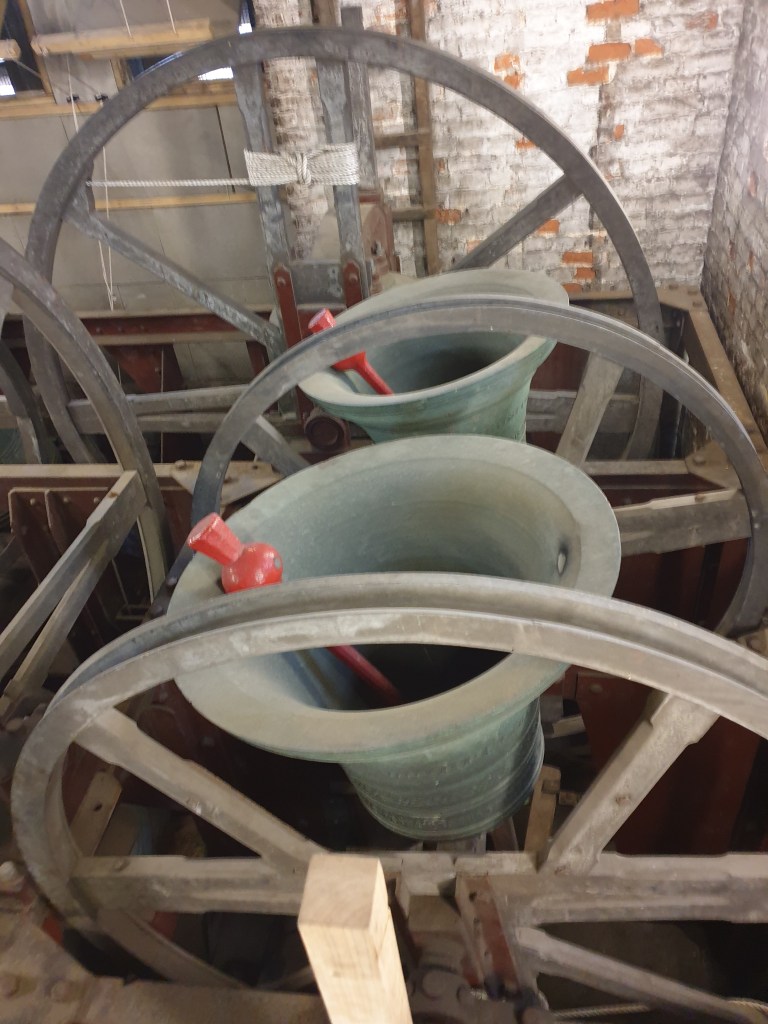
At some point we had a set of Ellacombe Chimes but these were removed at the time of the reordering of the church. The hammers still adorn the belfry floor. The ropes and frame having been removed at the same time.
It’s important that we keep records of what happens to our bells so that in the future, other generations can understand the importance of the bells and the lengths that others went to to make them available to us. At the moment we are only ringing 2 bells, just C and I on a Sunday morning, until such time as current restrictions are lifted and we can welcome our band and friends back.






 Bells, Bakes & Bettering Myself