Living the rich life

Our problems can’t be fixed by just having more money.  We hear a lot about how the NHS, where I work needs more money.  Yes, it does but simply throwing more money at it without a proper, sustainable plan, isn’t the answer.  Neither is it the answer for us on a person level. Having more money won’t suddenly make us happier.  Money allows us to enjoy different experiences, and not have to worry about a roof over our heads or food in our stomachs.  Yet we sometimes see images of people who have little money still leading a rich, simple and fulfilling life.

Its not about the money, it’s about our thinking about the money that creates how we feel about it.  Podcast fave Tonya Leigh suggests we should concentrate on living a rich life in the life we have now so that we can become a match for more riches. Riches come in many different ways. Stop putting off feeling good for “one day when…”, stop waiting for the money and start living for it now. We can train our minds to think richly, stop focussing on lack, scarcity and fear and focus on something bigger and greater than where we are. True wealth is not determined by how much you have in the bank but by what you feel.

TL offered some suggestions on how to live a rich life:

  • Want what you already have – we spend so much time thinking and worrying about what we don’t have, what’s missing from our lives.  When we change our focus, we start to see what is abundant in our lives.  TL suggests living in that state of appreciation for what we have now, our health, our families and friends, food and all those things we take for granted.
  • Enjoy and take care of what you already have – we can be so focussed on aiming for the next thing and the next thing that we forget to enjoy what we already have and take really good care of it. 
  • Check your assets – assets doesn’t just mean your bank account and savings.  It includes your health, friendships, intellectual capital, physical assets in terms of your home, food and clothing, time.  What are the assets you currently have that makes your life so abundant and wealthy?  Focus on that to feel rich.
  • Practice thinking like a rich person – when we think like a rich person we start to feel like a rich person.  When we feel like a rich person, we attract more riches. At the core is to train your mind to think abundantly.

We don’t have to buy things in order to be rich.  We don’t have to have more ‘stuff’. Just because you’ve got a lot of stuff, doesn’t mean you’re rich. Stop fighting for misery and excuses to feel bad.  Start looking for reasons to feel amazing and rich. 

There are over three billion people in the world who have no running water in their homes, when you think about your life from that perspective, you’ll see that your life is very, very rich.


How to keep that love alive

C and I will have been married 25 years in March and together for 29 come the summer.  Sometimes it can be difficult to feel the love.  It’s always there, but sometimes the romance might be missing in favour of practicalities, or we simply co-exist in an easy-going fashion.  We are always fully supportive of each other and back each other up when it matters.

March’s Psychologies Magazine (out in January, really?!!) has an article on keeping the love alive in which it suggests cultivating lasting love is a bit like nurturing plants in a greenhouse rather than leaving them to the frost. How you think about your relationship directly impacts your experience of it by shaping your feelings and influencing your actions.

Some couples have great chemistry and magnetism, know themselves really well and communicate brilliantly. Most couples, claims Cate Mackenzie, have some issues that need to be worked through. When you’re with a partner longer term you get to experience deeper growth and develop into a more authentic and well-rounded person as a result of being challenged and learning how to be in a relationship. Rather than thinking about how your partner should change in order to improve your relationship, Mackenzie suggests shifting the focus to yourself.  Invest in your friendships, make time for fun and consider therapy if you think it will help.  These can all help you become a friendlier person, which can lift a relationship.  Take responsibility for you own needs and wants and journey into your own vulnerability and authenticity.

So followed the ten-question quiz to determine what you need to allow love to flourish. Although my answers were quite spread across the board, the majority of results (by two points) for me pointed to “Commitment”.  The response was:

It’s good to have clarity about what you expect from a relationship, but sometimes high standards become unrealistic expectations.  In a healthy relationship, differences are valued and each partner grows by understanding the triggers for conflict between you.  But that can be hard, and sometimes it’s easier to give up and look elsewhere for a ‘better fit’.

When small irritations spiral out of control, they can trigger an exhausting internal debate about whether or not the relationship is working. But sometimes, being hyper-aware of other people’s faults is a defence mechanism to avoid commitment.  When we stop ourselves from feeling completely connected, we’re protecting ourselves against being hurt by rejection.

It might take your partner threatening to leave for you to feel certain about your feelings for them – which can be painful for both of you.  If your partner’s ‘faults’ were there when you met, but didn’t put you off, your focus on them as the relationship progresses may be fuelled by commitment anxiety. Explore with compassionate curiosity what scares you about intimacy.  Professional help from a therapist ca help you gain the perspective you need.”

I came from a four-year relationship where my opinion didn’t matter, I was constantly made to feel inferior and whilst it was ok for him to ‘bump into’ ex-girlfriends down the pub, if I so much mentioned another guy’s name, apparently, I was a tramp and on the pull.  It took me four years to pluck up the courage to leave that relationship.  I vowed at that point that no-one would ever treat me that way again. 

I won’t pretend everything is perfect with my relationship with C, we have our moments albeit very rarely, but mostly, it’s secure, loving and equal.  We both do what we want with our friends without the other getting jealous.  We share a hobby which we can either do together or separately.  We are fully supportive of the other’s actions. I certainly won’t be looking for a ‘better fit’ because I don’t believe there is one.  I have it already, thank you.

I guess there is an element of protecting myself from getting hurt or rejected and sometime that does boil over in certain situations.  I suspect there’s an element of both of us having been hurt in the past but we found each other and helped heal those wounds. I get less and less bothered by ‘faults’ and accept our relationship as it is.

I got a goodun and I plan on keeping him.

Contagious Places

Image by Prawny from Pixabay

#bellringing is riddled with jargon. From what we call the bells, its fixtures and fittings, to method types, to what we call pieces of work within a method and much more.  As we start to learn more complex methods, we use some of this jargon to abbreviate parts of methods.  This means that we learn the work within that jargon and can add it to other methods to create different ones. 

I am familiar with things like cats ears (A portion of work with two points upward separated by a whole pull, giving a portion of blue line that looks like cat’s ears, eg making a single in Stedman Doubles) and coat hangers (the opposite piece of work).  Cambridge places (Work consisting of three dodges with intervening pairs of places separating them, all in the same pair of positions), Kent places (Hunting interrupted by two contiguous places (in lieu of a dodge), as in Kent). Long work (An extended portion of work, often on the front or back, often characteristic of a particular method), and various others.

In a recent virtual #bellringing session we were ringing London Scholars’ Pleasure Treble Bob Minor which has bedsprings in the middle (a place, dodge and place) and Kingston Treble Bob Minor which introduced me to the phrase Contiguous places (Successive places made by the same bell (in adjacent places) eg (3rds and 4ths in Kent). At one point in the method someone went a bit awry, and C told them they should be doing “contagious places”, much to everyone’s mirth.

Small wonder it’s difficult to get to grips with the language of bells and bellringing. I’ve been doing it for forty years and yet I still find out new phrases.  They are all meant to help you navigate a method.

If ever your stuck for understanding #bellringing jargon, John Harrison has a great resource at https://jaharrison.me.uk/Ringing/Glossary/L.html#top which has an extensive alphabetical list of words and phrases. His website is a fascinating resource not only for #bellringing jargon, but articles he’s written, talks he’s presented, all mixed with some personal information about his #bellringing career and his other interests in fell walking, metal sculpture and brickwork. It’s not the prettiest of websites but the content is extensive, varied and very well researched.

I urge you to take a look.  You might learn a thing or two. I did!

Communicating like a Queen

How you communicate with others can inspire, or cause people to ignore you, but the way you communicate sends a powerful message to yourself. Every day we communicate ourselves to the world. The way we show up, the way we carry ourselves and the way we speak sends a very powerful message.

So, podcast fave Tonya Leigh suggested we focus on communication, to not be afraid of speaking out, communicate how we feel and ask for what we want. She shared her seven tips on how to communicate like a Queen:

  1. No blaming – the minute you start to blame someone else for how you feel or for what has happened you become a victim. Take full responsibility for how you feel because that’s where your true power comes from.  The minute you blame someone else you are giving them power over you.  Practice saying “I am feeling this because of what happened”, so honouring what has happened but own how it made you feel. Don’t make someone else responsible for your emotional state.
  2. Be honest – we spend a lot of time lying to ourselves and lying to others. Saying yes when we mean no, not being truthful about how we feel about things, becoming resentful and angry. If you are honest you bypass all that drama. Being honest forges strong relationships with others.
  3. Be direct – ask for what you want/need, straight up without beating around the bush.  Say what you mean and mean what you say. If you don’t want to do something or go somewhere, just say so.
  4. Listen – really put yourself in the other persons shoes without needing to feel you have to have all the answers.  If you’re listening to someone else and at the same time trying to figure out what to say in response, you’re not really listening, you’re not present with the other person. 
  5. Speak with confidence – commit to what you want to do, what you belief.  Stop saying you’ll try.  Commit to doing it. If your language is all wishy-washy you’re not committed, don’t trust yourself to follow through. 
  6. Speak from a place of power – stop saying your struggling with something.  Ask for the facts of it and start to look at the possible solutions and how you can navigate this challenge, what it is trying to show you. 
  7. Speak from a place of love – you will find you will choose different words, say less, be more intentional and the result is so much more beautiful that when you speak from place of anger, frustration etc. It doesn’t mean you deny how you’re feeling, you can still set boundaries, you speak your truth.

When you practice all of these steps it puts you back in charge and communicating like a Queen.

Why is making some decisions difficult and scary?

A decision is making a choice between alternative courses of action in a situation of uncertainty.  This may be why is can be so hard to make decisions, or why we keep making the same ones. The moment you make a powerful decision you step into that uncertainty.

Podcast fave Tonya Leigh offers seven tips on what she described as elegant decision making:

  1. Limit your decisions – we typically make 70 conscious decisions a day.  We start to experience decision fatigue which is where our ability to make good decisions deteriorates. Its hard to make good decisions when we’re mentally exhausted. At the end of a busy day, we start to not give as much attention to decision making and end up sabotaging ourselves.  To combat this is to limit your decisions. This could be what you eat, eating the same things over and over and save the need for diversity for special occasions. That also limits the trips to the shops, you don’t have to think about what to have for breakfast or lunch. Wearing the same few things every day reduces the need to have to decide on an outfit every day.  Limiting where you shop and what you buy, restrain what you buy online to avoid having to return items that don’t fit, or save shopping trips for special occasions. Finances can be limited by automating a lot of the process of moving money about.
  2. Make decisions from where you want to be not from where you are – we often look at what is around right now and base our decisions on what we currently see. Our current thinking is the result of past thinking and past decisions. If you keep looking at what is and making decisions based on that you’ll stay right where you are.  Think about your future self and what decision do they would make. This is where it’s scary, but you have to have confidence and faith in yourself and know everything you want that you don’t have now is within that decision and you need to make some courageous and bold decisions. Its an internal shift in making a decision that aligns with the person you want to be.
  3. Stop asking everyone else what you should do – when we do this, we are delegating our life and decisions to other people.  Its useful to have an outside perspective but if you ask others what they’d do but they are filtering it through their own past beliefs and experiences.  Then you end up confused.  When you make your own decisions it’s a very different experience that if someone makes it for you. Trust yourself to take time to think if you knew what to do what would your decision be.
  4. What does your body tell you? – how often to we override our intuition because someone else told us to do something their way. You will know the truth and it will set you free. When your gut tells you something, listen to it.  If something doesn’t resonate with you it is not your truth.  If you learn to listen to your gut it will guide you to the right response.
  5. Let your values guide your decisions – when you know what you value you can use it to guide your decisions.  If you look at a decision through the lens of your gut intuition and your core values, you’ll be able to tell if it’s a good fit or not.
  6. Give yourself a deadline – procrastinating at making a big decision means it might never happen and you miss out on opportunities along the way. Having a deadline is the space needed to gather information, then decide by that deadline and move on.  There are no wrong decisions, only ones you learn from.  Don’t put pressure on yourself to make the right decision or believe that decisions are the making of your happiness, that comes from your thoughts and feelings. Just make a decision without the drama.
  7. The most important decision you make is not the first one, but the second – the second decision is deciding how you are going to feel about your first decision.  So many times, we doubt ourselves, living in regret. When you make a decision, decide to feel good about it and go all out for it. It’s much more liberating.

I certainly eliminate some of my decision making.  I regularly have the same thing for breakfast on workdays.  I prepare my breakfasts and lunches for the week ahead so I have the same thing for lunch each working day of the week but might have something different next week.  I tend to pre-empt decisions around clothes by making the decision the day before about what I’m going to wear, set it out and it’s ready in the morning. I do tend to switch from an evening and if C starts asking me questions, I find it really hard to concentrate enough to make a sensible contribution or decisions.  More often I’ll go along with what he’s saying, but if my gut is telling me I need to think more carefully on the matter, I’ll tell him I’ll look at it later or tomorrow.  My finances are all wrapped up.  Standing orders and Direct Debits set up where necessary.  The rest is spending money to play with. 

I have a future vision for about five years’ time so I’m already making decisions around how to make that happen.  That includes ensuring pensions are maximised, household issues like new roof tiles, are all taken care of so there should be no big financial layouts at an inconvenient time.  Thinking about the fun stuff, I’ve booked some experiences using vouchers I had for my 50th birthday, so things to look forward to and align with my desire for more culture and to experience the finer things in life. 

When I was booking these experiences, I asked C which theatre show he’d prefer to see, then I thought “hang on a minute, it’s my birthday voucher, I’ll decide which show we’re going to see”, so we’re going to see what I wanted to see.  I might ask another person’s opinion about something, but that doesn’t mean I’m going to follow it.

I am usually quite good at spotting when my body is telling me something isn’t quite right.  When that happens, I usually take a bit longer to come to a conclusion, find out more information, or try to reconcile the options in my head.  I try to think “if I did x, what would happen? And if I did y, what would be different?”.  I try to be as informed as possible, particularly about big decisions.

Sometimes that might feed into setting a deadline for making a decision.  I might put it off for now if I’m not convinced, or need more information, or just not in the right headspace to deal with it at that time.  I try to resolve it quickly though so it’s not hanging over me too long.  Deal with it one way or another and move on.

I usually feel quite good after making a decision. I feel committed to that choice and can park that issue now it’s been decided upon.  It still might not be the best decision, but even if I’ve got it wrong, I’ll learn something from it.

Now, if only I could decide which chocolate to have.  I’ll have all of them to avoid any regrets!

How to be ordinarily extraordinary

Most of us probably think we’re rather ordinary, average, mediocre, active yet ineffective, moving but not towards our dreams.  We pootle along doing what we do without thinking how simple things can turn our ordinary day into something rather extraordinary. And that extraordinary day might be for you, but it might impact someone else too and turn their day into an extraordinary one too.

An article by Dan Waldschmidt for Success Magazine described how “extraordinary starts with you—perhaps an ordinary person at an ordinary job doing ordinary things on an ordinary day. No special advantages. No remarkable skills that can’t be duplicated. No large bank account. Just all-around “ordinary.”

Then, you decide to do something extra. To be something extra. Something a lot-a-bit extra. And not just one time. But day after day after day.

And then one day, everyone watching you will notice that “ordinary” is no longer an accurate description for the person you have become. For what you have done. And they will shake their heads and remark that what they have seen is extraordinary. Because it was. And because you will be.

And that’s how extraordinary happens.”

Being extraordinary doesn’t have to break the bank, or even necessarily put you out of your way much.  It can be really simple, if you want it to be.

Waldschmidt listed 126 ways in which you could choose to extraordinary in everyday ordinary situations.  And yes, I’m going to list them all!

If you do one thing today, make it extraordinary.  Which one would you choose to focus on? I might go with number 61 😊

1. Open the door for a stranger.

2. Say, “Thank you.”

3. Learn from your mistakes.

4. Stop whining.

5. Fear less.

6. Be kind.

7. Let yourself be inspired.

8. Lead someone.

9. Pay off debt.

10. Choose a side.

11. Pay more for quality.

12. Lend a hand.

13. Let past mistakes go.

14. Be invincible.

15. Be more efficient with your time.

16. Stop playing politics.

17. Plan to be successful.

18. Be an expert.

19. Stop defending yourself.

20. Decide to take action today.

21. Fight mediocrity.

22. Laugh at life.

23. Go to bed tired.

24. Ask what you can do better.

25. Give a stranger flowers.

26. Hold the elevator door.

27. Compliment a great idea.

28. Work on being patient.

29. Create what’s missing.

30. Stay in mental shape.

31. Practice getting back up.

32. Shake hands while looking the other person in the eye.

33. Assume the best in others.

34. Try something new.

35. Listen to your critic.

36. Get into financial shape.

37. Donate time to charity.

38. Teach what you’ve learned.

39. Give an opinion when it’s hard.

40. Care about others.

41. Pay attention to the details.

42. Be a friend.

43. Do physical labor.

44. Brag on someone else.

45. Share more.

46. Love someone.

47. Have a dream.

48. Get up an hour earlier.

49.  Write down your thoughts.

50. Apologize more.

51. Stay mentally strong.

52. Put yourself in tough places.

53. Cry when you are hurt.

54. Have a purpose each day.

55. Don’t stop until you finish.

56. Be passionate about others.

57. Pay attention to the conversation.

58. Appreciate differences.

59. Be less selfish.

60. Ease someone else’s pain.

61. Imagine the possibilities.

62. Smile at those around you.

63. Care enough to cry.

64. Make a call because “you’re thinking about them.”

65. Be a mentor.

66. Fail gracefully.

67. Practice being vulnerable.

68. Decide to be optimistic.

69. Ask more questions.

70. Read a new biography.

71. Do something outrageous.

72. Think for yourself.

73. Put in more effort.

74. Ask for help.

75. Tell the truth.

76. Get some exercise.


77. Decide not to get angry.

78. Explore new ideas.

79. Be more effective with your talents.

80. Slow down (for a few minutes).

81. Pursue your goals each day.

82. Make a list of tasks to get done.

83. Live with honor.

84. Feed your inspiration.


85. Avoid the crowd.

86. Stop being passive aggressive.

87. Find answers to your questions.

88. Be accountable.

89. Work on your biggest weakness.

90. Replace “No” with “No thanks.”

91. Let someone else get the attention.

92. Listen with your eyes.

93. Say what’s on your mind.

94. Defend your friends.

95. Shake off the straws before they break your back.

96. Offer encouragement.

97. Meditate on your goals.


98. Don’t do anything halfway.

99. Do good things for the right reasons.

100. Get help for your head.

101. Demand brutal analysis of your actions.

102. Put in the effort you expect of others.

103. Share a good example.

104. Offer to buy dinner or dessert.

105. Decide to learn from everyone.

106. Make a big deal of small wins.

107. Let life happen around you.

108. Have a big vision for those around you.

109. Enjoy others’ success.

110. Inspire others quietly.

111. Deliberately invest in healing.


112. Welcome diverse perspectives.

113. Don’t go to bed angry.

114. Anticipate the success of others.

115. Value your own time.

116. Ask others to “pay it forward.”

117. Write a kind note.

118. Offer to help for free.

119. Have a plan.

120. Overlook immaturity.

121. Care less about being right.

122. Schedule time to invest in others.

123. Give away your best idea.

124. Stop being offended so easily.

125. Remember the good times.

126. Decide that caring is more important than winning.

A woman of a certain age

I’m not great at being ill.  I haven’t got the time or patience. I certainly am not one for taking tablets if I can avoid it.  If I have a cold, I don’t bother to take remedies (unless its really bad), preferring the symptoms to ride out their nature course; for me it seems to get it over with quicker.  It’s like I can almost tell myself not to be ill.  When I feel symptoms of something coming on, I mentally tell myself I haven’t got the time to be ill right now so go away, it is kinda works to some degree.

Now that I’m a woman of a certain age, I’m conscious things might have a propensity to start getting worn out.  Whether its my joints or skin, or hair, or nails, or immune systems, whatever.  I have always been a bit cautious around the taking vitamin supplements.  I’m not convinced they really work, and they could possibly contraindicate other medication you might be on, and we shouldn’t be self-subscribing chemicals.  However, I am aware that taking additional supplements can have beneficial effects for some. 

For example, C takes a daily dose of cod liver and glucosamine.  Now, I don’t really know if they work, but he seems to think they do. I call it into question when he more regularly wears wrist supports for #bellringing nowadays though. 

I’m reading more and more articles in health and wellbeing magazines about the benefits of taking supplements in older age to help with muscle, joint and other ailments.  At the moment I don’t appear to have any.  So, should I consider starting to take them now, before I get symptoms?  Are they as effective after the damage has already been done, so to speak?

So, I’m going to try an experiment.  I have bought a bottle of multi vitamins intended for women of a certain age.  There are 30 tablets in the bottle and the recommended dose is one per day.  I realise that it can take some time for these things to have an effect, but by the time I’ve finished the bottle I ought to be able to tell if there’s been any change in my overall health, vitality, mood etc. 

Netdoctor suggests that “When it comes to feeling the benefits, there’s no single answer, thanks to a variety of factors that impact vitamin absorption – from the type of supplement you’re taking to the ways certain nutrients interact with each other in the body.” Biologically vitamins are absorbed in a matter of hours and are supposed to have immediate metabolic effects, but there are a number of reasons why their efficacy may prevent you getting the full benefit:

  • Deficiency levels – if you are already deficient it may take longer, or you may need a higher dose of that particular vitamin or mineral;
  • Type of supplement – those taken in liquid form are known to work quicker than those in tablet or capsule form as your body doesn’t have to breakdown the casing first;
  • Water vs fat-soluble – vitamins A, D, E and K are fat-soluble meaning they need fat to be absorbed and should be taken with food.  Water solubles dissolve in water and can have a faster effect;
  • Nutrient pairing – many vitamins and minerals are interrelated in how they work, for example vitamin D helps your body absorb calcium so if you have low levels of vitamin D, you’ll likely have low levels of calcium too.  But there are those that compete against each other too, like zinc and copper so if taken together you might have a higher intake of zinc because the recommended dose is higher than that of copper;
  • Lifestyle and habits – drinking alcohol and smoking can interrupt absorption levels.  Caffeine can block vitamin B6, calcium, iron, and magnesium so it is advised not to have caffeine for 45 minutes before or after taking any supplements;
  • Health issues – underlying health issues may prevent you being able to absorb properly, such as coeliac, or because you lack the right hormones that are intrinsic to B12 absorption.

Having read that, I need to adjust the time of day I take my supplement as I started taking it in the morning with my coffee.  I best hold off for a while!

So how will I be able to tell if any of this is working? Of course, there’s no straight answer. Its dependent on each and every person and which vitamin combination they are taking. It is also dependent on age, gender, digestive health, pre-existing levels, diet, pre-existing medical conditions and more.

It’s more helpful to look for signs of deficiencies, which vary depending on which supplement you’re deficient in. It is unlikely that you will feel or see anything if you’re nutritionally replete – however, you will notice signs of fatigue, poor skin, or nails if chronically lacking nutrients and these are all signs to look out for.

The only symptom I have on a regular basis is tiredness.  I can sleep for Britain.  I fall asleep very soon after our evening meal, wake up in time to go to bed, then more often than not sleep through until the alarm.  I can fall asleep pretty easily at any time of the day, even when I haven’t been up long.  I don’t know if I have any other deficiencies.  I can’t think of any outward signs. 

In 30 days’ time, I’ll see if taking a multi-vitamin for a woman of a certain age has made any difference whatsoever. I’ll try to keep open-minded about it.

5 Questions to define your core values

When you claim your personal values it allows you to fall into aligns with your deepest truth.  Your values tell yourself and the world what you stand for.  In a podcast by Tonya Leigh she shares some questions to help you decide on your own core values.

One of the things to do is revisit what you may have noted as your core values a few years ago.  Do they still represent you now? Values should help you grow and create the life you want to create and make sure your daily decisions align with what you value. Personal values are important to have in place to help your really know what you stand for, what you want your life to look and feel like.  Once you know those things it helps you make better decisions. 

Values are those things that we hold as valuable, important or acceptable. Ask yourself if you have defined what is valuable, important and acceptable to you.  You can value what you want so long as you like your reason for doing so. You would make a different decision about something to someone else based on your values.

TL gave five questions to help evaluate your core values:

  1. What are the value words that really resonate with you? It could be elegance, abundance, fun, joy, achievement, generosity, growth, help, happiness, love, passion, service, security, uniqueness, boldness, or anything that feels strong to you.  Google “personal value words” if you’re stuck for inspiration.  Write down the words that you are drawn to.
  2. What was the biggest highlight and the biggest lowlight of your life? During your highlights you’ll probably find you were living to your core values.  During your lowlights your values were probably being supressed. Think about what those moments can teach you about what you value.
  3. Who do you admire and what values do they embody?  When we admire someone it usually means that we aspire to be like them in some way. They don’t have to be public figures.  There is a direct correlations between someone you admire and your own core values. What values are they expressing that you want to incorporate into your own life?
  4. What values do you need to practice every day to get to where you want to be? Our values are buried in our dreams for our lives.  Think about your big dream and what values you need to incorporate into daily routine around decisions, how you show up, to tell the world what you stand for.
  5. What do you want people to be saying about you at your funeral?  Sounds a bit morbid, but it’s a fact of life. Take control of who you are and how you express your values so you can change the narrative.  When you know where you want to end up you can reverse engineer things to embody the values that will help you create that goal. Imagine the life you’ve lived and what people will say about you then live your life based on your core values to get you there.

Some words that resonated with me included authentic, fairness, growth, honesty, loyalty, self-respect, responsible, stable and trustworthy.  In 2015, as part of my Masters programme I did a personal values assessment. The results back then were very similar to how I still feel now.  They focussed on making a positive difference in the world, finding meaning in existence, development and growth, and a feeling of self-worth.

Trying to find a life highlight and lowlight is hard. There are many good and bad things that have happened in my life, but I don’t necessarily feel they are strong enough to be a highlight or lowlight.  There are some obvious ones like getting married and having my daughter, but I think another time I felt good about life was when we went to the US for our 10th wedding anniversary.  C and I started off in Washington DC, then went via Philadelphia to New York.  We flew business class and stayed in Hyatt Hiltons, all at no cost as C had air miles and hotel points from work.  That meant we could spend our money on going out to nice places to visit, soaking in the culture at the various Smithsonian museums, trying not to laugh at the so called history of “the making of the US” at the Philadelphia Independence Hall, to the over the top shopping experiences and walking through Central Park in the snow in NYC.  We were free of responsibilities of work and ringing, we were able to be ourselves and do what we wanted, when we wanted. We enjoyed cultured activities and tacky touristy ones, we ate and drank well. A lowlight for me was when I got into a bit of money difficulty when I was very young.  I was trying to keep up with the Jones’s and had credit cards and shop loyalty cards and racked up an astonishing amount of debt that the minimum payment amount on my credit card statement was more than I earned in a month.  I learned some valuable lessons from that which I have never looked back from.  I don’t have a credit card, or store cards.  If I don’t have the money in my account, I don’t buy it.  I don’t go into overdraft and I save for big ticket items, and I’m saving for my retirement.

Admiring people is always a difficult one for me.  We only get to see what they want us to see so it can be difficult to determine sometimes whether they are genuinely embodying those values or doing it for publicity.  I’m not a celebrity watcher.  I tend to admire people who have been able to turn their lives around through hard work and determination.  When you’ve had a set back its how you respond to it with grace and authenticity that resonates more with me.

I think the values I need to concentrate on more are self-worth, putting myself first for a change.  I realise that sounds awfully arrogant.  So much of my life is doing things for others, being places or doing something I don’t really want to.  I want to start to get some of my life back whilst I’m still able to enjoy it.  I’m going to be planning more things that I want to do.  Saying no to things I don’t want to do more often.  Not compromising my own life to suit others so much.

I don’t suppose there’ll be anyone left who cares by the time I pop my clogs.  I don’t mean that to get sympathy, but given I’m the youngest of my family and friends group, my husband is 15 years older than me, the law of averages might suggest I’ll be the last one left, unless something drastic happens.  I fully intend to have a non-funeral.  No service, no gathering, no party.  Just burn me and scatter me somewhere.  Therefore I don’t expect anyone to say anything about me at my funeral.  I often attend funerals of ringers and listen with interest to their Eulogies.  Sometimes what people say is far from the person I knew.  They are often spoken of who wonderful they were, loving, kind, funny and so on, when my experience of them was they were grumpy, mean and a bully.  But that’s back to the idea of only seeing one side of someone’s life.  You don’t get to see the whole picture.  To be honest, I don’t really care what people will say about me when I’m gone.  I won’t be there to listen.  The nearest I’ll get to anyone saying anything about me as my annual appraisal at work.  They often say I’m hardworking, fair, softer than I might first appear.

What values do you want to embed in your life?

6 Ways to reconnecting with your self

Any person who is in touch with their sensuality is empowered.  Many women, in particular, feel that this is a part of their lives that is missing. Those who work in traditionally male environments often don’t feel connected to that feminine part of themselves.  Podcast fave Tonya Leigh suggested that part of us living our best life would be getting back in touch with that side of ourselves.  She offers some tips to consider getting back in touch with your feminine side:

  1. Learn to manage your mind – the three dominant emotions that keeps us from that feminine part of ourselves are guilt, shame and overwhelm.  When our own thoughts create negative feelings, we often deny ourselves those things that will make us better wives, mothers, daughters, community members and businesswomen, those things that will heal us. These are feelings that we can control.
  2. Manage your schedule – everything we put on our schedule is our choice.  We need to put ourselves on our schedule.  That may mean turning things down, saying no to people, give up obligations, others may be disappointed.  But when we learn to manage our minds, we can deal with all that drama. If we are not on our own schedule how do we expect to create time for pleasures, time alone, creating fun, try new things, being playful and creating space for connection with ourselves and those we love. Make connecting a priority.
  3. Practice where to connect with your body – through dance, yoga, walking, whatever.  When we’re disconnected from our bodies, we can’t tell how we feel, when we’re full, what sensations we’re experiencing.  Learn to be kind to our bodies, practice reconnecting with our bodies and play around with what those practices could be.
  4. Create sensual style – do your clothes and accessories spark that feminine side of you? Get properly fitted underwear.  Find a perfume, or lipstick, or have beautiful loungewear.  What matters is how we feel in it.  Are we being intentional with our style?  It helps us create emotion.  Look at what we’re wearing and how can we spice it up a bit to help us spark that femininity again.
  5. Create a sensual environment – have fresh flowers around the home, music playing in the background, candles, scents.  It’s these little details that we use and create that remind us how important they are and what they say about us. 
  6. Experience life through our senses – we often fail to smell the delicious aromas, or hear the wind, or notice what is going on through our senses.  Take time to taste food (it can help you lose weight too).  Look around and notice what we hear, smell, feel, taste. 

I am getting better at controlling my mind around negative thoughts.  Whilst I’m more careful about what I say and do around others, I understand that I am not responsible for their responses.  I will do my best not to upset people, and its certainly not something I do deliberately, but how they respond to it is their business.

Sometimes, I feel overwhelmed with the number of things I have on my to do list.  A lot of what C and I do revolves around #bellringing but that’s not spending quality time together.  We have a number of vouchers for experience days that we often struggle to get organised enough to book.  Obviously during the last couple of years booking things has been difficult anyway.  This year we celebrate our 25th wedding anniversary and promised ourselves that we’d go away for a couple of weeks.  When we first started talking about it we were looking to go abroad but have down played that now to staying in the UK.  We’re just really bad at planning “down time” together.

I know I have to make myself move more.  I can be sat at my desk all day and if I’m not careful, find that I have hardly moved at all.  My working days are nine and a half hours long, so to be sat in an office chair that long does nothing for my posture or making me feel any better.  Whenever I can I almost schedule time to go for a walk at lunchtime. I’ll look at the meetings I have and see the best time I can slot it in.

I am working on my style.  I used to live in #bellringing polo shirts and jumpers all the time.  I’ve ditched most of them and only bring them out for #bellringing events.  I’ve gathered more colour and moving away from monochrome all the time.  I’m trying different fabrics, styles and combinations.

I buy fresh flowers every couple of weeks from the market stall in the high street.  They usually last that long.  It has added an element of calm and relaxation to the room.  I only have them in the lounge, we don’t have either the space anywhere else, or the inclination to spend that amount of money on them.  I do enjoy watching the buds open up and show the full beauty of the petals though. I’ve hand candles for years.  I have two particular sorts that I use regularly, but people often gift them to me.  Then of course the other major scent in our house is of baking, whether its cake or bread.

I am a bit of a fast eater and often have to remind myself to slow down and taste what I’m eating.  But I am better at looking around and noticing things when we’re out on a walk.  C often looks at the floor or only straight ahead whereas I’ll look around and up, close up and far away. 

So, I’m getting there I think.  How about you?

Mapping Meaningful Connections

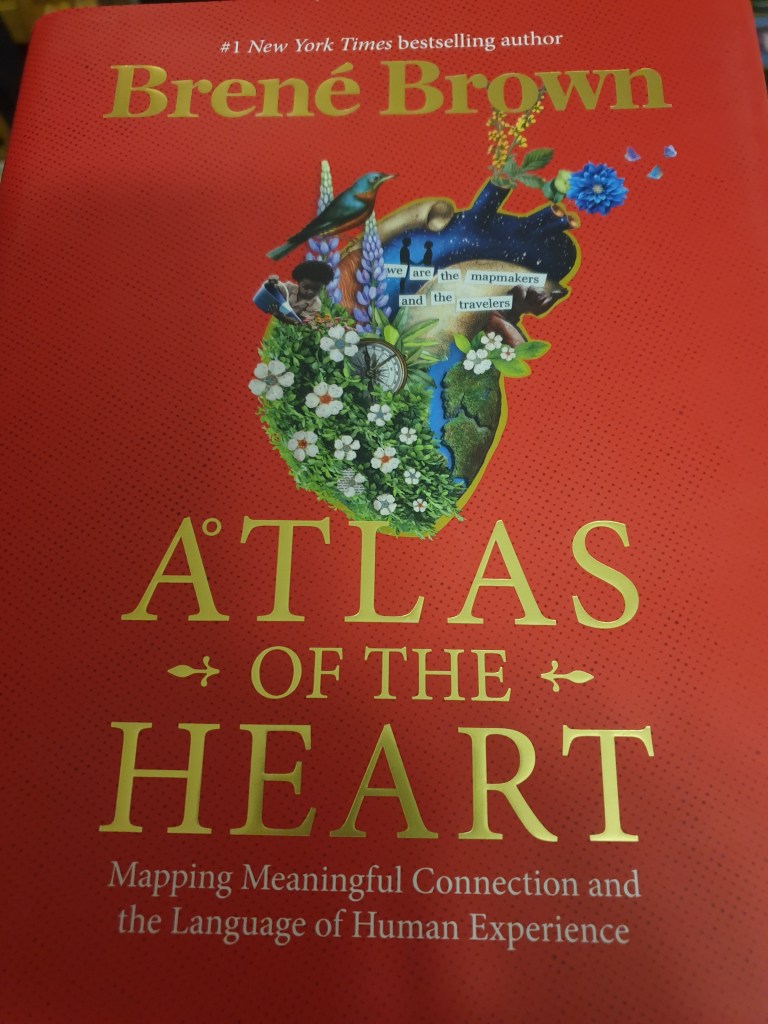
My latest read on my self-awareness and development fumble through life is Brene Brown’s Atlas of the Heart. Brown’s is a renound researcher and author of experiences that make us who we are. This book takes the reader through 87 emotions and experiences that define what it is to be human.

The back cover explanation says that Brown’s maps the necessary skills and an actionable framework for meaningful connection, giving us the language and tools to access new choices and second chances.

The book groups those 87 emotions and experiences into categories:

  1. Places we go when things are uncertain or too much – stress, overwhelm, anxiety, worry, avoidance, excitement, dread, fear, vulnerability
  2. Places we go when we compare – comparison, admiration, reverence, envy, jealousy, resentment, schadenfreude, freudenfreude
  3. Places we go when things don’t go as planned – boredom, disappointment, expectations, regret,discouragement, resignation, frustration
  4. Places we go when its beyond us – awe, wonder, confusion, curiosity, interest, surprise
  5. Places we go when things aren’t what they seem – amusement, bittersweetness, nostalgia, cognitive dissonance, paradox, irony, sarcasm
  6. Places we go when we’re hurting – anguish, hopelessness, despair, sadness, grief
  7. Places we go with others – compassion, pity, empathy, sympathy, boundaries, comparative suffering
  8. Places we go when we fall short – shame, self-compassion, perfectionism, guilt, humiliation, embarrassment
  9. Places we go when we search for connections – belonging, fitting in, connection, disconnection, insecurity, invisibility, loneliness
  10. Places we go when the heart is open – love, lovelessness, heartbreak, trust, self-trust, betrayal, defensiveness, flooding, hurt
  11. Places we go when life is good – joy, happiness, calm, contentment, gratitude, foreboding, joy, relief, tranquility
  12. Places we go when we feel wronged – anger, contempt, disgust, dehumanisation, hate, self-righteousness
  13. Places we go to self-assess – pride, hubris, humility

I haven’t really got into it yet but just reading through the introduction I get a sense of its going to be a good read. Brown is honest and open about her own life challenges and hope they shaped the person she is today. Its backed up with empirical research and real life examples.

I’ll keep you posted with what I learn.