A pile, a shelf or a library?

I have spent most of this past week researching, hearing about, coming across, or just finding a number of books that have piqued my interest. I mentioned the other day about hearing of a new author (to me anyway) and fiction novels she’d written set in Tudor times. Then I came across an article in my LinkedIn feed of self help books that apparently we’d want to be seen reading. Then there’s the book that completes a series I have that had just been published and Amazon delivered my preordained copy of.

I have plenty of book vouchers to use up otherwise I would have ordinarily downloaded these onto my tablet. So I decided to go to the bookshops in town to get shot of these vouchers. Seems like the shops aren’t so keen.

Having gone into one well known High Street bookstore that I had a specific voucher for, I had the author and titles of the books written down. I couldn’t find the two by Nicola Cornick that I’d heard about in a podcast, but surprisingly did find the self help book with the slightly rude title. When I went to pay for that book I asked if they had the others in at all and maybe I just couldn’t see them. The shop assistant said “no we don’t have those“. Then just took the voucher, rung up the one book and gave me my receipt and told me how much was left on the voucher.

I went to the next very well known High Street bookstore and looked on the shelves and couldn’t find the Cornick books there either. Again I went to the assistant and asked. This time I was told “no we don’t have those in but I could order then for you and they’d be here in a couple of days“. Yes please that would be great. Details exchanged and I await a message when they’ve arrived. Pay on collection.

Now, I’m sure the first bookstore could also have offered to order them in, but as they didn’t offer I took my custom elsewhere.

This does now mean that I have five books waiting to be read. And still a lot of money left on the vouchers. Just need enough down time to sit and read them.


“It’s not failure if you enjoy the process”

This quote from Oprah Winfey popped into my timeline the afternoon in which a group of us had failed to score a quarter peal in the morning. We had met with the intention of going for a quarter peal of Yorkshire Surprise Major on the understanding that as it was one person’s first attempt at a quarter of a Surprise Major method, if it came a cropper, it would be no big deal.  It also happened to be the conductor’s birthday so it would have been a nice thing to attempt as a compliment.

We had been virtually #bellringing for nearly 45 minutes and we were only two leads away from the end when the conductor’s technology failed, therefore bringing our attempt round to a premature end. Whenever I ring in a quarter peal, as I’m sure most people do, I ring with the absolute intent of scoring it, and although the one ringer was less experienced at ringing Surprise Major methods, they had been given advice on which bell to ring and what would happen and equipped themselves very well.  We were all of the mind that we would go for it and see how far we got.

It does seem sometimes happen that if quarters or peals are lost there needs to be a post-mortem and an attempt at determining what or who was at fault.  Most people feel quite down if they don’t score it, and if you were the person who went wrong and caused the pile up, you’d probably feel really bad for the rest of the band. It tends to be more irksome if ringing in a real tower and people had to travel a distance to ring with, what some might consider, nothing to show for it.

Disappointing though it was not to have scored the quarter to mark the conductor’s birthday, there was no bad feeling afterwards at all.  Everyone was congratulated for getting that far, especially the person with less experience.  There was a feeling of “well that was jolly good practice” and “it proved you can do it”. There were also calls for rearranging it soon so that we could score it and get that first quarter of Surprise Major in the bag.

It makes a real difference when you ring with people who are non-judgemental and who appreciate just ringing together for the pleasure of ringing and helping someone less experienced along the way.   We decided not to resume ringing for the rest of the duration of the practice time but had a good chat about everything else instead.  It was a pleasure just to have everyone’s company.

We may have failed to score the quarter but we enjoyed the attempt and the process of how we got to even attempt it.

How to make the most of your background in 3 easy steps

I have been with my current employer for 20 years now.  I’ve had several different roles during that time as I like to be challenged and once I feel that there is nothing left for me to achieve in that role, it’s time to move on.  The result of that is that I have a very different background to a number of my colleagues, and because I’ve met and worked with a lot of different people around the organisation, I can generally find the right person to deal with a problem, or at least someone to start with.

Something happened in the office building that sent everyone else into a bit of a tail spin.  It had people for upstairs coming down wondering what to do, and those that were downstairs looked at me and decided that as I was the most senior person there (apart from one but she was on a call at the time),  that I should be nominated to deal with it.

It meant that I had to take some sort of charge, but also decide what to do and who to contact.  Luckily, my 20 year background meant that I knew who to call and what to ask for and where to go if it didn’t happen quickly enough.  Within the space of half an hour the problem was being dealt with. The situation will have ongoing implications for the following day and I won’t be there but the next part was to ensure that anyone else was informed about what was going on and what the situation the next day would be.

Calling on my previous knowledge of the organisation, different staffing groups, and former colleagues, the situation was brought swiftly under control in three steps.

Step 1 – take charge.  Stop anyone getting hysterical (ok, it wasn’t quite that bad), decide what needed to be done immediately and delegate some tasks to others.

Step 2 – contact other people who I knew would be able to help resolve the problem.  When I couldn’t get hold of them directly, try other people around them, and keep trying until you get through.  Once through to someone, tell them exactly what the problem is and what is required to help resolve it.

Step 3 – inform others who might be impacted the following day. Make sure that everyone who needs to know what’s happening, what the next stage is and what to do.

I suppose it was lucky that the issue was something that I could call on my former background knowledge for, it might have been different otherwise, but I would still have been looked at by the others as being the one in charge.

I may have been around the block, but I know people when its needed.

Two Steps Down

https://www.england.nhs.uk/wp-content/uploads/2021/03/qsir-two-steps-down.pdf

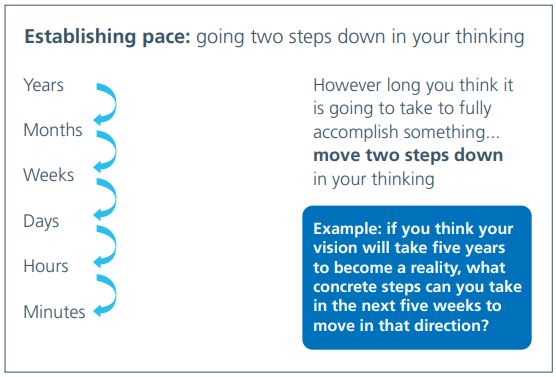
We all have aims in life, goals that we’re striving for, ambitions to fulfil, a five-year master plan, but sometimes turning those aims into reality can seem such a distant prospect, too difficult, and often, something we feel we may never achieve.

A couple of years ago I went on a course for work called Quality Service Improvement and Redesign (QSIR).  The aim was to provide guidance on how we could approach looking at our services and using lots of different tools, consider how we might be able to make step changes, or giant leaps in efficiency and effectiveness. I found the best bit was around process mapping, something that I really enjoy doing. However, as we consider the grand plan, the longer-term project, it can become daunting.

If making progress is going to take a long time, QSIR offers the suggestion of breaking it down into smaller, more manageable steps.  For example if it feels like something will take two years to achieve, what can be done in two weeks that takes you closer to that?  Take two “steps” back.  So, two (or five, or seven, or whatever your estimate timescale is) years becomes two weeks; two months becomes two days, two weeks becomes two hours, two days become two minutes.

This works for home life too.  I am currently considering what my five-year plan is, where I want to be, what I want to be doing, work-life balance and all that.  I have an idea of what I want, but it’s going to take five years to get there.  In the mean time I can think about what I can do in the next five weeks.  That might be looking at my finances, writing a Will, deciding how much employed work I still want to be doing and in what capacity and so on. They are small, manageable chunks that are perfectly doable in that timescale that will get me closer to realising my dream.

There are other tools within the QSIR arsenal that would help me towards that dream.  I could brainstorm ideas with others especially as it would impact some of them.  I could develop an action plan to keep me on track. I could review against progress and re-evaluate effectiveness.

And for me, of course, underpinning all of this would a spreadsheet or two of data, forecasts and possibilities, actions, risks, lessons learnt and somewhere it might even involve a process map.

Influential influence

As I move into the next phase of my career in the next few months, it will become much more important to be able to influence others outside my normal sphere of activity.  I’m already a middle manager with a wide network across the organisation, but the next step will take me into a higher stratosphere of connections.  I need to change up my influencing from my subordinates and peers to upper levels and very senior levels of the organisation.

The Centre for Creative Leadership offers four areas of advice for effective leaders to inspire, persuade and encourage by using the knowledge and skills of a group to help point people towards and common aim and bring about commitment to change.

1) organisational intelligence – being aware of not just the organisational structure bur the informal structure of the political landscape by networking to build strategic allies, consider context and goals before decided how and when to express an opinion, paying close attention to nonverbal clues, active listening, and considering how others might feel, and leaving others with a  good impression without coming across as too aggressive.

2) Team promotion – and a bit of authentic self-promotion without bragging or being selfish.  A bit of well placed self-promotion can provide visibility and opportunities for the team by providing some organisational pride, make capabilities and ideas more visible across the organisation, therefore improving collaboration.  Leaders need to put themselves in the spotlight and find ways to find an audience and sell their team’s story.

3) Trust building – without trust there is probably much less commitment from others, or access to tapping into the full creativity of the team.  Being able to leverage this is crucial when dealing with tough challenges or making strategic changes.  People look for leaders who show some vulnerability and inspire them, understand them and guide them.  It’s a careful balance between pushing people in to areas they are uncomfortable with whilst listening to their concerns and feedback.  Being tough but empathetic with others as they struggle, as well as demonstrating urgency and patience requires careful balance.

4) Leveraging networks – In order to influence others leaders need to cultivate networks.  As organisations shift and morph, leaders need to recognise personal networks must also be dynamic.  They need to be strategic about choosing how and when to tap into the right network.

Then there’s choosing the right influential tactic:

1) logic – taps into rational and intellectual positions, presenting the argument for the best choice of action based on organisational and personal benefits, appealing to the head.

2) emotional – connecting the message, goal or project to individual goals and values, tapping into personal feelings of well-being, service and belonging, tugging at the heart strings to gain support.

3) cooperative – collaborating, consulting and alliance building.  Working together to accomplish mutually important goals, extending the hand to help others.

An invitation landed in my inbox recently that gives me the opportunity to share a new framework that I created with very senior operational and corporate leads across the organisation.  Whilst doing this scares me half to death, I recognise that it’s the ideal opportunity for me to be able to share this piece of work with the very people who will need to be taking it forward in their parts of the organisation.  It’s my piece of work and I am proud of it, and the reception it has received so far. 

Next steps is to make it a reality.

New Author (to me anyway)

I’m very picky about my pleasure reading. I really only tend to read historical fiction and even then only really Tudor period. It does make it quite difficult to find new books to read.

I was catching up with one of my podcasts Tudor Dynasties, when out on my lunchtime walk and the host was interviewing Nicola Cornick. Nicola has written fiction based on other, lesser known Tudor ladies, with a lot of artistic licence it has to be said.

The Phantom Tree is the story of Mary Seymour, daughter of the playboy Thomas and Dowager Queen Katherine Parr. Mary’s story is a bit of a mystery as after the Queen died and Thomas was executed, she was farmed out to an unsympathetic aunt who didn’t want her. The real life mystery is that there are no records of what happened to Mary. Did she grow to adulthood? What would life have been like for her? The story hypothesises.

Cornick’s second novel The Forgotten Sister is about the life of Amy Robsart, the feted wife of Elizabeth I’s favourite Robert Dudley.

Both novels are dual time period mysteries. There are parallel stories running through them and they don’t necessarily answer the burning questions…what happened to Mary? and did Amy fall or was she pushed?

Both ladies are little known in their own right and usually only a reference to the stories of the men in their lives. The podcast conversation was interesting and has piqued my interest enough to consider purchasing one, if not both books. I have about £75 of book vouchers to use up, that I have to use in a bookshop, although I would have preferred a Kindle version to download.

Celebrity Endorsement

Does celebrity endorsement of a produce or service really work?  It must do to some degree as its something that happens very regularly, and there are those people who aspire to be like their favourite celeb and emulate everything they do.

In the #bellringing world there are actually a number of famous people who have been or are bellringers, generally most of them don’t do it regularly because of their celebrity commitments.  People like Alan Titchmarsh (gardener), Timmy Mallett (kids tv presenter), Jo Brand (comedian), Norma Major (wife of former Prime Minister) have all been known to grab a rope.  Some even did quite well and have rung quarter peals, if not peals.  There are also those who had a bell handling lesson for the purposes of broadcasting a programme.  Changringingwiki (https://wiki.changeringing.co.uk/Famous_bellringers) has a list of some 24 listed as “proper” ringers and another 16 for artistic licence.  I do know of a few others that aren’t on that list e.g. Susan Calman who recently visited a tower in Scotland as part of a series she was recording.

Could #bellringing benefit from celebrity endorsement?  If so, what sort of celebrity would give #bellringing a good name?  There are pros and cons though.

Having a celebrity ambassador or endorsement can help your brand stand out, and can build credibility.  Celebrities tend to be trusted by their fans, whether that trust is founded or not is a different matter.  The celeb would be risking their career if they endorsed a dodgy product or services.  Having the right celebrity involved can open up different audiences to your message. 

It should be remembered though that when you sign up a celebrity, you sign up everything about them.  If that celeb finds themselves embroiled in a scandal, this could have disastrous consequences for your product.  They could overshadow your message.  If the focus is too much on the celebrity, the produce message gets lost, and they could endorse more than one product, which may be counter intuitive to your product. Endorsements can be expensive.  The celeb wants to make as much money for as little work as possible.  The bigger the celeb, the bigger the price tag. https://baerpm.com/2018/01/02/pros-cons-celebrity-endorsements/

Jo Brand recently mentioned on a popular satirical tv show that she learned to ring, but then went on to say that its dangerous and you should have a good A&E department nearby.  That isn’t really the message that we want people to have of #bellringing.  The question now is, can I get her to change her opinion by getting her to have another go.  Teaching and support is very different now to when she learned many years ago.

I’ve written to Jo’s agent, so we’ll see if we get anywhere.

Getting up earlier vs getting more Zzzzz’s

I read many articles that advocate waking up early and starting your day earlier to make the most of it and get those things done that will set you up for a great day ahead, like doing your morning meditation or exercise session.  Some find it gives them some vital “alone” time for reflection or before the busyness of the day begins.

I do find that during the summer months I wake up earlier naturally, probably because it’s light outside, however, that doesn’t necessarily mean that I get out of bed and get on with the day.  Generally, I internally groan that its aaaaaaages before I need to be up and about and try to get in another few precious moments of sleep. 

However, once I am up, I’m up.  I don’t like sitting around.  I shower, dress, swig my coffee then go to work.  Even at the weekends, I get up, shower, dress and am wanted to get on with something or go somewhere.  I hate sitting around, wasting time. I can get up at any time of the morning.  If we’re catching a flight and I need to be up at 4am, I can get up and get on with the day.  I’m not loping about all groggy thinking that it is outrageous to be up at that time of day.

I do however like my sleep.  I think it’s because I have so much going on with a full day at the office, then come home to #bellringing meetings or activities most evenings.  I can keep going as late in to the night as you like if I’m on the go, but as soon as my butt hits the sofa, within half an hour I can fall asleep.  Once I’ve sat down, that’s it.  I’m not budging for anybody.

I have a tendency to fall asleep somewhere between 9 and 10pm.  Then I wake up at about Midnight, in time to go to bed.  I can remain conscious enough to get ready for bed and brush my teeth, but invariable, I can go straight to sleep again when my head hits the pillow.  According to my Fitbit I clock up an average of 7hrs 23mins of sleep a night, although that can range from 5½hrs to nearly 8½hrs at the weekend.  The app also gives you a sleep score where it works out the quality of the snoozing based on time spent awake, in REM, Light or Deep sleep cycles, and heart rate.  My average score over the last month as been 82, which puts me in the Good category.  Recommendations to improve sleep scores include exercises at least 3-4 hours before going to sleep, maintaining a regular sleep pattern and taking at least 150 minutes of active exercise per week.

I could get up earlier, but then I’d only be sitting around waiting for other people to get up, or go to work, by which time, I’d probably nod off again!

Back to Baking

The last week has been very much taken up with #bellringing activities.  Every evening there have been a webinar to attend, giving some great insights in to getting back to ringing after the pandemic.  I’ve also had the customary two virtual #bellringing sessions.  It was rather nice to get back to my other free time love, baking.

The green box from BakedIn arrived very promptly after dispatch, and for once I was ready for it.  All the extra ingredients needed were already in the fridge or cupboard.  Due to the postponement of a regular Friday afternoon #bellringing meeting, I actually had a spare couple of hours to indulge in some baking therapy, and for possibly the first time ever I actually made the bake on the day it arrived.

It was a simple bake.  Cupcake batter, a cinnamon syrup, then some runny icing and sprinkling of pecans.  The Cinnamon Bun Muffins were very quick to knock together.  They smelled absolutely lovely whilst baking.  In no time at all they were done, iced and ready for taste testing.

I was disappointed however that the taste of cinnamon wasn’t very strong, I would have personally liked it much more noticeable.  The bakes themselves though were incredibly light and fluffy, not the usual stodge that shop bought muffins can sometimes be.

I am calorie counting at the moment and trying to make more healthy snack choices, but the pull of the muffin with my afternoon cup of mint tea was too great.  I did however manage to restrict myself to one, although could have quite easily gobbled two or three.  I used my MyFitnessPal app to calculate the calories per muffin and was rather pleased that I hadn’t succumbed to more than one.  They worked out at 248 calories each.

I only had coffee for breakfast and a slice of bread with light Philadelphia and an apple for lunch, we had Pinch of Nom Simple Chicken Curry and rice for dinner, so I had one bottle of beer during the evening’s virtual beer tasting and snuck in a mint magnum as a treat.

That leaves ten muffins between the two of us for the rest of the weekend.   

Cluster Busters

The idea of #bellringing clusters isn’t anything new, but the language is.  Towers have always grouped together and shared ringers when needed, and at our tower we have been fortunate to have been supported by, and supported other towers. The formal idea of clusters or hubs or groups or whatever you want to call them has become more relevant in recent years.  This may be because there are fewer ringers to go around, but also the Central Council has helped fund Ringing Centres and in more recent years ART, the Association of Ringing Teachers has introduced a similar concept of Hubs.

The idea is that a group of towers club together to share their resources both in terms or tower, teachers, helpers and learners.  A learner will get a much richer experience if they start early enough going to different towers and having different teachers helping them.  So long as those teachers are all following the same plan.

It’s less daunting for learners to go elsewhere if there is someone there they already know.  They might be concerned about their own lack of ability or that they might be holding others back. 

The advantages of having a cluster include:

  • More teachers, but who are all following the same plan or methods;
  • Different bells ring differently and helps with handling techniques;
  • Being flexible around when ringing sessions are run, could be during the week day, evenings or weekends, which allows learners and teachers to be flexible and fit in with family and other commitments;
  • More sociable, getting people together;
  • More than one pair of eyes seeing where a learner might need to make adjustments;
  • Helps reduce teacher burn out by spreading the load and the organisation.

Its important to remember to do something every now and then for the helpers and teachers to keep them interested, and to show learners how it should be done.

Other things to develop might include:

  • Moving from practices to service ringing, weddings etc;
  • Learning to ring handbells;
  • Entering striking competitions;
  • Great social opportunities;
  • Getting young ringers involved in teaching;
  • Planning more advanced sessions.

What makes it work?

  • Ringers and teachers with a common vision;
  • Being flexible;
  • Leaders who can work together

Being part of a cluster does not negate the value of the district or association as this provides other opportunities and support.

How can we take advantage?