Place bell, lead end or coursing order – what is the difference and how do they help?

Image by Hatice EROL from Pixabay

A topic of conversation at this morning’s virtual #bellringing session attempted to explain the difference between place bell order and coursing order. The explanation may have been perfectly fine, but for at least two of us, our failure to comprehend, left us dazed and more confused.

Place bells could have two meanings (why would we want to make it easy):

  1. is a way to understand at what point in the change a bell strikes.  Typically, starting with rounds: 1,2,3,4,5,6 bell number 3 is in 3rds place.  Now if we were to mix the order of the bells up a bit by ringing a method, the order the bells strike might be 1,3,5,2,4,6 so now bell number 3 has moved and bell number 5 is now in 3rds place, i.e. it’s the bell that strikes 3rd in the change.
  2. Is to describe the piece of work a particular bell in that place starts with and what it might be doing next. E.g. 3rds place bell in Plain Bob Minor goes out to the back, plain hunts down to the front and makes 2nds next time.  Understanding that comes with a whole bunch of learning the different parts of work in the method. So if the ringing was getting a bit scrappy and someone told at you that you are 3rds place bell, it should help you get back on track by knowing what the work that 3rds place bell does.

Lead end order is the order of the place bells in a plain course of any given method.  So, using Plain Bob Minor again, the order the bells do the work can be described as 2,4,6,5,3 (we ignore the treble for these purposes as it plain hunts without doing the method work).  We could therefore say that 2nds place bell becomes 4ths place, which becomes 6ths place, then 5ths place and 3rds place. It defines the order of work to be rung.

Not to be confused with coursing order.  This is where the bells follow each other around.  Your course bell is the bell that follows you down to the lead. The bell that takes you off the lead is known as your after bell. In the above example if you were ringing the 5th, your course bell would be the 6th and your after bell would be the 3rd.  Coursing order is cyclical, so the bells will always cycle round the method in that way until a call is made.

Coursing order becomes particularly important when you start to ring touches of methods, a way of shortening or extending the piece of ringing by adding things called “bobs” or “singles” (there are other calls as well, but we’ll not worry about those here).  This is called Transposition.  Its’ what clever conductors use to know what order the bells should be in when a call is made.  Every time a call is made, it changes the order of the bells. Transposition helps you work out what the new coursing order is.

I’m not going to try and explain that here because much cleverer people that I have explained it elsewhere but if you’re really intrigued here’s a couple to start with:

How I used something destructive to find something good

I was reading an article on a LinkedIn site I follow which had quotes from successful business people about the best advice they’d ever received.  One quote from Allison Dunn, president and CEO of Deliberate Directions stated a mentor once told her “The only person in your whole life you get to choose is your spouse—everyone else is given to us: parents, siblings, schoolmates, co-workers, neighbours, even your children—so choose wisely”. 

In my early twenties I was in a long term relationship and lived with a guy who was earning roughly twice as much as me, he’d done his three year stint in the army and was pursuing a career in accountancy.  We’d hooked up at my 18th birthday party where he was the barman at the venue the party was held at.  We moved in together in to a tiny one room bedsit with a shared bathroom and kitchen.  From there we moved to a flat of our own and we got engaged and had even booked the church for our wedding.

Then he suddenly decided to move to another county.  One where he had lived before and had always wanted to go back to.  We hadn’t discussed it at all.  He just announced it.  I asked what I was supposed to do and he replied I could come too if I wanted to. I was young and naïve so duly followed, now requiring an hour long commute at either end of the working day. 

I spend two years trudging back and forth and during that time we bumped into his ex-girlfriends in pubs and he banged on and on about “when I was in the army…” He told me I didn’t know anything about anything and would never amount to much and if I went out with my own friends of an evening, clearly I was on the pull.

Eventually, I woke up and decided that I’d had enough.  I got up really early one Saturday morning and decided to move back to my parents.  I packed up my stuff in silence.  He didn’t even question what I was doing.  When I came to leave he told me that I didn’t have to but when I asked if there was any point in me staying he said probably not.

Despite that failed relationship I learned a lot about how I would be in any future relationship.  I would have my own ground rules about what I would do, when and with whom.  Any other partner would have to meet me on equal footing.  I was never going to be disrespected again.

Fast forward and I got together with C.  The first thing I did was to set out my ground rules and tell him that I would never ask his permission to do anything. I might ask his advice and I might consult with him but if I wanted, or didn’t want to, do anything I didn’t need his permission. 

C and I are very similar in that we don’t really do conflict.  We bumble along quite merrily.  We are comfortable in our independence but also as a couple.  We have things that we can do together and things we do separately.  We generally make decisions together and are totally united with the way we brought up R, and how we support her now.  I have become the wicked step-mother to his other children which has had some interesting challenges, particularly when they were younger.  I think we have a good relationship.

C makes me feel safe, valued and respected.  He totally blew me away by his response to something last year that I really didn’t expect he would go to that extreme for me. He might not like some of the things I say and do but never chastises me about it.  But then I don’t always like somethings he does or says.  We have similar outlooks on life and neither of us can be bothered to argue.  I can honestly say that we have never had a fight or serious argument.  It takes too much energy.

He supports me in all my endeavours.  After he retired early a couple of years ago, he has taken on the role of domestic goddess.  Dinner is ready when I get home from work, and he’s a damn good cook.  The washing is done (ok, I still do the ironing), the cleaning is done.  The food shopping is done.  He doesn’t get frustrated with all the meetings I’m at in the evenings, or at least never says anything.  He doesn’t complain when I’ve bought more clothes than I need (with my own money).  He supports my family shenanigans. I am sure there are things about me that frustrate him but he never mentions them. 

We have been married for over 24 years now and together 28.  I think we’ve got the measure of each other and as we transition into our dotage, I’m sure there will be new challenges ahead.  However, I am confident that we can continue to face them together.

I chose wisely.

Taking Pride

Image by Boris Štromar from Pixabay

June is Pride Month, the anniversary of the Stonewall riots of 1969 and works to achieve equal justice and equal opportunity for lesbian, gay, bisexual, transgender, and questioning and others (LGBTQ+).  Although I personally don’t identify with that demographic I manage a large staff group some of whom do, and I have friends who identify.  I see my role as a leader, and a friend, as being an ally to those who struggle to get support, who are victimised and who feel that they are not seen, heard or respected.  As such I am a member of our organisations LGBTQ+ equality and diversity network.

At today’s meeting we were discussing the use of pronouns and how difficult it can be to get it right or how some people feel that too bigger deal is being made of it.  Personally, I see it as everyone’s role to help normalise this so it isn’t a big deal and that everyone should feel comfortable being who they are and ate comfortable with how they are addressed.  I immediately changed my office email signature to include my preferred pronouns in an effort to support and help normalise this way of thinking. I did the same when I got home and updated all my personal email signatures.

We were also discussing ways in which this group of our staff could connect even if they didn’t want to be part of the network.  Spaces like Facebook groups or WhatsApp groups are too public for some and there were concerns about data transfer etc.  We should have a safe space for staff to ask questions, seek and share advice and information.

In the NHS we use a system that allows discussions, teams, consultations etc to happen in a safe, secure environment.  I use it for the Buddy Network that I’m also a member of.  It took no time at all to set up a new forum group, email the link around to a few other members of the group and see whether it would work.  It would need moderating and I’m not the best placed to be able to do that, but if my little bit of help assists others in finding a safe space, then I am more than happy to help.

We have some events coming up the organisation is supporting and I hope people don’t just use it as an opportunity to blag a freebie, but take the time to think about colleagues, friends and family, patients and visitors, who may need that extra bit of support, and learn not to spread hatred, victimise others and celebrate everyone’s uniqueness.

To all my colleagues, friends and family – Happy Pride  

When intuition deserts you

Image by mohamed Hassan from Pixabay

Ever had that feel when you just know something is good or bad? Your gut instinct is to stand and fight or run a mile?  When you just know… Our intuition comes from a wealth of psychological processes our brain goes through using past experiences and is such an instinctive response that we barely register it consciously.

I have been in situations where I’ve been asked for a response to something and specifically implored to not engage my analytical brain, but go with what my gut says, what’s the first answer I would give without thinking about it. 

Karen Young wrote that intuition is the link between our subconscious and conscious mind and there are ways to sharpen our intuition and listen to it when we need to make decisions.  She found research that linked emotion and intuition with a real physical presence in our gut, hence “gut feeling”.  The 100 million neurons in our gut are sometimes referred to as our second brain, adding to that butterfly in the stomach feeling when we are nervous or have to make a difficult decision. https://www.heysigmund.com/9-ways-to-tap-into-your-intuition-and-why-youll-want-to/

Over the years I can put several life events down to following my intuition and gut feeling.  From changing jobs simply by appearing to know when and where to have a conversation with the right people who can manifest that with me, to the people I choose to have as friends, and I’ve had to let go of several of those over the years.

The fear of letting others down, living up to others’ expectations, or being judged by others seems to be a common block to listening to intuition.  And as someone who loves the logical and ordered, the data and the evidence that backs up a decision or action, “going with my gut” can be really difficult.

I have recently been asked to reconsider a part time job proposal.  It was something that was talked about a year ago or so, but went quiet due to my change in role at work and other factors that needed further consideration.  My fears are telling me that I should not do it. That I ought to have a full time income (not that I necessarily need it). That I’m only just 50 years old and plenty of full time work left in me.  That I’ve spent so long crafting this career it would be foolhardy to throw it away.  I am really torn about it though, as the new role is something that really interests me, something that I can use my skills in and something that someone else is asking me to consider and therefore they have faith in me being able to deliver it (I presume).  My intuition and gut feeling is not being very helpful in trying to resolve this issue.  So the logician in me responded to say that they needed to fully consider what they wanted this role to achieve and how it would affect other similar roles that could also be classed in the same category, and if they were going to pay someone to do that job, should it be someone more qualified at it than I am?  Almost talking myself out of it. 

Are you a coffee or tea person?

When I was very much younger, living with my parents, I used to drink milky tea.  Pretty much everyone in the household did so it seemed the natural thing to do.  Then for some reason, at I can’t remember what age, I decided I didn’t like tea anymore.

I remember working for a firm of accountants who had pods of tea, coffee or hot chocolate, that you tipped into you mug then topped it up with hot water.  The tea and the coffee came in with milk, or without milk options. I was still predominately drinking white tea then.  We ran out of white tea, so I moved over to white coffee instead.  It was tolerable.  Then we ran out of white coffee as well, so I migrated to black coffee. 

I’ve never really been a big fan of milk, or dairy type products, yoghurts and the like.  It all tastes like gone off milk to me.  It therefore didn’t seem too much of a problem to shift to black coffee. 

Since then, I’ve never gone back to drinking milk in my hot beverage, or drinking tea.  The traditional sort anyway.

When I changed jobs in August 1990 the new company had a Maxpax machine.  Unlimited, short stumpy looking paper cups full of tepid watery stuff that didn’t resemble anything particularly.  I do recall getting through somewhere in the region of eight cups of this black liquid throughout the average day, until one day I decided imbibing that quantity of caffeine probably wasn’t good for me. I decided to go cold turkey and just stop, substituting my intake with water instead.  For the first two weeks I had the worst withdrawal headaches I can ever remember.

Over the years, I have refined my taste buds and consider myself a bit of a coffee snob now.  We rarely drink instant coffee, and we now grind beans first thing in the morning ready for my travel cafetiere to take to work each morning.  If we are at home, the coffee pot goes on for a good two mugs worth to start the day.

When I first started my current substantive post, one of my team kindly offered to make me a coffee and said they had decent stuff, promptly producing a tub of Azera.  I turned my nose up and retrieved my travel mug and asked her to take a deep sniff of what I called real coffee.  She never offered again.

I have never returned to tea drinking with the exception of going through a phase of raspberry tea in the afternoons but honestly found that a bit too sweet.  After a bit of research I swapped that for mint tea, and now tend to have a mint tea when I’m at home or out and about in the afternoon. 

Two mugs of real coffee in the morning, occasionally a mint tea in the afternoon, but the rest of the day its good old water.  Unless its wine Wednesday of course (in the evening)!

When nothing else will do

Have you ever had an inclination to want something in particular and nothing else will do? That was me in the kitchen on Sunday afternoon.

I was preparing my breakfasts and lunches for the working week ahead – this week its biscoff pancakes for brekkie and thai chicken salad for lunches – and I remembered that there was a little homemade lemon curd and some buttercream in the fridge. I was set on making a good ole Victoria Sandwich cake but lemony.

When I took the lemon curd out it had set solid. I thought it would loosen up a bit to a more spreadable consistency once it had warmed up a little so left it on the side whilst I made pancakes and salads. I went back to it half an hour later and it was still solid. It wasn’t going to spread at all. In fact when I ran a spoon around the bowl, it came away in one solid disc.

Now I have jam of different flavours and biscoff spread in the cupboard that would have made a more than adequate alternative, but I had in my head that it would be lemon. And nothing was going to change my mind.

Rather disillusioned I didn’t bake anything in the end. That meant we had no treat to go with our afternoon cup of tea.

I need to get my baking a**e back into gear. I keep looking at cake designs thinking that I could actually do some of them but haven’t got the motivation to do them. It seems a bit of a waste to spend ages making an awesome cake only for the two of us.

I’ve been looking through my baking books and cake magazines and thinking yes, I’ll do that but then never get round to it. More forward planning required to make sure I have all the ingredients in ready to go when the bug bites.

For now, there will be no lemon cake. Maybe something next weekend.

Getting ready to welcome others back up the tower

For the first time in about 7 months we are looking forward to having other ringers in the tower with us for Sunday service #bellringing. There is still only likely to be 4 of us this week but it will make a real change to hear more bells than the usual ding and dong C and I have been doing.

Sticking to the guidance issued by the Central Council the most we can have in the tower is 6 people for no longer than 45 minutes, with masks and good ventilation.

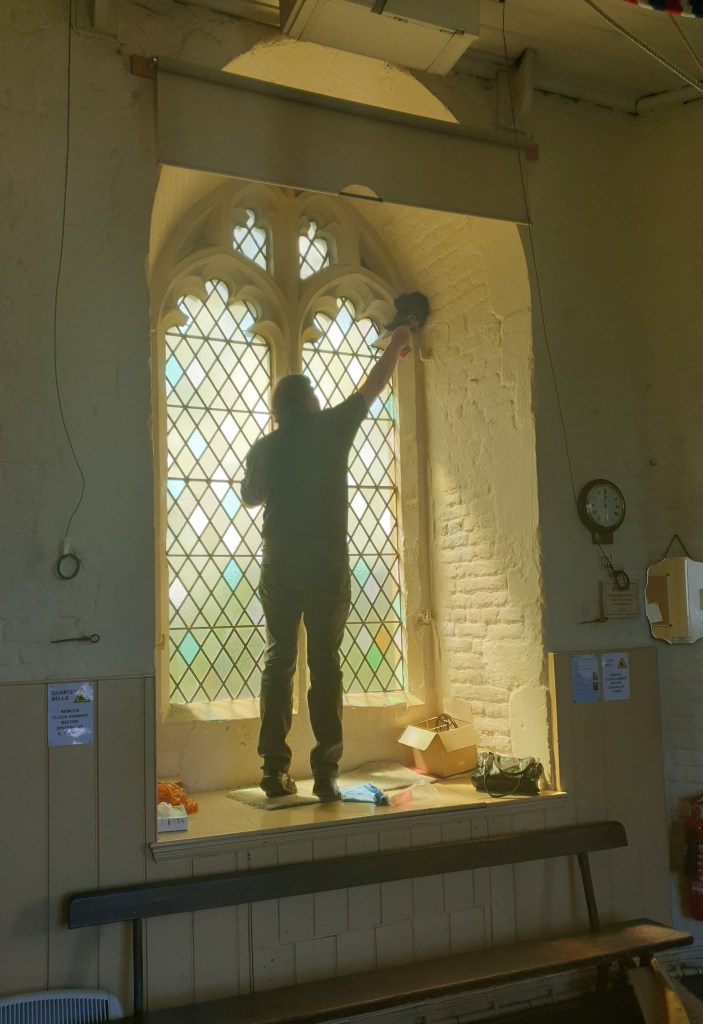
In preparation C and I did a bit of a spring clean. We took some cleaning equipment with us, including the ostrich feather duster I blagged from conference about 6 years ago. C was in charge of the high dusting on account of his longer reach.

Whilst he did that I tackled the spiral staircase from the ringing room down to ground level, some 52 steps. That job hadn’t been done for a very long time indeed. Probably not since our deputy tower captain’s late wife last did it. I wore a mask and had glasses on to protect from breathing too much dust and cobwebs in.

I left C to do the rest of the vacuuming whilst I did my best to resemble a chimney sweep.

When I came back upstairs I hadn’t realised how dirty I’d got until I happened to see myself in the mirror. I was filthy. It was in my hair, all over my face, on my glasses and some had got through the mask so my face was covered. My neck and decolletage were covered. I had to blow my nose a dozen times before the black stuff stopped coming out.

It took us nearly an hour to complete our mission but we were very pleased to have done it.

Afterwards we bought some lunch and strawberries, cherries, grapes and raspberries from the High Street farmers market and sat in the park in the sunshine. A well earned repost.

Hopefully we’ll be up to six ringers next week but for now I’m excited at the prospect of four.

The easy way to say thank you

You will have read before about this virtual #bellringing platform called Ringing Room that enables bell ringers from all over the world to ring together in a virtual world, given we have not been able to ring much in the real world.

I started using Ringing Room in May 2020.  It had been around for a few months already by then and the developers were still making changes to it, enhancing the user experience, fixing bugs etc.  I even managed to get it featured on the BBC 10pm News in June.  It has revolutionised ringing from being able to ring with our friends, meeting new friends, ringing with people from anywhere and everywhere, and ringing things we never thought we could in a tower.  There are even several groups of new ringers who have only ever rung in Ringing Room and never stepped foot in a tower and tried real bells. 

The development is ongoing, and Wheatley was introduced more recently.  Wheatley is basically a bot that will ring all of the others bells unassigned to people, so if you want to ring something on 8 bells but only 6 people are there, Wheatley will fill in the gaps.  I think Wheatley will be greatly missed when we go back to tower ringing and meet one or two short! 

The developers were rightly rewarded earlier this year by winning a large financial prize at the Association of Ringing Teachers awards.  And still the platform goes from strength to strength.  What started off as a big of a hobby experience rapidly has been the saving grace of ringers everywhere.  It has 5 servers in 4 different countries. I ring in 2 or 3 regular sessions per week, with the occasional extra practice every now and then, so get good use out of it.

Ringing Room is free to use.  It doesn’t spam you with emails once you’ve signed up.  It doesn’t bug you if you haven’t visited the site in a while.  It quietly sits there, ready when you are. Every now and then I remember to send a donation.  There is a facility to do this on the Ringing Room site, but again, it’s a button that quietly sits there, doesn’t shout out at you, doesn’t draw your attention to it, makes no expectation and there’s no pressure.

I was about to make a donation again when I saw a new option – to become a Patron by making a regular contribution.  Being able to donate regularly would be easier for me, so I wouldn’t forget, but also provide the developers with a more regular stream of income to support the platform and future developments.  There were 3 options, £3 per month, £10 per month and £20 per month.  There was still the option to make a one of donation of any amount.  I had no hesitation in supporting the £20 per month option. The value I get out of it is more than worth it.  Patrons would also get access to exclusive voting privileges on new features to be added to the platform. 

There are I don’t know how many thousands of users of Ringing Room now, and if each of them made a small contribution to the upkeep and development of the platform, it would be a small way towards thanking the developers for the extraordinary work they have done in creating Ringing Room.

Some people might think that Ringing Room will have its day once we are able to get back into towers to ring real bells, but I for one fully intend to keep using it, even if its for my own practice.  I don’t think I’m alone in that thought.

What does outstanding look like?

Image by Gerd Altmann from Pixabay

I am doing a piece of gap analysis work and using the NHS change model gap analysis tool to help with this.  Over the space of nine different tabs in a spreadsheet, the tool covers:

  • Shared purpose
  • Leadership by all
  • Motivate and mobilise
  • System drivers
  • Measurement
  • Project and performance management
  • Improvement tools
  • Spread and adoption
  • GAP tool

The last one is basically a pictorial representation of the scores entered in to each of the other tabs on where we are now and where we want to be, in a range for zero to ten in radar diagrams.

On each of the other tabs, the same three questions are asked with a different emphasis:

  1. What does outstanding look and feel like?
  2. What works well?
  3. What would be even better if…?

Of course, this is a work based tool, but it could so easily be used for everyday life too. The whole point of a gap analysis is to reflect on where we are now versus where we want to be in the future.  Then we can consider what actions are required to get us there and in what timeframe.

Even if we were to look at this as an individual wanting to make changes in our lives, we can consider each of these, for example, our shared purpose might be to provide a safe and loving home environment.  Leadership in that context might mean who is going to be responsible for what and when, it could be some home maintenance, it could be primary carer responsibilities and so on.  Then how we motivate and mobilise could encompass opportunities to engage with other members of our families or social groups to assist, if someone has some particular skills that could be made use of. You could resort to incentives to gain that assistance, like “if you come over and help me paint the lounge, I’ll cook you dinner”. 

What system drivers could be included in a scenario such as this? Maybe a driver for painting the lounge is because you’re putting the house on the market and you want to freshen it up for prospective buyers.  The project and performance management includes things like planning when the activity is going to take place, what you need in order for it to happen (buying paint and brushes).  The improvement tools could be as simple as a before and after photo of what the lounge looked like and how shiny and refreshed it looked after the decorating party.  Spread and adoption could extend to now you’ve decorated the lounge, how about the bedrooms and kitchen? 

But what does outstanding look and feel like?  Do you have a DIY snagging list that you can tick everything off to make sure that the walls have been painted, that the window sills and skirting boards have been done, that the doors have been refreshed?  

A rather trivial example, but you get my meaning.  It could be adopted for pretty much anything you want to change.

Taking a more philosophical approach, what does outstanding look and feel like to you as a person?  Are you the best version you could be?  By answering the other two questions, we can start to examine how we might see outstanding. 

What works well now?  What do we instinctively know is good behaviours, habits, personal attributes?  What do other people tell us?  What non-verbal feedback do we get from others that might indicate approval in what we do or say? What things can we build on or take advantage of to make our ambitions real?

On the other hand, what would be even better if….?  What has, or might prevent us from making our ambitions a reality? How could we respond differently to get a more positive outcome?  How could we be more assertive of our needs without being obstinate?  How could we be more empathetic towards others? 

What does outstanding look and feel like to you?

Are you a cynic, sceptic or realist?

Image by Gordon Johnson from Pixabay

Do you ever have doubts about other people’s intentions, good or bad?  Do some things seem just too good to be true? Do people have ulterior motives?

As with all good writers (not that I’m counting myself among them), I’ll start with the definitions:

Cynic – a person who believes that only selfishness motivates human actions and who disbelieves in or minimizes selfless acts or disinterested points of view. https://www.dictionary.com/browse/cynic

Sceptic – i) a person who questions the validity or authenticity of something purporting to be factual, ii) a person who maintains a doubting attitude, as toward values, plans, statements, or the character of others. https://www.dictionary.com/browse/skeptic

Realist – a person who tends to view or represent things as they really are. https://www.dictionary.com/browse/realist

Recently, I’ve been trying to lose, or at least minimise, my cynicism of others and try to believe what they are doing and saying are genuine, and that we all believe that what we do and say is the correct version of the truth. I have been guilty of thinking that (some, not all) people only do things for their own gain, whether that’s to look better in the eyes of others, to garner some sort of advantage over others, or to make their plight sound worse than someone else’s in order to gain the most sympathy.

Being cynical may stem from a bad past experience but it can prevent us from having meaningful relationships with others if the whole while we are thinking that everyone is out to get us. It may also have negative effects on our happiness and wellbeing, and rub off on those around us.   https://www.happierhuman.com/stop-being-cynical/

I am trying to reprogramme my brain to assume that whatever someone does or says is for the general better, and to take it at face value, and that they mean well by it. Being constantly genial and lenient may have its flaws given that it could lead me into being gullible and susceptible to someone’s bad intentions, whilst assuming they could only be doing or saying something unselfishly.

I have very recently called into question the authenticity of someone’s actions, based on their previous track record.  I am very sceptical of this person’s version of the truth given that they have been caught out before but it doesn’t seem to deter them from trying to pull the wool over other people’s eyes.  I could be doing this person an injustice on this occasion but it’s very hard to believe them when they have such a poor track record. 

Constantly being sceptical about another’s version of the truth can also manifest in developing poor relationships with others. Again, I am trying to believe that their version of the truth is in fact the real version.  I will take this particular person’s latest action on face value and deal with it as such.

Sometimes, we can get cynicism and scepticism confused with realism.  In our version of the truth we say or do things we absolutely believe to be the true version and support our arguments with axioms like “I’m being realistic about it”. Viewing realism this way puts a pessimistic tone to it, when we might want to consider being realistic about something as an optimistic perspective, seeing things for what they are without any judgement.

Being realistic about it, I recognise that I am the eternal combined cynic and sceptic.  Being realistic in an optimistic way will increase my chances of a happier, healthier life with constructive, engaging relationships with others.  Being realistic about the future and making sound decisions based on evidence can bring a sense of wellbeing, without having to immerse myself in relentless positivity that can often feel fake.