As I’ve been on annual leave this week, one of the things that I wanted to do was some reading. Trouble is, I’ve read all the fiction books that I’ve invested in and although I have some non-fiction to wade through, felt that being on “holiday” wasn’t the best time to read those.
I haven’t downloaded a Kindle edition of a book in ages. I much prefer the physical thing to hold, turn pages and even the smell. I am also a bit OCD when it comes to collections. If there are a number of books by an author I enjoy, or a series that run together, then I have to buy all of them, and read them in order.
My favourite genre is historical fiction, most specifically Tudor period. I’ve read all the Jean Plaidy, Phillipa Gregory et al. Having most recently thoroughly enjoyed Alison Weir’s series on the Six Tudor Queens. I have the final instalment already on pre-order. I happened to be rummaging around that well known online purchasing site and came across a series of Alison Weir e-shorts. These seem to be companion stories to the Six Tudor Queens series. There are 7 e-shorts so far that relate to the first 4 books of the Tudor Queens, so one can assume that there are more to come. For £0.99 each, it was a no brainer to download the lot.
I’ve gone through the precis for each e-short and listed them in order of which main Six Tudor Queens books they sit along side so that I can, as with full series, read them in order. There appears to be 1 that sits with Katherine of Aragon, 1 that bridges that with Anne Boleyn, 1 that accompanies Anne Boleyn, 1 for Jane Seymour and 2 for Anna of Kleves.
I have a whole day with no meetings or need to be anywhere else or do anything in particular, that I can give wholeheartedly over to reading these e-shorts. Give me a nudge when dinner’s ready!
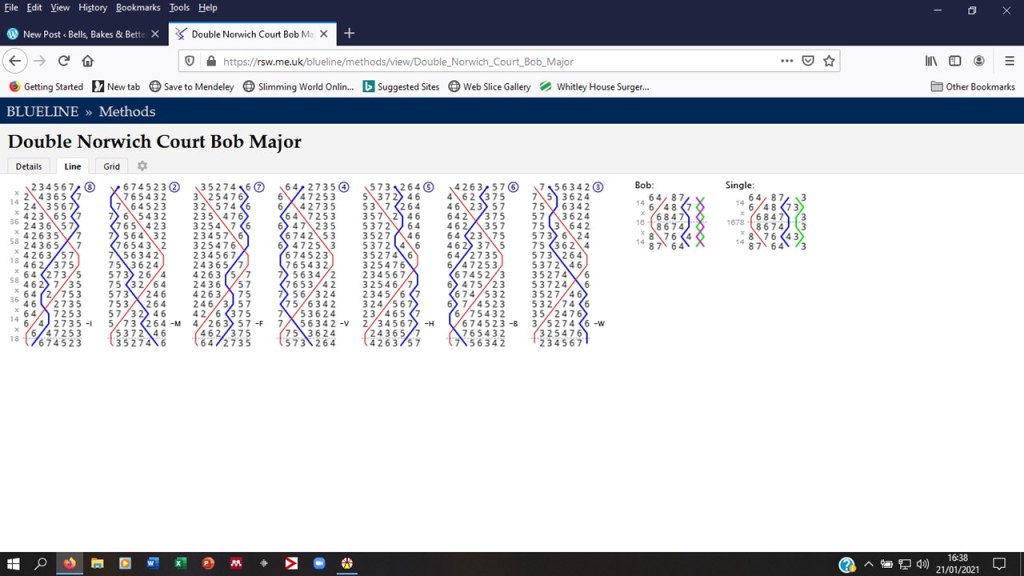
Cheating somewhat I know, but that’s how I remember Double Norwich Court Bob Major, by reciting First, Treble Bob, Near, Full, Far, Repeat. The purists amongst ringers will probably tell me that’s absolutely heinous, but it works for me.
I’ve never really been able to learn methods the “right way”. When I first started to learn methods, some 39 years ago, I would usually be presented with a table with 3 columns, the work of the bell, what happens at a bob and what happens next. No explaination. No mention of place bells, no clues to the method construction. I just learnt the work by rote. That’s just how it was done where we were. The locals didn’t know any different, so they couldn’t teach any different.
Now, fast forward many, many years and I’m trying to learn more complex methods and even, on the rare occasion trying to splice a few of them, and I really struggle. When I learn a new method I try my hardest to learn the start of each place bell but I don’t seem to be able to break it up that way. I learn the whole of the blue line by sort of rythmically reciting the piece of work. Given that generally I tend to ring round the front to middle bells (depending on how many), I have no idea what the back bells ststart with. I look at the work of the 2 and that, to me, is where the methods starts. When I ring the same method from a different bell, it’s like learning a whole new method all over again, although by the time I get to what I can actually recognise as where the 2nd starts, I can relax a bit. This does make it rather difficult to be able to just join in on any bell, or to ring on higher numbers as trying to recite a whole blue line can be difficult to remember.
This is probably the biggest thing that sets me back with ringing.
Not so long ago, I was about to participate in a virtual #bellringing session and the instructions were sent through via email and said that the other learner in my session wanted to practice splicing all the right place methods. I had absolutely no idea what that meant. When someone says to me that I’m (insert bell number of your choice here) place bell, they may as well be talking Martian in all but the very basic of methods.
Now, I’m a grown up, and you could argue that I should be able to go away and find out these things for myself and try to learn and understand what all this jargon means. I’ve tried. I’ve picked up books that claim to explain how to learn methods and within about a paragraph or two, I’ve switched off. Maybe I’m just not being receptive enough to the information that is being presented to me. Maybe it’s my own self-sabotage that says that I’ll never understand it anyway, so why bother trying. I’ve tried writing methods out, by place bells, to break them down to their constituent parts, but once the blue line “clicks” it all merges in to one long line and I have a job undoing it all again.
There are some methods that I can now recognise certain place bells, but that’s only because I’ve been ringing those methods for a very long time, and had the opportuntity to ring them from different bells often enough. However, as someone who can easily ring Cambridge Surprise Major, Royal and Maximus, I have no idea what any of the bells above 6th place does to start with. If I were to ring one of those bells, I would need to learn its start all over again and get to a place, or a pattern, in the method that I was familiar with.
For where I am in my ringing career right now, using cheats like First, Treble Bob, Near, Full, Far, Repeat for Double Norwich, and Two and a Penny, One and Tuppence for Erin works, but I guess I’ll have to put more effort in if I’m ever going to crack splicing the Standard Eight!
Do you ever do those questionnaires in magazines? You know, the ones that tell you, depending on your score, what is in store for you in the coming year, what your personality traits are, or what your love life will have in store?
I remember as a kid the only magazine I bought with any regularity was Smash Hits. The only questionnaires they did worked out which pop star you were likely to marry. Of course you had to do the quiz over and over again until you got the answer you wanted. BTW, the only legitimate answer was Simon le Bon 😍
As I progressed (?) on to mags like Cosmopolitan the questionnaires were more along the lines of “how to make him fancy you” and “why your friends don’t like you much”. I guess they thought they were some sort of attempt at self help.
In the workplace over the years I’ve done many, many psychometric tests like Belbin, designed to find out your fundamental personality traits, then try to convince you how you and your colleagues could all work together in perfect harmony despite your differences. I’ve done Belbin so many times for different reasons. I still come out as ISTJ, the logistician. Introverted, observant, thinking and judging. I like facts and data. I like methodology and practicality. It means I’m honest and direct, strong willed, dutiful, responsible, practical. But on the flip side I can be stubborn, insensitive, always by the book, judgy, and self blaming when things fail.
Because I’m not spontaneous or outgoing I find it hard to make friends or trust people’s motives, or express emotions freely (until really pushed). This is the area I’m working on hardest and the moment and I don’t mind telling you, its bloody hard.
I did a magazine questionnaire this week in Psychologies Magazine about what kind of comfort do you need. Each question has 4 options to choose from then you count the times you’ve selected a particular response and it tries to explain what area you need to search in order to find solace.
Have you ever noticed there’s always at least one question where none of the answers is applicable?
Apparently, according to the number of hearts, diamonds, circles and squares I ticked, I have equal measure of hearts and squares. That means that I need to be looking for something spiritual and relational.
By spiritual it doesn’t mean finding God or some mystical thing, but could be in the form of rituals that allow time for reflection, and to connect with others. It suggests that I should focus on treating everyone with kindness, respect and lack of judgement and increase deep listening, filter out the gossip.
Relational suggests investing in meaningful connections with people and changing the relationship I have with myself. Being more compassionate with myself will, apparently, help me find comfort from others.
So, take my intovertedness and difficulty in making friends, insensitivity, stubbornness and self deprecation and just go out there and make meaningful connections. Just like that. Easy. Not.
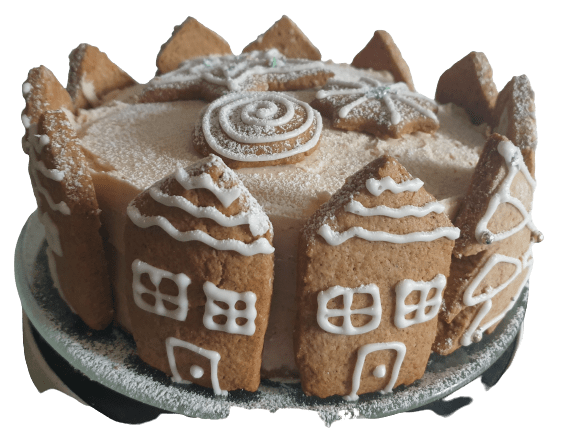
I finally got around to baking the BakedIn Winter Spice Cake. Its a test of biscuitery and cakery. Gingerbread houses, trees and stars and a cinnamon flavoured cake and icing.
It was, as you might expect, quite time consuming. Need to make the dough for the biscuits, then whilst that’s chilling in the fridge, make the cake batter. Then when the cakes are baking its time to roll out the dough and cut out the shapes. Then bake them whilst the cakes are cooling. Then make the icing while the biscuits cool. A little bit fiddly in parts but otherwise quite satisfying to put it all together.
The smell of the cinnamon and the gingerbread is just like its Christmas cooking all over again. Christmas food is just about the best.
Food smells, like any other smell, has the ability to transport us to the past, to experiences and periods of our lives.
There’s always been a smell, that I can’t really describe, that always reminds me of my grandads kitchen and the massive panty/cupboard where he kept all the crockery and some tins (peaches, pears and spam generally) and packets of food. I can’t really remember a particular smell from my nanna’s, but I do remember the food. She’d get enough in for tea that “whatever you don’t eat now you’ll have to take home with you”.
I wonder what olfactory memories our daughter will have of our house. There’s certainly been a lot of baking. I know she came in from her evening job when she was doing her A levels, and always said that whatever was cooking for dinner smelled lovely. Usually something like chilli or spaghetti bolognese.
We needed to drop some documentation off to a friend for their signatures so decided to use it as an opportunity for our daily exercise walk. They live about 2 miles away, so it wasn’t going to be too hard to walk there and back. In fact we’ve done it several times, especially last year.
Having looked at the weather forecast for the week ahead it was declared that today would be the better day to do that.
We start by walking into town, then taking the footpath round the back of the University campus. This takes you northwards along the river and up through a park before joining the housing estate where our friends live.
As we’ve walked this route many times over the last 10 months we’ve seen the landscape change. We’ve seen it through spring and summer and autumn and now winter.
The river rises with the rain fall and floods the surrounding fields, then it recedes to reveal dried out earth in the heat of summer. The trees bud, leaf and become home to wildlife, then shed to reveal the abandoned birds nests.
The number of people we pass fluctuates with the seasons. Everyone and his mother was out in the summer. You ran the risk of being run over by errant cyclists who seem to think they own the footpath. Children who have no idea how to walk in straight lines don’t seem to get out of the way whichever side of the path you walk on. And dogs. Dogs on leads, dogs on the loose, dogs walking calmly, dogs getting hysterical at the thought the ball might get thrown any second now. Dogs that want to come and say hello, and dogs who look at you for help as this is the eleventybillionth walk they’ve been on today.
Only the die hards venture out in the winter time. Everyone wrapped up in hat, gloves and scarf. Breath visible in the cold nip of air. Hardly any birdsong. Everyone walking with more sense of urgency to get back home in the warm.
We get to our friends but of course we can’t go in. We weren’t even going to stop, just push an envelope with the documents to sign through the letterbox. They heard the rattle so popped their heads up at the window like meerkats on the lookout. Then came to the front door to say hello. We stood well back at the end of the garden path. We didn’t chat for long as didn’t want them standing on their doorstep, letting all their home’s warmth out. Then we trudged back home.
A slightly different route back for a change. Took us along the side of the railway line back into town. Didn’t see any trains go by. The footpaths were a bit mucky. By now it was getting a bit dark. I was getting a bit warm under all the wrappings. I was ready to get back home and have a nice cup of mint tea.
4.5 miles walked in an hour and a half (including chatting time). That’s my exercise for the day.
When I was very much younger power cuts were a regular occurance. This was generally due to coal minors working to rule because of pay cuts.
We’d get the candles out from the cupboard under the kitchen sink and play cards or read by candlelight or talk. I don’t really remember much about them being a particular problem, but then as a kid it probably made no difference to my world. I guess if you were trying to work, or cook dinner for the family, or in the middle of something really important it would be really annoying.
During adult life when there’s been power cuts its often a case of a tripped switch, so a quick rummage in the cupboard under the stairs to sort it out. Maybe a dodgy fuse in an appliance.
We had a proper power outage this evening. The whole street went out. It was actually quite exciting in a way. Oooo, wonder what’s caused that? How long is it going to last?
Rather disappointingly, it was only a matter of about a minute before everything kicked back on again. And these days you can check on line to see what happened.
This evening’s little darkened interlude was brought to us by engineers carrying out emergency repairs to the network. By the looks of things there’s been a power cut nearby for some considerable time that is still not sorted, so our little blip may have been connected.
Makes you think about things that we take for granted and only notice when they go wrong. Every day lights go on, kettles boil and water gets heated. I know we pay our bills for that privilege. We never say thank you for making sure that the lights go on, the kettle boils and the water is hot. We only complain when it doesn’t.
Some of the roles I’ve had at work in the past have been a lot like that. You never get thanked for doing a good job every day, you just get complaints when it doesn’t happen properly.
I remember saying at the interview I had when I applied for my Masters course that a patients journey has so many interactions that shape a patients view of the care they’re going to receive, that could go wrong at any stage, with the organisation before they even get to say hello to a clinician.
Firstly the patient needs to get there, so there needs to be good public transport or parking facilities. When they arrive they walk through grounds that need to be maintained. Then walk into a building that needs to be upright, light, heated and equipped. Then either see a receptionist or a self serve totem that means having a computer system that works. Then, maybe if they’re early for their appointment they go for a coffee, so that needs to be avaliable, then of course they’ll need a wee so toilets need to be cleaned and serviced. Then, when they get to the clinic area, their notes are miraculously available, whether paper or electronic. All of that before anyone has said hello.
But we never say thank you for all that. We just take it for granted and complain when any of that system doesn’t work to our liking.
Its simple, right? You just stick a # in front of a word, job done. But what’s the point of the #?
The # is there for you to link your post, in whatever medium that might be, to a word that may connect you with others who might be interested in the same topic. It can help your post reach a myriad of different audiences. The hashtag became popular with Twitter, but you can use it on just about any social media platform. It means that anyone looking for a particular topic can search using the hashtag and find other sites and content of interest. Very useful if you are wanting to get a message out or share information with the masses. According to some sources you can get 45% more likes and 67% more comments on your content by using the right hashtag strategy.
I use a very small number of hashtags on my posts about bellringing, mainly because some social media platforms have a limit on the number of characters you can use, but mainly because I’m rubbish at thinking on synonyms, you know, those other words that are related to the one you’re using. For example, I use #bellringing a lot when I post about any bellringing activity, or sharing information. For some reason it took me ages to connect #bells, #bellringers, #ringing, #campanology. Search these hashtags and it opens up another world of bell related sites, some not so relevant to the type of bellringing I do, but means the posts has the potential to reach a whole new audience.
Up until recently, I’ve never really used a hashtag as a search function to find other like minded topics, but as I’ve got more into using social media, I’m finding out all sorts of useful tips. There’s a whole business made out of teaching people how to hashtag properly. I took the plunge a while back and purchased an e-book on how to make the most of hashtags, but only because it was going super cheap. And, I have to say, I’ve learned quite a bit from it.
The particular e-book I purchased was more specifically focussed on Instagram, the least of the main social media platforms that I’m familiar with but the ideas can be used across the other platforms too. I look after 3 different Instagram accounts, including my personal one. I had them open as I was going through the e-book and putting the suggestions into play immediately as I was reading through it.
I edited the profiles for each account to make them more appealing and relevant so that it instantly gives a viewer the information they need about the account. I looked at the hashtags that were suitable for the size of each account based on the number of followers each account already had. Using hashtags relating to topics where there are too many followers already means that our messages could get lost in amongst all the noise. I thought about the keywords that users might be searching for when they’re trying to find our information. I then used those words to search sites where the ideal audiences would also be looking at. I followed a number of those, then looked at the kind of hashtags they were using and jotted down any that I thought might be useful.
Then its about the engagement. Once you’ve found the top accounts in your topic of interest, by liking and commenting on their accounts regularly, this will help your visability too, amongst their followers.
I’ve made a list of all the hashtags that I think would be useful for each of the accounts I look after and now that I’m starting to use them, I’ll be able to look at the analytics to see how they are helping reach wider engagement.
Yesterday I ordered some books from Amazon which I hope arrive during the coming week, as I have some annual leave and therefore time to read them. Amazon told me that they should all arrive the following day.
Today Amazon tells me that my parcel should arrive today any time before 10pm. Thats going to be scary if the doorbell rings that late at night!
I have high hopes for these books. They will help me to understand and do better in the social media world. At least that’s what I’m hoping. I hope they are worth the wait.
According to logisticsmgepsupv.wordpress.com we spend around 6 months of our lives waiting in line for things, 43 days on hold with automated customer services, and 27 days waiting for a bus, 32 minutes per day waiting for a doctor, 28 minutes in a security line at the airport, 21 minutes for our significant other to get ready to go out, and 38 hours a year sitting in traffic. A Daily Mail survey suggested that we wait around 4 months of our lives waiting for the kettle to boil.
Sometimes the planning and experience associated with the waiting process can be extremely pleasurable. Like the smell around the house when you’re baking chocolate brownies. The creative processes of art, cooking, crafting, travel, and a myriad of other things can give as much pleasure during the creating or planning process as the final product does. And when you have that final product, it will be all the more sweet knowing the effort it took to create it.
As I’ve said before, I am an ongoing development as a human being and am trying to get as much pleasure out of the creation of the person I want to be, as much as what the end result might be.
I have the next week off work as annual leave. I have no plans, and no real thoughts about what to do with my time. I have a couple of reports to write and could bake something but other than that, because we can’t go very far due to lockdown, no other real thoughts about what to do. That got me thinking about why we do what we do (or not).
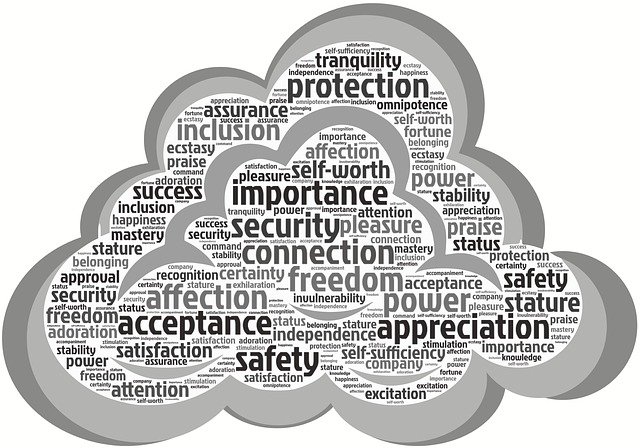
You could take Maslow’s hierarchy of needs and work through that systematically, but does that cover it? Yes, there are some basic needs that ought to be addressed: the need for food, shelter, sleep, company etc. We need our elements of security around employment, health and some material belongings. There is certainly a need for friendship, family, love and a sense of connection. But then we get on to the things that you could argue we don’t NEED, we just WANT. Respect, recognition, strength, and then self-actualisation – to be the best we can be.
There’s another school of thought that suggests a different solution to why we do what we do.
A sense of obligation – to share experience and knowledge, the obligation to serve others. A sense of duty, and pride – perhaps via volunteerism, a call to action, pride in a job well done and our want to succeed. We should be wary of the vice like self intention, cunningly disguised as “being in our best interests”, which only really offer temporary pleasure. Acts of kindness and our altruistic love for the benefit of others. Passion for our favourite activity or cause, our desire to do something. The desire to “tick the box”, perhaps something off our bucket list, but could lead on to somewhere else. Our destiny may be coloured by family tradition, a hobby or particular calling that other family members before us have excelled in. Yes, there’s a need to have a sense of fulfilment to keep us energised and empowered through our self-actualisation. But maybe we do it for others, to have something to share or for the “greater good”.
Tony Robbins, an author and podcaster, as well as being a mutli-billion dollar entrepreneur, in his TED Talk and book, describes 6 human needs – certainty, significance, variety, love/connection, growth and contribution – and how each influences our thoughts, feelings, behaviours and actions. By understanding what drives us, we can understand how to meet those needs. The same for people around us, once we know what drives them, we can help them meet their needs too.
At a very fundamental level, I know I need to be safe, secure, independent and have a sense of purpose. The narcissist in me does need some form of appreciation every now and then, but I certainly need feedback to make sure that I’m at least heading in the right direction and to help me achieve some personal growth. I need to be educated. I need to understand things and learn from them. I try to encompass all of that in my working, social and family life and am conscious that I don’t always get it right.
How often do we get an opportunity to just sit and listen, I mean REALLY listen to the sounds around us?
Both C and I were sat out our respective desks in the study, going about our business when it suddenly hit my ears there there was silence. Neither of us were speaking. At the time neither of us was hammering our keyboards or frantically clicking a mouse. But then I noticed the non-silence which actually became quite loud.
I could hear the birds twittering in the back garden, as clear as a bell. The hum from the fan on C’s PC, continual hum. The wall clock ticking, so loudly too that it beggers belief that sometimes you barely notice it at all. There was an occasional mouse click as one or other of us scrolled up whatever it was we were reading on the screen. There was a throat clearing after a glug of water. There was a chair squeaking under the pressure of shifting weight. There was an airplane outside on its way to, or from, who knows where. There was pen scratching on paper as I was making notes. There was a belly rumble and an over emphasised exhalation.
Within the space of somewhere between 5 to 10 minutes there were all these sounds surrounding me, but there was silence. Peaceful, gratifying, restorative. All of these amazing sounds that I might have missed had the radio in the kitchen been on, or had I been hammering away at documents or emails, or people talking.
Silence can provide us with so many benefits if we choose to allow them into our lives.
It can allow us to concentrate and focus, which apparently can be lost if the sound is over 80 decibels. Obviously the writer of that point has never been to a #bellringing practice where concentration is required despite the noise of the bells.
It can allow our minds to be more creative. Some eminent scientists did their best creative work after a period of solitude and quietness.
It can allow us to discover how we may improve our lives when attention is given to self awareness practices. Taking time to self reflect can help figure out what and where we want to be.
It can help relax us and reduce stress levels if we allow a period of silence.
It can affect our ability to learn. The more noise we are exposed to the worse we perform and find it harder to concentrate.
Doing nothing and remaining silent can increase productivity of new brain cells, which in turn supports greater productivity as much as tenfold.
Silence can help cultivate calmness and peacefulness when you regularly practice silence and patience.
If you are able to, I invite you to sit somewhere comfortable and just be silent for even just a few moments. Make a note of all the things that you can hear in the silence. You’ll be surprised how much surround sound there is.





 Bells, Bakes & Bettering Myself