
Snips of clips of dings and dongs

Every Sunday during lockdown C and I have been ringing 2 bells at our tower ahead of the live streamed service.  I record these on my phone camera and upload the video to my youtube channel, which has a grand total of 15 subscribers, mostly family!  I only really do it for my own interest and to link to it on our #bellringing Twitter page so that the church and community can see what we do and that we’re doing our bit to keep the bells going. It always gets retweeted by the city community radio station and the diocesan account.

I send a link to my personal Facebook profile so that my #bellringing friends can watch it if they want to.  I suspect no one is really bothered, but again, it’s just about keeping #bellringing out there.

Over the last couple of weeks it’s been surprising to hear that a number of people actually look forward to me posting our exploits.  One of the first times I posted a clip of C and I making places and dodging, someone commented on our ringing as being a “master class in bell control”.  I don’t know about that.  Someone else said that they look out for the post every week and watch it.  I guess it might be helping some people feel connected and offering something when so many other people can’t go out and ring their bells yet. 

Off the back of all of that we’ve just been asked if an extract of one of my clips can be used as a training aid and a demonstration of good bell control.  I’ve never really considered my bell control as being worthy of such interest.

Sometimes, our Sunday morning #bellringing isn’t so great.  It can be surprisingly difficult to count to 3.  We swap places for a whole pull, hand and back stroke, then back again 1,2,1.  Then we dodge so the 2nd bell pulls in at hand stroke and the 1st bell holds off, then at back stroke the now 1st bell holds up and the 2nd bell pulls in.  We do that 3 times so that the bell that started off life in 2nds place is now leading first, so we go back to making places, whole pull swap, then swap back again.  Then we dodge the other way around so that the pull in and holding up is done the other way around.  We do that 3 times, so now we’re back to where it all started.  We continue doing that until it either starts to sound a bit scrappy, we lose count or we get bored. 

We tend to fit in 3 sets of about 5 or 6 minutes each time.  If the first attempt goes well, I won’t bother recording any more, but if it sounded rubbish, or the organ starts blasting part way through, or something else happens that means it wouldn’t be a good sound / visual, I’ll record each time and then pick the best one to upload. 

If you go back to the beginning when I first started recording, I had to balance my phone on the table, or the cabinet in the corner, keep it propped up with something so it didn’t slide about or fall over, and put it on selfie mode so that I could see what it was focussing on and make sure everything was in the image.  That meant that it looked like the bells had be rehung anticlockwise.  Last Christmas C bought be a gimbal so that I can mount my phone steadily and have it record the right way round even with the screen facing you, it’s not on selfie mode that way.  It also makes it easier to zoom in or position the view higher or lower, left or right.  It would also mean that I could set it to track something moving, or have it perfectly balanced even if I was walking around holding it.  At some point I’ll get some decent footage of the bells themselves. 

It’s good to hear that my recording are being enjoyed, even if only by a few, and that someone feels that they are good example of bell control.  I don’t think I’m in for a BAFTA or Oscar anytime yet though.
Time to move on

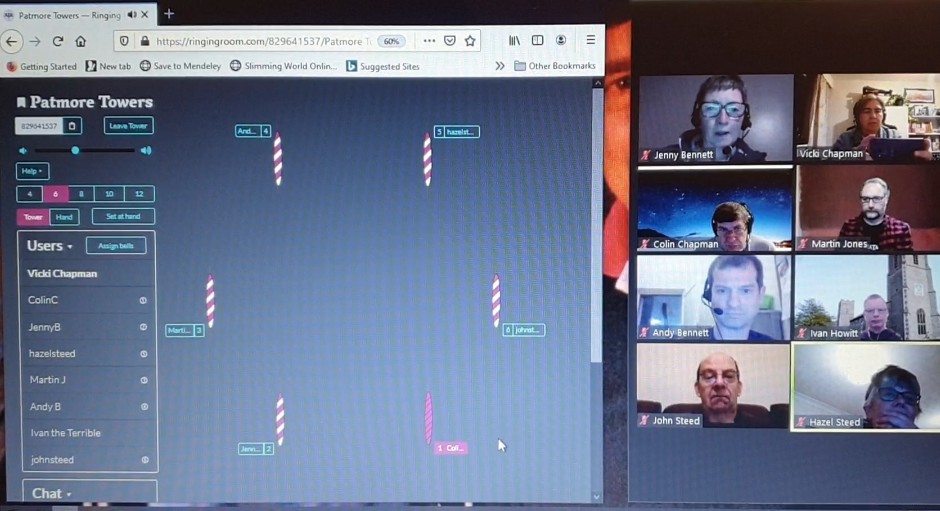
Our virtual #bellringing practices on a Thursday evening with friends and family have had a bit of a progressive plan.  We started off with some simple “plain” minor methods i.e. where the treble plain hunts and worked our way up to surprise minor and then started introducing an 8 bell method as well.  We’ve had methods of the month for the past few months so we can consolidate our learning.

February saw us ringing York Surprise Minor and Kent Treble Bob Major, and for March we’re moving on to Durham Surprise Minor and Oxford Treble Bob Major.

A lot f the methods we played with I’ve never rung before, and some of the rest of the band haven’t either.  Its been quite a fascinating experiment.  Some of these methods I never would have thought that I’d ever ring.  I dare say, that when we get back to ringing in the real world, I’m unlikely to ring those methods in a tower.  The places we ring at regular just don’t ring that sort of thing. 

I would like to try and ring them in a proper tower, but suspect that that might require some engineering to get the right band and the right time. 

Some methods are transitory, they are stepping stones that help you understand more complex methods, and the likelihood of going back to them on a regular basis is minimal.  Some are very similar and are good to be spliced together for variation, you just need to remember which one is which.

My brain capacity isn’t good enough to retain all of these, so I suspect that if we were to try to ring them in a tower, I would have to relearn them all over again.

Still, its good fun, stretching the brain and having a go at things we don’t normally ring.

Every day’s a school day

It seems like it at the moment anyway.  Between doing my online mindfulness course, which has really challenged some thoughts and feelings, and learning methods for virtual #bellringing in Ringing Room sessions, of which I had 4 this week.

The first #bellringing session was a district practice which I didn’t need to learn anything new for but the session that I run on Thursdays we’re consolidating methods that we’ve been learning for February.  Some of those methods are repeated at a Friday morning session but sometimes something different.  Then every other Friday there’s another session that changes methods every time.  This week I needed to learn Newcastle and Alnwick Surprise Minor.  And in 2 weeks’ time, we’re aiming for London and Wells Surprise Minor, and I set new methods for our Thursday session at the beginning of the month.

Some of these methods I’ve never even looked at, always thinking they are beyond my capability but with the advent of Ringing Room, have been able to ring things that I wouldn’t normally get to ring in any of the towers that I would normally frequent.

Learning to ring takes time, even just the basics of handling a bell on your own, then you need to join in with others and make a meaningful sound.  Then you can move on to the more complicated stuff, but that tends to depend on others a bit more, as you can only ring to the standard of the most novice ringer in the band.  However, learning skills that require longer term commitment can be rewarding and stimulating for the brain.

A quick internet search shows that there are a multitude of sites that promote learning something new, from new skills, to new languages, to cooking and baking, knitting and creating videos.  I’ve always found learning something new to be rewarding.  It doesn’t necessarily make me an expert in it but it gives me better understanding, better skills, better adjustment and a wider range of things to do.

Having just completed the 6 week mindfulness course, I’m now looking around the site to find the next thing to dive into. 

Analysis Paralysis

I’m doing an online course in mindfulness and wellbeing at the moment and have been fortunate to spend all of the day going through the next module, which has been discussing, amongst other things, the merits of whether mindfulness teachers need to be qualified or regulated in some way, and whether attending an 8 week intensive mindfulness course is sufficient for someone to set themselves up as a mindfulness teacher. Don’t panic, I’m not going to be opening up a clinic any time soon.

Being scientifically objective about mindfulness is difficult in that it is difficult to measure one person’s experiences against another’s.  We all come pre-programmed with inbuilt prejudices and life experiences that cause us to be open or judgemental about ideas.  We all have unconscious biases that impact our opinion as to whether a therapy has been helpful or not.

Connection to a teacher is important.  Without a rapport and mutual understanding student and teacher may not settle into a place of trust.  People attend mindfulness based stress relief (MBSR) or mindfulness cognitive behavioural therapy (MCBT) for a multitude of reasons, but it is important to recognise that many of them do so because they have been referred as part of a treatment therapy for depression or stress/anxiety, trauma or PTSD. However, even those of us who are seemingly quite resilient and able to cope with most things could end up being triggered by regressing into something that we had long ago put away, dealt with, coped with or moved on from, as part of mindfulness practice.

Is someone who has been on an 8 week course sufficiently qualified and experienced enough to handle that?

If I were in the situation of needing support to such a level, I would be wanting to find out more about the person delivering the sessions.  In a business environment we are taught to use the PESTLE analysis tool to investigate the political, economic, social, technological, legal and environmental aspect of a business before investing or setting up a new business.  If I were looking for a teacher who was going to be helping me explore the deeper parts of my brain, and help me find ways to cope and recover I would want to know that the teacher had done those same sorts of analysis on the subject of mindfulness and not just got a certificate of attendance.