Magazine Questionnaires

Do you ever do those questionnaires in magazines? You know, the ones that tell you, depending on your score, what is in store for you in the coming year, what your personality traits are, or what your love life will have in store?

I remember as a kid the only magazine I bought with any regularity was Smash Hits. The only questionnaires they did worked out which pop star you were likely to marry. Of course you had to do the quiz over and over again until you got the answer you wanted. BTW, the only legitimate answer was Simon le Bon 😍

As I progressed (?) on to mags like Cosmopolitan the questionnaires were more along the lines of “how to make him fancy you” and “why your friends don’t like you much”. I guess they thought they were some sort of attempt at self help.

In the workplace over the years I’ve done many, many psychometric tests like Belbin, designed to find out your fundamental personality traits, then try to convince you how you and your colleagues could all work together in perfect harmony despite your differences. I’ve done Belbin so many times for different reasons. I still come out as ISTJ, the logistician. Introverted, observant, thinking and judging. I like facts and data. I like methodology and practicality. It means I’m honest and direct, strong willed, dutiful, responsible, practical. But on the flip side I can be stubborn, insensitive, always by the book, judgy, and self blaming when things fail.

Because I’m not spontaneous or outgoing I find it hard to make friends or trust people’s motives, or express emotions freely (until really pushed). This is the area I’m working on hardest and the moment and I don’t mind telling you, its bloody hard.

I did a magazine questionnaire this week in Psychologies Magazine about what kind of comfort do you need. Each question has 4 options to choose from then you count the times you’ve selected a particular response and it tries to explain what area you need to search in order to find solace.

Have you ever noticed there’s always at least one question where none of the answers is applicable?

Apparently, according to the number of hearts, diamonds, circles and squares I ticked, I have equal measure of hearts and squares. That means that I need to be looking for something spiritual and relational.

By spiritual it doesn’t mean finding God or some mystical thing, but could be in the form of rituals that allow time for reflection, and to connect with others. It suggests that I should focus on treating everyone with kindness, respect and lack of judgement and increase deep listening, filter out the gossip.

Relational suggests investing in meaningful connections with people and changing the relationship I have with myself. Being more compassionate with myself will, apparently, help me find comfort from others.

So, take my intovertedness and difficulty in making friends, insensitivity, stubbornness and self deprecation and just go out there and make meaningful connections. Just like that. Easy. Not.

Suggestions welcome.

Worth the wait?

Yesterday I ordered some books from Amazon which I hope arrive during the coming week, as I have some annual leave and therefore time to read them. Amazon told me that they should all arrive the following day.

Today Amazon tells me that my parcel should arrive today any time before 10pm. Thats going to be scary if the doorbell rings that late at night!

I have high hopes for these books. They will help me to understand and do better in the social media world. At least that’s what I’m hoping. I hope they are worth the wait.

According to logisticsmgepsupv.wordpress.com we spend around 6 months of our lives waiting in line for things, 43 days on hold with automated customer services, and 27 days waiting for a bus, 32 minutes per day waiting for a doctor, 28 minutes in a security line at the airport, 21 minutes for our significant other to get ready to go out, and 38 hours a year sitting in traffic. A Daily Mail survey suggested that we wait around 4 months of our lives waiting for the kettle to boil.

Sometimes the planning and experience associated with the waiting process can be extremely pleasurable. Like the smell around the house when you’re baking chocolate brownies. The creative processes of art, cooking, crafting, travel, and a myriad of other things can give as much pleasure during the creating or planning process as the final product does. And when you have that final product, it will be all the more sweet knowing the effort it took to create it.

As I’ve said before, I am an ongoing development as a human being and am trying to get as much pleasure out of the creation of the person I want to be, as much as what the end result might be.

Good things come to those who wait, apparently.

Why we do what we do

I have the next week off work as annual leave. I have no plans, and no real thoughts about what to do with my time. I have a couple of reports to write and could bake something but other than that, because we can’t go very far due to lockdown, no other real thoughts about what to do. That got me thinking about why we do what we do (or not).

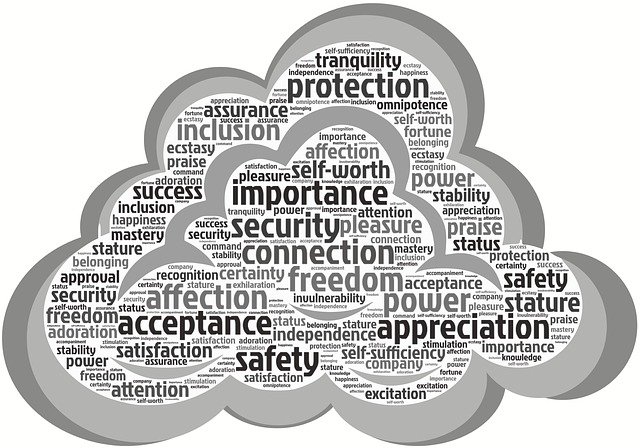
You could take Maslow’s hierarchy of needs and work through that systematically, but does that cover it? Yes, there are some basic needs that ought to be addressed: the need for food, shelter, sleep, company etc. We need our elements of security around employment, health and some material belongings. There is certainly a need for friendship, family, love and a sense of connection. But then we get on to the things that you could argue we don’t NEED, we just WANT. Respect, recognition, strength, and then self-actualisation – to be the best we can be.

There’s another school of thought that suggests a different solution to why we do what we do.

A sense of obligation – to share experience and knowledge, the obligation to serve others. A sense of duty, and pride – perhaps via volunteerism, a call to action, pride in a job well done and our want to succeed. We should be wary of the vice like self intention, cunningly disguised as “being in our best interests”, which only really offer temporary pleasure. Acts of kindness and our altruistic love for the benefit of others. Passion for our favourite activity or cause, our desire to do something. The desire to “tick the box”, perhaps something off our bucket list, but could lead on to somewhere else. Our destiny may be coloured by family tradition, a hobby or particular calling that other family members before us have excelled in. Yes, there’s a need to have a sense of fulfilment to keep us energised and empowered through our self-actualisation. But maybe we do it for others, to have something to share or for the “greater good”.

Tony Robbins, an author and podcaster, as well as being a mutli-billion dollar entrepreneur, in his TED Talk and book, describes 6 human needs – certainty, significance, variety, love/connection, growth and contribution – and how each influences our thoughts, feelings, behaviours and actions. By understanding what drives us, we can understand how to meet those needs. The same for people around us, once we know what drives them, we can help them meet their needs too.

At a very fundamental level, I know I need to be safe, secure, independent and have a sense of purpose. The narcissist in me does need some form of appreciation every now and then, but I certainly need feedback to make sure that I’m at least heading in the right direction and to help me achieve some personal growth. I need to be educated. I need to understand things and learn from them. I try to encompass all of that in my working, social and family life and am conscious that I don’t always get it right.

The 6 Domains of Resilience

The #MSEBUDDYNETWORK I’m part of at work is a great resource for being able to support colleagues who just feel that they need someone to listen to them, for somewhere safe to spout off, or to just reflect and recoup.

There have been some great resources shared throughout the programme and another such example was shared yesterday. Available via the NHS Leadership Academy (through whom I did my Elizabeth Garrett Anderson Senior Healthcare Leadership MSc) are some bite size learning snippets around health and wellbeing conversations specially focusing on resilience.

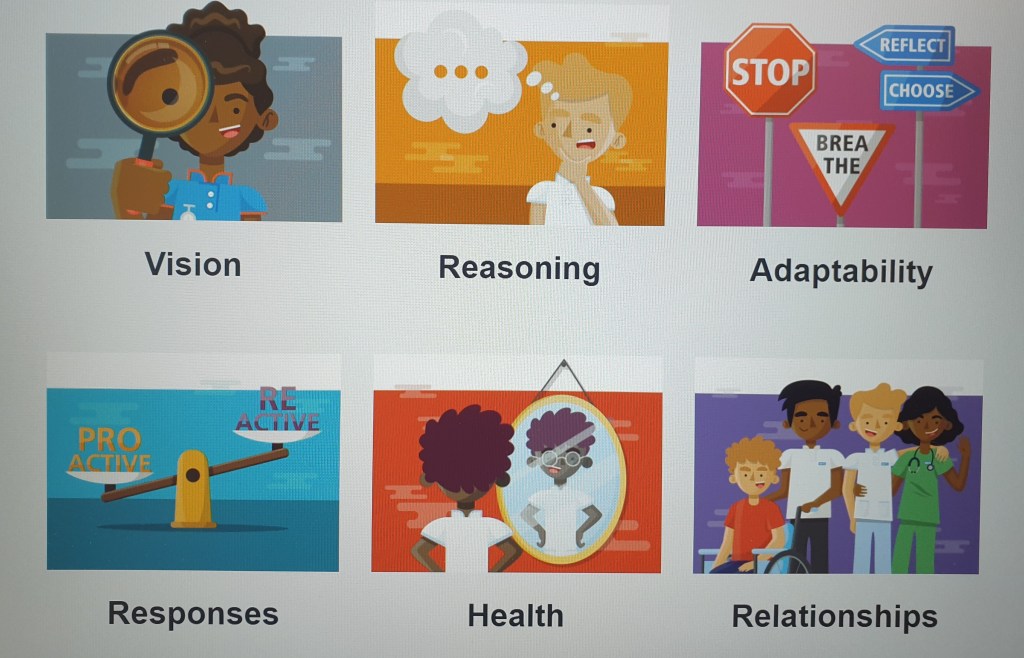
The resource was developed by Sonya Wallbank, a clinical psychologist and organisational development lead. It is broken down into 6 dimensions covering Vision, Reasoning,  Adaptability, Responses, Health and Relationships. Each dimension then goes on to explain its impact and offers suggestions to think about how we could focus our energies into improving them.

The resource is there to support facilitators of conversations and can be applied to your own experiences as well as used as a template to help others. My personal opinion is that we should not expect to help others where we cannot help ourselves first, so for me to support anyone else, I need to understand my own experience.

VISION: This is about setting personal goals and values and understanding why we do what we do and helping shift our anxieties and concerns into hope and curiosity. The questions posed are about asking yourself what you believe is your purpose in life, whether you are engaged in activities that bring out the best in you and inspire you, and what are your goals and how could you get nearer to them.

REASONING: This is our ability to problem solve, be resourceful and anticipate and plan for things and our reactions to set backs. The ask is to reflect on how you react to change in plans, what you need to be able to cope better with change or difficult circumstances, and how you could plan for a range of different potential scenaios.

ADAPTABILITY: Considering our ability to bounce back, be realistically optimistic and flexible about expectations and acceptance of change. You might need to consider how you adapt to last minute changes of plans, how to say “no” or “I could do that if…” instead of saying “yes“, and what could you achieve if you had a bit of extra help.

RESPONSES: How do we react emotionally, psychologically and biologically, to what’s going on around us. What are the things that you are worried about that you could do something about, what are the things that are outside of your control, do you need extra help to get you through this response?

HEALTH: How we feel plays a major part, how are we physically, financially and environmentally. Are there simple changes to lifestyle that could help, do you need help with controlling finances, are you OK in your work or home space?

RELATIONSHIPS: Our culture, team and other relationships all contribute to our resilience. Is there anything that leaders or colleagues could do to help make you feel safer in sharing ideas or opinions, where can you get support outside of your team, what networks and communities do you connect with and what will enable you to thrive.

Another great resource that enables us to help others. But as I said, in order to help others I need to be able to understand my own responses, so I’ll have a sit down and think.