Worth the wait?

Yesterday I ordered some books from Amazon which I hope arrive during the coming week, as I have some annual leave and therefore time to read them. Amazon told me that they should all arrive the following day.

Today Amazon tells me that my parcel should arrive today any time before 10pm. Thats going to be scary if the doorbell rings that late at night!

I have high hopes for these books. They will help me to understand and do better in the social media world. At least that’s what I’m hoping. I hope they are worth the wait.

According to logisticsmgepsupv.wordpress.com we spend around 6 months of our lives waiting in line for things, 43 days on hold with automated customer services, and 27 days waiting for a bus, 32 minutes per day waiting for a doctor, 28 minutes in a security line at the airport, 21 minutes for our significant other to get ready to go out, and 38 hours a year sitting in traffic. A Daily Mail survey suggested that we wait around 4 months of our lives waiting for the kettle to boil.

Sometimes the planning and experience associated with the waiting process can be extremely pleasurable. Like the smell around the house when you’re baking chocolate brownies. The creative processes of art, cooking, crafting, travel, and a myriad of other things can give as much pleasure during the creating or planning process as the final product does. And when you have that final product, it will be all the more sweet knowing the effort it took to create it.

As I’ve said before, I am an ongoing development as a human being and am trying to get as much pleasure out of the creation of the person I want to be, as much as what the end result might be.

Good things come to those who wait, apparently.
Why we do what we do

I have the next week off work as annual leave. I have no plans, and no real thoughts about what to do with my time. I have a couple of reports to write and could bake something but other than that, because we can’t go very far due to lockdown, no other real thoughts about what to do. That got me thinking about why we do what we do (or not).

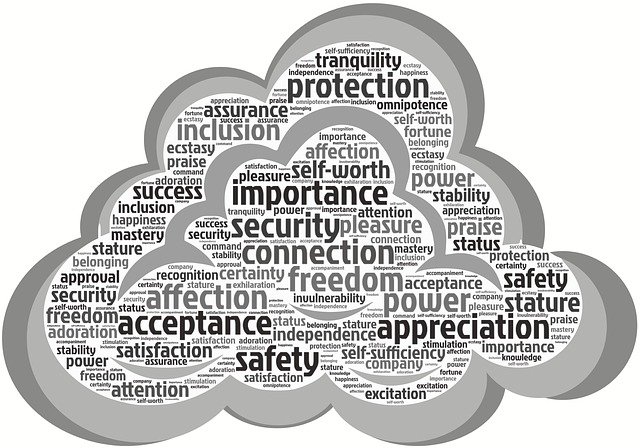
You could take Maslow’s hierarchy of needs and work through that systematically, but does that cover it? Yes, there are some basic needs that ought to be addressed: the need for food, shelter, sleep, company etc. We need our elements of security around employment, health and some material belongings. There is certainly a need for friendship, family, love and a sense of connection. But then we get on to the things that you could argue we don’t NEED, we just WANT. Respect, recognition, strength, and then self-actualisation – to be the best we can be.

There’s another school of thought that suggests a different solution to why we do what we do.

A sense of obligation – to share experience and knowledge, the obligation to serve others. A sense of duty, and pride – perhaps via volunteerism, a call to action, pride in a job well done and our want to succeed. We should be wary of the vice like self intention, cunningly disguised as “being in our best interests”, which only really offer temporary pleasure. Acts of kindness and our altruistic love for the benefit of others. Passion for our favourite activity or cause, our desire to do something. The desire to “tick the box”, perhaps something off our bucket list, but could lead on to somewhere else. Our destiny may be coloured by family tradition, a hobby or particular calling that other family members before us have excelled in. Yes, there’s a need to have a sense of fulfilment to keep us energised and empowered through our self-actualisation. But maybe we do it for others, to have something to share or for the “greater good”.

Tony Robbins, an author and podcaster, as well as being a mutli-billion dollar entrepreneur, in his TED Talk and book, describes 6 human needs – certainty, significance, variety, love/connection, growth and contribution – and how each influences our thoughts, feelings, behaviours and actions. By understanding what drives us, we can understand how to meet those needs. The same for people around us, once we know what drives them, we can help them meet their needs too.

At a very fundamental level, I know I need to be safe, secure, independent and have a sense of purpose. The narcissist in me does need some form of appreciation every now and then, but I certainly need feedback to make sure that I’m at least heading in the right direction and to help me achieve some personal growth. I need to be educated. I need to understand things and learn from them. I try to encompass all of that in my working, social and family life and am conscious that I don’t always get it right.

The 6 Domains of Resilience

The #MSEBUDDYNETWORK I’m part of at work is a great resource for being able to support colleagues who just feel that they need someone to listen to them, for somewhere safe to spout off, or to just reflect and recoup.

There have been some great resources shared throughout the programme and another such example was shared yesterday. Available via the NHS Leadership Academy (through whom I did my Elizabeth Garrett Anderson Senior Healthcare Leadership MSc) are some bite size learning snippets around health and wellbeing conversations specially focusing on resilience.

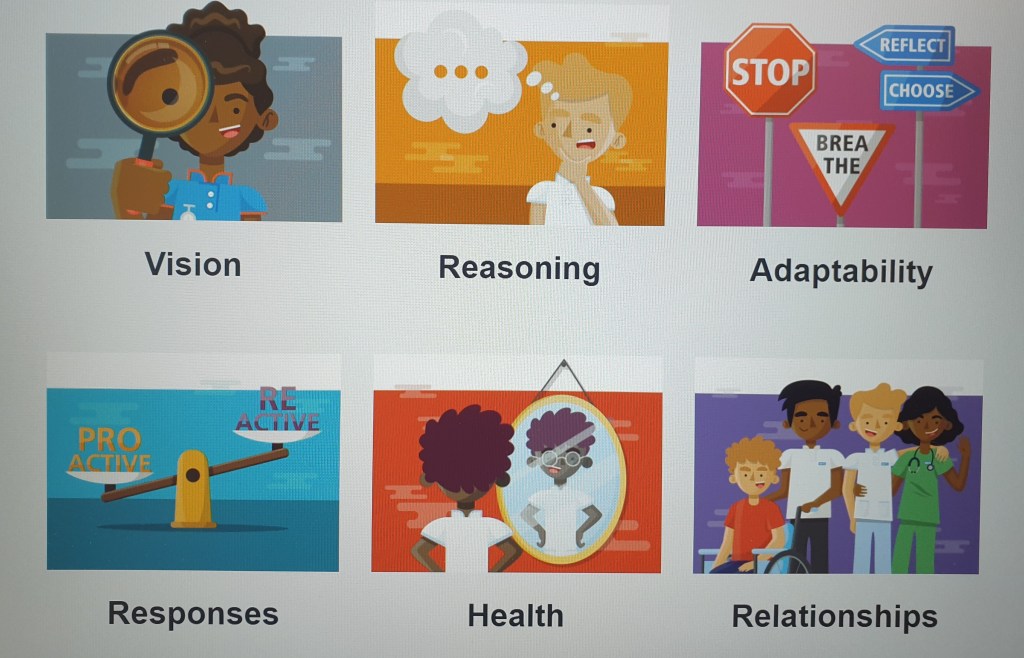
The resource was developed by Sonya Wallbank, a clinical psychologist and organisational development lead. It is broken down into 6 dimensions covering Vision, Reasoning,  Adaptability, Responses, Health and Relationships. Each dimension then goes on to explain its impact and offers suggestions to think about how we could focus our energies into improving them.

The resource is there to support facilitators of conversations and can be applied to your own experiences as well as used as a template to help others. My personal opinion is that we should not expect to help others where we cannot help ourselves first, so for me to support anyone else, I need to understand my own experience.

VISION: This is about setting personal goals and values and understanding why we do what we do and helping shift our anxieties and concerns into hope and curiosity. The questions posed are about asking yourself what you believe is your purpose in life, whether you are engaged in activities that bring out the best in you and inspire you, and what are your goals and how could you get nearer to them.

REASONING: This is our ability to problem solve, be resourceful and anticipate and plan for things and our reactions to set backs. The ask is to reflect on how you react to change in plans, what you need to be able to cope better with change or difficult circumstances, and how you could plan for a range of different potential scenaios.

ADAPTABILITY: Considering our ability to bounce back, be realistically optimistic and flexible about expectations and acceptance of change. You might need to consider how you adapt to last minute changes of plans, how to say “no” or “I could do that if…” instead of saying “yes“, and what could you achieve if you had a bit of extra help.

RESPONSES: How do we react emotionally, psychologically and biologically, to what’s going on around us. What are the things that you are worried about that you could do something about, what are the things that are outside of your control, do you need extra help to get you through this response?

HEALTH: How we feel plays a major part, how are we physically, financially and environmentally. Are there simple changes to lifestyle that could help, do you need help with controlling finances, are you OK in your work or home space?

RELATIONSHIPS: Our culture, team and other relationships all contribute to our resilience. Is there anything that leaders or colleagues could do to help make you feel safer in sharing ideas or opinions, where can you get support outside of your team, what networks and communities do you connect with and what will enable you to thrive.

Another great resource that enables us to help others. But as I said, in order to help others I need to be able to understand my own responses, so I’ll have a sit down and think.

Start as you mean to go on

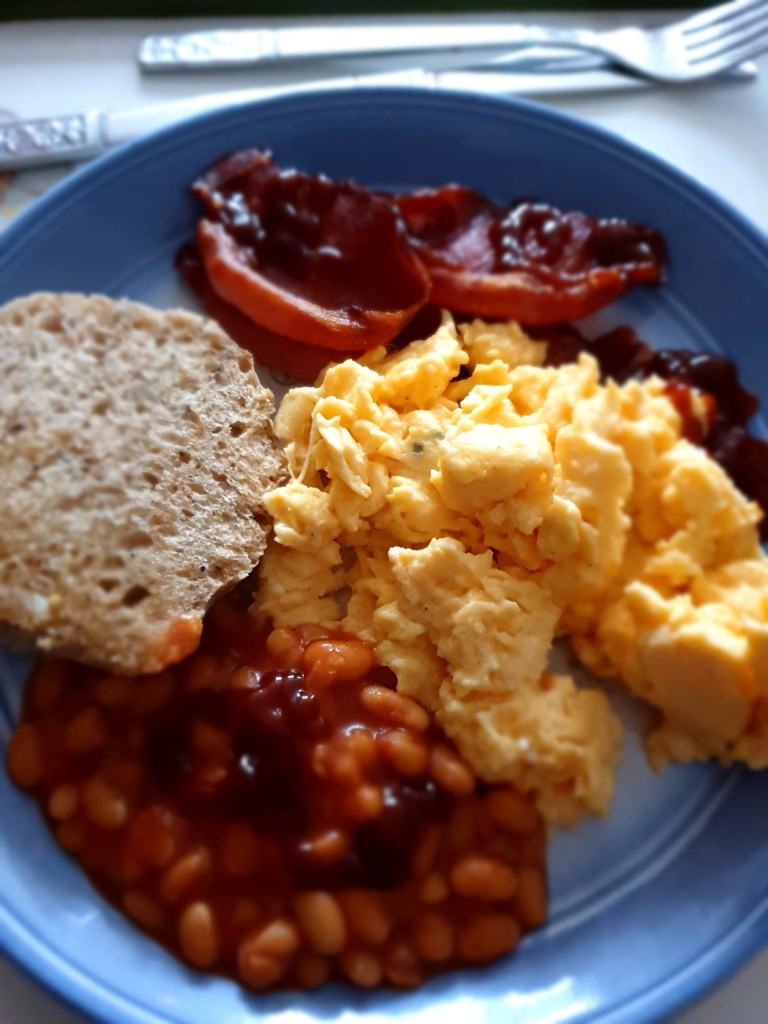
New Years Day morning. A new year ahead that hasn’t been written yet. C made a cooked brunch. I could get used to that 😋.

This year will mark a significant birthday for me. The day this blog is uploaded will mark 50 days until I turn 50. I don’t have any issues with turning 50, it is but a number after all.

The 12 months before I turned 40 I kept a daily diary. I did think of doing something similar for the year that I turned 50 but somehow never got round to it. I guess you could say that I’ve used this blog as a sort of diary, although there’s lots that I haven’t written in a blog that I would have written in a diary.

Starting a new year and a new decade of life gives me the opportunity to start afresh and start as I mean to go on. I could get used to C cooking me breakfast every day but thats not practical or too good for my health. I could take this opportunity to establish some new habits. Start or do more of the things that I ought to do better and drop things that I should not, do less of or that self sabotage.

I read somewhere on line recently that it can take from 18 to 254 days to form a new habit and an average of 66 days for a new behavior to become automatic. Now, I’m not one for New Years resolutions, but I have 50 days to do 50 things that will have a positive habit forming effect on my life to take me into my 50s.

Where to start? Drop me some suggestions 👇

2020 Review of the Year

OK, so let’s join the band wagon of a review of the last year. After all, its been a very different kind of year. Every aspect of every part of life has been impacted one way or another.

Career – started the year thinking it was going to be another year of same old, same old. For the first 3 months that’s exactly how it was. When covid hit it put a lot of things into perspective and I made a decision that, to be honest, had been brewing a while. An opportunity came along to get back into project management, albeit on a secondment. I had to take it for my own sanity. Even though I didn’t start in the new role until December, the thought of it being there was enough to see me through some really horrible months.

Ringing – various ups and downs along the way. Normal routine of Sunday service, monthly quarter peals and weekly practices turned into nothing at all, then maybe 5 people of a Sunday but no practices, then down to just the 2 of us. It looked like we could have gone back up to 5 again for Christmas Day but at the last minute it was not to be. At first I didn’t want to embrace the virtual world of #bellringing. It just didn’t seem worth it. But by May I was running my own weekly practice for family and friends, joining in the odd other online practice and starting to run a monthly district practice and organise a monthly 10 bell practice. Taking full advantage of ringing methods that I wouldn’t normally get to ring in a tower.

Home life – I suppose this is where its hit hardest. We haven’t been able to gather as a family for all the usual events. Mum’s 80th birthday, the May “counting”, R’s birthday, Dad’s birthday. No holiday, no ringing weekends. No visits to North Lincolnshire or Hemel Hempstead or Nottingham. No Cake International Show. We did manage to get a couple of day trips to see R when we were all allowed to mix in small groups again but towards the end of the year it became impossible again. We did set up a regular fortnightly family Skype so we could all keep in touch and at least see each other on a screen if not in person.And of course Christmas was very different. No car boot present swap, no drinking Baileys with R. Just a low key day with C, and chatting with family on Skype.

Cakes – as we haven’t had the usual gathering I’ve not needed to bake as many cakes. I did make a small one for mum’s 80th, a friends 60th and Dad’s birthday, but they only needed to be small ones. I have tried some other bakes instead and been mostly up to date with my BakedIn boxes. I’ve tried a few other recipes too, and did manage to get to a socially distanced class with my favourite teacher at @thecupcakeoven to learn how to make cakecicles and heart gems. I didn’t need to make a Christmas cake as we’re not massive fans of it and we got so much food in the hampers that people sent us. I’m hoping that there’ll be more opportunity for cake in 2021.

I suppose I’m quite fortunately really in that I’ve still been able to go to work and keep some semblance of routine. I’m reasonably tech savvy so have been able to embrace video conferencing and Ringing Room. And of course, the most important bit is that I have managed to stay healthy, as has the rest of the family.

Nothing is going to dramatically change as the clock strikes midnight and a new year starts. But there is hope on the horizon. My colleagues are going through an incredibly tough time and are on their knees trying to keep everyone else healthy but with little support and those idiots that flout the rules and put everyone else at risk. But I do have a sense that we will come out of this the other side. Things will be different and we won’t go back to the way things were, or at least I hope not. We have proven that we can work and play differently.

New Year, new you

My various social media feeds are already abuzz with suggestions about how to start the new year with a new outlook, or a new plan or a new … (insert anything of newness here). Magazines are already cramming the newsagent shelves with top tips on making 2021 the “best year yet“.

An article I’m currently reading offers 4 such tips.

1. Have a vision of where you want to be. Dream big and realign your mindset to think bigger and be more ambitious.

2. Learn something new. Overcome the fear of new knowledge by reading or watching YouTube videos, or do an online course.

3. Prioritise wellbeing to help focus on success. Stress associated with moving forward should be met with taking time to step back and relax.

4. Strengthen your resolve. Put in the time and effort to gain success. Keep going when things get tough. Implement good habits that support your goals.

Well, that’s all fine and dandy but I find it mildly contradictive. You’ve got to steam ahead with goals and learn new stuff and keep going when things get tough, but chill out and relax. If I’m chilling out and relaxing, how exactly am I embracing my ambition, expanding my knowledge and being more resilient? Unless my goal is to chill out, learn how to chill out properly and I resolve to chill out better. Maybe that’s the answer.

Whatever your vision is, whether you want to learn something new, however strong your resolve is and however good you are with your personal wellbeing, I wish you a happy, healthy and safe New Year.

Reflexivity

A group of us picked up where we’d left off in the next session of a leadership course being run by the Trust, and spent a while discussing reflexivity: the examination of your own beliefs, judgement and practices, with the purpose to have a better understanding of what we do with that knowledge.

We were asked to consider what attributes of teams get the best out of us as leaders, and what attributes of ourselves bring out the worst in our team.

For me, the former requires focus, direction, lateral thinking, autonomy and timeliness.  For me to function at a higher cognitive level my team needs to be focused on the task at hand, to all be pulling in the same direction for the same purpose, to find solutions to problems using their own skills, experiences and initiative, and to keep to agreed timescales.  Then, I can fully support their needs, priorities and strategic direction.

I probably set some high expectations and then expect my team to deliver to the same level and quality of output, at the same pace, as me. Of course I’m heading for trouble there. I am a world away from their reality and have a very different skill set. I need to remember that and make concessions. Of course this is going to irritate them because if they are unable to deliver to my expectations,   they may feel under pressure, unsupported, or even like they had failed. And if I don’t get what I expected then I might feel let down and frustrated.

Having recognised this over the years I have tried hard to acknowledge different skill sets and work with people’s skills rather than against them. I try to ensure that people are comfortable with what is being asked of them but at the same time stretch them a bit and help them develop new skills.

Being able to do this will lead to my team being more autonomous,  focused and problem solving. Thus enabling me to be more strategically supportive.