Making your voice heard

Have you ever felt like you’re talking to deaf ears?  You’ve been trying to tell someone something for ages and they’re just not listening?  And then they even have the cheek to say that you never told them?

Just lately, I feel that I’ve been telling people what’s been going on but the message just isn’t getting through.  Messages either aren’t being recognised for their content, or not being considered important enough to disseminate, therefore others aren’t finding out, and feel like nothing is being done.

Case in point today.  For the last, who knows how many months, I’ve been telling a group of people what I am doing to help alleviate a situation for a larger group of people.  That larger group of people have not had that information shared with them, so are getting up in arms about things appearing not to be happening. Because the larger group of people are getting irate, they’re taking it out on the smaller group, who are complaining that they are being got at.  I’ve explained so many times that if they bothered to share the information that I’d given them with the larger group, the larger group would be more satisfied and aware of what is happening on their behalf.

Other recent situations have involved one person complaining that things they are responsible for aren’t working properly, so I’ve given advice on things they might like to try instead to see if it improves things (and I know they do because those same things have been employed elsewhere and worked well).  They don’t bother doing anything different and come back again complaining still that things aren’t working right. 

Am I speaking Martian?

I’ve had times when I’ve felt that I’m just not being heard. What’s given me the strength to speak up was having read a book called “Thanks for the Feedback” by Douglas Stone and Sheila Heen.  It gave me some practical tools to apply which ultimately gave me the courage to speak up for myself and get my point across. 

Things that I have learned about trying to get my point across is that people need to be understood, be clear on what their own issues are, but also be clear on what my concerns are.  People need to be educated rather than blamed or accused of something.  It gets a far better response. Having clear expectations means that there should be no room for misunderstanding, and clearly people I’ve come in to contact with either need it repeating multiple times until it sinks in, or in writing so that I can refer them back to it.

Yet still some people don’t, or won’t listen.
Magazine Questionnaires

Do you ever do those questionnaires in magazines? You know, the ones that tell you, depending on your score, what is in store for you in the coming year, what your personality traits are, or what your love life will have in store?

I remember as a kid the only magazine I bought with any regularity was Smash Hits. The only questionnaires they did worked out which pop star you were likely to marry. Of course you had to do the quiz over and over again until you got the answer you wanted. BTW, the only legitimate answer was Simon le Bon 😍

As I progressed (?) on to mags like Cosmopolitan the questionnaires were more along the lines of “how to make him fancy you” and “why your friends don’t like you much”. I guess they thought they were some sort of attempt at self help.

In the workplace over the years I’ve done many, many psychometric tests like Belbin, designed to find out your fundamental personality traits, then try to convince you how you and your colleagues could all work together in perfect harmony despite your differences. I’ve done Belbin so many times for different reasons. I still come out as ISTJ, the logistician. Introverted, observant, thinking and judging. I like facts and data. I like methodology and practicality. It means I’m honest and direct, strong willed, dutiful, responsible, practical. But on the flip side I can be stubborn, insensitive, always by the book, judgy, and self blaming when things fail.

Because I’m not spontaneous or outgoing I find it hard to make friends or trust people’s motives, or express emotions freely (until really pushed). This is the area I’m working on hardest and the moment and I don’t mind telling you, its bloody hard.

I did a magazine questionnaire this week in Psychologies Magazine about what kind of comfort do you need. Each question has 4 options to choose from then you count the times you’ve selected a particular response and it tries to explain what area you need to search in order to find solace.

Have you ever noticed there’s always at least one question where none of the answers is applicable?

Apparently, according to the number of hearts, diamonds, circles and squares I ticked, I have equal measure of hearts and squares. That means that I need to be looking for something spiritual and relational.

By spiritual it doesn’t mean finding God or some mystical thing, but could be in the form of rituals that allow time for reflection, and to connect with others. It suggests that I should focus on treating everyone with kindness, respect and lack of judgement and increase deep listening, filter out the gossip.

Relational suggests investing in meaningful connections with people and changing the relationship I have with myself. Being more compassionate with myself will, apparently, help me find comfort from others.

So, take my intovertedness and difficulty in making friends, insensitivity, stubbornness and self deprecation and just go out there and make meaningful connections. Just like that. Easy. Not.

Suggestions welcome.

Worth the wait?

Yesterday I ordered some books from Amazon which I hope arrive during the coming week, as I have some annual leave and therefore time to read them. Amazon told me that they should all arrive the following day.

Today Amazon tells me that my parcel should arrive today any time before 10pm. Thats going to be scary if the doorbell rings that late at night!

I have high hopes for these books. They will help me to understand and do better in the social media world. At least that’s what I’m hoping. I hope they are worth the wait.

According to logisticsmgepsupv.wordpress.com we spend around 6 months of our lives waiting in line for things, 43 days on hold with automated customer services, and 27 days waiting for a bus, 32 minutes per day waiting for a doctor, 28 minutes in a security line at the airport, 21 minutes for our significant other to get ready to go out, and 38 hours a year sitting in traffic. A Daily Mail survey suggested that we wait around 4 months of our lives waiting for the kettle to boil.

Sometimes the planning and experience associated with the waiting process can be extremely pleasurable. Like the smell around the house when you’re baking chocolate brownies. The creative processes of art, cooking, crafting, travel, and a myriad of other things can give as much pleasure during the creating or planning process as the final product does. And when you have that final product, it will be all the more sweet knowing the effort it took to create it.

As I’ve said before, I am an ongoing development as a human being and am trying to get as much pleasure out of the creation of the person I want to be, as much as what the end result might be.

Good things come to those who wait, apparently.

Why we do what we do

I have the next week off work as annual leave. I have no plans, and no real thoughts about what to do with my time. I have a couple of reports to write and could bake something but other than that, because we can’t go very far due to lockdown, no other real thoughts about what to do. That got me thinking about why we do what we do (or not).

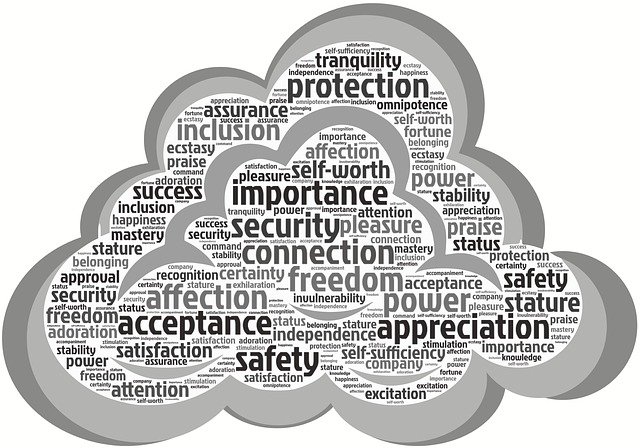
You could take Maslow’s hierarchy of needs and work through that systematically, but does that cover it? Yes, there are some basic needs that ought to be addressed: the need for food, shelter, sleep, company etc. We need our elements of security around employment, health and some material belongings. There is certainly a need for friendship, family, love and a sense of connection. But then we get on to the things that you could argue we don’t NEED, we just WANT. Respect, recognition, strength, and then self-actualisation – to be the best we can be.

There’s another school of thought that suggests a different solution to why we do what we do.

A sense of obligation – to share experience and knowledge, the obligation to serve others. A sense of duty, and pride – perhaps via volunteerism, a call to action, pride in a job well done and our want to succeed. We should be wary of the vice like self intention, cunningly disguised as “being in our best interests”, which only really offer temporary pleasure. Acts of kindness and our altruistic love for the benefit of others. Passion for our favourite activity or cause, our desire to do something. The desire to “tick the box”, perhaps something off our bucket list, but could lead on to somewhere else. Our destiny may be coloured by family tradition, a hobby or particular calling that other family members before us have excelled in. Yes, there’s a need to have a sense of fulfilment to keep us energised and empowered through our self-actualisation. But maybe we do it for others, to have something to share or for the “greater good”.

Tony Robbins, an author and podcaster, as well as being a mutli-billion dollar entrepreneur, in his TED Talk and book, describes 6 human needs – certainty, significance, variety, love/connection, growth and contribution – and how each influences our thoughts, feelings, behaviours and actions. By understanding what drives us, we can understand how to meet those needs. The same for people around us, once we know what drives them, we can help them meet their needs too.

At a very fundamental level, I know I need to be safe, secure, independent and have a sense of purpose. The narcissist in me does need some form of appreciation every now and then, but I certainly need feedback to make sure that I’m at least heading in the right direction and to help me achieve some personal growth. I need to be educated. I need to understand things and learn from them. I try to encompass all of that in my working, social and family life and am conscious that I don’t always get it right.

Surround sound

How often do we get an opportunity to just sit and listen, I mean REALLY listen to the sounds around us?

Both C and I were sat out our respective desks in the study, going about our business when it suddenly hit my ears there there was silence. Neither of us were speaking. At the time neither of us was hammering our keyboards or frantically clicking a mouse. But then I noticed the non-silence which actually became quite loud.

I could hear the birds twittering in the back garden, as clear as a bell. The hum from the fan on C’s PC, continual hum. The wall clock ticking, so loudly too that it beggers belief that sometimes you barely notice it at all. There was an occasional mouse click as one or other of us scrolled up whatever it was we were reading on the screen. There was a throat clearing after a glug of water. There was a chair squeaking under the pressure of shifting weight. There was an airplane outside on its way to, or from, who knows where. There was pen scratching on paper as I was making notes. There was a belly rumble and an over emphasised exhalation.

Within the space of somewhere between 5 to 10 minutes there were all these sounds surrounding me, but there was silence. Peaceful, gratifying, restorative. All of these amazing sounds that I might have missed had the radio in the kitchen been on, or had I been hammering away at documents or emails, or people talking.

Silence can provide us with so many benefits if we choose to allow them into our lives.

It can allow us to concentrate and focus, which apparently can be lost if the sound is over 80 decibels. Obviously the writer of that point has never been to a #bellringing practice where concentration is required despite the noise of the bells.

It can allow our minds to be more creative. Some eminent scientists did their best creative work after a period of solitude and quietness.

It can allow us to discover how we may improve our lives when attention is given to self awareness practices. Taking time to self reflect can help figure out what and where we want to be.

It can help relax us and reduce stress levels if we allow a period of silence.

It can affect our ability to learn. The more noise we are exposed to the worse we perform and find it harder to concentrate.

Doing nothing and remaining silent can increase productivity of new brain cells, which in turn supports greater productivity as much as tenfold.

Silence can help cultivate calmness and peacefulness when you regularly practice silence and patience.

If you are able to, I invite you to sit somewhere comfortable and just be silent for even just a few moments. Make a note of all the things that you can hear in the silence. You’ll be surprised how much surround sound there is.

The 6 Domains of Resilience

The #MSEBUDDYNETWORK I’m part of at work is a great resource for being able to support colleagues who just feel that they need someone to listen to them, for somewhere safe to spout off, or to just reflect and recoup.

There have been some great resources shared throughout the programme and another such example was shared yesterday. Available via the NHS Leadership Academy (through whom I did my Elizabeth Garrett Anderson Senior Healthcare Leadership MSc) are some bite size learning snippets around health and wellbeing conversations specially focusing on resilience.

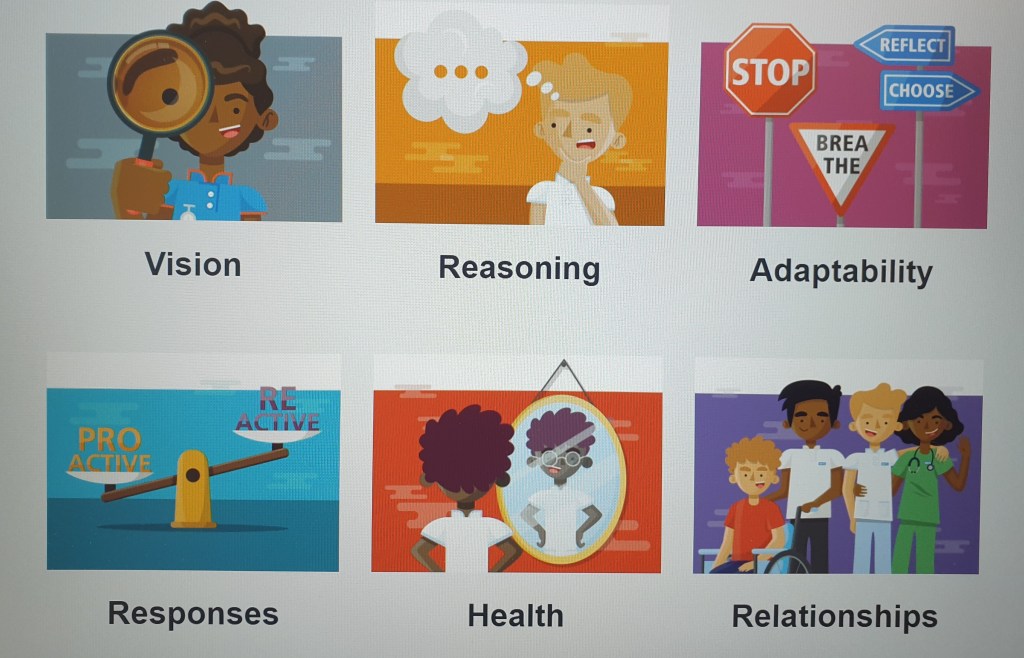
The resource was developed by Sonya Wallbank, a clinical psychologist and organisational development lead. It is broken down into 6 dimensions covering Vision, Reasoning,  Adaptability, Responses, Health and Relationships. Each dimension then goes on to explain its impact and offers suggestions to think about how we could focus our energies into improving them.

The resource is there to support facilitators of conversations and can be applied to your own experiences as well as used as a template to help others. My personal opinion is that we should not expect to help others where we cannot help ourselves first, so for me to support anyone else, I need to understand my own experience.

VISION: This is about setting personal goals and values and understanding why we do what we do and helping shift our anxieties and concerns into hope and curiosity. The questions posed are about asking yourself what you believe is your purpose in life, whether you are engaged in activities that bring out the best in you and inspire you, and what are your goals and how could you get nearer to them.

REASONING: This is our ability to problem solve, be resourceful and anticipate and plan for things and our reactions to set backs. The ask is to reflect on how you react to change in plans, what you need to be able to cope better with change or difficult circumstances, and how you could plan for a range of different potential scenaios.

ADAPTABILITY: Considering our ability to bounce back, be realistically optimistic and flexible about expectations and acceptance of change. You might need to consider how you adapt to last minute changes of plans, how to say “no” or “I could do that if…” instead of saying “yes“, and what could you achieve if you had a bit of extra help.

RESPONSES: How do we react emotionally, psychologically and biologically, to what’s going on around us. What are the things that you are worried about that you could do something about, what are the things that are outside of your control, do you need extra help to get you through this response?

HEALTH: How we feel plays a major part, how are we physically, financially and environmentally. Are there simple changes to lifestyle that could help, do you need help with controlling finances, are you OK in your work or home space?

RELATIONSHIPS: Our culture, team and other relationships all contribute to our resilience. Is there anything that leaders or colleagues could do to help make you feel safer in sharing ideas or opinions, where can you get support outside of your team, what networks and communities do you connect with and what will enable you to thrive.

Another great resource that enables us to help others. But as I said, in order to help others I need to be able to understand my own responses, so I’ll have a sit down and think.

Start as you mean to go on

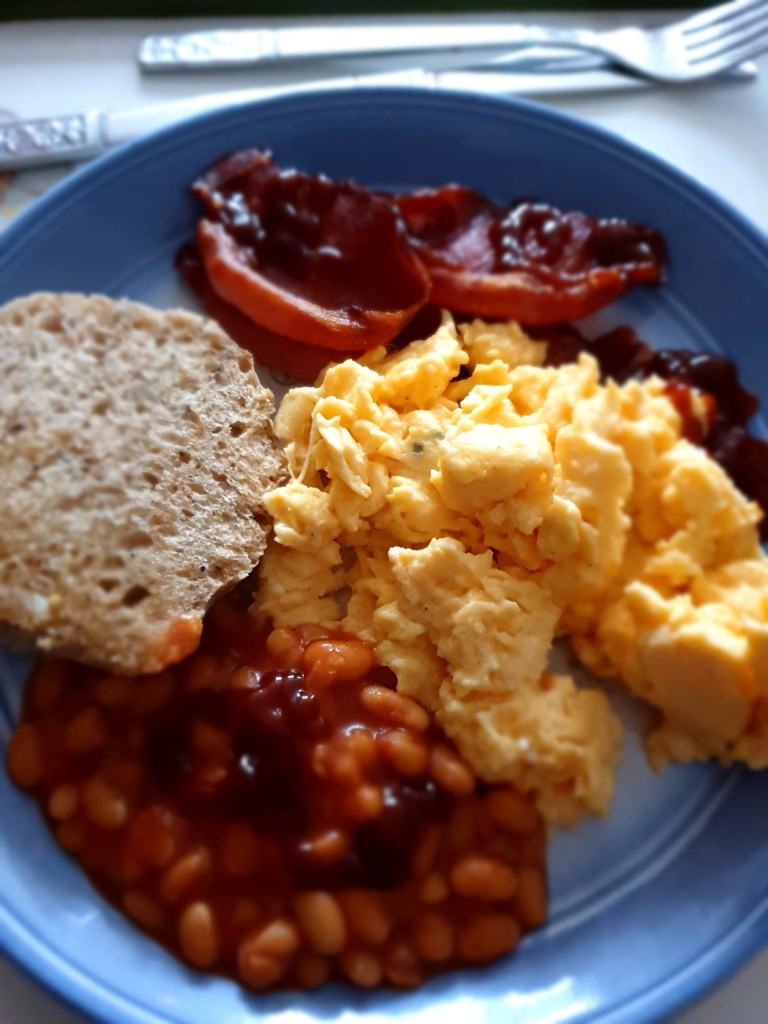
New Years Day morning. A new year ahead that hasn’t been written yet. C made a cooked brunch. I could get used to that 😋.

This year will mark a significant birthday for me. The day this blog is uploaded will mark 50 days until I turn 50. I don’t have any issues with turning 50, it is but a number after all.

The 12 months before I turned 40 I kept a daily diary. I did think of doing something similar for the year that I turned 50 but somehow never got round to it. I guess you could say that I’ve used this blog as a sort of diary, although there’s lots that I haven’t written in a blog that I would have written in a diary.

Starting a new year and a new decade of life gives me the opportunity to start afresh and start as I mean to go on. I could get used to C cooking me breakfast every day but thats not practical or too good for my health. I could take this opportunity to establish some new habits. Start or do more of the things that I ought to do better and drop things that I should not, do less of or that self sabotage.

I read somewhere on line recently that it can take from 18 to 254 days to form a new habit and an average of 66 days for a new behavior to become automatic. Now, I’m not one for New Years resolutions, but I have 50 days to do 50 things that will have a positive habit forming effect on my life to take me into my 50s.

Where to start? Drop me some suggestions 👇

2020 Review of the Year

OK, so let’s join the band wagon of a review of the last year. After all, its been a very different kind of year. Every aspect of every part of life has been impacted one way or another.

Career – started the year thinking it was going to be another year of same old, same old. For the first 3 months that’s exactly how it was. When covid hit it put a lot of things into perspective and I made a decision that, to be honest, had been brewing a while. An opportunity came along to get back into project management, albeit on a secondment. I had to take it for my own sanity. Even though I didn’t start in the new role until December, the thought of it being there was enough to see me through some really horrible months.

Ringing – various ups and downs along the way. Normal routine of Sunday service, monthly quarter peals and weekly practices turned into nothing at all, then maybe 5 people of a Sunday but no practices, then down to just the 2 of us. It looked like we could have gone back up to 5 again for Christmas Day but at the last minute it was not to be. At first I didn’t want to embrace the virtual world of #bellringing. It just didn’t seem worth it. But by May I was running my own weekly practice for family and friends, joining in the odd other online practice and starting to run a monthly district practice and organise a monthly 10 bell practice. Taking full advantage of ringing methods that I wouldn’t normally get to ring in a tower.

Home life – I suppose this is where its hit hardest. We haven’t been able to gather as a family for all the usual events. Mum’s 80th birthday, the May “counting”, R’s birthday, Dad’s birthday. No holiday, no ringing weekends. No visits to North Lincolnshire or Hemel Hempstead or Nottingham. No Cake International Show. We did manage to get a couple of day trips to see R when we were all allowed to mix in small groups again but towards the end of the year it became impossible again. We did set up a regular fortnightly family Skype so we could all keep in touch and at least see each other on a screen if not in person.And of course Christmas was very different. No car boot present swap, no drinking Baileys with R. Just a low key day with C, and chatting with family on Skype.

Cakes – as we haven’t had the usual gathering I’ve not needed to bake as many cakes. I did make a small one for mum’s 80th, a friends 60th and Dad’s birthday, but they only needed to be small ones. I have tried some other bakes instead and been mostly up to date with my BakedIn boxes. I’ve tried a few other recipes too, and did manage to get to a socially distanced class with my favourite teacher at @thecupcakeoven to learn how to make cakecicles and heart gems. I didn’t need to make a Christmas cake as we’re not massive fans of it and we got so much food in the hampers that people sent us. I’m hoping that there’ll be more opportunity for cake in 2021.

I suppose I’m quite fortunately really in that I’ve still been able to go to work and keep some semblance of routine. I’m reasonably tech savvy so have been able to embrace video conferencing and Ringing Room. And of course, the most important bit is that I have managed to stay healthy, as has the rest of the family.

Nothing is going to dramatically change as the clock strikes midnight and a new year starts. But there is hope on the horizon. My colleagues are going through an incredibly tough time and are on their knees trying to keep everyone else healthy but with little support and those idiots that flout the rules and put everyone else at risk. But I do have a sense that we will come out of this the other side. Things will be different and we won’t go back to the way things were, or at least I hope not. We have proven that we can work and play differently.

Flying visit

I needed to pop over to my substantive department to get them to start working on a specific task.

At first my ID badge wouldn’t let me in the department. How rude, I’ve only been gone a week! I set an individual off on the task required but needed to hang about to check he’d understood everything properly.

I decided to kill a bit of time by having a wander about and say hello to a few people. It was interesting how many of them didn’t respond. Even when I joked that I’d only been gone a week had they forgotten me already, only one person responded.

Now, I could take it personally, as a slight that they feel abandoned, or ignored themselves, but given that some of them hardly spoke to me when I was there before, I won’t take it to heart.

I went and sat in my old office for a while, which now feels a bit desolate and empty. I stared at the walls that I had put photographs my daughter had taken on, that were now bare. The photographs are now on the wall over my home office desk instead, no room in the new office.

Already I felt like a bit of an outsider. It brings into stark reality that everyone is replaceable and life goes on. I’ve never felt that I’m irreplaceable and have in fact tried to foster a culture that is not reliant on one single person to make it function.

I’ve always tried to encourage staff to have the confidence to make decisions for themselves, or at least know where to go to for help. I don’t want to be the bottleneck to progress, nor the sort of person who is unwilling to share knowledge in a vain attempt to hold some power over others, or some misguided sense of superiority, or feel threatened by someone else knowing more than me.

Information is for sharing. Knowledge is for those that want it. The team will move on without me and I shall always blow their trumpet.

What you permit you promote

What you allow, you encourage. What you condone, you own.

This phrase was mentioned recently with regard to leadership. I don’t think that this should be solely levelled at leaders. I think this is something that anyone at any level should look to.

If you see a damaged piece of equipment is it solely the responsibility of the leader to fix it? They may well have the responsibility to get it fixed, or purchase a new one, but if staff on the shop floor keep walking past it “oh yeah, that’s been broken for ages” without either reporting it or removing it, then surely they are complicit in any accident that may occur later on if someone tries to use it. The same if something is untidy or a behaviour is unacceptable. If anyone allows it to continue without addressing it, at a commensurate level of responsibility, then they are promoting, allowing or condoning.

As a leader though, you can be quite constrained about how to deal with an issue. Policies and procedures may require certain levels of challenge. Start with an informal conversation to address a behavioural problem, set some improvement objectives, revise them. If after a period of time there is no improvement, escalate to a more formal stage, then repeat the objectives and review. Then, if there’s still no improvement, escalate again and so on. Sometimes there may be 4 stages before anything final is resolved. All of that takes time and of course may have to be kept confidential. That means the rest of the team may think that nothing is being done about it.

For replacing equipment it might be an easier process, but again it has to go through several layers of authorisation before an actual order is placed. That takes time and it looks like nothing is being resolved.

Bring that back to something like parenting. I remember saying to my daughter, when she had books, toys and other stuff strewn across the floor “move it or lose it”. If she hadn’t tidied up within an agreed time frame, I would scoop it all up and put it in the bin. And I mean the outside bin, not a waste paper basket or the kitchen bin.

Mostly with my daughter you only had to tell her once, or on the rare occasion of following through, I did actually put her school work in the outside bin. She threw a wobbly and had to fish it out. But next time I asked her to tidy up “move it or lose it”, she did as asked.

I think as parents, or leaders, shop floor folk, or even family members or friends, it is something that we should all adhere to this mantra, in any situation, walk of life, relationship. If you permit the bad things to happen, you are promoting them as acceptable and the norm.