You should be so lucky, lucky, lucky, lucky

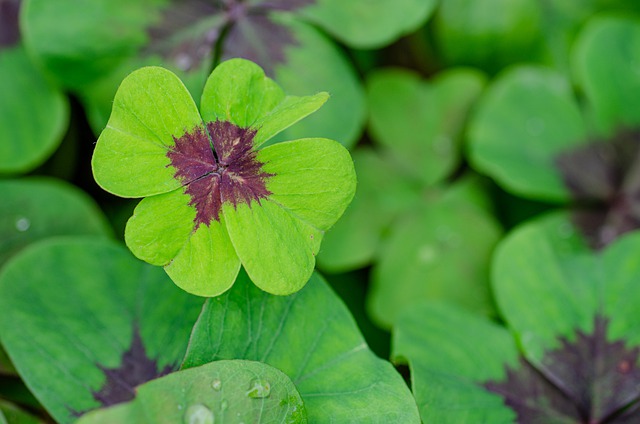
Image by Katharina N. from Pixabay

To paraphrase pop princess Kylie!

Does everything you do have to be meticulously planned out or do you leave something to chance or luck? We are encouraged from an early age to make grand plans “what do you want to be when you grow up?”, develop strategies and check in to make sure we’re still on track and everything is under control. But how much do we put down to sheer luck?  Can luck be harnessed or manifested?  Surely we’d all have won the lottery by now if we were that lucky.

When you consider events that have truly shaped your life, random encounters that introduce you to the love of your life, coming up with a new business venture whilst stirring your latte in the coffee shop, or bumping into an old acquaintance who ends up offering you the job of your dreams, sometimes these aren’t just passively passing luck stopping by for a visit.  According to Dr Christian Busch in Psychologies Magazine, there is an active element that prompted you to seize an opportunity that presented itself, and you did something with it.

It’s a different kind of luck at play here. Not the blind luck such as you happened to have been born into a wealthy family, but the smart luck we create for ourselves when we turn random and unexpected into something positive by our own actions.  Its about joining the dots and making the most of what you are presented with.

According to some research the greatest opportunities and improvements, good and bad, are often down to serendipity.  Good luck resulting from unplanned moments in which a proactive decision leads to a positive outcome. Suddenly the most mundane of encounters can have the potential to change your life for ever.

There are some who seem to be luckier than others, and they may have somehow developed an intuitive muscle for the unexpected.  We can underestimate how predictable the unexpected really is.  True learning and success isn’t about having a linear process and controlling the exact outcome.  Instead of having an exact plan, we need to learn to join the dots.

Successful people tend to have a combination of planned direction but with some freedom to accept the unknown. Its not about letting go of control but gaining influence over uncertainty to be able to use it to your advantage.

Accepting unexpected changes, limitations and imperfections allows you to reframe situations to see an opportunity where others may just see a problem. Busch offers five ways to cultivate serendipity into your everyday life:

  1. Set hooks – whenever you communicate with someone, case a few hooks: concrete examples of your current interests, hobbies and vocation.  This maximised the change you and the other person coincidentally latching onto common grounds and shared passions.
  2. Change the way you ask questions – imagine meeting someone new at a dinner party.  You might go into autopilot and ask what they do.  This limits the other persons response but positioning yourself for smart luck means asking more open-ended questions that open up conversations that might lead to something more intriguing.
  3. Nurture and expand your network – technology fosters serendipitous networking from home but setting “serendipity bombs”.  Write honest, speculate message to people you admire to share you they have already shaped your trajectory, and open up a dialogue about how they can be part of your future journey.  Follow people your respect and make a point of providing thoughtful, relevant commentary on what they have posted.
  4. Reflect on incidences when serendipity could have happened but didn’t – perhaps you bumped into someone but didn’t start a conversation with them.  Perhaps you had an idea in a meeting but didn’t share it.  Identify what held you back and tackle it.
  5. Write down three thing you would do if you had no constraints and you couldn’t fail – write down the reasons why you think you cannot reframe the situation.  Then the reasons why or how you can. Then act on them and make it happen.

Serendipity can be a profound source of moments that make life meaningful and turn unexpected potential threats into a source of opportunity.  Every chance encounter is an opportunity to find love, make new friends, forge a new interest, get that career started.

Go out and grab it by the horns.

It’s only taken 40 years

Image by Tumisu from Pixabay

I learned to ring when I was eleven years old.  Taught by my father at towers that jogged along quite nicely but weren’t particularly high fliers when it came to method ringing and conducting teaching.  By the time I was eighteen and left home I could ring Plain Bob Double, Minor, Triples and Major, and Grandsire Doubles and Triples, and the occasional other Doubles/Minor method that we might have learned for a specific occasions such as All Saints Place Doubles for All Saints Day, at All Saints Church.  It wasn’t until I left home that I started to venture into other methods like St Clements College Bob Minor, and after a couple of years away started to learn Cambridge Surprise Minor. I may have gone via Kent and Oxford Treble Bob, I can’t remember.

There was never any encouragement to learn how to conduct things.  That’s not a gripe, that’s just the way it was at the towers I rang at.  I did call Call Changes, but it was never discussed, supported or even suggested that I learn to call or conduct methods.

When I returned back to my home county, I took up ringing at some different towers and my Minor repertoire extended a little bit with St Simon’s, St Martin’s and others.  Again, I was never invited to conduct, and it didn’t occur to me to pursue it as there were already those in the tower more experienced who just did it.

Then I met C and my method ringing sky rocketed.  I recall one #bellringing holiday where he wrote the line for Stedman Doubles and Triples out on a napkin over lunch during the first day, then for the rest of the tour I rang Stedman at every tower, every day and by the end of the week was ringing touches of it as if I had known it for years.  My methods started expanding into Surprise Minor, Major and now Royal and Maximus. 

At some point I did learn how to call touches of Plain Bob Doubles.  As most people probably do, I started with myself unaffected regardless of what bell I was ringing, then figured out the Make In Out method.  I think this was around the time I was ringing St Simon’s et al.  I did get as far as calling a few quarter peals of Plain Bob Doubles.  I may have even called Go and That’s All for some other methods, but very rarely.

I’ve not really been too worried about conducting as there has always been more experience people around to do that for me. I also feel that I could Call but not Conduct.  Me calling a quarter peal of Plain Bob Double relies on everyone doing as instructed and staying in the right place.  I wouldn’t be able to sort them out if it went wrong.

I guess with the passage of time, I have more awareness of some methods and although I still don’t ring or learn by place bells, I can see where some of the other bells are and can put people right based on seeing where the treble is or knowing what piece of work I’m doing and whether they should be with me or somewhere else in the change. 

In recent years it has become much more noticeable about the lack of female conductors.  A piece of research undertaken shared stories on women’s experiences of being encouraged, and learning to conduct.  The Women in Ringing research (www.womeninringing.info) explored the gender balance within #bellringing and the barriers to progression and untapped potential which may impact the longer-term sustainability of #bellringing.

Anyway, we had a district meeting earlier this week so I went along to support it.  It was a great evening with lots of laughter and learners trying new things.  One lady had only practiced Plain Bob Doubles on the simulator, so had her first goes at ringing it with “real people” and did really well.  Others were stretched and moved away for their usual bell, and everyone got a go with a strong band around them and someone standing with them if needed.  It was a fun practice and the locals really appreciated the support and enjoyed themselves, throwing themselves into whatever they were ringing.

I was asked to call Go and That’s All a couple of times either to Plain Bob Doubles or Minor, and a to a touch of Plain Bob Doubles.  When it came to trying a touch of Plain Bob Minor a band caught hold and the ringing master asked several others if they would like to call the touch.  Everyone declined citing inexperience.  C was sitting this one out and was on the bench behind me.  So I volunteered to have a go and he could poke me in the leg when a call was due just to make sure I got it in the right place.  I called the very simple touch where a Bob was called every time the bell I was ringing was doing its 5/6 up or 5/6 down dodges.  Four calls in total.  C did poke me in the leg at the appropriate times, but I was already there, called the Bob and even managed some semblance of being able to see where the Treble was at the time. 

That is the first time I have EVER called a touch of Plain Bob Minor.  EVER. And I have to say I was rather chuffed. 

I would like to call more, and I need to do more homework around that I understand, but there are opportunities on a Sunday morning or a practice night where I could at least say Go and That’s All to plain courses of things. 

From the success of last week’s virtual #bellringing session where we all got to have a go at saying Go and That’s All to plain courses of the new method we were learning, and the invigoration from calling my first touch of Plain Bob Minor this week, I might well push to call more, even if I can’t fully conduct things yet.  I’ll need to read some more chapters of Calling It Round (https://callingitround.cccbr.org.uk) then just put myself out there.

An unusual networking opportunity

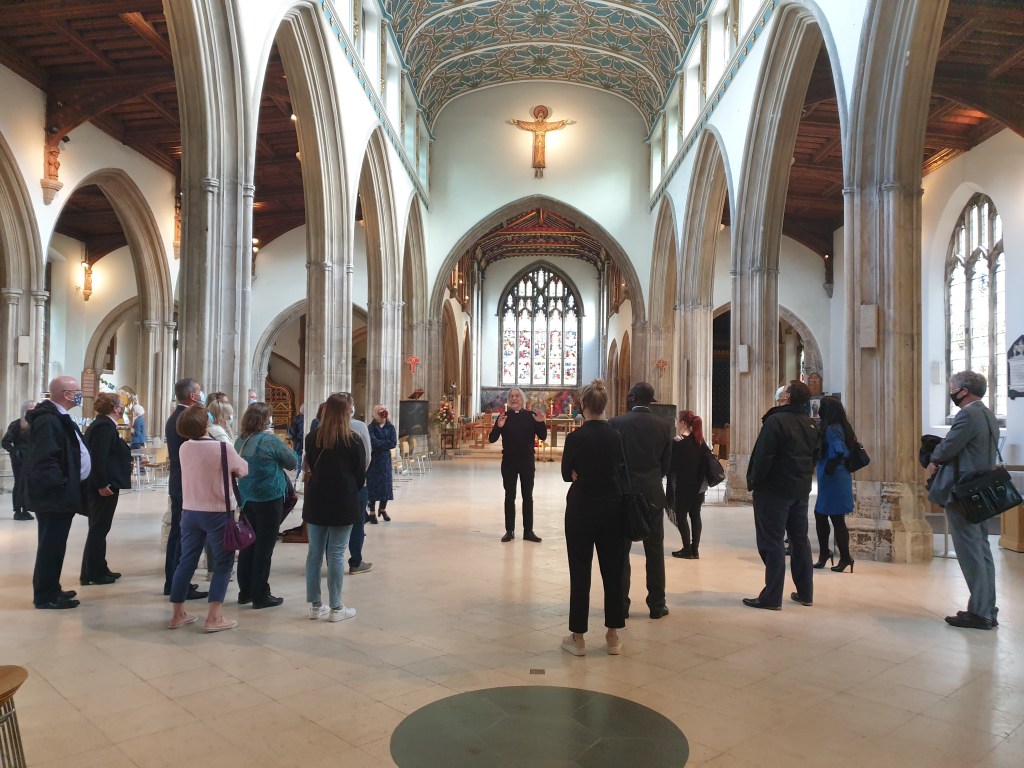
C and I, as cathedral bellringers, were invited to a lunchtime event hosted by the Dean for local business and cathedral groups.  It was the first event of its kind and entitled “How are we”? The idea was for people to meet, have a short guided tour of the cathedral from the Dean then just chat over a spot of lunch.  No sales pitch, no begging, no religious conversion therapy, just chat about how things are going as we crawl out of this pandemic.

C and I were slightly bemused to have been invited, but I later found out that several of the cathedral groups were also invited as part of the cathedral community.  It seemed we were the only ones to pitch up though.

There were about 30 people from the local council, businesses, retail and corporate. The tour started outside the south porch with the Dean explaining a little bit of the history of the building and pointing out where ancient met modern.  Inside we went to St Peter’s Chapel, where the Dean mentioned the space that gives opportunity for quiet reflection or intimate conversation.  He did mention, as it’s the chapel where all the war memorials are, that the bellringers (and thus pointed us out) were working with the cathedral to update the bellringers memorial. 

He then moved us across to St Cedd’s Chapel and explained a bit about Cedd and how he brought Christianity to the heathens and the Chapel at Bradwell.  Moving into the centre of the nave, the Dean pointed out some more architecture and art (apparently our cathedral is known as one of the most modern art cultured cathedrals).  He extolled the virtues of the vast open space and possibilities of different use.  As we moved up to the Alter he spoke of the Bishop’s seat, the only reason we are a cathedral.  I thought of Air Force One at that moment and how the US President’s plane is only called Air Force One when the President is on board and if they move to a different plane, that one changes its moniker.  If the Bishop’s seat was somewhere else, so would the cathedral be.

It was really interesting to hear some stories about how different parts of the building had evolved over time.  I had taken a few photos of the group listening to the Dean as we wandered around.

A sandwich lunch had been provided with tea and coffee and it wasn’t long before I assumed my usual position in pouring cups of hot beverage, wiping surfaces down, offering sandwiches around and refilling cups.  The person who has organised the event was trying to do everything herself so it seemed the obvious thing to do to help.  I knew where things were in the kitchen and not afraid to make myself useful, even though technically I was a guest.  The relief on her face was palpable.  She was trying to network with people, make sure the Dean stayed out of trouble and sort the refreshments out.  C busied himself chatting with the cathedral architect and someone else and seemed happy enough. 

As the event started to draw to a close, I started to gather up empty cups and abandoned plates and take them to the kitchen where one of the vergers started to load the dishwasher.  The Dean said his thank yous to everyone for coming and there seemed to be genuine appreciation of the event and desire to do something similar again.  The lady who’d organsied it was worried that it wasn’t going to be successful but given that nobody seemed to be in a terrible hurry to leave and were happy to continue networking and looking around, I told her that I thought it had been very successful.

Oddly, it was probably something that I would never have bothered to go to previously.  It just so happened that I had the day off work and C and I both thought it wouldn’t hurt to do a bit of networking.  I suggested that if they wanted to do something similar again, we could offer tours of the bell chamber, do a bit of demonstration ringing and get people to have a go.  Worth a try!