Accessing help when and where you need it

As you know, I’m part of the #MSEBuddyNetwork where I work.  A growing group of staff who offer support to others by way of listening and signposting people to other organisations or people for help and support.

This week on our usual Tuesday lunchtime catch up, we were joined by members of the second cohort of buddies, which was great.  It not only shows that there is a need for this type of thing, but also that there are staff willing to act as Buddies and offer that support to their colleagues.  Our Tuesday sessions are an opportunity for us as Buddies to get together and debrief, or share any concerns that we have.  Its been really interesting to hear what some of the other Buddies are experiencing, and we are extremely careful not to go into any detail about particular conversations, to ensure privacy.  It gives us the chance to help other Buddies out, to Buddy the Buddy, and to think about how we might respond if were found ourselves in a similar conversation.

Every so often someone external to the Buddy Network comes along to give a talk on a useful topic, or to share information about a group or organisation that might be able to offer extra guidance, or support to those in need.  This week we learned about the “Here for You” initiative, a joint venture between Essex and Herts providers to support NHS staff mental health and wellbeing and offer in-reach and out-reach support, and can fast track to primary and secondary care where appropriate.  Their model ranges from supporting compassionate leadership and management through increasing intensity to psychological support services.

One of the Buddy Network organisers shared an app that they had been made aware of during their Mental Health First Aid training called “Hub of Hope”.  An app you can download on to your phone, and when you put in a location or postcode, it comes up with all sorts of organisations and places you can go to get further support for mental health concerns from its database of the UK’s leading mental health support organisations. It brings together local, national, peer, community, charity, private and NHS services in one place.

Whether we are dealing with colleagues at work, friends or family members, it is important to be able to access information, support and help when and where you need it.  I would certainly recommend downloading the app, if not for you, then for someone you know.

Sitting with adversity

I’ve just completed a free, online 6 week course in Demystifying Mindfulness course via Future Learn (www.furturelearn.com).  The course covered the “science of mindfulness, how it works and why from a political, psychological and philosophical perspective”.  Throughout the course were a series of Mindfulness Labs, opportunities to practice a meditation technique. Something not so long ago I would have said was nonsense. One of the ones that resonated with me most was the one on Sitting with Adversity.

Usually throughout a meditation the participant is encouraged to let go of thoughts and feelings and concentrate on breath or sounds.  In this particular one though we were actively encouraged to invite a difficult situation, thought or feeling and to acknowledge its existence, to sit alongside it, before considering “each in breath a new beginning and each out breath a letting go”.

So many situations to choose from. I may well have to come back to this meditation several times to get through them all.  However, at the end of the 15 minutes or so, I felt much calmer about the situation I had been thinking about.  I chose to lessen its hold over me and consider what was within my personal means of being able to do about it.  In the end, I chose to let it be what it will be.

Even coming to terms with that simple statement of letting something be what it will be and making a conscious decision to not let it affect me in the way it had been, was enough to lighten to load.

I have done several short courses via Future Learn and would thoroughly recommend it as a way of broadening horizons and dipping into something before deciding whether or not its something you want to pursue further.

The 6 Domains of Resilience

The #MSEBUDDYNETWORK I’m part of at work is a great resource for being able to support colleagues who just feel that they need someone to listen to them, for somewhere safe to spout off, or to just reflect and recoup.

There have been some great resources shared throughout the programme and another such example was shared yesterday. Available via the NHS Leadership Academy (through whom I did my Elizabeth Garrett Anderson Senior Healthcare Leadership MSc) are some bite size learning snippets around health and wellbeing conversations specially focusing on resilience.

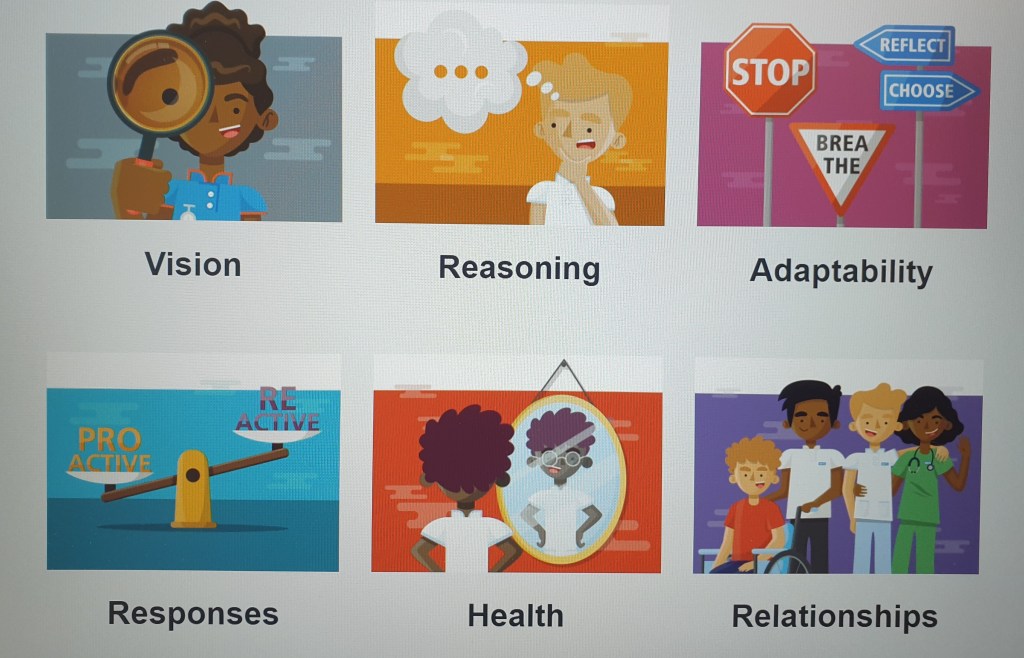
The resource was developed by Sonya Wallbank, a clinical psychologist and organisational development lead. It is broken down into 6 dimensions covering Vision, Reasoning,  Adaptability, Responses, Health and Relationships. Each dimension then goes on to explain its impact and offers suggestions to think about how we could focus our energies into improving them.

The resource is there to support facilitators of conversations and can be applied to your own experiences as well as used as a template to help others. My personal opinion is that we should not expect to help others where we cannot help ourselves first, so for me to support anyone else, I need to understand my own experience.

VISION: This is about setting personal goals and values and understanding why we do what we do and helping shift our anxieties and concerns into hope and curiosity. The questions posed are about asking yourself what you believe is your purpose in life, whether you are engaged in activities that bring out the best in you and inspire you, and what are your goals and how could you get nearer to them.

REASONING: This is our ability to problem solve, be resourceful and anticipate and plan for things and our reactions to set backs. The ask is to reflect on how you react to change in plans, what you need to be able to cope better with change or difficult circumstances, and how you could plan for a range of different potential scenaios.

ADAPTABILITY: Considering our ability to bounce back, be realistically optimistic and flexible about expectations and acceptance of change. You might need to consider how you adapt to last minute changes of plans, how to say “no” or “I could do that if…” instead of saying “yes“, and what could you achieve if you had a bit of extra help.

RESPONSES: How do we react emotionally, psychologically and biologically, to what’s going on around us. What are the things that you are worried about that you could do something about, what are the things that are outside of your control, do you need extra help to get you through this response?

HEALTH: How we feel plays a major part, how are we physically, financially and environmentally. Are there simple changes to lifestyle that could help, do you need help with controlling finances, are you OK in your work or home space?

RELATIONSHIPS: Our culture, team and other relationships all contribute to our resilience. Is there anything that leaders or colleagues could do to help make you feel safer in sharing ideas or opinions, where can you get support outside of your team, what networks and communities do you connect with and what will enable you to thrive.

Another great resource that enables us to help others. But as I said, in order to help others I need to be able to understand my own responses, so I’ll have a sit down and think.

Understanding Emotional Intelligence

Emotional intelligence (EI), sometimes referred to as Emotional Quotient (EQ), is the ability to understand, manage and use your emotions in a positive way to help relieve stress, effectively communicate, empathise, overcome and difuse difficult situations.

This week’s #MSEBuddyNetwork focused on understanding our EI. We were asked to complete a questionnaire to determine our current state of EI in the 4 areas of self awareness, managing emotions, motivating oneself, empathy and social skill. At the end of the questionnaire you tot up the scores and there’s a brief descriptor of how to interpret the scores. If you score 10-17 this indicates a development priority, 18-34 suggests giving attention to the weaker areas and 35-50 indicates this area of strength.

Having an understanding of you EI affects your performance at work, your physical health and mental wellbeing, your relationships with others and social intelligence.

I scored 40, 37, 36, 37 and 29 in each area respectively. No surprises that the area I need to work on most is in social skills. I’m not a great mixer. I like my own space and am close to a very small group of people. I’m not an outgoing sort of person and not brilliant at networking. But this area is key to my every day work and some of the roles I occupy in a voluntary capacity. Its about persuasion, building rapport, collaboration. I’m OK at the reflection, change management and leadership side of social skills.

The Skillsyouneed.com website has some useful resources and suggestions on how to develop in these areas as well as suggestions on further reading.

The other thing I thought would be useful to do would be to get someone who knows you reasonably well to do the questionnaire but about you. That way it could validate your own perception of your strengths and weaknesses, or shed some light on your blind spots (Johari window).