Giving as good as I got

I have benefitted over the years from having people at work, more senior to me, notice what I am capable of and look out for opportunities for me to progress and get promotions.  They have been my cheerleader, mentioning me to others as someone who might be able to help solve their problems.  My last three positions were brought about through conversations with someone, who then prompted someone else, and an opportunity door opened for me.

Until yesterday, I didn’t really twig, that I am now that person for others.  I am the one cheerleading others into opportunities and finding ways for progression and promotion for others.  I am now that person who I had the benefit from.  It’s now my turn to support others.

In my previous two roles I managed large teams of people.  There were a few who showed a spark, who had something worth cultivating. I spent time with them helping them to consider whether a change in career would be good for them, whether they had the right skills and attributes for a different role. 

It seems a bit counter intuitive to be helping your staff to move to a different job, after all, it’s going to leave you short of experienced staff in your own area.  But I feel we shouldn’t be selfish in that regard.  Where people show an interest, a spark of enthusiasm, and indeed some level of competence, I feel its my job to nurture that.  To provide opportunities for them to experience other things, to have a go at something they may not otherwise get the chance to try.

I have sat with staff looking at job descriptions going through each one, line by line to explain where they have transferrable skills, or where they need to get some more exposure or experience.  Often, these people have the skills but lack the confidence to try.  Once you start to point out to them that it’s not all about knowing everything there is to know about a job before you get there. There will be things they can do that are similar, systems they’ve used that demonstrate they can learn a new system.  Even considering household chores as project planning.  How do you get the kids out to school every morning and then get to work on time?  Its all about planning and having things in place.  These are all skills that people don’t necessarily think about when they look at a job description.

Just lately I have given support to someone looking to get out of the role they are unhappy in.  One has come up that I think they could be capable of doing, but they lack the confidence because they’ve not done that sort of thing before.  Well, me neither.  My last two big teams I managed I knew nothing about their service, but I knew how to process map, I knew how to plan and how to deal with people.  The rest I learned along the way.

One of the most fun books I’ve read was Richard Branson’s ‘Screw It, Let’s Do It!’  The premise simply being do it anyway.  You don’t know if you can do it unless you try.  You might fail, many, many times, but you learn from those failures and build on them.  If you never try, you never learn.  There’ll be people there to help you along the way.

If you’re thinking of a new career move, or a change in direction in any part of your life, I say “screw it, just do it”. 

How one sentence can change your life

Image by 165106 from Pixabay

Whether we recognise it or not, we all need and use mentors and coaches that we can look up to who have travelled that path we are on now.  We might not recognise someone in that role “officially” but every time we have a conversation with someone, and we ask questions, or for advice, the other person is mentoring or coaching. You probably have many people who have inspired you, or you’ve learned from, or someone who has had an impact on you.

For anyone who has delved into the world of personal development, you can often look for more “official” role models.  It could be a colleague or work based mentoring scheme, or through the world of personal development and life coaching.  There are hundreds of them out there ready to help.  But how do you know which one to approach?  It’s going to cost you money and you want to make sure you get value for that.  You need to feel comfortable with them as going through the process can leave you feeling quite vulnerable.

I spent time with one person and all she said every time I asked a question or for advice was, “what would you tell someone else if they asked that question?”  That’s not helpful if you’re searching for those answers yourself.  Someone else’s story is different to your so it doesn’t necessarily translate.  If I knew what to tell someone else, I wouldn’t be asking the question myself, would I?  Thankfully, I wasn’t paying for this particular pearl of wisdom, and I’ve not been back since to that particular person.

We can often feel guilty for investing in our own growth and so far, I’ve not spent real money on it, but I am curious about it.  I saw something recently on LinkedIn which sounded really fun.  It was a group for women for fun and fascinating conversations in and around London, with events hosted at some truly stunning locations.  I was really tempted, it sounded like fun and a good opportunity for networking and to experience different things.  But something held me back.  The cost actually wasn’t that extravagant: £20 per month or £220 for the year for which you get exclusive access to the podcast, the online community and networking and so on.  Obviously there was a cost of attending an event on top of that, but factor in the glitz and glamour of attending an intimate supper in one of London’s most gorgeous venues, drinks nights, or bespoke evenings like wine tastings, book clubs, walks and talks.  It all sounded like a fun thing to do, to experience.  What was really holding me back was two things:

  1. Would I fit in with this group of people?  My lifestyle is so very different at the moment.  Would I look and sound like an idiot around these, presumably very cultured and clever people?
  2. Could I justify the expense?  It’s not much, but without being able to see exactly what I’d be getting for my money, I don’t know whether it would be worth the investment, and what I’d truly get out of it.

But surely if I don’t try, how will I ever know?  It’s a bit like mentoring and coaching, until you try with someone, you’ll never know if it’ll work for you or not.

Now, I’ve also had some great work based coaches.  Two stand out.  One I’d never met before and knew nothing about, who was very much senior to me, who was willing to meet with me over a coffee and chat about my future.  She carefully explored how I thought my career was going, and I do remember one particular piece of advice she gave me “when you go for an interview, wear some sexy undies, it’ll make you feel really special, and you’ll hold yourself completely differently”.  I’ve never actually put that to the test, but I can see her point.  The second coach I’ve had experience with was someone I know of, not necessarily very well, but we have mixed in work circles before.  She knew more about my situation and pushed a bit harder at the “what do you really want?” thoughts. This really helped me galvanise my own plans. She never told me what I should do, she asked how various things made me feel, and asked me to explore my feelings around the various options that were open to me.  It was a very soft and gentle approach but had some hard hitting lessons behind it.

So, I’m currently flitting between what should be my next self-development step with coaching or mentoring. Again, I need to look at where I want to be in life and what things do I want to experience.  Should I invest at least one £20 monthly fee in this London club and dip my toe in the water to see if it’s the right fit?  I know only I can answer that question. 

When you start to investigate life coaches, you’ll see they charge £thousand’s for their efforts.  I recognise that’s due to their expertise and knowledge in this area, but can it really be value for money?  Obviously, they would claim it is and all the intangible results you’ll benefit from along the way.

But they might just have that one sentence that could make a world of difference.

6 people in your corner OR 5 mentors you need?

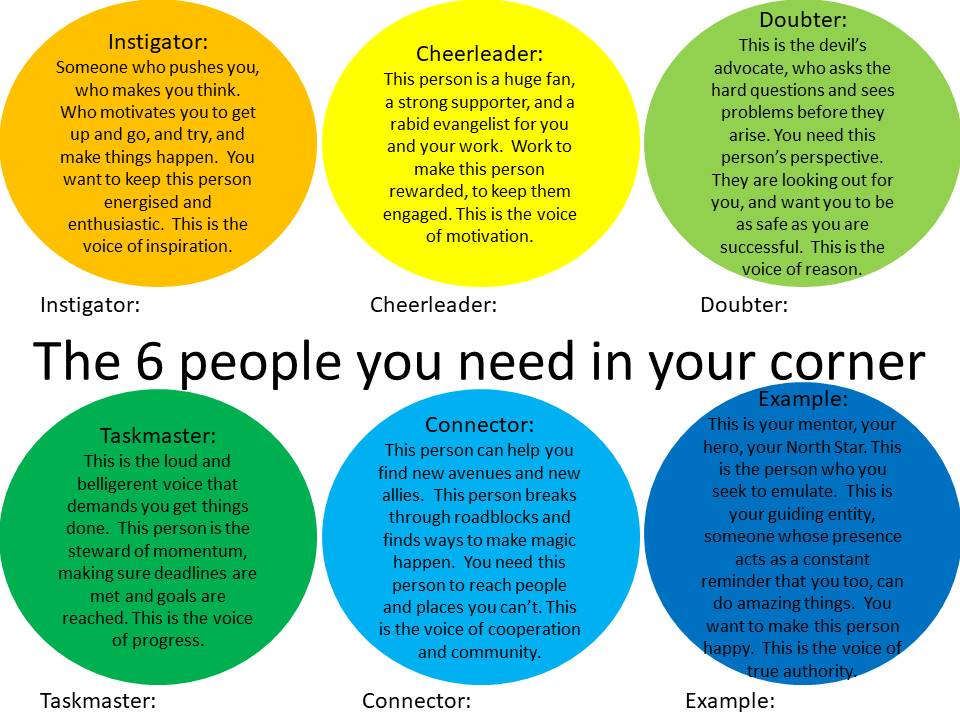
Several years back one thing I picked up, presumably from some talk or online article was the notion of having 6 people in your corner.  Basically, these represented 6 characters that would help and support your leadership journey.  They didn’t all have to be different people, although they could be, or some, or all of them could be the same person.

The 6 characters were:

The Instigator: Someone who pushes you, who makes you think.  Who motivates you to get up and go, and try, and make things happen.  You want to keep this person energised and enthusiastic.  This is the voice of inspiration.

The Cheerleader: This person is a huge fan, a strong supporter, and a rabid evangelist for you and your work.  Work to make this person rewarded, to keep them engaged. This is the voice of motivation.

The Doubter: This is the devil’s advocate, who asks the hard questions and sees problems before they arise. You need this person’s perspective.  They are looking out for you, and want you to be as safe as you are successful.  This is the voice of reason.

The Taskmaster: This is the loud and belligerent voice that demands you get things done.  This person is the steward of momentum, making sure deadlines are met and goals are reached. This is the voice of progress.

The Connector: This person can help you find new avenues and new allies.  This person breaks through roadblocks and finds ways to make magic happen.  You need this person to reach people and places you can’t. This is the voice of cooperation and community.

The Example: This is your mentor, your hero, your North Star. This is the person who you seek to emulate.  This is your guiding entity, someone whose presence acts as a constant reminder that you too, can do amazing things.  You want to make this person happy.  This is the voice of true authority.

Back in about 2009, when I first discovered this, I knew exactly who these people were.  Some of them wore multiple hats for me.  After about 2011 when I’d changed jobs, I really could not pinpoint anyone amongst my work colleagues that fitted any of those roles for me.  Happily, I am once again in the position where I can identify at least one person, even if it’s the same person, for each of those roles.

I’ve just read an article by Anthony Tjan on ideas.TED.com who suggests that we should have 5 mentors:

The Master of Craft: “If you know you want to be the best in your field — whether it’s the greatest editor, football quarterback, entrepreneur — ask, Who are the most iconic figures in that area?” says Tjan. This person can function as your personal Jedi master, someone who’s accumulated their wisdom through years of experience and who can provide insight into your industry and fine-tuning your skills. Turn to this person when you need advice about launching a new initiative or brainstorming where you should work next. “They should help you identify, realize and hone your strengths towards the closest state of perfection as possible,” he says.

The Champion of your cause: This mentor is someone who will talk you up to others, and it’s important to have one of these in your current workplace, says Tjan: “These are people who are advocates and who have your back.” But they’re more than just boosters — often, they can be connectors too, introducing you to useful people in your industry.

The Copilot: Another name for this type: Your best work bud. The copilot is the colleague who can talk you through projects, advise you in navigating the personalities at your company, and listen to you vent over coffee. This kind of mentoring relationship is best when it’s close to equally reciprocal. As Tjan puts it, “you are peers committed to supporting each other, collaborating with each other, and holding each other accountable. And when you have a copilot, both the quality of your work and your engagement level improve.”

The Anchor: his person doesn’t have to work in your industry — in fact, it could be a friend or family member. While your champion supports you to achieve specific career goals, your anchor is a confidante and a sounding board. “We’re all going to hit speed bumps and go through uncertainty in life,” says Tjan. “So we need someone who can give us a psychological lift and help us see light through the cracks during challenging times.” Because the anchor is keeping your overall best interests in mind, they can be particularly insightful when it comes to setting priorities, achieving work-life balance, and not losing sight of your values.

The Reverse Mentor: “When we say the word ‘mentor,’ we often conjure up the image of an older person or teacher,” says Tjan. “But I think the counterpoint is as important.” Pay attention to learning from the people you’re mentoring, even though they may have fewer years in the workplace than you. Speaking from his own experience, Tjan says, “Talking to my mentees gives me the opportunity to collect feedback on my leadership style, engage with the younger generation, and keep my perspectives fresh and relevant.”

They both cover a lot of the same ground but Tjan has some interesting other ideas.  I know who my Champion and Copilot are.  I think I am my own Anchor really.  I’m pretty clued up to my own values and setting personal priorities to achieve a good work-life balance.  I’m not sure who my Master of Craft is at the moment or my Reverse Mentor as I’m fairly disconnected with leading or mentoring anyone at the moment.

Do you know who you’d have in your corner or who are your 5 mentors?