This week can do one

The feeling you have after a week’s annual leave, supposedly of having rested and regathered, hasn’t lasted long on my return this week.  For some reason its been a real challenge, more so than usual.

So many of my team are either on annual leave or off sick, or off because someone in their household has symptoms so they need to isolate.  Of course the knock on effect for those left in the office has been really difficult.  The volume of work doesn’t decrease, and the type of role we have means that you can’t just leave it until the next day. Stresses and strains were really showing.

I have emailed all our services users to explain our predicament to give them the heads up that our service might not be up to standard. It has prompted a few to offer support where they can, albeit very limited, for which we are incredibly grateful. Of course there are others who are adding more pressure by phoning through monotonously, demanding that theirs is more important than anyone else’s. Well, no its not. Its all as important as each others because it involves patients, and one patient is no more or less important than the next.

In order to support my team as best I can I will come in on my day off to deflect some of the grief they’re getting, and I have also bought them all a prepaid coffee voucher as a thank you for their hard work. Neither of these things goes anywhere near to making up what they’re dealing with this week, but a simple way for me to acknowledge them.

Here’s hoping next week is a bit better. This week can definitely do one.

Moral Injury

The #MSEBuddyNetwork meeting yesterday was discussing moral injury, particularly in light of dealing with the pandemic.

The group were sharing issues where they have been asked to do things, or not do, that go against the individual’s morals or that they could make things right.

As a manager of a large team I had to introduce mechanisms to try to keep the whole team safe and Covid secure. This has meant impacting on their home situations. As time has gone on, staff are getting tired and frustrated that their seems to be no end in sight.

The NHS is an incredibly resilient organisation, however the individuals within it are really struggling. People come in to work, and on the surface seem fine, but we recognise that deep down they are not. Accepting the current situation does not mean that we necessarily agree with it, but we are trying to manage it as best we can.

We also need to be careful not to project those things on to others either in the workplace or at home. Sometimes we need to accept that we can’t fix everything and that we have to accept a lower bar, but that doesn’t mean we agree with it.

You’ve got mail

One of the things I dread when I go back to work after some annual leave is the size of the email in box. I refuse to log in when I’m on leave or my day off. If I’m not at work, I’m not at work.

To some in managerial positions that might seem like sacrilege. Surely if you’re a manager you should be available all the time. Well, no. I’m available the hours to which I am contracted to and for what you pay me, and if the work you are asking me to do falls outside of that, then we need to have a serious conversation.

I have done my fair share of ridiculous hours, weekends, nights, earlies etc. Been on call, been on conference meetings, and been in for meetings on my day off and all sorts. The trouble is, the more you do it, the more it becomes expected, and the more you get in the habit of doing it, and don’t switch off.

I do make some concessions. If a meeting absolutely has to take place on my day off and its imperative that I’m there, I will of course support it if I can. But I ensure I get that time back.

I have so much else going on in life outside of work too that I can’t afford to do it. My brain would explode.

There should be nothing that either can’t be dealt with by someone else, or that can’t wait until I get back.

My role as a manager and leader is to equip my staff to be self sufficient and confident to deal with most eventualities, and I should not be a bottleneck in the way.

So, 305 emails in the inbox after 1 week off. A chunk of those are routine and can be dispatched fairly promptly. That took me down to 206 by lunchtime. Then there’s the ones that I do need to read but don’t necessarily have to do anything with or about. Then there’s the ones that do require input.

By the end of the first day back I’ve got them down to a manageable 31. And don’t forget, more were coming in throughout the day too.

Another day tomorrow and another new bunch of emails to wade through.

Remembrance Ringing

#bellringing traditions run deep. From Christmas morning, New Years Eve, weddings, funerals, but especially Remembrance Sunday.

In 2018 I was the project coordinator for the #Ringingremembers campaign, an initiative to recruit at least 1400 new bellringers to symbolically replace those that were lost during WW1, on the 100th anniversaryof the Armistice. The project was a massive success due to the community spirit in wanting a way to remember those who had died, as well as the hard work put in by the #bellringing community, who recruited and taught new ringers in the months leading up to the anniversary. So successful was the campaign that we recruited over double the original target.

Fast forward 2 years and it was a very different story this Remembrance Sunday. Due to lockdown restrictions #bellringing has been severly curtailed since March, and there hasn’t been a full return to ringing since the first lockdown yet.

Therefore #bellringing this Remembrance Sunday featured the lone tolling of one bell to mark the Nation’s tribute to the fallen. For many ringers this has been one of the most painful days of not being able to ring.

What is worrying is that all the efforts put in 2 years plus ago, might be undone, as we’re nowhere near a return yet. And when we do return, how many of our number won’t? Whether age, infirmities or loss of interest, those who can’t or who have found other things take up their time, I’m sure the number of ringers will have diminished.

The Central Council of Church Bellringers is working hard to keep things going and formulating plans for a return to ringing, but there may not be another hook for us to regain a recruitment campaign in quite the same manner.

As with most #bellringing activities the rewards are commensurate with the amount of effort put in. In the coming months and years we are going to need to put in a huge effort to reap the rewards.

Time to get the thinking caps on and start planning.

Focus, focus

Wednesday evening’s #bellringing meeting agenda had 15 items on it and the meeting was scheduled for 2 hours with 9 attendees. Focus and a good Chairperson was going to be required in order to get through that lot in the time allowed. The meeting platform of choice was Zoom.

Usually this particular meeting is well managed and several email and offline discussions would have already taken place, so a lot of it is for informational purposes, but sometimes assigning actions to move things forward, and the odd formal bit of business that requires sign off.

There are some quite major projects on the go as well as needing to ensure the core business activities are kept on track. Fortunately this group are all well versed and good humoured, so the meetings don’t tend to feel like they drag or are unnecessary.

The meeting rattled through, including some sticky subjects, business duly conducted and only 10 minutes over published time. I think I only got one action out of it, so all good. 🤣

One of the things I can’t help but notice during these types of meetings is people’s refreshment choice. There were several glasses of wine in evidence, a couple of reds, 1 white I think and possibly 1 rose. There were a couple of mugs, presumably with tea or coffee in, unless they were cunningly disguising their beer or wine. My own beverage of choice was red wine, but it was wine Wednesday in our house after all 😀

Able Relationships

Day 2 of our Leadership course talked about 3 able relationships that leaders should consider.

1. NOTICABLE – how we should take notice and responsibility of ourselves, of others and of the task.

2. RESPONSIBLE – how we respond to problems can sometime make it worse. We have the power to choose our response: change it, change ourself, accept it or walk away.

3. DESIRABLE – how much do we want to change ourself to manage relationships and leadership behaviours.

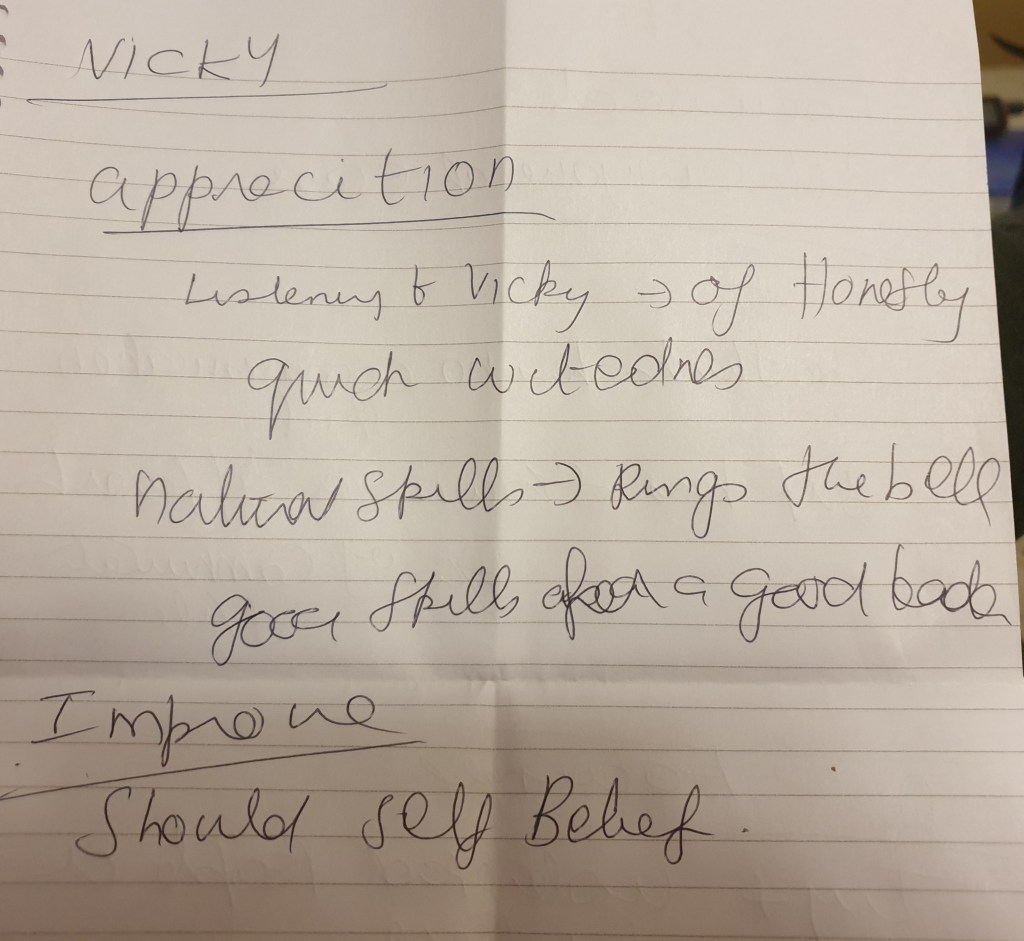
The final exercise of the day was to take it in turns to talk about each member of our group in terms of what we had appreciated about them over the last 2 days and what we felt they could do to improve their leadership skills. That person had to sit quietly and listen and then had an opportunity to respond. Bearing in mind that before day 1 most of us had never met.

When it came to my turn to be analysed I sat in the hot seat with sweaty palms. The comments around what people had appreciated about me were things like my quick witedness, honesty, natural skills, good leadership qualities, focused, put everyone at ease, not pretending to be something I’m not and very able.

The suggestions about what I need to improve on were having a greater sense of self belief, understanding others a bit more and being aware of my own ability. One of the comments I had made about myself earlier in the day was that I don’t consider myself a people person, but everyone disagreed and felt that I had been open, friendly, curious, caring and inclusive and that I should try to stop seeing myself that way.

These 2 days were a really useful practical assessment and learning experience. All previous leadership courses I’ve been on, and indeed my Masters in Healthcare Leadership, have tended to be more theoretical but didn’t really give anything by way of practical suggestions. The giving and receiving of feedback for me, has been key to unlocking some changes I need to make in my own perception of myself so that I can be more like how others see me. As one of the group said I am my own worst saboteur.

This course continues next month with another couple of days. We weren’t given anything to work on between now and then, but I guess the idea is that we take this new found knowledge about ourselves, and work on those areas to improve.

Intra, inter and Extra

Day 1 of our leadership course is asking us to reflect on our intra, inter and extra awareness. The awareness of ourselves, others and the wider world.

In a task in the afternoon we were given 4 instructions, the second of which was to select a leader for the task through a formal process. There were 4 of us in the team and after a very brief discussion about process I was nominated by all of the other 3, so I didn’t really get the opportunity to challenge.

The task was to prepare a 3 minute presentation to the Executive about building and maintaining morale, highlighting the challenges and changes required of leaders. We then had discussion and decided a way forward, then we had to pretend to present it.

After the task everyone is then invited to provide feedback on the content and dynamics of the leadership of the task. Basically invite character assassination but in a constructive way.

I was invited to give feedback first on how I thought it had gone and how people had behaved and contributed before they gave feedback on my leadership of the task.

Given that we’d only met each other that morning and had done a couple of small tasks together, there seemed to be already some understanding of people’s skills and attributes. Apparently, I was nominated to lead this task as I had already demonstrated earlier my ability to understand the rules of a task, to methodically approach the task and keep people on track.

Whilst it was really hard to listen whilst others talked about you, it was a very supportive environment, and I didn’t feel in any way threatened or demoralised by what people said. I actually found it uncomfortable because people were saying very complimentary things about my style. In fact there was nothing negative at all.

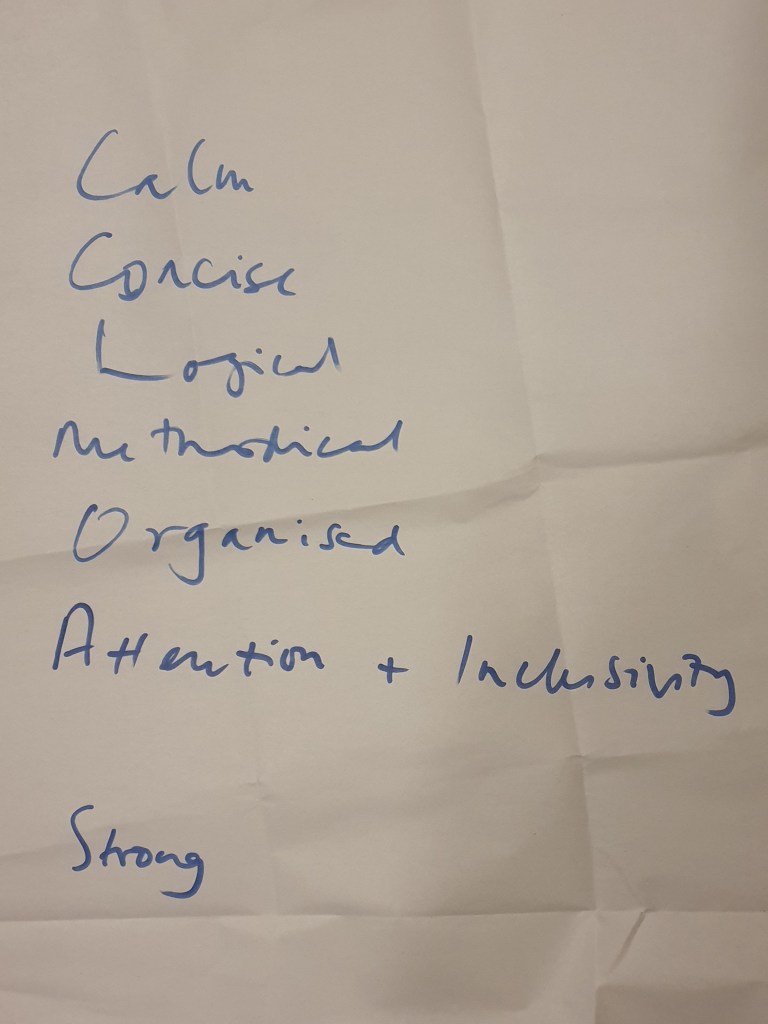
I was described as calm, considered, logical, methodical, organised, inclusive and paid attention to everyone, and strong when I needed to pull people back on topic and keep them to time. One person even said that they aspired to be like me.

The trouble is that I have no belief in that myself. I’m not saying they were lying about what they said, it would be difficult to accuse the whole group of conspiring, but I just don’t see it in myself.

The group facilitator wrote it all down (pictured) and told me to take it home and keep it to remind me of my leadership attributes, and believe it when other people see it in me, even if I don’t see it myself.