Empathy, empathy, they’ve all got it empathy

OK, really bad pun on the Carry On film where Kenneth Williams plays Julius Caeser and utters those immortal words “infamy, infamy, they’ve all got it infamy”!

Anyone who has been on a leadership course will have been told that a leader needs to have multiple skills in order to be effective.  They must be good at influencing others, planning, building and maintaining relationships, finding ways to improve things, set the direction of the team, create the vision and delivery the strategy.  There are so many things that a leader must be good at or develop in order for perceived success.

With the sphere of building and maintaining good relationships comes the essential skill of empathy in order to achieve engagement, happiness and performance.

These days, especially post-pandemic (yes, I am aware it’s not over yet but the way people are behaving they seem to think it is), people are suffering more from the stresses of the workplace.  You could read this into any walk of life where there is a leadership role, e.g. a voluntary position.  There has been a decline in mental health with 67% of people in a global study experiencing increase anxiety and stress. People are more openly admitting to being sad, irritable, and having more trouble concentrating, taking longer to think things through and finding it harder to juggle their responsibilities. An article in Forbes by Tracy Brower stated that more people suffer from sleep deprivation due to stress and that people experience more negative feelings that spill over into their personal lives when they get an “off” email at work.  When people experience rudeness at work it can have a negative affect on performance, turnover and customer/patient experience.

Being more empathetic during tough times can be a powerful contribution to positive experiences both for individuals and teams.

When people receive more empathy from their leaders they are more innovative, engaged and less likely to want to leave the team or organisation. People feel more included and find a better work/life balance, and therefore more able to cope with juggling their responsibilities.

Brower stated that leaders can demonstrate empathy in two ways:

  1. Consider someone else’s thoughts through cognitive empathy. Think if you were in the other person’s position what would they be thinking.
  2. Use emotional empathy.  Think what it would feel like to be in the other person’s position.

Leaders don’t need to be experts in mental health.  Its enough to check in, ask questions and take cues from what’s being said, or not said.  Where there is alignment between what the leader says and does, there is a greater feeling of trust and engagement from others. Empathy in action is understanding someone else’s problems and doing something to help. Its considering another person’s perspective with compassion.

Empathy is something that I have awoken to more during the last couple of years.  Empathy, empathy, we can all show empathy.

How to create personal impact in 7 days

Image by Gerd Altmann from Pixabay

I was glancing along my “office” bookshelf earlier and came across a “Teach Yourself in a Week” book on personal impact by Christine Harvey.  It must have been several years since I last read it as I don’t recall it at all. It can help both in the workplace, but also when we consider #bellringing recruitment opportunities, when we are giving talks or presenting information about #bellringing.

The layout gives a bite sized topic for each day for seven days.  This one sets out:

Sunday – conquer non-verbal power

Monday – avoid embarrassment and discrediting yourself

Tuesday – structure your presentation to prove your point masterfully

Wednesday – make your point stick using incidents, analogies and humour

Thursday – grasp 13 ways to grab and hold attention

Friday – Build you fool-proof presentation planning matrix

Saturday – put icing on the cake of professionalism

Rome wasn’t built in a day but apparently we can learn in a week what experts learn in a lifetime. If only it were that simple. I thought I’d give it another read, one day at a time.

The first thing is to learn the three main aspects of impact: words, voice and non-verbal movement and actions. Harvey claims that the most accepted findings on what percentage impact each of these elements has is 7%, 38% and 55% respectively.  Therefore, it doesn’t matter what words you use, more the tone and what else you do that matters.  The five aspects of non-verbal impact are eye contact, stance, walking, gestures and projection of conviction with researchers finding that audiences give speakers 40% less effectiveness rating where there is no eye contact. So Rome wasn’t built in a day but if the Italian art of gesticular communication is anything to go by, this has a greater impact than a sedentary encounter.

The next thing to do is create credibility, personal, expert and reputable source credibility and draw upon your strengths to discuss any topic that comes your way. By providing credible facts or information this helps your listener take notice.

Then we can use emotional and logical proof to help get your point across. Using numbers or statistics, quotes and references give gravitas to your conversation. Using analogies, humour and incidents help create a picture, or a story.  It helps your audience make an emotional connection to your message that will stick with them.

In order to grab and hold attention it’s a good idea to have powerful opening, use questions, get the audience involved, use objects, create suspense and have a powerful close. I always try to do very little using Powerpoint or formal presentation styles, I’d much rather sit round a table with the audience and give them something to create that they can take away with them, especially if I’m teaching rather than presenting.

If you find yourself giving a more formal presentation its worth thinking about your main message, what are you trying to get across, plot the story so it flows.  Time your presentation so as not to go over any allotted time, or ramble on too long. Nothing so dull as someone droning on for longer than say, half an hour, about something you are not familiar with and can’t engage with. I usually find the Q&A session at the end more stressful.  Giving a presentation is easy enough if I’ve written it and know what the topic is, but you can’t foresee the sorts of questions you might be asked.  I will always admit if I don’t know the answer, or draw others in to help respond if possible, or even ask the questioner how they might tackle whatever problem they are enquiring about.

Having skim read this book again, I have refamiliarised myself with a number of useful pointers to employ next time I need to present or run a workshop (which will be quite soon apparently)!

Am I making a good impression?

Image by Gerd Altmann from Pixabay

Must admit, this is something that evades me at times.  I have been told that I have a resting bitch face, and that a lot of people find me scary on first meeting me. There’s a number of reasons for that but I suppose the combination of those two things don’t make for a good first impression.

The Young Entrepreneur Council suggested 10 things that improve a first impression:

  1. Smile, it makes people happier  – something I’m not naturally good at.
  2. Be present, give the other person 100 % of your attention, put the phone away and listen.   I’m ok with that one.
  3. Be on time, be respectful of other people’s time – I am usually the other way, I turn up super early for things, I like to make sure technology is working if it’s a virtual meeting, or get there in plenty of time, I would rather be hanging about that be a minute late.
  4. Be authentic, be yourself – I am very much “what you see is what you get”. If I don’t agree with you, I’ll tell you, I don’t try to be something I’m not, it takes too much energy.
  5. Make eye contact, stand your ground but also so the other person they have your attention – I try to do this as much as possible but sometimes it’s difficult.  It can be a bit creepy or appear confrontational.  I worked with someone once who barely even opened her eyes when she spoke, let along looked you in the eye.  She used to do this weird fluttery thing (not in a flirty way) that I found intensely irritating.
  6. Show confident body language, moving slowly and confidently shows you take yourself seriously and confidently – I think I’m generally confident in how I move.
  7. Ask questions, this shows you’re listening – I do ask questions, sometimes those questions that everyone else is thinking but don’t want to ask in case it makes them look stupid, I’m not afraid of that.
  8. Put your phone away, be present – This is one of my pet hates.  When people constantly look at their phone during pre-arranged meetings, especially when they are the one who instigated the meeting.  It’s just rude.
  9. Show sincere interest, explore others’ uniqueness – I try really hard to explore people’s skills and knowledge, but also what they want and where they want to go.  I will help people progress, much to my own detriment when they go off for a better role elsewhere, but I’m pleased to have helped them on their way.
  10. Exude warmth, make someone feel warm and fuzzy when they’ve left. Exuding that feeling through being exceedingly kind, staying ultra-engaged in what the other person is saying and staying authentic, you will be seen as a trustworthy and all-around good person – I probably need to work on that one.  Some people leave a meeting with me with more knowledge, or supported, or valued, but I know I’m known for not being particularly warm and fuzzy.

I know that I can be judgy of other people, although I’m trying hard not to be so judgy, and I know others’ are judging me. How do I make them judge me with a good impression?

Are you listening?

Image by Gerd Altmann from Pixabay

I used to have a manager who never really listened to what I was saying, he had an agenda, he had other people and departments to worry about and I was one of his least troublesome people so he would often talk about the others in our one to ones rather than listening to anything I had to say. It used to infuriate me that my one to ones were spent talking about other people. That was when he even turned up for them, often he didn’t, and didn’t even offer an apology let alone rearrange it.

I am aware that sometimes I can interrupt people when they are talking, usually because I have an example to share, or can see where it’s going so move the conversation on by making them aware that I understand what they’re talking about. As I am aware of this, it is something I try to stop myself from doing.  When I catch myself I stop talking and apologise for interrupting.

We all like to think that we’re a good listener, but are we really?  We might hear what someone is saying but are we actually listening to the words, the intonation, the timbre? So much more can be gleaned by fully listening to what and how something is being said.

Listening to others helps build trust, connects us, helps us to understand the people and world around us. How do we become a better listener?

Nidhi Kush Shah suggests some phrases that may help:

Thank you for sharing that…” – it can take courage and trust for people to talk and open up to us so we should thank them for putting their trust in us.

Tell me more / please elaborate” –we should use this to encourage a deeper exploration of the conversation, it shows that we are genuinely interested in finding out more.

Let me see if I am clear…” – this gives us the chance to paraphrase and add our own interpretation and allows the other person to know that we understand, or provide them a change to add or amend their story.

What I like about your idea is…” – again repeating what the other person said shows them that you are listening and offers support.

Can I interrupt / ask a question…” – some people are not concise or well-articulated.  When we want to move a conversation along its ok to use this kind of interruption so long as it’s in a way that is empathetic and respectful.

Being a good listener is a skill that most of us could probably do better at.  I know I could.

How do you engage with the unengagable?

Image by Terri Cnudde from Pixabay

That million dollar question all leaders want the magic answer to. 

I’ve done many a course and read many a book or article on how we should be engaging with people to get the most out of them and provide them with job/participation satisfaction.  We are told that we should include them in decision making, regularly communicate with them, and invite them to participate in projects that will allow them to share their expertise and grow their skills. We should be empowering them to make decisions.  We are reminded that a disengaged team can cause a drop in morale and performance and be disruptive.  https://jouta.com/blog/how-to-re-engage-a-disengaged-employee/

But there are some who just don’t want to be engaged with.  They want to be valued, they want to be appreciated and for their efforts to be noticed. They want reward for doing a good job (some even want reward for doing an adequate or poor job, or for simply turning up at all).  They want to feel listened to and communicated with.  They want to be involved.  That is, right up until the time when you invite them to be involved.

One thing I struggle with time and again is trying to get people to look wider than the work that is right in front of them, especially when they tell me that they are not happy, or feel undervalued.  I invite them to participate; I offer courses that support their current role and any development they might want.  I provide them with opportunities to use their knowledge and skills and to develop processes and procedures or plans that they will ultimately be responsible for. I provide open door opportunities to share ideas and talk freely.

But they just don’t want to play.

I’m not the sort to press gang unless absolutely necessary, I ask for volunteers. There are times when I have had to say “you and you are going to help with this” but I want to see who has a spark, who is interested, and who wants to be involved. I shouldn’t be the one suggesting all the process changes; I’m not doing the job.  I can see opportunities to improve efficiency or process, but ultimately they have to own and be accountable for it, so it makes sense that they help develop it.

We are reminded that people respond positively when they are empowered to make choices and decisions for themselves, yet when they are given the opportunity they don’t want to take it. Figuring out what matters to them and how to spread positive stories, exchange ideas openly, and disseminate best practice is all well and good but only works when morale is already high and people are generally happier. https://www.achievers.com/blog/how-to-convert-a-disengaged-employee-into-an-engaged-one/  In this current climate, that’s really hard to do in a virtual world.

I think it also depends on the example they are given.  Enthusiasm breads enthusiasm, contempt breads contempt.   I try to be as upbeat as I can and to understand frustrations others are going through trying to deliver their piece of work or part of the project.  I acknowledge that not everything can be done as perfectly as we might want it to be and sometimes corners might need to be cut in order to meet a more pressing need.  I understand that there are often outside pressures that affect how motivated they feel.  However, there are usually others in closer relationships that seem predetermined to be pessimistic about everything. Everything is a disaster, it’s not their fault, and it’s nothing to do with them, they are not responsible or accountable.  That kind of vibe tends to spread like wildfire and before you know it most of the team is feeling down.  They don’t realise that they vibe they are giving off is affecting how others feel and then it spirals. 

I know that it’s extremely hard to eternally upbeat about everything all the time, it would be exhausting, and I certainly have my days when I’m not motivated or interested at all.  But if I want a more optimistic team around and people to be more engaged, then it’s my responsibility as a leader to start that vibe, or to find help when I need it.  If I can change one person’s attitude, which can then spread to someone else, I’d be happy.

I want people to develop, I want them to be fulfilled in what they do, be satisfied at the end of the day they did all they could to use their strengths.  I want them to feel they have all the information they need about what’s going on in their immediate and wider world.  I want all these things for them and provide opportunities for that.  They just don’t seem interested in taking it. People complain about lack of development, I give them the opportunity to develop, they don’t want to take it. They complain about not knowing what’s going on, so I tell them but then they don’t listen or connect the dots with the relevance to them. I need to make more of an effort to ensure the message is put across in a ways that does demonstrate relevance to them.

Whilst it would be great to have one to ones with absolutely every person to determine what motivates them and how they could be better developed, communicated with etc, the practicalities are not so simple.  It might be that I wouldn’t need to do that with everyone, just take a few key people to one side and address their motivations, then through the wonders of osmosis everyone else will feel more engaged and valued.

Reflecting on some of the reasons why previous attempts to engage others hasn’t worked it is useful to consider these questions:

  1. Who in my team have I connected with the least? what gets in the way of connecting with them more?  
  2. Think about the people I connect with the least in my team, service users and peer group, and notice any similarities.
  3. Think about who in my team I enjoy connecting with and why?
  4. Think about those who I feel psychologically safe around and why? and those who I do not and why?. What are the differential factors?   

There are many tools to try but I still don’t have a solution for how to engage the unengagable.

Taking Pride

Image by Boris Štromar from Pixabay

June is Pride Month, the anniversary of the Stonewall riots of 1969 and works to achieve equal justice and equal opportunity for lesbian, gay, bisexual, transgender, and questioning and others (LGBTQ+).  Although I personally don’t identify with that demographic I manage a large staff group some of whom do, and I have friends who identify.  I see my role as a leader, and a friend, as being an ally to those who struggle to get support, who are victimised and who feel that they are not seen, heard or respected.  As such I am a member of our organisations LGBTQ+ equality and diversity network.

At today’s meeting we were discussing the use of pronouns and how difficult it can be to get it right or how some people feel that too bigger deal is being made of it.  Personally, I see it as everyone’s role to help normalise this so it isn’t a big deal and that everyone should feel comfortable being who they are and ate comfortable with how they are addressed.  I immediately changed my office email signature to include my preferred pronouns in an effort to support and help normalise this way of thinking. I did the same when I got home and updated all my personal email signatures.

We were also discussing ways in which this group of our staff could connect even if they didn’t want to be part of the network.  Spaces like Facebook groups or WhatsApp groups are too public for some and there were concerns about data transfer etc.  We should have a safe space for staff to ask questions, seek and share advice and information.

In the NHS we use a system that allows discussions, teams, consultations etc to happen in a safe, secure environment.  I use it for the Buddy Network that I’m also a member of.  It took no time at all to set up a new forum group, email the link around to a few other members of the group and see whether it would work.  It would need moderating and I’m not the best placed to be able to do that, but if my little bit of help assists others in finding a safe space, then I am more than happy to help.

We have some events coming up the organisation is supporting and I hope people don’t just use it as an opportunity to blag a freebie, but take the time to think about colleagues, friends and family, patients and visitors, who may need that extra bit of support, and learn not to spread hatred, victimise others and celebrate everyone’s uniqueness.

To all my colleagues, friends and family – Happy Pride  

What is your unique leadership contribution?

An interesting question and one that does not reflect on your leadership style rather your leadership actions.

I’ve done many a leadership course, heck my entire BA (Hons) and MSc were based on leadership. A lot of literature covers the different leadership styles but I don’t recall at any point considering what my unique leadership contribution was.

We spent a lot of time dissecting Goleman’s Leadership Styles and deciding which most suited our personal style:

  1. Commanding – “do as I say”, driven to achieve, works best in a crisis.
  2. Visionary – “come with me” self-confident, empathetic, works best when changes need a new vision or clear direction.
  3. Affiliate – “people come first” creating harmony and building emotional bonds, great for healing rifts and motivating people during stressful situations.
  4. Democratic – “what do you think?” forging consensus from participation, inclusive, collaborative, great for getting buy-in and input from valuable sources.
  5. Pacesetting – “do at my pace” high standards setting, conscientious, driven to achieve, great for getting quick results from a highly motivated team.
  6. Coaching – “try this” developing others, empathetic and great for helping others improve and develop long-term strengths.

David Goleman “Leadership that Gets Results” Harvard Business Review March – April 2000

At some point during the exploration you come to realise that you are a bit of all of them and there’s a time and a place for each to come to the fore.

The difference with leadership contribution is not based on what leadership style you predominantly operate in, but what you actually do to contribute to the team/organisation etc.  Thinking about what contribution have you made this year/month/week, what contribution do you want to make in the coming year, what lasting contribution do you want to leave your team/organisation with when you move on? 

I would make that more simplistic by asking “how have I made things better”?

I have been with my currently employer for over 20 years now and have been fortunate enough to work in different departments that have given me different experiences and afforded me a wider understanding of how the whole organisation works.  I have been involved in fantastic project management teams responsible for building multi million pound new hospital wings and centralising services which gave me greater knowledge of clinical and support services. I have managed two very large teams, one with over 250 staff that operated 24/7 and another of over 65 staff who are crucial to clinical functions. 

During those opportunities, I would say that my unique contribution has been able to identify efficiencies from process mapping functions and designing out the bottlenecks that obstruct smooth operation of services.  I have written strategy documents (doing another one at the moment) that impact on multiple parts of the organisation.  I have written policies that support those strategies, and I have implemented changes to the way things are done that provide assurances, and make work practices more efficient and effective.

I am less keen on the managing people aspect of department/service management as I don’t think that’s where my strengths are.  I am happiest reading, interpreting, reviewing, pulling apart, rethinking and redesigning.  I do love a good process map, a set of statistics and a spreadsheet.

I still have a way to go before retirement but as I start to consider my latter working life and where I want to be in 5 or 10 years’ time I would prefer to utilise my unique contribution skills as several services that I connect with start to go through their restructure and consultations, to help define their purpose, strategy and policies.   I hope that when the times comes for me to hang up my spreadsheets, that my unique contribution will have benefitted my teams, the organisation and ultimately our patients.

What is your unique leadership contribution?

6 people in your corner OR 5 mentors you need?

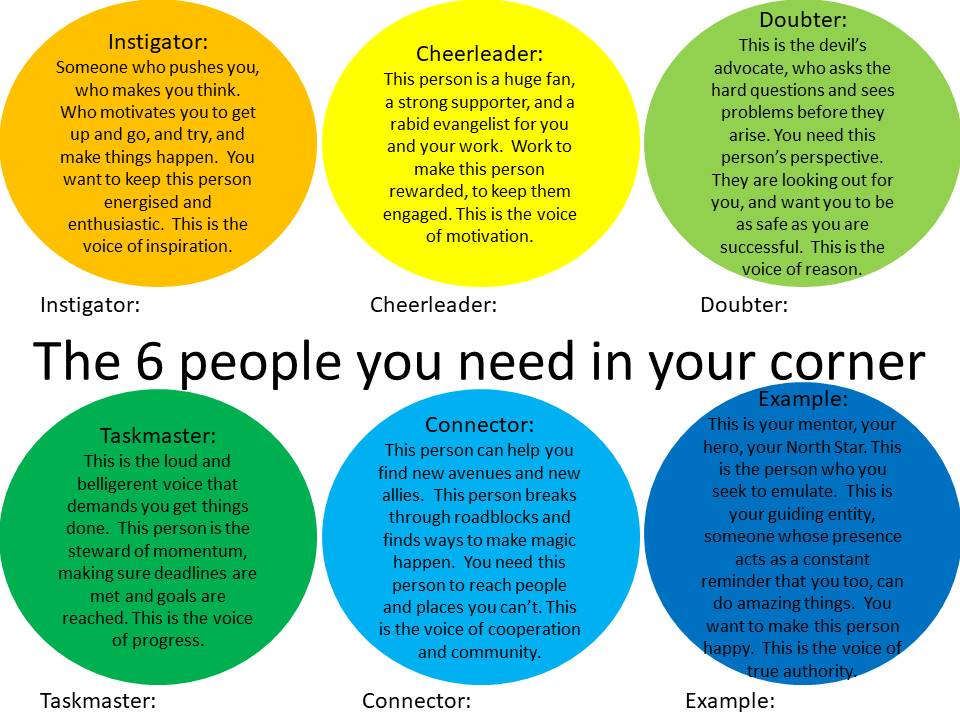
Several years back one thing I picked up, presumably from some talk or online article was the notion of having 6 people in your corner.  Basically, these represented 6 characters that would help and support your leadership journey.  They didn’t all have to be different people, although they could be, or some, or all of them could be the same person.

The 6 characters were:

The Instigator: Someone who pushes you, who makes you think.  Who motivates you to get up and go, and try, and make things happen.  You want to keep this person energised and enthusiastic.  This is the voice of inspiration.

The Cheerleader: This person is a huge fan, a strong supporter, and a rabid evangelist for you and your work.  Work to make this person rewarded, to keep them engaged. This is the voice of motivation.

The Doubter: This is the devil’s advocate, who asks the hard questions and sees problems before they arise. You need this person’s perspective.  They are looking out for you, and want you to be as safe as you are successful.  This is the voice of reason.

The Taskmaster: This is the loud and belligerent voice that demands you get things done.  This person is the steward of momentum, making sure deadlines are met and goals are reached. This is the voice of progress.

The Connector: This person can help you find new avenues and new allies.  This person breaks through roadblocks and finds ways to make magic happen.  You need this person to reach people and places you can’t. This is the voice of cooperation and community.

The Example: This is your mentor, your hero, your North Star. This is the person who you seek to emulate.  This is your guiding entity, someone whose presence acts as a constant reminder that you too, can do amazing things.  You want to make this person happy.  This is the voice of true authority.

Back in about 2009, when I first discovered this, I knew exactly who these people were.  Some of them wore multiple hats for me.  After about 2011 when I’d changed jobs, I really could not pinpoint anyone amongst my work colleagues that fitted any of those roles for me.  Happily, I am once again in the position where I can identify at least one person, even if it’s the same person, for each of those roles.

I’ve just read an article by Anthony Tjan on ideas.TED.com who suggests that we should have 5 mentors:

The Master of Craft: “If you know you want to be the best in your field — whether it’s the greatest editor, football quarterback, entrepreneur — ask, Who are the most iconic figures in that area?” says Tjan. This person can function as your personal Jedi master, someone who’s accumulated their wisdom through years of experience and who can provide insight into your industry and fine-tuning your skills. Turn to this person when you need advice about launching a new initiative or brainstorming where you should work next. “They should help you identify, realize and hone your strengths towards the closest state of perfection as possible,” he says.

The Champion of your cause: This mentor is someone who will talk you up to others, and it’s important to have one of these in your current workplace, says Tjan: “These are people who are advocates and who have your back.” But they’re more than just boosters — often, they can be connectors too, introducing you to useful people in your industry.

The Copilot: Another name for this type: Your best work bud. The copilot is the colleague who can talk you through projects, advise you in navigating the personalities at your company, and listen to you vent over coffee. This kind of mentoring relationship is best when it’s close to equally reciprocal. As Tjan puts it, “you are peers committed to supporting each other, collaborating with each other, and holding each other accountable. And when you have a copilot, both the quality of your work and your engagement level improve.”

The Anchor: his person doesn’t have to work in your industry — in fact, it could be a friend or family member. While your champion supports you to achieve specific career goals, your anchor is a confidante and a sounding board. “We’re all going to hit speed bumps and go through uncertainty in life,” says Tjan. “So we need someone who can give us a psychological lift and help us see light through the cracks during challenging times.” Because the anchor is keeping your overall best interests in mind, they can be particularly insightful when it comes to setting priorities, achieving work-life balance, and not losing sight of your values.

The Reverse Mentor: “When we say the word ‘mentor,’ we often conjure up the image of an older person or teacher,” says Tjan. “But I think the counterpoint is as important.” Pay attention to learning from the people you’re mentoring, even though they may have fewer years in the workplace than you. Speaking from his own experience, Tjan says, “Talking to my mentees gives me the opportunity to collect feedback on my leadership style, engage with the younger generation, and keep my perspectives fresh and relevant.”

They both cover a lot of the same ground but Tjan has some interesting other ideas.  I know who my Champion and Copilot are.  I think I am my own Anchor really.  I’m pretty clued up to my own values and setting personal priorities to achieve a good work-life balance.  I’m not sure who my Master of Craft is at the moment or my Reverse Mentor as I’m fairly disconnected with leading or mentoring anyone at the moment.

Do you know who you’d have in your corner or who are your 5 mentors?

The Instant Gratification Monkey

I was reading an online article from Tim Urban, who studied why procrastinators procrastinate.  He possets that they can’t help it.  In their brain the procrastinator has the Rational Decision Maker who steadily guides the mind in to doing what needs to be done, and then there’s the Instant Gratification Monkey who sideswipes things and sends the mind off wandering for some instant satisfaction for information or other, that takes us away from our steady path.

The Instant Gratification Monkey takes us off to play in what Urban calls the Dark Playground, that space where all the fun, new, shiny things hang out that distract us from what we should be doing. In the back of our minds though is this constant feeling of anxiety or regret for that looming deadline or that thing that we’ve been working towards for ages.  When that deadline approaches though, it’s time for a visit from the Panic Monster who scares us away from the Dark Playground back in to a sense of productivity to get things done.

Urban offers three steps to turn procrastination into motivation:

  1. recognise that you are procrastinating.  Being aware of something is usually the first step in resolving it. 
  2. Understand the reason for the procrastination.  Is it the task itself, or is it you? Is it that you aren’t enjoying it, not qualified for it, or feeling overwhelmed by it?
  3. Set objectives, tactics and rewards.  Depending on the reason for the procrastination in the first place it might be as simple as having a to do list if you’re feeling overwhelmed, or someone that holds you to account, or if you promise yourself a treat if you get that thing done.

There are times that I procrastinate.  It’s not usually because I don’t want to do something, more that I don’t want to do that particular thing right now.  I will send that email out but after I’ve watched this episode of that tv programme I like.  I will write that report just as soon as I’ve finished making lunch.  I will learn how to ring handbells properly, just as soon as I’ve written that report and sent that email.  Sometimes it can become a vicious cycle.

Other days, I can blast through even the most boring, or painful task without so much as a second thought.  It’s about the frame of mind that I’m in.  Sometimes, I find being in a particular place, or with particular people helps galvanise me into action.  Sometimes I just wake up and tell myself that today I’m going to power on through all that stuff and clear my to do list.

Today has definitely been one of the latter type of days.  I’ve finished the first draft of a strategy document.  I’ve documented a framework that I invented that supports that strategy.  I’ve been for a power walk.  I’ve read the next section on learning to ring handbells and had a few goes at it.  My Rational Decision Maker was in charge today.

I wonder if that means tomorrow I’ll be all out of juice and my Instant Gratification Monkey will be running the show.

The Ladder of Participation

Someone at work mentioned that they were reading an article about the Ladder of Participation.  This got me thinking about my own participation in activities both at work and home, predominantly about the roles I have within the #bellringing community.

The Ladder, devised in the late 1960’s, has three categories: Non-participation, Tokenism and Citizen Power.  Each category has a number of rungs within it that describes how citizens, the general public, can through participation, have more influence in society. https://nhspublicvoice.wordpress.com/2016/10/27/ladder-of-participation-shows-how-involved-you-are/

Starting at the bottom rungs of the ladder in the non-participative categories are Manipulation and Therapy.  These two are there to educate and cure the participant and to achieve public support through PR activities.

The next three rungs are in the Tokenism category and cover Informing, the one way flow of information, Consultation, the use of attitudinal surveys, meetings, public enquiries, but can be seen as a window dressing, before escalating to Placation, allowing citizens to give opinion or advise but holding on to the right to judge the legitimacy of that advice.

The real Citizen Power comes with the top three rungs of the ladder.  Partnership, the redistribution of power between citizens and the power holders with shared decision making.  Delegated Power, where the citizens now have the power to make decisions and assure accountability.  Citizen Control, where the participants hold the power for entire job planning, policy making and managing activities.

In the #bellringing context I can see definite elements of manipulation and therapy and informing, where we are providing information, guidance and exercises to educate and support.  We are currently undertaking various consultations to find out what people want from their #bellringing organisations.  I hope that we do not then use that to placate, but inform decision and policy making.  We have seen some great examples, particularly over the last 12 months or so or partnership, Association of Ringing Teachers, Central Council of Church Bell Ringers and The Ringing World working together.  We are certainly offering opportunities for Delegated Power in the workgroup structure, which allows anyone, even if they are not a Council member to participate and influence the direction we are taking, and providing expertise.  The Citizen Control might be a bit more tricky to manage wholescale, but there are pockets of activities that are directed by the ringers at a local level and we would want to support them with that.

No doubt there is room for improvement at every rung of the ladder, but it was interesting to note that we are on every rung. Where are you on the ladder?