I love learning new stuff. About me, about the world around me, about things that support my career and hobbies, about what makes people tick. I’m the sort that would read a chunky document for that one snippet of something. I will Google how to do things. I will ask others how they did that.
I am currently trying to lose some weight, not that its working but that’s more to do with my commitment than anything else, so I invested in Noom. The app that uses psychology to support weight loss. It takes you through a raft of new skills learning and understanding your own responses to food. I have finished all the modules and now its taking me through development of a self experiment in order to determine factors that will support and sustain my weight loss. This morning’s “lesson” was all about knowledge.
There are different types of knowledge that we all experience from time to time:
A priori – things we just know that don’t require life experience to be considered true, like 2+2=4. No one argues about it. Its just true.
A posteriori – experiential knowledge gained through some basic level of understanding, like we know the earth orbits the sun.
Explicit – that knowledge gained through learning, reading around a subject.
Tacit – the stuff that you just know, like all the lyrics to ABBA or Queen songs that seemed to be hardwired at birth.
Propositional – the knowledge of facts that can be declared as statement, like the sun is larger than the earth.
Non- propositional – procedural knowledge that can be explained and used, like knowing how to walk.
We probably experience all of those methods virtually every day.
I remember a talk at a #bellringing event demonstrating the different ways people learn. The speaker had brought in his kayak and used people of different ages to demonstrate the different ways.
He used C as the older learner where he just verbally explained what to do and C got on with it (auditory). Then he used someone in their 20s and showed them what to do (visual). Then he used R, who must have been about 10 or so, and he demonstrated, then sat with her and did it together (kinesthetic).
I think I am a mix of all three. I can take verbal instruction, so long as its not overly complex, I can watch something then copy it as I have done many times recreating cakes. And I learn through working together through a problem. I guess it depends on what the problem is.
What type of knowledge have you learned from and what type of learner are you?
We all go through life trying to do the best we can, and equating that to #bellringing, we all turn up at practice night, or Sunday service ringing, or for a wedding or special practice, or quarter or peal attempt or, at the moment virtual practice, with full intention to do the best we can. To ring the method accurately. To strike our bell in the right place. But at a practice night we’re there to try to learn new things as well and extend our repertoire (if we want to).
Briceno offers that sometimes, despite our best intentions we might not always get any better at the things we want to achieve, despite working hard at them. What he learned from his research is that we should deliberately alternate between two different zones.
Learning Zone: here the goal is to improve. So we undertake activities that help that improvement. This could be attending a training day, reading around the subject, watching YouTube videos, asking others for advice, standing behind someone while they ring, asking for feedback and so on. Here, we spend time concentrating on what we haven’t mastered yet, and expect to make mistakes along the way knowing that we will learn from them.
Performance Zone: is where the goal is to do something as best as we can, to execute it. Where we concentrate on what we already have mastered and try to minimise the mistakes. This might be ringing for a special event or a peal attempt, or a striking competition.
Briceno suggests that we should be deliberately alternating between the two zones to purposefully build our skills in the learning zone in order to apply them in the performance zone. Being clear about when we want to be in each of these zones, with what goal, focus and execution in mind helps us better perform and improve. The performance zone maximises our immediate performance, whilst our learning zone maximises our growth and future performance. The more time we spend in the learning zone the more we will improve in the performance zone.
To be able to spend more time in the learning zone we need to believe that we can improve, we must want to improve that particular skill, we must have an idea about what we can do to improve. Just performing the same method over and over again doesn’t necessarily help us improve. Without the process of practice, making mistakes, getting feedback and revision we will tend to stagnate in our current “safe” zone; methods that are familiar and easy, that we won’t feel like we’d be ridiculed for if we go wrong. My favourite is “if in doubt, ring the Treble”, that way I’ll stand a better change of not going wrong, or mucking it up for everyone else. The trouble with that is, I don’t progress myself.
In our #bellringing context this could be the difference between learning the theory of a new method and practicing it on a practice night on using an ringing simulator, in order to perform it to the best of our ability of a Sunday morning, or during a striking competition, or a quarter peal or peal. I also know that I’m really bad at this too. Often I might turn up to a practice having not put enough effort into the learning part, and then hash my way through it, or do enough to just get by without making too much of a pigs ear, but I haven’t learned it properly and will immediately forget it because I’ve not gone back over the bits I find difficult, or asked for help.
My latest thing is to try to learn to ring handbells. I don’t particularly want to ring handbells quarters or peals, but I want to be able to hold my own if I were asked if I could ring something simple. It’s been nearly 40 years since I learnt to ring a tower bell so going back to the beginning to ring handbells, to unlearn some of the things I’ve learned on tower bells and learn them in a different way, has been, so far, really quite difficult. However, I must persevere if I am to reach a decent performance zone. I must make that effort and spend that time in the learning zone, read, watch, listen, practice, make mistakes, get feedback, try again and eventually I will improve.
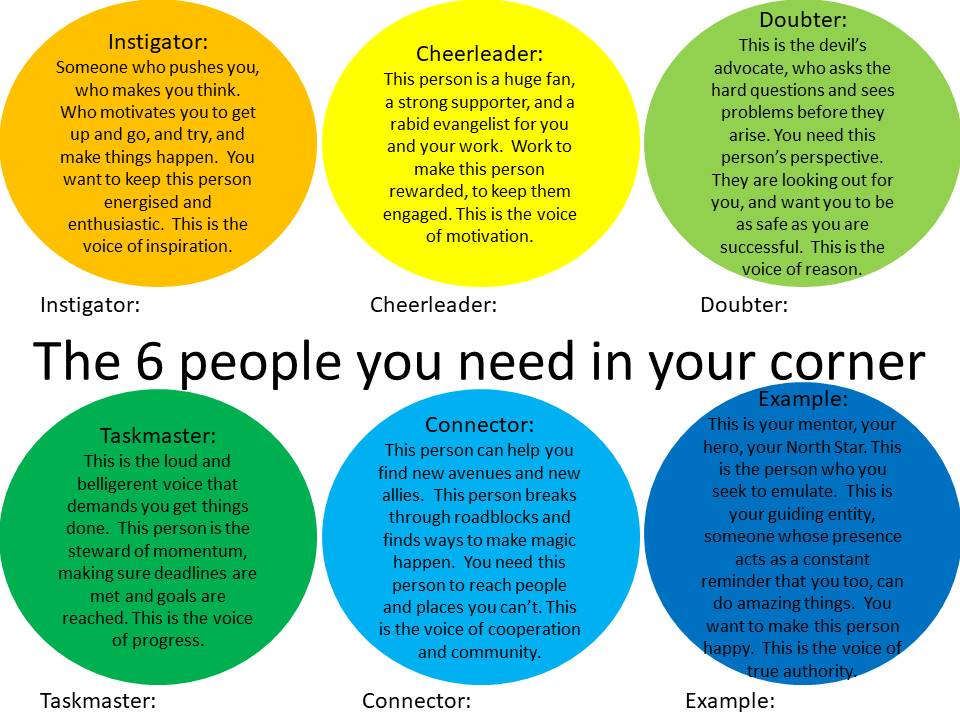
Several years back one thing I picked up, presumably from some talk or online article was the notion of having 6 people in your corner. Basically, these represented 6 characters that would help and support your leadership journey. They didn’t all have to be different people, although they could be, or some, or all of them could be the same person.
The 6 characters were:
The Instigator: Someone who pushes you, who makes you think. Who motivates you to get up and go, and try, and make things happen. You want to keep this person energised and enthusiastic. This is the voice of inspiration.
The Cheerleader: This person is a huge fan, a strong supporter, and a rabid evangelist for you and your work. Work to make this person rewarded, to keep them engaged. This is the voice of motivation.
The Doubter: This is the devil’s advocate, who asks the hard questions and sees problems before they arise. You need this person’s perspective. They are looking out for you, and want you to be as safe as you are successful. This is the voice of reason.
The Taskmaster: This is the loud and belligerent voice that demands you get things done. This person is the steward of momentum, making sure deadlines are met and goals are reached. This is the voice of progress.
The Connector: This person can help you find new avenues and new allies. This person breaks through roadblocks and finds ways to make magic happen. You need this person to reach people and places you can’t. This is the voice of cooperation and community.
The Example: This is your mentor, your hero, your North Star. This is the person who you seek to emulate. This is your guiding entity, someone whose presence acts as a constant reminder that you too, can do amazing things. You want to make this person happy. This is the voice of true authority.
Back in about 2009, when I first discovered this, I knew exactly who these people were. Some of them wore multiple hats for me. After about 2011 when I’d changed jobs, I really could not pinpoint anyone amongst my work colleagues that fitted any of those roles for me. Happily, I am once again in the position where I can identify at least one person, even if it’s the same person, for each of those roles.
I’ve just read an article by Anthony Tjan on ideas.TED.com who suggests that we should have 5 mentors:
The Master of Craft: “If you know you want to be the best in your field — whether it’s the greatest editor, football quarterback, entrepreneur — ask, Who are the most iconic figures in that area?” says Tjan. This person can function as your personal Jedi master, someone who’s accumulated their wisdom through years of experience and who can provide insight into your industry and fine-tuning your skills. Turn to this person when you need advice about launching a new initiative or brainstorming where you should work next. “They should help you identify, realize and hone your strengths towards the closest state of perfection as possible,” he says.
The Champion of your cause: This mentor is someone who will talk you up to others, and it’s important to have one of these in your current workplace, says Tjan: “These are people who are advocates and who have your back.” But they’re more than just boosters — often, they can be connectors too, introducing you to useful people in your industry.
The Copilot: Another name for this type: Your best work bud. The copilot is the colleague who can talk you through projects, advise you in navigating the personalities at your company, and listen to you vent over coffee. This kind of mentoring relationship is best when it’s close to equally reciprocal. As Tjan puts it, “you are peers committed to supporting each other, collaborating with each other, and holding each other accountable. And when you have a copilot, both the quality of your work and your engagement level improve.”
The Anchor: his person doesn’t have to work in your industry — in fact, it could be a friend or family member. While your champion supports you to achieve specific career goals, your anchor is a confidante and a sounding board. “We’re all going to hit speed bumps and go through uncertainty in life,” says Tjan. “So we need someone who can give us a psychological lift and help us see light through the cracks during challenging times.” Because the anchor is keeping your overall best interests in mind, they can be particularly insightful when it comes to setting priorities, achieving work-life balance, and not losing sight of your values.
The Reverse Mentor: “When we say the word ‘mentor,’ we often conjure up the image of an older person or teacher,” says Tjan. “But I think the counterpoint is as important.” Pay attention to learning from the people you’re mentoring, even though they may have fewer years in the workplace than you. Speaking from his own experience, Tjan says, “Talking to my mentees gives me the opportunity to collect feedback on my leadership style, engage with the younger generation, and keep my perspectives fresh and relevant.”
They both cover a lot of the same ground but Tjan has some interesting other ideas. I know who my Champion and Copilot are. I think I am my own Anchor really. I’m pretty clued up to my own values and setting personal priorities to achieve a good work-life balance. I’m not sure who my Master of Craft is at the moment or my Reverse Mentor as I’m fairly disconnected with leading or mentoring anyone at the moment.
Do you know who you’d have in your corner or who are your 5 mentors?
I’m on LinkedIn, the professional network on the internet that allows you to connect and strengthen professional relationships and learn new skills. You can follow organisations and groups in much the same was a Facebook and Twitter and other social media sites.
One of the groups that I follow for interest and to support #bellringing activities, rather than work related, is about Public Relations and in particular this group focuses on internal communications. In fact its called The Institute of Internal Communication. Each week a contributor called Carole Searwert, a copywriter and newsletter writer posts an article called Top Tips Tuesday which gives you some pointers that you might find useful. Admittedly, most of it relates to the business world rather than the small, social charity, activity type world, but occasionally there’s something that make sense.
This week’s top tips were all about How to Grow Your Newsletter List. In the #bellringing community, we tend to use newsletters quite a lot to keep in touch with our ringers, let them know what’s going on and what’s been coming up. We have them at all levels. Some districts do their own. Most association’s probably have one. The Central Council of Church Bellringers (CCCBR) and the Association of Ringing Teachers (ART) are currently issuing a joint one on survival and recovery strategies. ART have two of their own, Tower Talk and ART Works for slightly different audiences.
Most newsletters are usually quite well done. Lots of uplifting news and case studies, information that may help, updates on what’s been going on and useful contacts or diary information. Hopefully they come with lots of bright shiny photos too. Invariably these days they come in digital format, but some are still produced in paper, and some are both.
I contribute to many a newsletter and have at some time or other been featured in all of the above. But how do we know whether what we produce gets read? How can we increase our readership?
The article offers 10 suggestions, some of which are business orientated, but the things that I picked up that might be useful in a #bellringing newsletter context were:
Offering an interesting “lead magnet” as a sign up incentive. Now, this relates particularly to getting new business sign ups, however, the suggestions offered actually could form part of your regular newsletter offering e.g. “how to tips”, a cheat-sheet (in our case maybe an article that explains a particular method like the way I learned Double Norwich Court Bob Major as first, treble bob, last, near, full, far) accompanied by some diagrams.
Include a sign up link in your email signature. This I thought was interesting mainly from a Central Council perspective and I shall be offering it up to see if it works.
Add a “forward to a friend” button (obviously for digital newsletters). Again, I’m thinking Central Council and local Association websites News Page at the bottom of every article so that if someone likes it and thinks that a friend ought to read it, they can easily forward the link.
Promote your newsletter on your social media to raise awareness. Sounds a bit obvious but do we actually do it? Probably not consistently.
A two minute read at lunch time has now just turned into an evening’s work to see if it’s feasible.
Time for another check in on motivations in life via Psychologies Magazine. This weeks quick quiz of choice was to find out what my true passion is.
This is something that I’ve struggled to answer in the past. I don’t know what I want to do or be. I’m not entirely sure what my skills are, or wants and needs out of life. I’m not even sure that I could fully answer the question about what I enjoy most. So, after 8 deep and meaningful questions, the outcome to identify my true passion is….
Your core values centre on lifelong learning
You’re extremely motivated to get more knowledge under your belt, whether that’s academic learning, or through personal growth and self-development. You feel the most like ‘you’ when you’re acquiring new skills. You have a ‘growth mindset’ approach to life – you keep an open mind, and you never assume that you’re an expert at anything, because you know there is always more that can be learned. Therefore, it’s understandable that you may struggle more than most if you’ve been in the same job for a while, or feel as if your career isn’t offering any new challenges. The upside to this is that you become more motivated than most to embark on further education. You have the dedication to put in the time and effort to get professional qualifications that will support your ambition, either by advancing your career, or opening the door to a new one.
To be fair, I’ve done a number of these short quizzes now and have to say that most of them do seem to have some resonance. I do enjoy learning new things, even at an academic level. I did my Bachelors Degree when I was 40 and my Masters at 45. I’ve done a number of online courses both around academic study and personal growth and self-development. I would certainly never claim to be an expert at anything but have a decent awareness or appreciation for a number of things. I can quiet easily sit and read a 131 page long-term plan document in order to get that golden nugget I need from it. I will study a policy document, in fact I’ll write a fair number of them too. I don’t have a problem reading a text book to learn how to do something better. I am quite happy spending all day listening to speakers at conferences, work related or not. You’ll always find something out you didn’t know before, or be sign posted somewhere else to expand you understanding of an area. I’ll quite often have pen and paper to hand when I listen to certain podcasts as they often refer to other writers or articles or programmes that might be interesting.
The one great thing I’ve always said about #bellringing is that you won’t know everything. There’s always a new method to learn, or a teaching technique that you suddenly find helpful, or a resource that you could utilise that you hadn’t before. And if you think that you do know everything there is to know, that’s when you start to share it with others and help them learn and reach their potential.
I was never particularly academic at school. I did ok and enough to get by with some decent O level grades (now that ages me). I didn’t quite get enough to be able to A levels and therefore never had the opportunity to go to university in earlier years. I did feel that that held me back somewhat. One job I had, I ended up doing 3 people’s roles and doing the work of the manager, but I was told by the Director that I couldn’t have that job (and therefore salary) because I didn’t have a degree. Despite the fact that I’d been doing the role for a number of years. Suffice to say that was enough to spur me on both in terms of finding a different job, but reigniting my education.
I went on to complete 3 NVQs in Business Administration and Business Management, before enquiring about support for a degree. Once I’d got the learning bug I was off. I acknowledge that I was extremely fortunate in that my employer paid my university fees and allowed me study leave, and my family were supportive. My daughter at the time was starting on her GCSEs and we sort of became study buddies when we both got out laptops out to work. My Bachelor’s Degree in Business Management took 5 years to complete as it was part time whilst I was working full time and had family and #bellringing commitments. Then I went straight into my Masters course in Senior Healthcare Leadership which was another 2 years. I’m always interesting in courses that come up at work, but have to acknowledge that others may benefit from them and I’ve had my turn. I’m always happy to learn more. And, crucially, I like to share my new knowledge with colleagues. No point in keeping all that new stuff to yourself if you don’t help others.
I hope I continue to find new things to learn, expand my horizons, provide me with new opportunities.




 Bells, Bakes & Bettering Myself