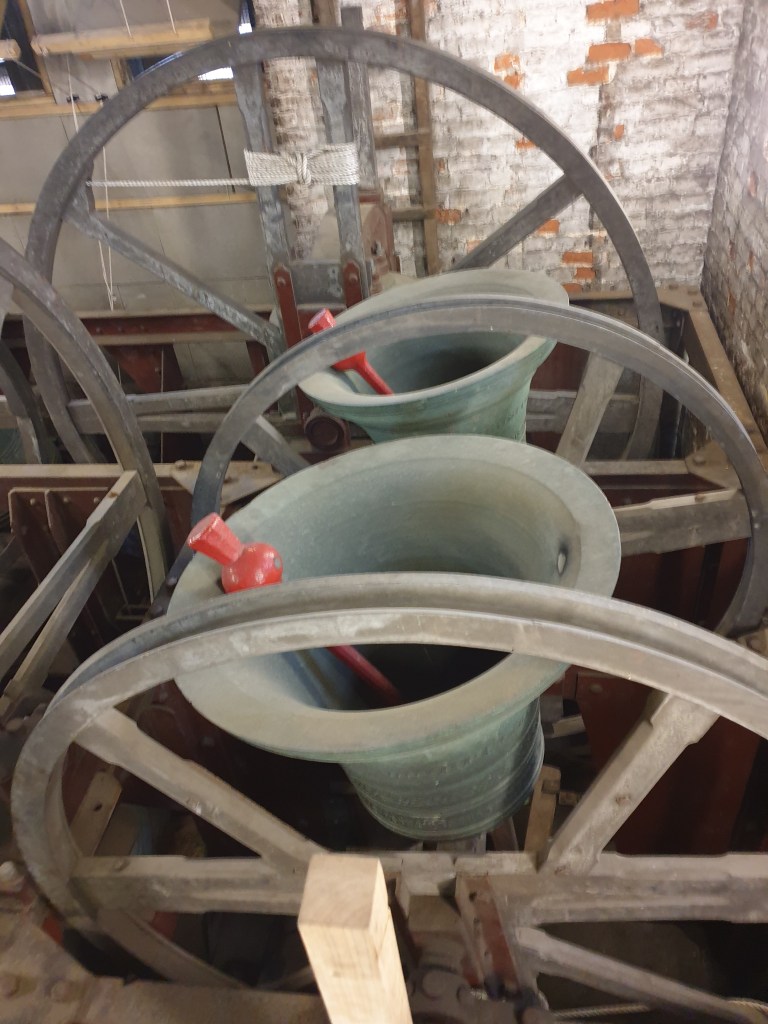
What no bells?

Although there has been no group #bellringing for such a long time now C and I have been going to the Cathedral and ringing two bells just to keep things going.

This week however we are away visiting E&M so not able to go to ring. In ordinary times we would go with E&M to their tower to ring on Sunday bit as they’re not back ringing yet either, we had the morning off.

An odd feeling to not go ringing but after yesterday’s marathon walk around Hardwick Hall we were all exhausted and enjoyed a couple of extra hours sleep.

I am looking forward to returning to the Cathedral next weekend when we will have a couple of extra of ringers for the first time in many, many months. The rules still only allow six people with social distancing, masks and good ventilation but it will be fantastic to hear more than ding and dong and try real ringing methods.

As we head into June and the possibility of no restrictions after the 21st (fingers tightly crossed) we may also be able to start practices again. I know many towers already have but because we are very reliant on people from other towers supporting our practice we’ve decided to hold off for a while.

It will be interesting to see and hear how we get on when trying to raise and ring the heavy bells for the first time in 16 months. Managing people’s expectations of what they could and should ring might be a challenge.

From what I’ve read on social media from other towers it seems that there has been a positive community reaction to bells being rung again but then I upoose no one is going to share any negative responses they’ve had.

I always share details of what ringing we are planning and what we’ve done on our Twitter account and tag local radio, the diocrsan office, the cathedral, local city sites as well. Some are really positive and like and share our posts which is lovely.

I want to build a closer relationship with the cathedral and diocesan offices and local community sites so that they start to fully consider the advantages that bellringers bring to church and community.

I’ve already had conversations with the cathedral office about a diocesan wide ring to mark the enthronement of our new Diocesan Bishop later on in the year and look forward to some closer links.

Influential influence

As I move into the next phase of my career in the next few months, it will become much more important to be able to influence others outside my normal sphere of activity.  I’m already a middle manager with a wide network across the organisation, but the next step will take me into a higher stratosphere of connections.  I need to change up my influencing from my subordinates and peers to upper levels and very senior levels of the organisation.

The Centre for Creative Leadership offers four areas of advice for effective leaders to inspire, persuade and encourage by using the knowledge and skills of a group to help point people towards and common aim and bring about commitment to change.

1) organisational intelligence – being aware of not just the organisational structure bur the informal structure of the political landscape by networking to build strategic allies, consider context and goals before decided how and when to express an opinion, paying close attention to nonverbal clues, active listening, and considering how others might feel, and leaving others with a  good impression without coming across as too aggressive.

2) Team promotion – and a bit of authentic self-promotion without bragging or being selfish.  A bit of well placed self-promotion can provide visibility and opportunities for the team by providing some organisational pride, make capabilities and ideas more visible across the organisation, therefore improving collaboration.  Leaders need to put themselves in the spotlight and find ways to find an audience and sell their team’s story.

3) Trust building – without trust there is probably much less commitment from others, or access to tapping into the full creativity of the team.  Being able to leverage this is crucial when dealing with tough challenges or making strategic changes.  People look for leaders who show some vulnerability and inspire them, understand them and guide them.  It’s a careful balance between pushing people in to areas they are uncomfortable with whilst listening to their concerns and feedback.  Being tough but empathetic with others as they struggle, as well as demonstrating urgency and patience requires careful balance.

4) Leveraging networks – In order to influence others leaders need to cultivate networks.  As organisations shift and morph, leaders need to recognise personal networks must also be dynamic.  They need to be strategic about choosing how and when to tap into the right network.

Then there’s choosing the right influential tactic:

1) logic – taps into rational and intellectual positions, presenting the argument for the best choice of action based on organisational and personal benefits, appealing to the head.

2) emotional – connecting the message, goal or project to individual goals and values, tapping into personal feelings of well-being, service and belonging, tugging at the heart strings to gain support.

3) cooperative – collaborating, consulting and alliance building.  Working together to accomplish mutually important goals, extending the hand to help others.

An invitation landed in my inbox recently that gives me the opportunity to share a new framework that I created with very senior operational and corporate leads across the organisation.  Whilst doing this scares me half to death, I recognise that it’s the ideal opportunity for me to be able to share this piece of work with the very people who will need to be taking it forward in their parts of the organisation.  It’s my piece of work and I am proud of it, and the reception it has received so far. 

Next steps is to make it a reality.