I’m very picky about my pleasure reading. I really only tend to read historical fiction and even then only really Tudor period. It does make it quite difficult to find new books to read.
I was catching up with one of my podcasts Tudor Dynasties, when out on my lunchtime walk and the host was interviewing Nicola Cornick. Nicola has written fiction based on other, lesser known Tudor ladies, with a lot of artistic licence it has to be said.
The Phantom Tree is the story of Mary Seymour, daughter of the playboy Thomas and Dowager Queen Katherine Parr. Mary’s story is a bit of a mystery as after the Queen died and Thomas was executed, she was farmed out to an unsympathetic aunt who didn’t want her. The real life mystery is that there are no records of what happened to Mary. Did she grow to adulthood? What would life have been like for her? The story hypothesises.
Cornick’s second novel The Forgotten Sister is about the life of Amy Robsart, the feted wife of Elizabeth I’s favourite Robert Dudley.
Both novels are dual time period mysteries. There are parallel stories running through them and they don’t necessarily answer the burning questions…what happened to Mary? and did Amy fall or was she pushed?
Both ladies are little known in their own right and usually only a reference to the stories of the men in their lives. The podcast conversation was interesting and has piqued my interest enough to consider purchasing one, if not both books. I have about £75 of book vouchers to use up, that I have to use in a bookshop, although I would have preferred a Kindle version to download.
One of the things on my To Do List is to update our entry on the Cathedral’s website. They are getting a new platform and whilst migrating things across, it has given them a chance to update things and make them look brighter with lots of fabulous photographs. I was asked to update the #bellringing entry, which to date, has been rather modest, and quite difficult to find.
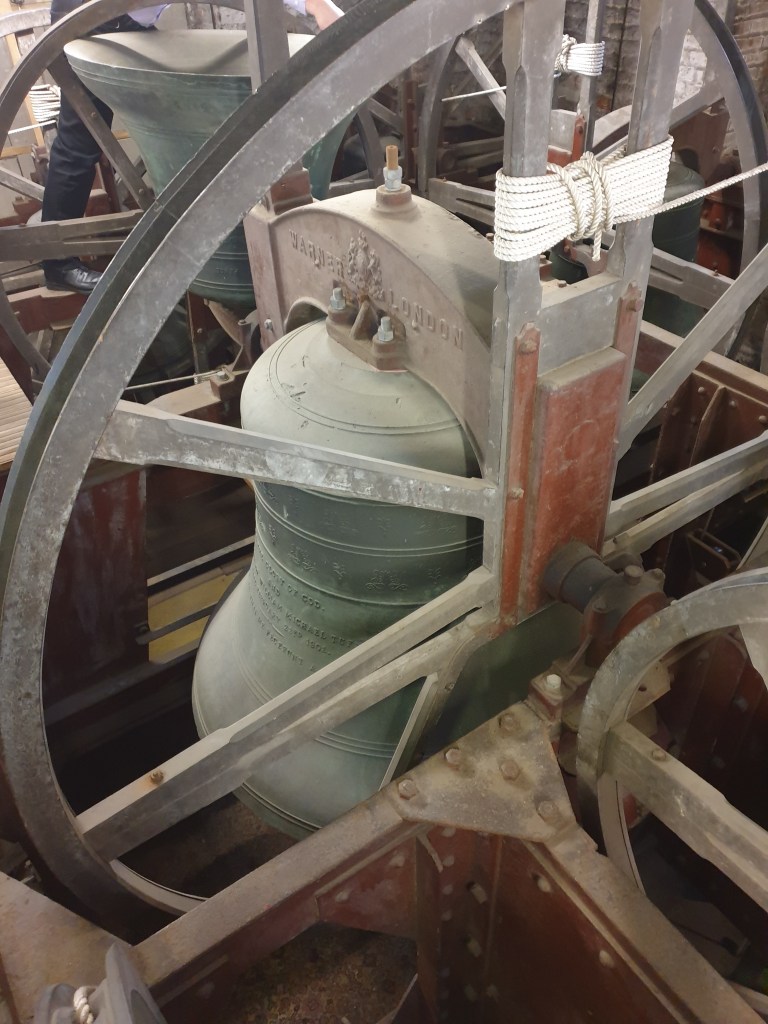
I was looking around for information that others might find interesting and came across something written by I don’t know who, about the history of our bells. From early recording of possibly 4 bells, over the years we have augmented, had completely new casting and doubled from the 6 bells that were first recorded in 1768 to the unique set of 12 (+1) we have now. Here’s an extract:
The mediaeval church tower probably housed bells but little is known about them until the 16th century when, in 1560, bell metal was given by William Reynolds, William Mildmay and Richard Maryon, churchwardens. In 1586 a rope was made for the ‘great bell’, and by 1591 there appears to have been four bells.
Ringers were active in the 17th century for they rang in 1624 ‘when the Prince came home’ and were paid 5s. In 1685 the parishioners sought to put an embargo on the ringers’ pecuniary gains for they informed the churchwardens they should not “at any time upon a publick day of rejoycing give above seven shillings to any Ringers and if the Ringers of the Town refuse to ring upon such publick dayes of rejoyceing, it be ordered that ringers be not permitted to ring upon their own pleasure.”
The present Sunday Service band (currently 5 ringers plus others from neighbouring towers) regularly rings for morning services on Sundays (outside of pandemic times), as well as for Weddings and for other special occasions. The current custom is to attempt a Quarter Peal on the first Sunday evening of each month after the 3.30 evensong in order to provide a means of reinforcing what has been learnt during practices on Monday evenings. These quarters are on 8, 10 or 12 bells supported by ringers from other local towers. The band continues to do well in local and county striking competitions.
There are only two other rings of 12 bells in the and we can justly feel proud of our bells and the long history of ringing here.
From 6 to 8 bells
In 1768 Morant, the great local historian, recorded six bells at the church. Originally there appears to have been a ring of eight, but the parishioners gave two of them to a neighbouring church in exchange for their chimes. However in the 1770s there was an awakening to the art of change ringing, and on 11th July 1777 a new ring of eight cast by Thomas Mears was opened with a peal of Plain Bob Major to celebrate the occasion. In the space of a few years the Society of ringers was second to none in the eastern counties, gaining a reputation for ‘exactness of calling and striking’ far and wide, one noteworthy achievement being a ‘long length’ peal of 10,080 changes, in 5 hours and 50 minutes of non-stop ringing, at at another neighbouring church, in 1819.
10 Bells
In 1820 two new treble bells were added at the Cathedral, making ten in all, but the Society seems to have dwindled in the 1830s and there was no active resistance when the two new trebles were moved to the newly built church in a hamlet in 1841.
The bells continued to be rung for royal and civic occasions but it took the activities of the Association to shake the band out of its torpor. In 1881 the eight bells were rehung by Warner in time for the fourth meeting of the Association at the cathedral in 1882, where the Association has met annually ever since. The Association report for 1886 said: “The chief event of the year has been the recent restoration of the two trebles to their places at St. Mary’s. The county town and centre of the Association now possesses a good ring of ten bells, and all that is needed is a band of local ringers to do them justice.” This latter rather caustic comment was perhaps unjustified because it was too much to expect a competent band to emerge within so short a time of rehanging and augmenting to ten bells. There were 13 members in the band in 1887 but only two appear to have been accomplished 8-bell ringers: J. Parmenter, and William Rowland, senior, whose grandfather had been a member of the original Society. However, progress was made and by 1913 several leading ringers had emerged, including William Parmenter junior, E.E. Parmenter, Tower Captain, and Henry F. Cooper.
12 Bells
In 1912 an order was placed with the John Warner bell foundry (Cripplegate, London) to recast the ring of ten and rehang them in a steel frame, but with the offer of two more bells it was decided to cast a ring of twelve (we have the only complete ring of 12 Warner bells in the country, in a rare fabricated steel frame.)
The new tenor (34½ cwt) was the gift of Mrs. Arkwright in memory of her father, William Tufnell, and the treble was presented by the Association to celebrate the church’s elevation to Cathedral status.
The old ring of ten was lowered in April 1913 and on 27th September 1913 the new ring of twelve was dedicated by the Bishop amidst a large congregation including nearly 300 bellringers. The ringers sat down to a meal in the Corn Exchange afterwards and a photo of this all-male gathering is in the ringing chamber.
A new Guild of Change Ringers was formed and under the master, Henry Cooper, rang for the enthronement of the first Diocesan Bishop on 23rd April 1914, and a few weeks later the first peal (over 5000 different changes of non-stop ringing) was rung on the 12 bells, with six local men in the band.
After the First World War ringers continued to make progress in the exercise under the Master, the late Leslie (Jack) Clark who was Tower Captain for 50 years up to 1977, and some of their successes are recorded on the peal boards which hang in the ringing chamber. One great achievement was a peal of Grandsire Caters by the Sunday service band on 26th April 1932.
A 13th bell
In 1947 the Taylor (Loughborough) bellfoundry cast a thirteenth bell, a ‘flat-sixth’, making it possible to ring a lighter octave in F when the number of ringers present, or their capabilities, make it desirable. This bell was the gift of Frederick J. French in memory of his father, Henry French, who had been a chorister and ringer at the Cathedral. The donor died before the bell was installed but generations of ringers since have been grateful for the versatility of ringing it has made possible.
In 2007 as part of the Cathedral’s Major Works appeal, new adjustable sound control shutters were installed to replace the ‘temporary’ polythene sheeting fitted some 30 years earlier. In 2009 the worn frictional parts (bearings, pulleys, clappers), were replaced or repaired to make all the bells easier to ring and put them in a good situation for the next 50 years.
At some point we had a set of Ellacombe Chimes but these were removed at the time of the reordering of the church. The hammers still adorn the belfry floor. The ropes and frame having been removed at the same time.
It’s important that we keep records of what happens to our bells so that in the future, other generations can understand the importance of the bells and the lengths that others went to to make them available to us. At the moment we are only ringing 2 bells, just C and I on a Sunday morning, until such time as current restrictions are lifted and we can welcome our band and friends back.
Being a bit of a history buff, particularly the Tudor period, I was interested to see Netflix advise me of a series available that is supposedly based on the life of Mary, Queen of Scots entitle Reign. I thought, great, I’ll have a watch of that. OMG, it drove me insane to the point of nearly switching off. There were so many inaccuracies throughout it from the costume, to the set designs to the story lines. For goodness sake, if you are going to base something on actual historical people, at least have some accuracy in what life was actually like at the time.
I’m ok with period dramas that are not based on actual historical characters, for example Bridgeton is not based on any person in history, it’s just set in a particular period of time, and at least the costume, sets and even the language was (mostly) of the right era.
Reign seems to have so much wrong with it it’s laughable. I say I nearly switched off because it was one of those things that it was so bad, that I wanted to watch just how bad it would get. I’ve watched two episodes so far and just about stuck it out.
I remember when the Other Boleyn Girl film came out at the cinema. I went to see it with my friend and before we got settled she said to me “I’m not sure I want to do this. You’re going to go off on one when they get it wrong aren’t you”? I’m sorry, I can’t help it.
I understand a bit of artistic licence with the storyline, but at least get the fundamental basics right. They did not have carpets in the 1500s. Nor did the women go around with out hoods, or wearing sleeveless, short dresses. I also get that they won’t necessarily have accents etc correct. Mary, Queen of Scots, by all accounts had a strong French accent, hardly surprising since she was brought up there from a very young age.
It seems that this American “highly fictionalised” (no kidding) series was cancelled after four seasons as the ratings dropped. As far as I can tell the end of series four leaves Mary married to Darnley, so it doesn’t quite complete the story of a queen who was brought up abroad, married three times, estranged from her children and forced to flee, hoping for mercy from her English queen cousin, only to be beheaded for plotting to take the English throne.
However sad Mary’s story was, it doesn’t really deserve being hashed in this attempt of storytelling. I’ll probably stick it out watching the rest of the series, but I won’t be sorry that it didn’t conclude.


 Bells, Bakes & Bettering Myself