I follow a Facebook group that posts about the Marie Kondo method of tidying, and I did start an attempt at it a while ago. Only ever got as far as tidying out my sock drawer. Someone mentioned on that group that they were struggling to keep on time with the continual cleaning and tidying rota. Someone else commented that their husband was always asking what needed doing (isn’t it obvious?). There are always a multitude of helpful answers to these sorts of dilemmas. What struck me most was that someone mentioned an app that they have on their phone that reminds them what tasks need doing and when. Really?
I’m a curious soul so I have a wander around my Appstore and found numerous tools that will help you with how to clean, what to clean, and when to clean it. I downloaded one just to take a deeper look at it. I landed on Sweepy. It has a cute little character that talks you through setting up each room in your house, and what items are in each room. You can set a frequency as to how often you want to clean it, its current state i.e. dirty or clean or somewhere in between. You can set the effort required to undertake the task from easy, medium, or hard.
For the premium (paid) version you can set up a daily schedule and it’ll send you reminders of what needs doing that day. This will also allow you to connect to others in your household to share the chores. You can set task validation for the smallest family members who always like to help (!!!) so you can give them little tasks that they can get on with, then check up on them and give them a virtual award for doing a good job. Needless to say, I’m not paying for it.
When you click on an element in a room you can select Done, enter the date it was completed, and change any of the settings. I haven’t actually done any yet. I have a fundamental dislike of housework. I actually got my previous management role (head of the hospital cleaners) after I’d said that I have no interest in cleaning, I vacuum when it gets crunchy underfoot and I dust when I can’t see the tv screen. They must have been desperate! I might do something just to tick it off and see what happens.
It’s just bonkers that there’s an app for just about anything you could think of now.
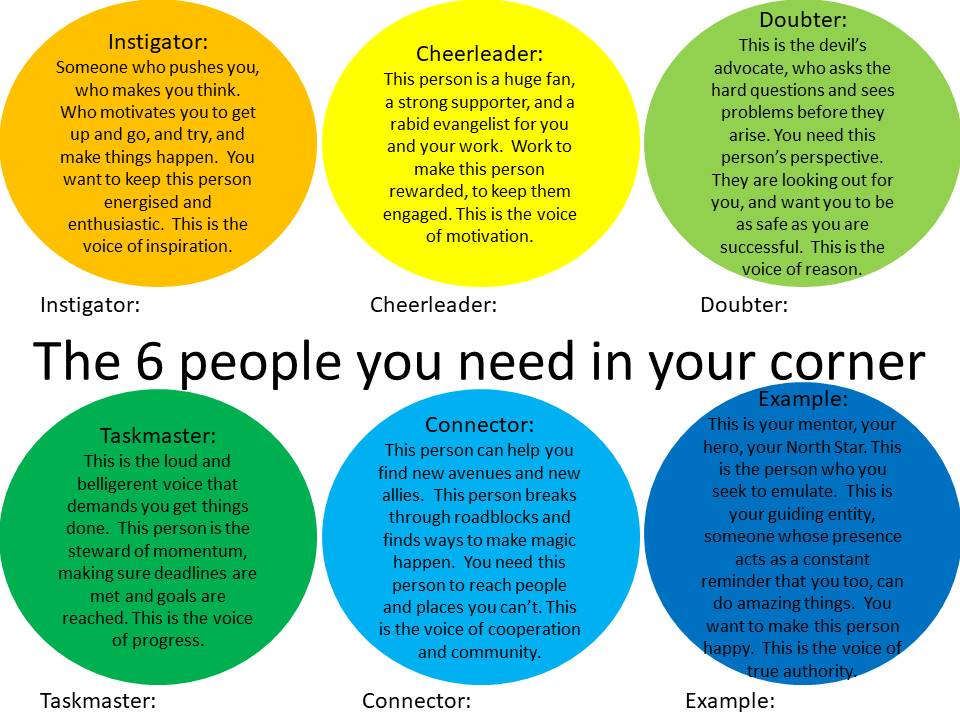
Several years back one thing I picked up, presumably from some talk or online article was the notion of having 6 people in your corner. Basically, these represented 6 characters that would help and support your leadership journey. They didn’t all have to be different people, although they could be, or some, or all of them could be the same person.
The 6 characters were:
The Instigator: Someone who pushes you, who makes you think. Who motivates you to get up and go, and try, and make things happen. You want to keep this person energised and enthusiastic. This is the voice of inspiration.
The Cheerleader: This person is a huge fan, a strong supporter, and a rabid evangelist for you and your work. Work to make this person rewarded, to keep them engaged. This is the voice of motivation.
The Doubter: This is the devil’s advocate, who asks the hard questions and sees problems before they arise. You need this person’s perspective. They are looking out for you, and want you to be as safe as you are successful. This is the voice of reason.
The Taskmaster: This is the loud and belligerent voice that demands you get things done. This person is the steward of momentum, making sure deadlines are met and goals are reached. This is the voice of progress.
The Connector: This person can help you find new avenues and new allies. This person breaks through roadblocks and finds ways to make magic happen. You need this person to reach people and places you can’t. This is the voice of cooperation and community.
The Example: This is your mentor, your hero, your North Star. This is the person who you seek to emulate. This is your guiding entity, someone whose presence acts as a constant reminder that you too, can do amazing things. You want to make this person happy. This is the voice of true authority.
Back in about 2009, when I first discovered this, I knew exactly who these people were. Some of them wore multiple hats for me. After about 2011 when I’d changed jobs, I really could not pinpoint anyone amongst my work colleagues that fitted any of those roles for me. Happily, I am once again in the position where I can identify at least one person, even if it’s the same person, for each of those roles.
I’ve just read an article by Anthony Tjan on ideas.TED.com who suggests that we should have 5 mentors:
The Master of Craft: “If you know you want to be the best in your field — whether it’s the greatest editor, football quarterback, entrepreneur — ask, Who are the most iconic figures in that area?” says Tjan. This person can function as your personal Jedi master, someone who’s accumulated their wisdom through years of experience and who can provide insight into your industry and fine-tuning your skills. Turn to this person when you need advice about launching a new initiative or brainstorming where you should work next. “They should help you identify, realize and hone your strengths towards the closest state of perfection as possible,” he says.
The Champion of your cause: This mentor is someone who will talk you up to others, and it’s important to have one of these in your current workplace, says Tjan: “These are people who are advocates and who have your back.” But they’re more than just boosters — often, they can be connectors too, introducing you to useful people in your industry.
The Copilot: Another name for this type: Your best work bud. The copilot is the colleague who can talk you through projects, advise you in navigating the personalities at your company, and listen to you vent over coffee. This kind of mentoring relationship is best when it’s close to equally reciprocal. As Tjan puts it, “you are peers committed to supporting each other, collaborating with each other, and holding each other accountable. And when you have a copilot, both the quality of your work and your engagement level improve.”
The Anchor: his person doesn’t have to work in your industry — in fact, it could be a friend or family member. While your champion supports you to achieve specific career goals, your anchor is a confidante and a sounding board. “We’re all going to hit speed bumps and go through uncertainty in life,” says Tjan. “So we need someone who can give us a psychological lift and help us see light through the cracks during challenging times.” Because the anchor is keeping your overall best interests in mind, they can be particularly insightful when it comes to setting priorities, achieving work-life balance, and not losing sight of your values.
The Reverse Mentor: “When we say the word ‘mentor,’ we often conjure up the image of an older person or teacher,” says Tjan. “But I think the counterpoint is as important.” Pay attention to learning from the people you’re mentoring, even though they may have fewer years in the workplace than you. Speaking from his own experience, Tjan says, “Talking to my mentees gives me the opportunity to collect feedback on my leadership style, engage with the younger generation, and keep my perspectives fresh and relevant.”
They both cover a lot of the same ground but Tjan has some interesting other ideas. I know who my Champion and Copilot are. I think I am my own Anchor really. I’m pretty clued up to my own values and setting personal priorities to achieve a good work-life balance. I’m not sure who my Master of Craft is at the moment or my Reverse Mentor as I’m fairly disconnected with leading or mentoring anyone at the moment.
Do you know who you’d have in your corner or who are your 5 mentors?

 Bells, Bakes & Bettering Myself