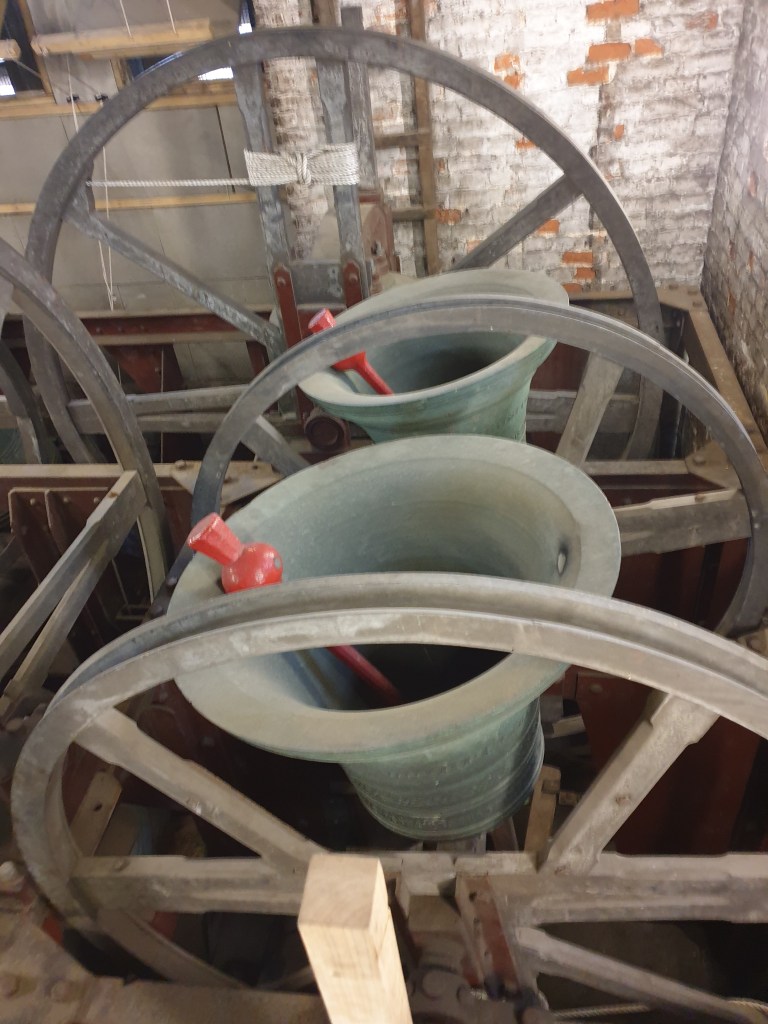
What no bells?

Although there has been no group #bellringing for such a long time now C and I have been going to the Cathedral and ringing two bells just to keep things going.

This week however we are away visiting E&M so not able to go to ring. In ordinary times we would go with E&M to their tower to ring on Sunday bit as they’re not back ringing yet either, we had the morning off.

An odd feeling to not go ringing but after yesterday’s marathon walk around Hardwick Hall we were all exhausted and enjoyed a couple of extra hours sleep.

I am looking forward to returning to the Cathedral next weekend when we will have a couple of extra of ringers for the first time in many, many months. The rules still only allow six people with social distancing, masks and good ventilation but it will be fantastic to hear more than ding and dong and try real ringing methods.

As we head into June and the possibility of no restrictions after the 21st (fingers tightly crossed) we may also be able to start practices again. I know many towers already have but because we are very reliant on people from other towers supporting our practice we’ve decided to hold off for a while.

It will be interesting to see and hear how we get on when trying to raise and ring the heavy bells for the first time in 16 months. Managing people’s expectations of what they could and should ring might be a challenge.

From what I’ve read on social media from other towers it seems that there has been a positive community reaction to bells being rung again but then I upoose no one is going to share any negative responses they’ve had.

I always share details of what ringing we are planning and what we’ve done on our Twitter account and tag local radio, the diocrsan office, the cathedral, local city sites as well. Some are really positive and like and share our posts which is lovely.

I want to build a closer relationship with the cathedral and diocesan offices and local community sites so that they start to fully consider the advantages that bellringers bring to church and community.

I’ve already had conversations with the cathedral office about a diocesan wide ring to mark the enthronement of our new Diocesan Bishop later on in the year and look forward to some closer links.

Third sector well-being

Third sector organisations are voluntary and community organisations which includes charities, associations, self-help groups and community groups, social enterprises etc. They are neither public nor private and are independent from government.  They usually play a role in history and culture and are value driven to improve public welfare, the environment or well-being.  Any surpluses are reinvested in the pursuit of their aims.  https://www.nao.org.uk/successful-commissioning/introduction/what-are-civil-society-organisations-and-their-benefits-for-commissioners/

#bellringing fits firmly into that sector.  We are there for the benefit of the church and communities we ring in. The social and well-being advantages of #bellringing are clear, it can give people a sense of purpose, an opportunity to socialise with others, a new hobby and sparks offshoot new interests in history, architecture, even engineering.  Getting out and about, meeting new people, developing new skills are all transferable to the workplace and great for young people to add to their higher education applications.  Societies are often charities, or at least their bell restoration fund is a registered charity.

As far as well-being goes, #bellringing ticks all 5 areas:

  1. Connecting with other people.  Bellringing is a team activity.  It requires connection with others and leads to other social activities like outings, pubs, and other non-ringing social activities;
  2. Being physically active.  You need to be able to climb spiral staircases (often), being able to raise arms above your head repeatedly.  There is a gentle cardio rhythm to it.  Its not all about brute strength.
  3. Learning new skills.  It can take about 15 hours to learn how to handle a bell on your own, that’s before you add other ringers into the mix, then there are more and more complex methods to learn, if you want to.  There really is no limit.
  4. Giving to others.  This is a sense of community.  Doing your bit for the church or for a community activity such as ringing for Armistice or a local event or celebration.
  5. Paying attention to the present moment.  This is essential.  You need to concentrate on your bell handling, your method ringing and everything in between. You can’t afford to let your mind wander.

Perhaps we should lobby to get #bellringing offered on prescription for people who are lonely or feeling a bit low.  We should be offering it out as adult education classes, young people’s after school activities or holiday activities.  Some already do this but wouldn’t it be great if we could spread that net wider. 

I’ve signed up to attend a webinar for third sector organisations on Better Community Engagement for Charities to see if there is anything we can learn.

Hmmm, thinking caps on.