The Ladder of Participation

Someone at work mentioned that they were reading an article about the Ladder of Participation.  This got me thinking about my own participation in activities both at work and home, predominantly about the roles I have within the #bellringing community.

The Ladder, devised in the late 1960’s, has three categories: Non-participation, Tokenism and Citizen Power.  Each category has a number of rungs within it that describes how citizens, the general public, can through participation, have more influence in society. https://nhspublicvoice.wordpress.com/2016/10/27/ladder-of-participation-shows-how-involved-you-are/

Starting at the bottom rungs of the ladder in the non-participative categories are Manipulation and Therapy.  These two are there to educate and cure the participant and to achieve public support through PR activities.

The next three rungs are in the Tokenism category and cover Informing, the one way flow of information, Consultation, the use of attitudinal surveys, meetings, public enquiries, but can be seen as a window dressing, before escalating to Placation, allowing citizens to give opinion or advise but holding on to the right to judge the legitimacy of that advice.

The real Citizen Power comes with the top three rungs of the ladder.  Partnership, the redistribution of power between citizens and the power holders with shared decision making.  Delegated Power, where the citizens now have the power to make decisions and assure accountability.  Citizen Control, where the participants hold the power for entire job planning, policy making and managing activities.

In the #bellringing context I can see definite elements of manipulation and therapy and informing, where we are providing information, guidance and exercises to educate and support.  We are currently undertaking various consultations to find out what people want from their #bellringing organisations.  I hope that we do not then use that to placate, but inform decision and policy making.  We have seen some great examples, particularly over the last 12 months or so or partnership, Association of Ringing Teachers, Central Council of Church Bell Ringers and The Ringing World working together.  We are certainly offering opportunities for Delegated Power in the workgroup structure, which allows anyone, even if they are not a Council member to participate and influence the direction we are taking, and providing expertise.  The Citizen Control might be a bit more tricky to manage wholescale, but there are pockets of activities that are directed by the ringers at a local level and we would want to support them with that.

No doubt there is room for improvement at every rung of the ladder, but it was interesting to note that we are on every rung. Where are you on the ladder?

Ding 1 and Ding 2

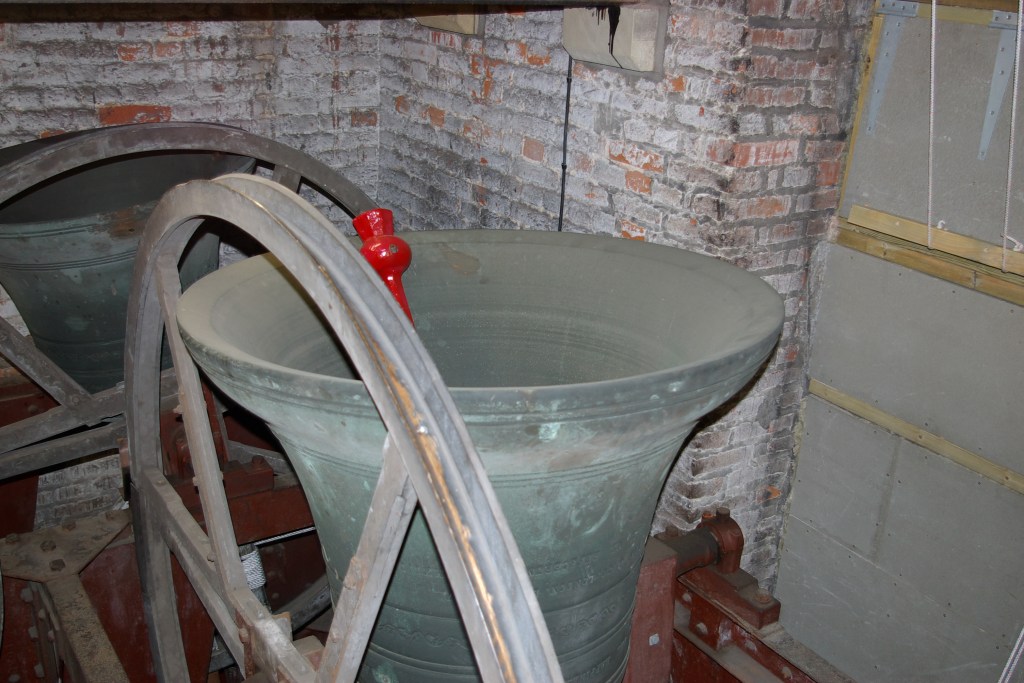
C and I having been ringing just 2 bells at the Cathedral on a Sunday morning now for exactly 4 months.  Prior to that we could ring in 2 groups so long as we were socially distanced, but since the last increase in Tiers and lockdowns, we had to reduce it to just the 2 of us.

We’ve got ourselves into a very good routine by ringing 1 and 2, then make places and back, then 3 dodges, then 3 places again, and we just keep doing that.  This means that you end up alternating dodging at handstrokes and backstrokes.  It’s a good handling practice, but its surprising easy to lose count up to 3!

Each week I’ve been taking a video and uploading it to our #bellringing social media so my friends can see that we’re still alive and doing something.  There are those who would ordinarily be ringing with us but can’t at the moment.  The majority of towers still aren’t ringing at all, so we’re lucky that the 2 of us can at least do something.  It seems to be well appreciated by the Cathedral, and we’ve had some comments from the public on our social media sites saying that they miss the sound of the bells, or that they heard us ringing our 2 bells.

We ring in short 5 or so minute bursts between about 10am and 10.30am, immediately prior to the morning service that is live streamed on the Cathedral’s social media.  I don’t think that any of our ringing has featured at all, as we’ve generally finished and wound our way down the spiral stairs just as the service starts.  We hope that the local community find some solace in the hearing of the bells and that the church is still “open”. 

We will continue to do our bit as long we as are able, and we wait patiently for when the time comes that we are able to welcome our bellringing colleagues back and we can ring on more bells and make a joyful sound.

Lost and found

You know when you know you have something, and you know where you last saw/used it, but for the life of you can’t find it when you need it next?  That was me and a set of colouring pens.

Now, we’re not talking anything deep and philosophical or anything like that.  We’re talking a set of colouring pens that I wanted, because I wanted to use a different colour, other than blue or black biro, to mark something off so that it was more visible.

I’ve had a set of colouring pens for ages, and I kept them with the squared paper that I used to write out #bellringing methods when I was learning something new.  Every bell was assigned its own colour and I would draw out each lead end so I could see when a different place bell started.  I’ve kind of moved on from doing that so much these days and use other methods for learning new methods that seem to work.

The pens however, were last seen with the squared paper, on the pile of books and magazines that are in the cubby hole to the left of where I sit on the sofa.  That’s where they’ve always been and had no need to be moved anywhere else. 

I have a nice new set up in our study with a new desk, chair, my laptop set up and my Holhem gimble ready and poised, and a nice shiny new stationery holder.  The stationery holder currently has my post it notes, my favourite couple of writing pens, a calculator, my business card holder safely ensconced.  There’s any empty slot shouting out for something to fill it.  The colouring pens would do marvellously, and then they would be at hand for me to mark off things on my events calendar.  But where the heck are they?

Having decided to look for said colouring pens two minutes before a video conference meeting was due to start, and not finding them instantly, I sat wondering for a while as the attendees for the meeting arrived.  Hmmmph!

Meeting over, I then had several actions as a result and some other things to immediately attend to, so the search for the illusive colouring pens dropped out of my mind for a while.  Then I went to sit down in my spot on the sofa and suddenly remembered that I had a mission to accomplish.  Find those ruddy colouring pens.  They’ve got to be there somewhere. 

Books and magazines start to get launched out of the way.  They can’t be far.  They shouldn’t be anywhere else.  They shouldn’t be this far down the heap.  After a full on three minutes of frustration, I flopped back in my sofa seat.  Grrrr.  Where are those blasted pens? 

Oh, hang on.  There’s a couple of books in the pile that have fallen over.  I’ll just put them upright again.  Oh, and hallelujah!  There are the prodigal pens. Hiding in the blackness of under the small coffee table that nestles amongst all these books and magazines.  Hoorah!

I happily skip (well, more like lumber) off back to the study, tip the pens out of their zipped, plastic casing and decide upon which colour to use as my marker.  Then, rather satisfyingly, plop them all into the waiting vacant slot in my stationery holder.  Having used the red pen to mark off my events calendar, I add that to the collection, then sit back to admire my handy work.

The simple pleasures!

Travelling all over the Country

Today was an epic day of activity for me on Ringing Room. This time of year we would ordinarily be #bellringing with a group of friends that we meet up with twice a year. Without being able to meet up for real we decided to try holding a virtual tower grab through the wonders of Ringing Room. On Saturday we had five towers to log in and out of that virtually had us travelling from Oxfordshire to Essex and back again. There are more towers on Sunday from Essex, Portsmouth and Nottingham. We may also try some quarter peals on Sunday morning as well.

So having spent an hour and a half in and out of various towers ringing all sorts of random methods, I then had a Cast of 1000 session for an hour and a half, where I was one of the students practicing spliced Cambridge, Yorkshire and Superlative Surprise Major, and some Lessness and Bristol Surprise Major.

Bearing in mind I’m nursing a stinking cold now as well, my brain was well and truly fried by the end of it. There was very little time between my Cast of 1000 ringing and the evening social Zoom event as part of the ringing weekend, so we cheated and C grabbed a chinese takeaway whilst I was ringing. Just about had enough time to eat it before logging back in to Zoom again.

There were nearly 20 of us on a Zoom chat, catching up as we missed out on the summer tour. We had a short business meeting as well just to think about plans for the year ahead, although its still unlikely that we’ll be able to have the summer tour this year either.

Its quite marvellous how we are all able to continue to ring and meet up with with people, albeit virtually.

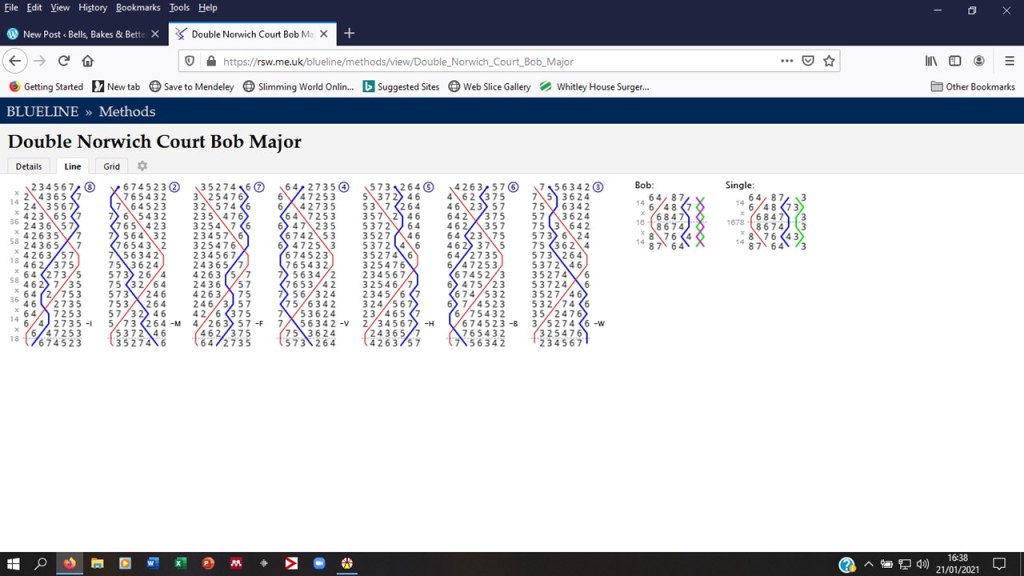
First, Treble Bob, Near, Full, Far (Repeat)

Cheating somewhat I know, but that’s how I remember Double Norwich Court Bob Major, by reciting First, Treble Bob, Near, Full, Far, Repeat. The purists amongst ringers will probably tell me that’s absolutely heinous, but it works for me.

I’ve never really been able to learn methods the “right way”. When I first started to learn methods, some 39 years ago, I would usually be presented with a table with 3 columns, the work of the bell, what happens at a bob and what happens next. No explaination. No mention of place bells, no clues to the method construction. I just learnt the work by rote. That’s just how it was done where we were. The locals didn’t know any different, so they couldn’t teach any different.

Now, fast forward many, many years and I’m trying to learn more complex methods and even, on the rare occasion trying to splice a few of them, and I really struggle. When I learn a new method I try my hardest to learn the start of each place bell but I don’t seem to be able to break it up that way. I learn the whole of the blue line by sort of rythmically reciting the piece of work. Given that generally I tend to ring round the front to middle bells (depending on how many), I have no idea what the back bells ststart with. I look at the work of the 2 and that, to me, is where the methods starts. When I ring the same method from a different bell, it’s like learning a whole new method all over again, although by the time I get to what I can actually recognise as where the 2nd starts, I can relax a bit. This does make it rather difficult to be able to just join in on any bell, or to ring on higher numbers as trying to recite a whole blue line can be difficult to remember.

This is probably the biggest thing that sets me back with ringing.

Not so long ago, I was about to participate in a virtual #bellringing session and the instructions were sent through via email and said that the other learner in my session wanted to practice splicing all the right place methods. I had absolutely no idea what that meant. When someone says to me that I’m (insert bell number of your choice here) place bell, they may as well be talking Martian in all but the very basic of methods.

Now, I’m a grown up, and you could argue that I should be able to go away and find out these things for myself and try to learn and understand what all this jargon means. I’ve tried. I’ve picked up books that claim to explain how to learn methods and within about a paragraph or two, I’ve switched off. Maybe I’m just not being receptive enough to the information that is being presented to me. Maybe it’s my own self-sabotage that says that I’ll never understand it anyway, so why bother trying. I’ve tried writing methods out, by place bells, to break them down to their constituent parts, but once the blue line “clicks” it all merges in to one long line and I have a job undoing it all again.

There are some methods that I can now recognise certain place bells, but that’s only because I’ve been ringing those methods for a very long time, and had the opportuntity to ring them from different bells often enough. However, as someone who can easily ring Cambridge Surprise Major, Royal and Maximus, I have no idea what any of the bells above 6th place does to start with. If I were to ring one of those bells, I would need to learn its start all over again and get to a place, or a pattern, in the method that I was familiar with.

For where I am in my ringing career right now, using cheats like First, Treble Bob, Near, Full, Far, Repeat for Double Norwich, and Two and a Penny, One and Tuppence for Erin works, but I guess I’ll have to put more effort in if I’m ever going to crack splicing the Standard Eight!