
Strange idea of fun

My sister does a lot of walking and is doing one of these Walk a 1000 Miles challenges.  She did it last year too and smashed it.  Every day we get social media pictures posted of interesting things she’s spotted on her walk and last year she had a series of themed days, say, where everything was a letter of the alphabet, or a colour, or shape etc.

This year she’s decided that she’ll just post a weekly summary, so that we don’t get bored of her pictures.  Not that we will, it’s lovely to see the countryside and the ever-changing landscapes throughout the seasons. 

I happened to ask whether she keeps a spreadsheet of her milage.  I’m a bit of a spreadsheet fiend and have them for just about most things.  A trait that it seems I’ve passed on to my daughter who has a box set viewing spreadsheet of all the programmes they watch, how many seasons and episodes so they can calculate how long it would take them to get through them all if they watched x number per day/week.

Anyway, the answer was yes she does have a mileage spreadsheet.  Nerd alert.  Follow up questions then came thick and fast.  Does it plot this year’s mileage against last years by day/week/month?  Is it annotated so you know what the cause and effect was of say, poor weather, sickness, holiday etc. Does it have a trendline?  A plot chart? Can you tell if you are on target to achieve the same, if not more mileage than last year? Pivot tables, charts.  Oh the possibilities.

She’s not as nerdy as me, and just has the raw data of what mileage she did each day, nothing fancy.  Oh, let me at it, purlease! She said that I probably have more fun things to do.  But this is fun. Let me at it, let me at it.

Then, one of our mutual friends joined in.  He’s also a data nerd.  Between the two of us, we got very excitable.  My sister was probably thinking that we’re a pair of freaks.  What’s one person’s idea of hell is another’s idea of fun.

Anyway, she has sent me her spreadsheet, and I shall enjoy having a play and see what I can come up with.  This is gonna be fun.
The same only different

Some of the more advanced #bellringing methods are variations on a theme. The work that you do in one method often becomes part of the work that you do in another.  Quite often experienced ringers will describe methods as “so and so over thingy” (obviously using real methods names).  For the educated this makes it easier to put those two methods together to create a new one.  For the rest of us though its pure gibberish.  I understand that its relative to where the treble is.

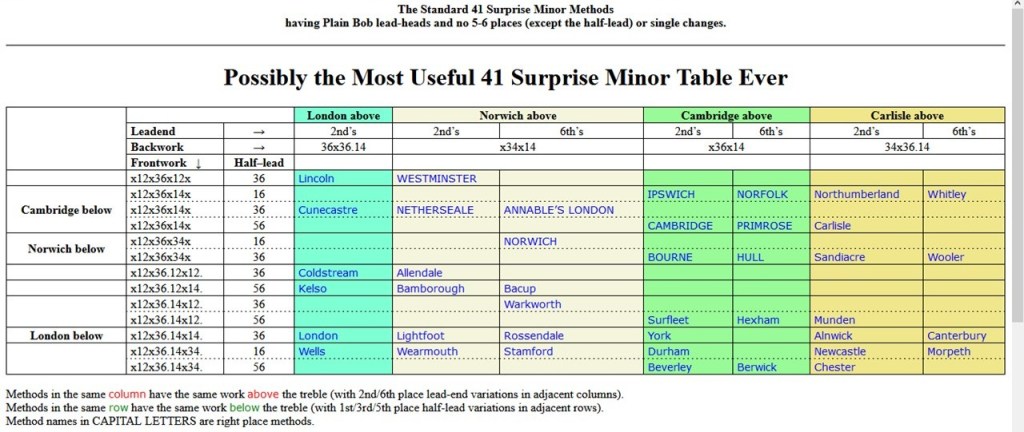
In the virtual #bellringing sessions that I run on a Thursday night we’ve been ringing York Surprise Minor and now moved on to Durham Surprise Minor. You can see a lot of similarities between the two. The experts in the group say that York is London below and Cambridge above.  That’s ok if you know London and Cambridge.  Durham is Wells below and Cambridge above.  Wells is Wells below and London above.  Confused?

There’s a really useful table at https://www.ringing.info/minor/minor_41.html and Complib gives you more information on what’s above and what’s below in each of the 41 Surprise Minor methods.

This week I’ve rung London below and Cambridge above, Wells below and Cambridge above, Wells and London.  I can’t learn them as one thing above and another below.  That just fries my brain. 

I can see that 5th place Wells is the same as 6ths place Durham and that 5ths place London is the same as 6ts s place York, which is, I suppose the same as the above and below bit, but I wouldn’t be able to figure that out without the line in front of me.

Mind…. blown!!

Analysis Paralysis

I’m doing an online course in mindfulness and wellbeing at the moment and have been fortunate to spend all of the day going through the next module, which has been discussing, amongst other things, the merits of whether mindfulness teachers need to be qualified or regulated in some way, and whether attending an 8 week intensive mindfulness course is sufficient for someone to set themselves up as a mindfulness teacher. Don’t panic, I’m not going to be opening up a clinic any time soon.

Being scientifically objective about mindfulness is difficult in that it is difficult to measure one person’s experiences against another’s.  We all come pre-programmed with inbuilt prejudices and life experiences that cause us to be open or judgemental about ideas.  We all have unconscious biases that impact our opinion as to whether a therapy has been helpful or not.

Connection to a teacher is important.  Without a rapport and mutual understanding student and teacher may not settle into a place of trust.  People attend mindfulness based stress relief (MBSR) or mindfulness cognitive behavioural therapy (MCBT) for a multitude of reasons, but it is important to recognise that many of them do so because they have been referred as part of a treatment therapy for depression or stress/anxiety, trauma or PTSD. However, even those of us who are seemingly quite resilient and able to cope with most things could end up being triggered by regressing into something that we had long ago put away, dealt with, coped with or moved on from, as part of mindfulness practice.

Is someone who has been on an 8 week course sufficiently qualified and experienced enough to handle that?

If I were in the situation of needing support to such a level, I would be wanting to find out more about the person delivering the sessions.  In a business environment we are taught to use the PESTLE analysis tool to investigate the political, economic, social, technological, legal and environmental aspect of a business before investing or setting up a new business.  If I were looking for a teacher who was going to be helping me explore the deeper parts of my brain, and help me find ways to cope and recover I would want to know that the teacher had done those same sorts of analysis on the subject of mindfulness and not just got a certificate of attendance.